Fast, free weekday tech brief: ideal for quick developer awareness and team syncs, but limited in depth and personalization.
Yes - if you want fast tech news in about five minutes a day. From what I see, TLDR still works best as a broad news brief, not a deep learning tool. It is free, easy to scan, and strong for general awareness, but it gets less useful when I want stack-level detail or more control over what I read.
Here’s the short version:
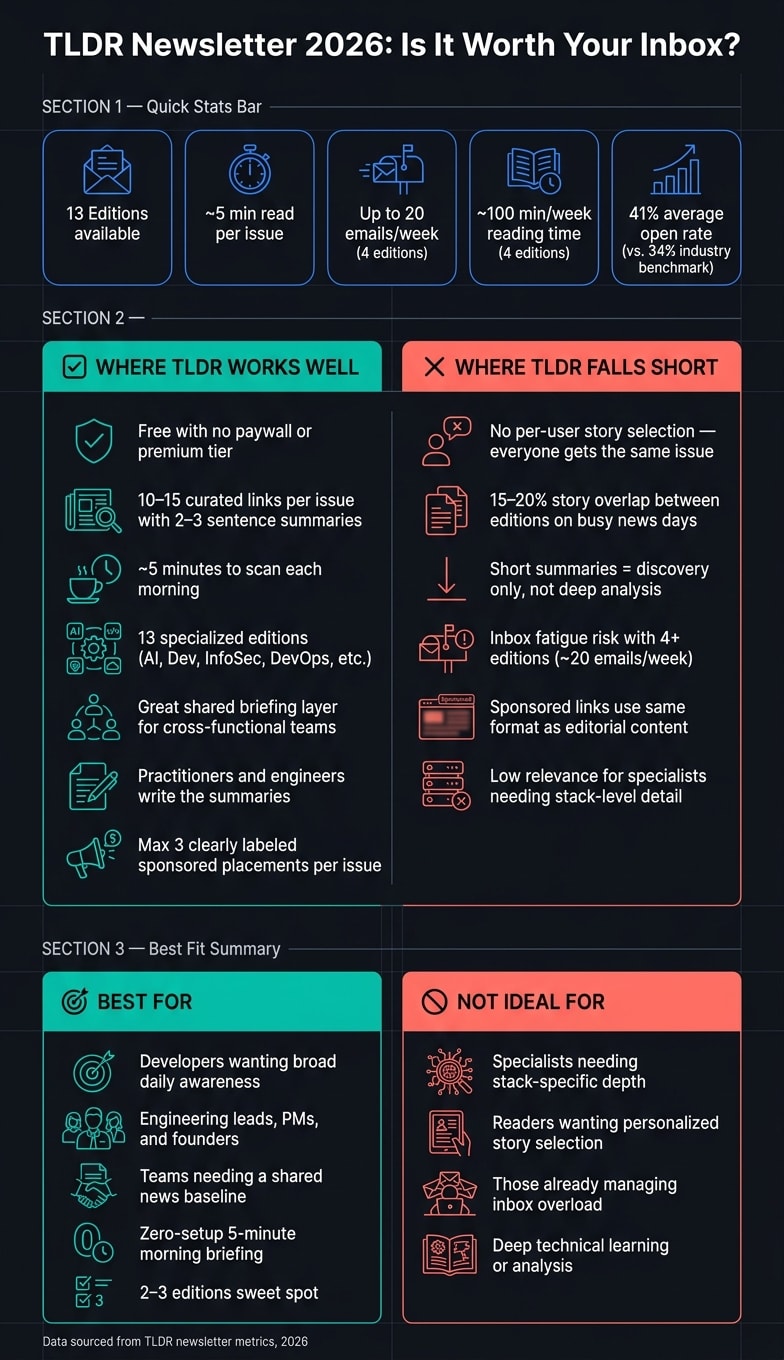
- Best for: developers, leads, founders, and PMs who want a shared daily news brief
- Main strength: 10–15 links per issue with short summaries and reading-time estimates
- Main limit: everyone gets the same stories inside each edition
- Cost: free
- Ads: up to 3 sponsored placements per issue
- Trade-off: good for discovery, weak for deep context
- Inbox risk: 4 editions can mean about 20 emails per week and around 100 minutes of reading
Quick Comparison
| Area | TLDR in 2026 |
|---|---|
| Price | Free |
| Format | Weekday email newsletter |
| Editions | 13 specialized editions |
| Reading time | About 5 minutes per issue |
| Personalization | Edition-level only |
| Summary depth | Short, top-line only |
| Team use | Good shared baseline |
| Best use case | Broad awareness |
| Weakest point | Low relevance for specialists |
If I had to sum it up in one line: TLDR earns inbox space for general tech awareness, but not as my only source. I also recommend following a bi-weekly tech trends newsletter for deeper community insights.
What TLDR is and how it works in 2026
By 2026, TLDR had grown into a network of 13 specialized editions built around the same email-first format.
Free, broad, and built for quick scanning
Each issue gives readers 10–15 links, and every link comes with a 2–3 sentence summary plus a reading-time estimate for the original source. The idea is simple: cover AI, software development, security, and the broader tech industry without forcing you to open a pile of tabs you don't need. That makes TLDR easy to scan in a few minutes, though it also means it can't always line up tightly with each reader's exact interests.
TLDR covers AI, Dev, IT, Infosec, DevOps, Product, and more. Practitioners and engineers write the summaries, which tends to mean less fluff and more signal for developer-heavy audiences. That editorial discipline shows up in TLDR's 41% average open rate, well above the roughly 34% industry benchmark.
How the curation and sponsorship model shapes the product
Every edition is free. There is no paywall and no premium tier. TLDR pays for the operation through B2B sponsorships, and each issue is capped at no more than three clearly labeled placements.
Sponsored items use the same headline-and-summary format as editorial links. They're labeled "Sponsored", but because the layout is the same, ads can blend into the editorial feed at a glance. That's part of the trade-off: the format keeps the newsletter smooth and easy to read, but it can blur the line a bit for readers who want a more specialist experience.
That broad, low-friction format is where TLDR works best; the next section covers where it starts to fall short.
Where TLDR still works well for developers
That broad format feels less personal than a custom feed, but it shines when you need fast awareness.
Fast awareness without extra setup
TLDR shows up in your inbox every weekday morning and takes about five minutes to scan. That compressed reading time is the whole point: TLDR turns about 45 minutes of manual feed-checking into a five-minute habit.
If you'd otherwise hop between Hacker News, X, and RSS feeds, that one bundled scan saves time in a way you can feel right away. One of TLDR's biggest editions also gets a strong open rate.
The separate editions help cut noise without piling on much more email. A backend engineer can subscribe to TLDR Dev for framework and tooling news, while a security-focused developer can follow TLDR InfoSec for CVEs and vulnerability disclosures without digging through general-interest items.
That steady format also makes TLDR easy to pass around inside a team.
A shared briefing layer for teams and cross-functional roles
TLDR also works well for teams. Engineering leads, product managers, and founders often follow very different sources, which makes it harder to keep a shared sense of what's going on across the industry. TLDR gives them that common baseline without forcing everyone onto the same app or process.
TLDR Founders leans toward founders and executives. That audience mix suggests it works less as a personal learning tool and more as a shared briefing layer for people who need broad situational awareness without deep technical detail. Engineering leads can also grab links from the Miscellaneous or tools sections and drop them into a team Slack channel, which turns passive reading into an easy async discussion starter.
The steady headline-plus-summary format also makes each item simple to skim and pass along.
Where TLDR falls short in 2026
TLDR's broad, fast format is also where it runs into limits.
No per-user story selection means less relevance for specialists
You can pick an edition, but you can't control which stories show up inside it. That keeps production simple, but it also means every subscriber gets the same issue. For people in narrow roles, a lot of that content may miss the mark.
Trying to fix that by subscribing to more editions can backfire. The overlap piles up fast. On busy news days, there's an estimated 15–20% story overlap between editions.
So the bigger problem isn't just how much lands in your inbox. It's whether those stories are worth your time.
Short summaries help discovery, not deep understanding
TLDR's 2–3 sentence summaries tell you what happened, but not always why it matters or what to do with it. It points you to stories. It doesn't give much context. In plain English: it's built for discovery, not analysis.
That becomes more obvious if you subscribe to several editions at once. Four editions - Main, AI, Dev, and Infosec - add up to about 20 emails per week and roughly 100 minutes of reading time.
TLDR strengths and limits at a glance
| Category | Strengths | Limitations |
|---|---|---|
| Personalization | Choice of editions | No per-user story selection or stack-level tuning |
| Depth | Good for broad awareness | No original analysis or second-order context |
| Inbox load | Consistent daily habit | Can create inbox fatigue for multi-edition subscribers |
| Sponsorship | Clearly labeled (max 3 per issue) | Sponsored links are formatted similarly to editorial content |
These trade-offs make TLDR a better fit for broad awareness than for tailored or deeper reading.
Who TLDR works for and how it fits with daily.dev
Best fit: developers who want broad news in five minutes
Those limits make TLDR a better match for broad, lightweight awareness than deep personalization. It works best for developers who want a reliable five-minute briefing with zero setup.
The numbers back that up. The flagship edition and TLDR AI both post 47% open rates, which is well above the roughly 34% tech-newsletter benchmark.
It can also work well as a shared team briefing. When tech leads, product leads, and founders all read the same issue, everyone starts from the same baseline without adding extra meetings or process.
That’s the point where a personalized feed starts to matter more.
When a personalized feed adds more value
Specialists hit TLDR’s limits first. Because it tries to serve everyone from junior developers to CTOs, a single issue can feel only partly useful if you need stack-specific detail. You may get a quick snapshot, but not much that speaks directly to the tools and topics you work with every day.
That’s why pairing TLDR with a personalized discovery layer makes sense.
daily.dev is free forever and comes at the problem from a different angle. Instead of one editorial team picking the same stories for everyone, it pulls from thousands of sources and filters content by the tags you choose, like Rust, Kubernetes, or AI engineering. Its browser extension puts discovery right into your new tab, while Search and Squads let you dig deeper when something catches your attention.
In plain English: TLDR pushes a short briefing to you, while daily.dev helps you pull in the topics you want, when you want them.
Conclusion: TLDR is still useful, but not for every workflow
Yes - TLDR still has a place if your goal is broad awareness, not deep specialization. It’s free, consistent, and fast.
But the tradeoffs are just as clear: there’s no per-user story selection, the summaries lean more toward awareness than understanding, and inbox fatigue can creep in if you subscribe to too many editions. For most people, the sweet spot is two or three editions, not a long list.
If you need stack-specific relevance and deeper discovery during the day, a personalized feed like daily.dev can do more. For a lot of developers, the best setup isn’t choosing one or the other - it’s using both for different jobs.
FAQs
How many TLDR editions should I subscribe to?
To avoid inbox overload, stick to two or three editions at most.
Start with the flagship TLDR edition for general tech news. Then add one or two more focused editions, like TLDR AI or TLDR Dev.
That setup gives you a solid mix without turning your inbox into a pileup. Go past that, and you can end up with 15 to 20 emails a week, often with overlapping content.
Is TLDR enough on its own for staying informed?
TLDR is great for day-to-day awareness, but it usually isn’t enough by itself if you want the full picture.
Its short summaries tell you what happened, but not always why it matters. Most professionals use it as a high-level scan, then pair it with a deeper source for context and expert insight.
Who gets the most value from TLDR?
TLDR is a good fit for busy tech professionals, especially software engineers, developers, and founders who want a fast, dependable daily read on industry trends without long-form commentary.
It tends to work best for readers who like quick, engineer-written summaries. You’ll likely get more out of it if you subscribe only to the specialized editions that line up with your role or day-to-day work.