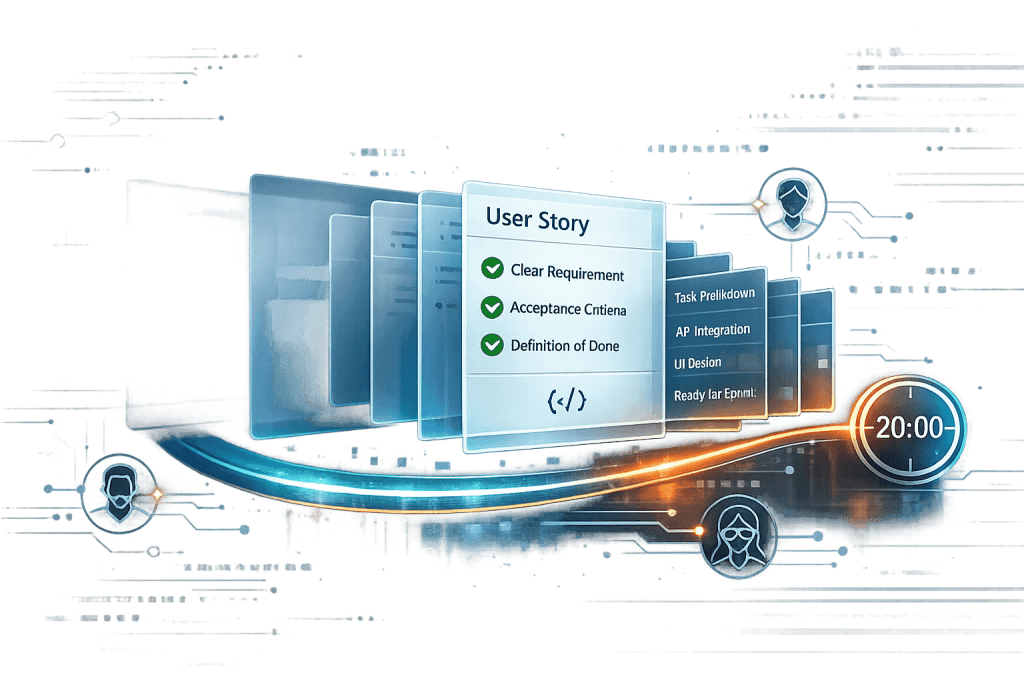
Discover 10 essential tips for maintaining a healthy product backlog to enhance your Agile team's efficiency and deliver value consistently.
A well-maintained product backlog is crucial for Agile success. Here are 10 key tips:
- Set clear priorities
- Follow the DEEP method
- Review regularly
- Get everyone involved
- Write clear user stories
- Keep the size in check
- Match product goals
- Be ready to adjust
- Use smart estimation
- Make it visual
These practices help teams stay focused and deliver value consistently. Aim for 50-150 backlog items, representing 2-6 months of work.
| Tip | Key Benefit |
|---|---|
| Clear priorities | Focuses team on high-value work |
| DEEP method | Organizes backlog effectively |
| Regular reviews | Keeps backlog current |
| Team involvement | Improves collaboration |
| Clear user stories | Enhances understanding |
| Manageable size | Prevents overwhelm |
| Goal alignment | Supports product vision |
| Flexibility | Allows quick adaptation |
| Smart estimation | Improves planning |
| Visualization | Boosts comprehension |
Related video from YouTube
2. Follow the DEEP Method
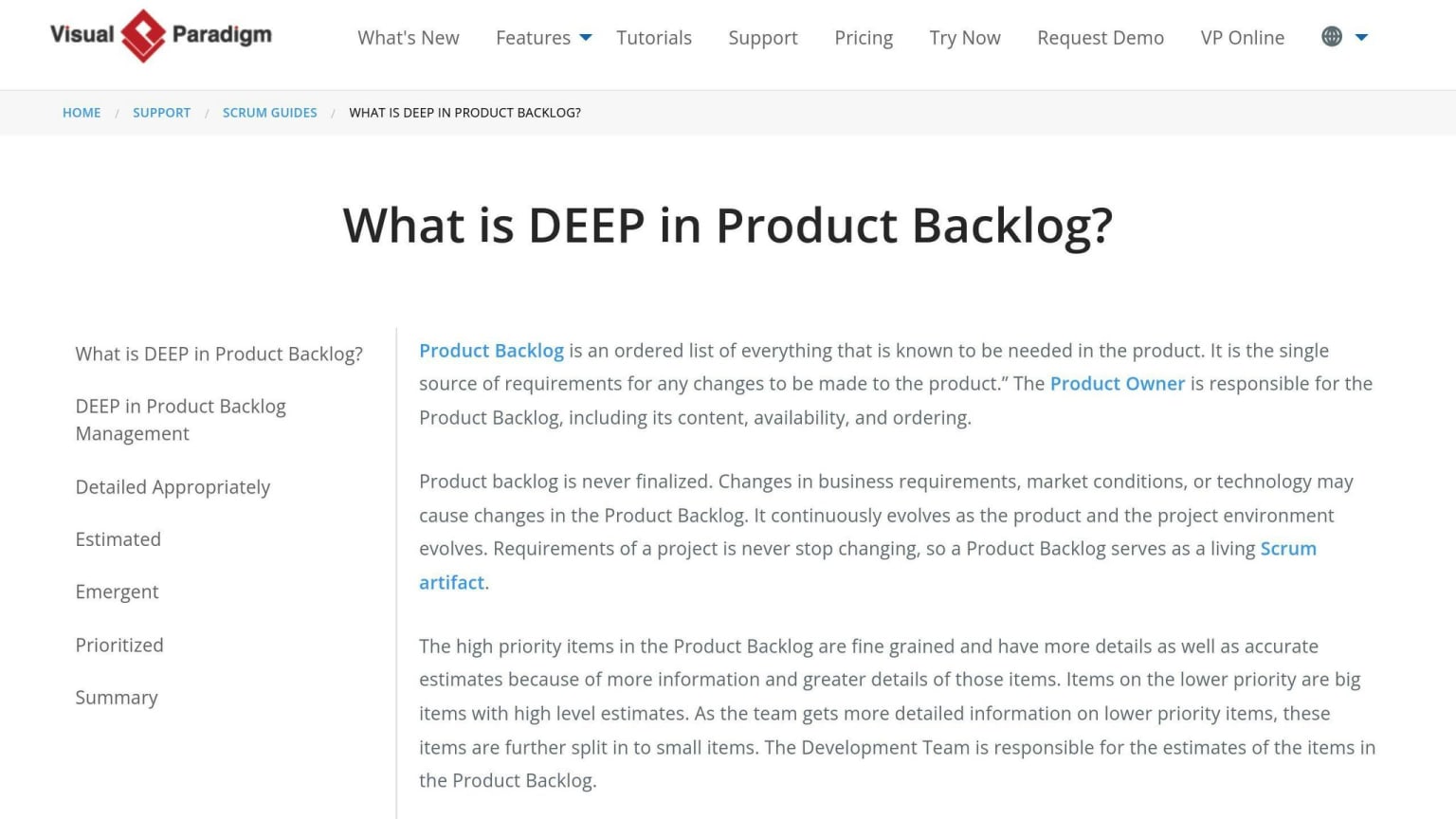
The DEEP method organizes your product backlog:
- Detailed appropriately
Top items need clear details. Lower items can be less defined.
- Estimated
Assign story points to high-priority tasks:
| Priority | User Story | Story Points |
|---|---|---|
| 1 | Upgrade Hardware | 13 |
| 2 | Optimize Software | 8 |
| 3 | Improve Network Infrastructure | 5 |
- Emergent
Keep your backlog flexible. Update based on new info and feedback.
- Prioritized
Sort by value, considering user needs, business impact, and feasibility.
"The product backlog should be sorted with the most valuable items at the top and the least valuable at the bottom." - Roman Pichler
3. Review Regularly
Frequent backlog updates are key. They help teams:
- Focus on priorities
- Improve sprint planning
- Adapt to changes
- Enhance collaboration
Tips for effective reviews:
- Schedule grooming sessions each sprint
- Include key team members
- Focus on next 2-3 sprints
- Break down large items
- Update estimates
Leave room for surprises:
| Sprint Capacity | Planned Work | Buffer |
|---|---|---|
| 100% | 90% | 10% |
4. Get Everyone Involved
Team input is crucial. Here's how:
- Hold skills workshops
- Rotate responsibilities
- Include developers in refinement
- Invite stakeholders to planning
- Use collaborative tools
| Benefits | How to Achieve |
|---|---|
| Diverse views | Mix departments |
| Better communication | Open discussions |
| More engagement | Vary tasks |
| Shared responsibility | Set collective goals |
Spotify's "Squad" model shows this in action. Each squad owns a feature area, boosting teamwork.
"Cross-functionality is... how members combine different skills most effectively." - Barry Overeem
5. Write Clear User Stories
Create user stories that are easy to understand:
Use the standard format:
As a [user type],
I want [goal],
So that [benefit].
Keep it simple
Focus on user value
Make them testable
Follow INVEST criteria:
| Criteria | Description |
|---|---|
| Independent | Can be developed separately |
| Negotiable | Open to refinement |
| Valuable | Clear user benefit |
| Estimable | Effort can be assessed |
| Small | Fits in one sprint |
| Testable | Clear acceptance criteria |
- Start with epics
- Refine regularly
"Write your stories so that they are easy to understand. Keep them simple and concise." - Roman Pichler
6. Keep the Size in Check
A bloated backlog loses effectiveness. Aim for 50-150 items, covering 2-6 months of work.
To maintain a lean backlog:
- Set limits
- Prune regularly
- Consolidate similar items
- Use a holding tank
- Focus on immediate goals
Backlog size guide:
| Size | Action |
|---|---|
| < 50 items | Add more detail |
| 50-150 items | Maintain |
| > 150 items | Prune and consolidate |
"The art of maximizing the amount of work not done is essential." - Agile Manifesto
7. Match Product Goals
Align backlog items with product objectives:
- Define clear product goals
- Evaluate items against goals
- Use OKRs to link items to outcomes
- Prioritize by impact
- Check alignment monthly
Example:
| Goal | Backlog Item | Alignment |
|---|---|---|
| Increase retention 20% | Personalized recommendations | High |
| Expand to Europe | Multi-language support | High |
| Improve performance | Optimize database queries | Medium |
| Increase revenue 15% | New premium features | High |
This approach keeps development focused on what matters most.
8. Be Ready to Adjust
Keep your backlog flexible:
- Review weekly or bi-weekly
- Use customer feedback
- Stay open to new ideas
- Communicate changes
- Balance stability and flexibility
Aim for:
| Aspect | Fixed (70%) | Flexible (30%) |
|---|---|---|
| Purpose | Core features, critical bugs | New ideas, market responses |
| Timeframe | Current sprint, near-term | Mid to long-term |
| Commitment | High | Low to medium |
9. Use Smart Estimation
Estimate effectively:
Use story points
Adopt Fibonacci sequence
Try Planning Poker
Consider Three-Point Method:
Scenario Description Example (hours) Optimal Best-case 2 Pessimistic Worst-case 8 Most Likely Realistic 4 Average: (2 + 8 + 4) / 3 = 4.6 hours
Focus on relative sizing
Involve the whole team
Refine estimates regularly
"Estimating work in Scrum involves using story points... to represent relative effort." - Shabana Parveen
10. Make It Visual
Visualize your backlog:
- Use Kanban boards
- Try digital tools like Trello or Jira
- Use color coding
- Add swimlanes
- Show story points
For larger backlogs, try treemaps:
| Theme | User Story | Points | Status |
|---|---|---|---|
| Rental Car | Rent a car | 5 | Done |
| Rental Car | Get insurance | 3 | In Progress |
| Rental Car | Baby seat | 2 | Not Started |
| Airplane | Aisle seat | 1 | Done |
| Airplane | First class upgrade | 3 | Not Started |
"Treemaps allow for hierarchical representation of data, ideal for complex backlogs." - Dr. Ben Shneiderman
Conclusion
A healthy backlog drives success. It boosts efficiency, adaptability, team morale, and customer satisfaction. Start by assessing your current backlog, then gradually implement these tips. Experiment to find what works best for your team and product.
FAQs
How do you determine backlog health?
Consider these factors:
- DEEP characteristics
- Readiness for sprint planning
- Size (aim for 100 items or less)
- Age (less than 9 months old)
- Balance of new features, support, tech debt, and innovation
- Regular refinement
- Health metric: at least twice the team's average velocity
Example:
- Average Velocity: 20 points
- Healthy Backlog: At least 40 points
"A good product backlog is detailed appropriately, emergent, estimated, and prioritized." - Roman Pichler