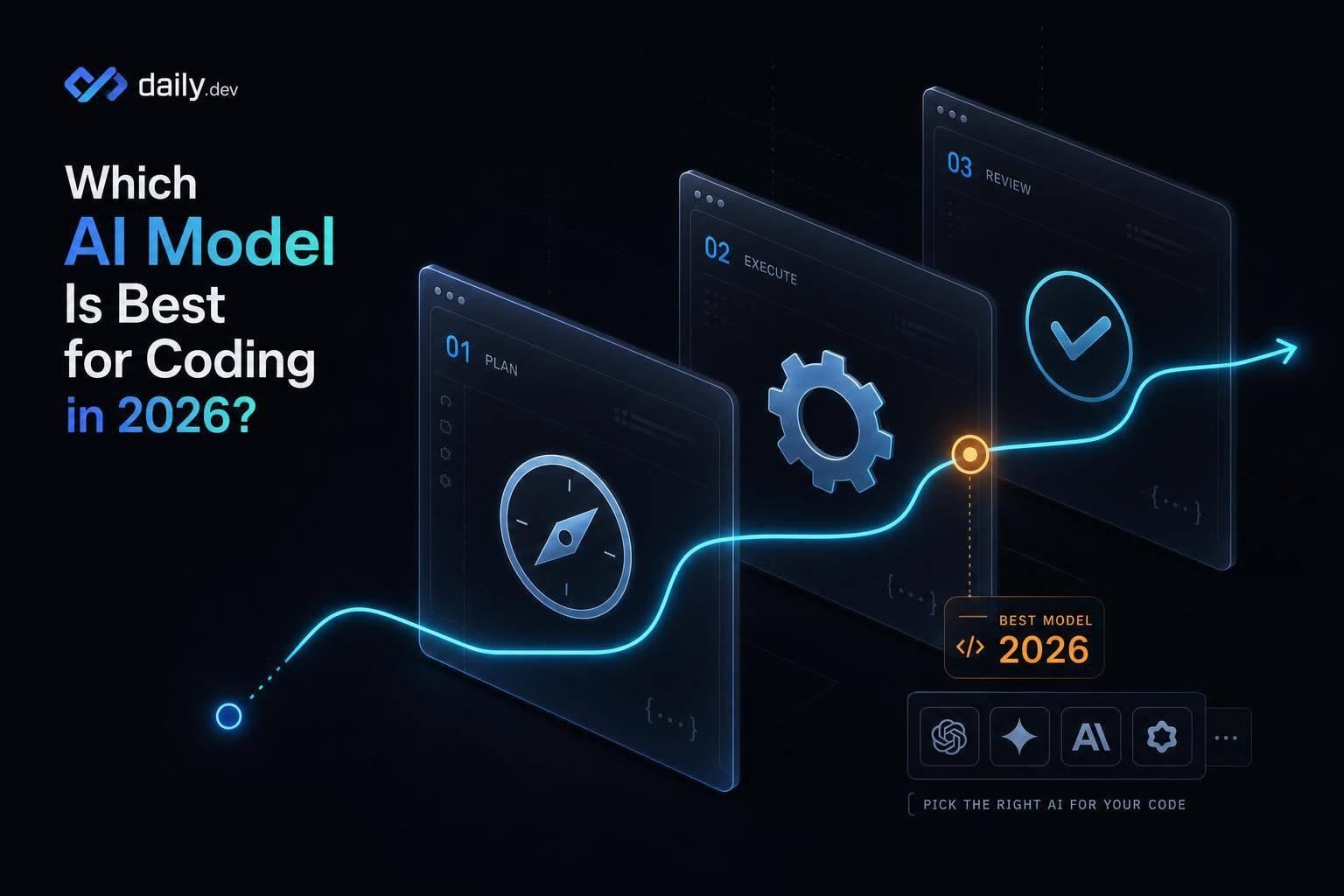
No single AI model wins every coding job—route planning, execution, and review across specialized models to balance accuracy and cost.
If I had to give one short answer, it would be this: there is no single best coding model in 2026. I’d pick Claude Opus 4.8 for deep refactors and bug work, GPT-5.5/5.6 Sol for terminal-first agent flows, Gemini 3.1 Pro for huge repos with up to 2 million tokens of context, and DeepSeek V4 Pro or Qwen 3.6 Coder when cost and volume matter most.
Here’s the part that matters to you: today, coding models are judged less by toy benchmarks and more by whether they can work through a repo, run tests, read logs, edit many files, and keep going without drifting. That’s why scores like 69.2% on SWE-bench Pro for Claude Opus 4.8, 82.7% on Terminal-Bench 2.0 for GPT-5.5/5.6 Sol, and 80.6% on SWE-bench Verified for DeepSeek V4 Pro tell a more useful story than old coding tests that many top models now max out.
If I were choosing fast, I’d use this rule:
- Deep refactors and bug fixing → Claude Opus 4.8
- Terminal agents and strict JSON/diff output → GPT-5.5 or GPT-5.6 Sol
- Very large codebase review and UI work → Gemini 3.1 Pro
- Bulk jobs, CI fixes, and cheaper runs → DeepSeek V4 Pro
- Simple scripts and CRUD-heavy work → Qwen 3.6 Coder
The big takeaway: I wouldn’t lock into one model. I’d split planning, execution, and review across more than one model family to cut blind spots and control spend.
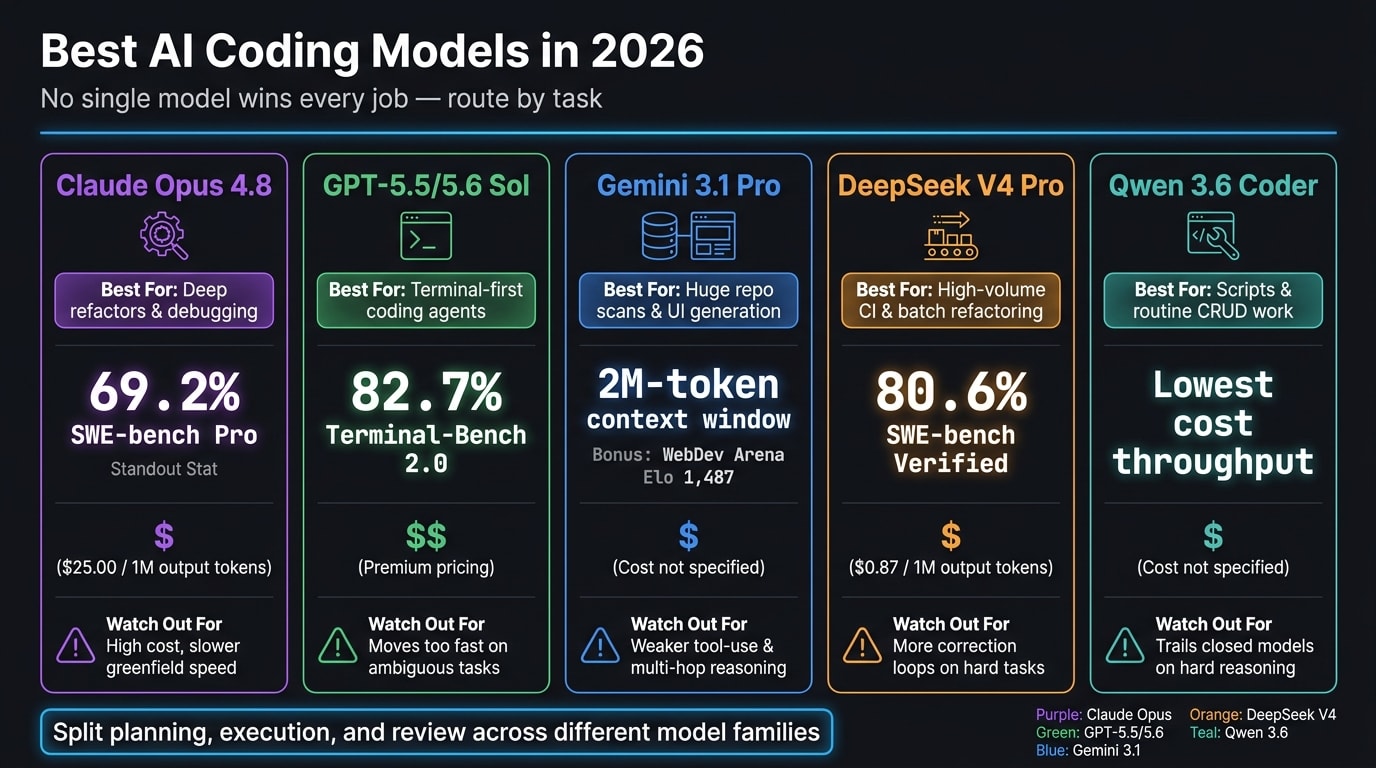
Quick Comparison
| Model | Best Use | Standout Stat | Main Tradeoff |
|---|---|---|---|
| Claude Opus 4.8 | Deep refactors, debugging | 69.2% SWE-bench Pro | $25.00 per 1M output tokens |
| Claude Sonnet 5 | Day-to-day repo edits | 63.2% SWE-bench Pro | Lower ceiling than Opus |
| GPT-5.5/5.6 Sol | Terminal-first coding agents | 82.7% Terminal-Bench 2.0 | Can act too fast on vague prompts |
| Gemini 3.1 Pro | Huge repo scans, UI generation | 2M-token context | Tool-use and long reasoning trails can slip |
| DeepSeek V4 Pro | High-volume coding jobs | 80.6% SWE-bench Verified | More retry loops on hard tasks |
| Qwen 3.6 Coder | Scripts and routine app work | Low-cost throughput focus | Trails top closed models on hard reasoning |
So if you want the short version: Claude leads on deep code work, GPT leads on terminal agents, Gemini leads on raw context size, and DeepSeek leads on price for bulk coding.
Model-by-model breakdown: where each frontier model is strongest
On these tasks, the top models split by workflow fit, not just raw coding ability.
Claude Sonnet and Opus: best for deep refactors and long sessions

Claude Opus 4.8 is the 2026 leader for production refactors. It scores 69.2% on SWE-bench Pro, ahead of GPT-5.5 and Gemini 3.1 Pro on that benchmark . In practice, it tends to ask clarifying questions when a prompt is vague. It also does a better job of keeping existing idioms and naming in place instead of rewriting everything from scratch .
At $25.00 per 1M output tokens, Opus 4.8 makes the most sense for high-stakes work . For most teams, Claude Sonnet 5 is the better default. It scored 63.2% on SWE-bench Pro at a lower price point, which makes it a strong pick for in-repo file editing .
GPT-5 and Gemini: terminal workflows and UI-heavy builds
If Claude stands out for deep edits, GPT-5 and Gemini tend to win in faster or broader workflows.
GPT-5.5/5.6 Sol is the strongest model for terminal-based agent workflows. Its 82.7% on Terminal-Bench 2.0 leads the field . It's also the most format-disciplined choice when your setup depends on clean JSON or diffs . The catch: it can commit too early when a task is ambiguous .
Gemini 3.1 Pro fits a different lane. Its 2M-token context window makes it a strong match for large codebase sweeps, architecture reviews, and security audits . It also leads the WebDev Arena with an Elo of 1,487, which helps explain why it performs well on UI generation and design-to-code work . Its main weak spots show up in tool-use accuracy and multi-hop reasoning across longer agent traces .
DeepSeek and Qwen: coding at scale
For teams focused on volume and cost, the picture changes again.
DeepSeek V4 Pro is the low-cost standout for coding at scale. It reaches 80.6% on SWE-bench Verified while costing about $0.87 per 1M output tokens - far cheaper than GPT-5.6 Sol . That makes it a good fit for CI-generated test scaffolding, batch refactoring jobs, and internal tooling where lots of tasks run every day. The tradeoff is a 128K context limit, plus more correction loops on the hardest reasoning work .
Qwen 3.6 Coder plays a similar role for scripts, CRUD features, and other high-throughput tasks where speed and cost matter more than precision .
| Model | Strongest Use Case | Main Limitation |
|---|---|---|
| Claude Opus 4.8 | Deep refactors and debugging | High cost; slower greenfield speed |
| GPT-5.5/5.6 Sol | Terminal agents and structured output | Moves too quickly on ambiguous tasks |
| Gemini 3.1 Pro | Monorepo audits and UI generation | Weaker tool-use and multi-hop reasoning |
| DeepSeek V4 Pro | High-volume CI and batch refactoring | More correction loops on hard tasks |
| Qwen 3.6 Coder | Scripts and routine CRUD work | Trails closed models on hardest reasoning |
Head-to-head on real coding tasks
Refactoring, debugging, and long-context reasoning compared
In day-to-day coding, the gap between these models shows up fastest in refactors, debugging, and long-context work.
For multi-file refactoring, Claude Opus 4.8 is the clearest pick. It stays steady across long traces and sticks with existing naming patterns and code idioms instead of rewriting everything in its own voice. When a task is a bit fuzzy, it tends to slow down and make fewer wild guesses. That same pattern shows up in debugging too.
For debugging, Claude Opus 4.8 gets the edge because its tool use is more accurate when reading logs, tracing call stacks, and running diagnostic queries across many files. GPT-5.5 moves faster, but it’s more likely to slip on off-by-one indexing mistakes . That tradeoff becomes more obvious as the amount of context grows past a normal prompt window.
For long-context reasoning, Gemini 3.1 Pro stands out for one simple reason: it’s the only model here that can handle a single-pass review of a repo that goes past 1M tokens. Inside the 1M-token range, Claude Opus 4.8 and GPT-5.5 still come out stronger.
| Task | Best Fit | Runner-Up | Watch Out For |
|---|---|---|---|
| Multi-file refactoring | Claude Opus 4.8 | GPT-5.5 | GPT-5.5 rewrites more aggressively, adding diff noise |
| Debugging | Claude Opus 4.8 | GPT-5.5 | GPT-5.5 can hit off-by-one mistakes in indexing |
| Large repo audit | Gemini 3.1 Pro | Claude Opus 4.8 | Gemini is weaker on multi-hop reasoning |
| Batch fixes at scale | DeepSeek V4 Pro | - | More correction loops on hard tasks |
Agentic coding: which models hold up in longer autonomous workflows
Long-context accuracy matters. But autonomous workflows push these models even harder.
GPT-5.5 is the top choice for terminal-heavy agent work, posting an 83.4% score on Terminal-Bench 2.1 . That matters because structured output can make or break an agent pipeline. If one step feeds the next, clean formatting and stable schema handling save a lot of pain.
Claude Opus 4.8 tends to hold together better in multi-file agent loops where the model has to keep its reasoning straight over many steps. A practical setup that’s getting more common in 2026 is to use a larger model like Opus 4.8 for planning, a lower-cost model like Claude Sonnet 5 for execution, and a model from another vendor for review. The logic is pretty simple: models trained on the same stack often miss the same things .
Here’s the short version:
| Scenario | Best-Fit Model | Why |
|---|---|---|
| Large legacy refactor | Claude Opus 4.8 | Preserves semantics; high tool-use accuracy |
| Front-end redesign | Gemini 3.1 Pro | Strong UI generation |
| CI-driven fix generation | DeepSeek V4 Pro | Best unit economics for bulk work |
| Long-running coding agents | Claude Opus 4.8 | Most coherent over long-horizon autonomous work |
How to pick the right model without locking yourself in
A straightforward model-picking guide for developers and teams
Use the task-by-task comparison above to route work by job, not by model name.
- Mission-critical refactors and multi-file migrations → Claude Opus 4.8
- Agentic and terminal-heavy workflows → GPT-5.5 or GPT-5.6 Sol
- UI-heavy and multimodal work → Gemini 3.1 Pro
- High-volume routine work → DeepSeek V4-Pro or Qwen 3.6 Max-Preview
Once you know the task, split the work across models. Use a stronger model for planning, a lower-cost one for execution, and a second model from another vendor for review. That last step helps catch shared blind spots.
If you're doing day-to-day interactive coding, a subscription like Claude Max or Cursor is usually more predictable. For programmatic agents and CI/CD pipelines, pay-per-token API access is often cheaper - but set spend guardrails before you start .
How to keep up with model releases and coding benchmarks
This space moves fast, so treat model choice like dependency management. It's not a one-time call. It's something you revisit on a regular schedule.
Tools like Cursor, Zed, and Aider already let you switch the underlying model with a dropdown or config change, so changing models doesn't mean rebuilding your workflow . Model choice is a workflow setting.
Track releases and benchmark shifts on daily.dev.
Conclusion: the best coding model in 2026 depends on the task
When you look at refactoring, debugging, long-context work, and agentic coding side by side, one thing becomes clear: no single model wins every job.
Claude Opus 4.8 stands out for deep refactoring and long-horizon reasoning. GPT-5.5 and GPT-5.6 Sol are the main picks for terminal-heavy workflows and new feature work. Gemini 3.1 Pro is the long-context option for repos that go past 1M tokens. DeepSeek V4 Pro is the budget pick for high-volume coding.
So the practical rule is simple: split planning, execution, and review across different model families.
Model choice moves fast. Benchmarks move fast. Pricing moves fast. It makes sense to treat model selection the same way you treat a dependency version - something you revisit on a schedule, not something you set once and leave alone.
Track model releases and benchmark shifts on daily.dev.
FAQs
How should I split coding tasks across models?
Use a routing strategy instead of leaning on one model for everything.
A simple split works well: send about 80% of routine work to faster, lower-cost models like DeepSeek V4 Pro, Gemini 3.1 Pro, or Claude Sonnet 4.6. Then save Claude Opus 4.8 or GPT-5.6 Sol for the 20% of tasks that call for stronger reasoning.
In practice, that means setting a few clear rules inside your IDE or agent to decide when a task should move up to a stronger model. You can base those rules on things like file count, task length, or keywords such as refactor or optimize.
Then check usage and cost on a regular basis. That way, you can keep an eye on where your spend is going and tighten the rules if too many simple jobs drift to higher-cost models.
Which model is best for my codebase size?
It depends on the job.
For full-repository analysis when cost matters, Gemini 3.5 Flash and Gemini 3.1 Pro stand out. Both offer 1M-token context and pricing that works well for budget-conscious teams.
If you're dealing with complex refactors across many files in a large repo, Claude Opus 4.8 is the premium pick when correctness matters most.
A lot of teams split the work between models. They use large-context models for architecture-level review, then switch to faster models like Claude Sonnet 5 or GPT-5.5 for tighter, file-level edits.
One thing matters more than the flashy context-window number: output-token price. That's often where costs stack up.
How often should I reevaluate my coding model?
Reevaluate your coding model at least once a month. Frontier models can change in as little as six to eight weeks, so a setup that worked well last month may not be your best option now.
Many production teams also do a formal review every quarter. That gives them a set time to adjust model picks and routing thresholds based on output quality and cost.
Before you switch your default model or agent scaffold, run your own internal evaluation suite on 50 to 100 representative tasks from your codebase.