A tech discussion site's value endures—use 10-minute scans, 1–2 links, and top comments to find real technical signal amid growing AI noise.
Yes - but only if I use it with a tight filter.
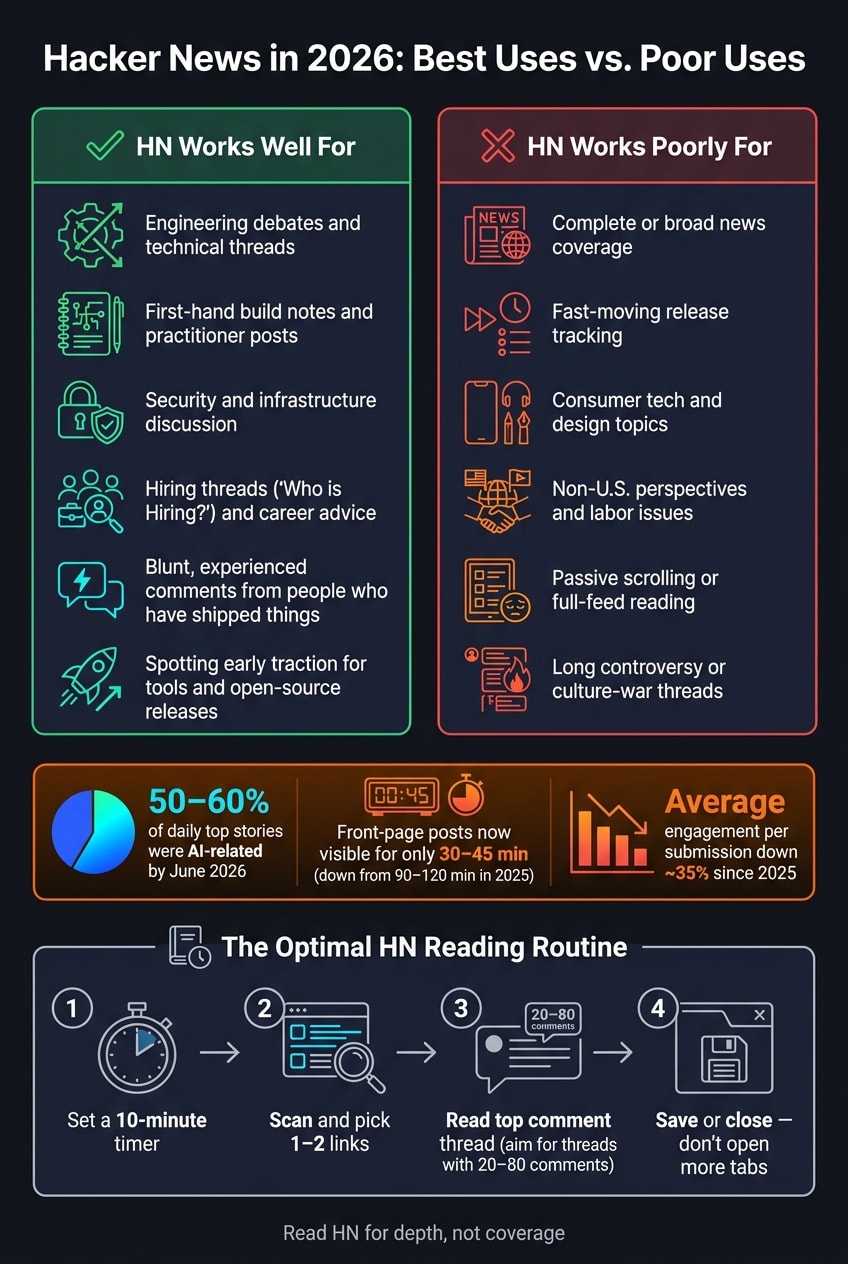
If I treat Hacker News like a full news feed, I waste time fast. If I use it to find 1–2 strong links, scan the top comments, and leave, it still pays off. That matters more now because about 50%–60% of daily top stories were AI-related by June 2026, front-page posts often last only 30–45 minutes, and average engagement per submission is down by about 35% from 2025.
Here’s the short version:
- HN still works well for: engineering debates, first-hand build notes, security talk, hiring threads, and blunt comments from people who have shipped things
- HN works poorly for: complete news coverage, fast release tracking, broad topic range, and long debate-heavy threads
- The main shift in 2026: more AI-heavy front pages, shorter visibility for posts, and less depth across many comment sections
- The best way I’d use it: a 10-minute scan, 1–2 links max, top comments only, then save or close
- The core idea: HN is a discussion layer, not a full news product
A quick way to think about it: read HN for depth, not for coverage. If I want broad tech awareness, it still helps. If I want stack-specific updates every day, I need other ways to stay updated alongside it.
| What I’d use HN for | What I would not use HN for |
|---|---|
| Technical comment threads | Full news tracking |
| First-person engineering posts | Fast-moving release coverage |
| Security and infra discussion | Consumer tech breadth |
| “Who is hiring?” and career threads | Passive scrolling |
That’s the honest answer: HN is still worth reading in 2026, but only in small doses and with clear intent.
Where Hacker News still delivers real value
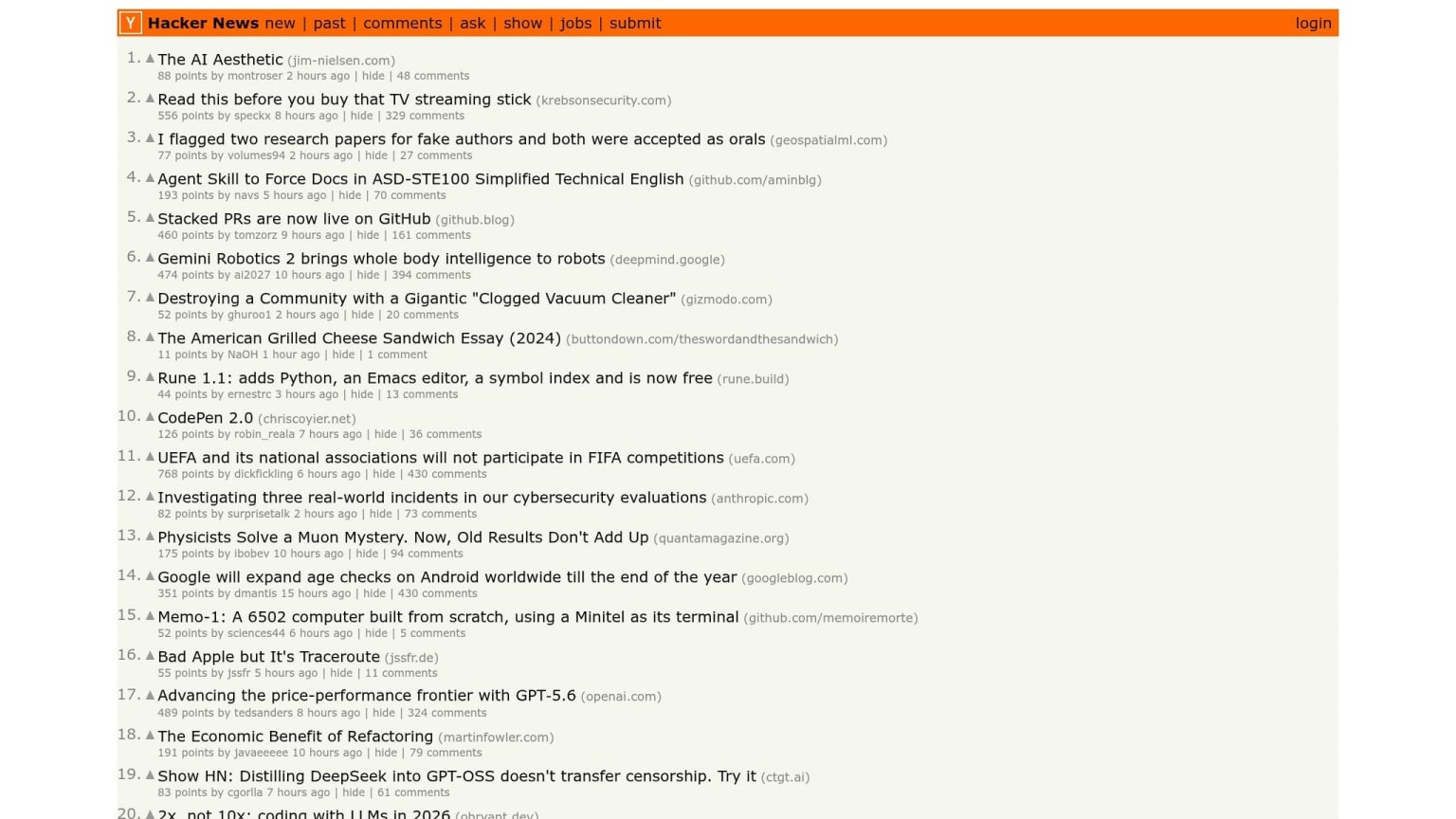
HN still pays off when you use it for depth, not breadth.
Technical threads with real depth
When a post links to a real engineering write-up - something like "How we scaled X" or "Benchmark results for Z" - the comments often end up being the best part.
You’ll see experienced builders jump in with production caveats, architecture tradeoffs, and implementation details the original author missed. That back-and-forth tends to bring out edge cases, failure points, and hard lessons that don’t always make it into the main post. In plain English: the comments still matter because they pressure-test technical claims instead of just repeating them.
Founder, operator, and product signal
HN still shows what founders, operators, and engineers are paying attention to: infrastructure shifts, open-source releases, AI tools, and supply-chain risks.
Posts framed around actual use - like "this broke in production" or "here's what we actually measured" - usually get more traction than vendor announcements or opinion pieces. That makes HN a fast filter for spotting whether a tool or practice is getting real traction.
But that same feed also mixes solid signal with a lot of noise.
Career and hiring discussions worth reading
HN's "Who is hiring?" threads still help U.S. developers. They’re more candid than polished job boards, with direct signals on remote work, pay, and engineering culture.
"Ask HN" career threads work the same way. They often include blunt, practical advice on engineering management, job changes, and compensation. The value is there, but only if you find the right thread and skip the rest.
What changed and where HN falls short now
HN still has signal. But the noise is louder, and the range of topics is tighter than it used to be. That matters when you're deciding how much of your day it should get.
HN is not a complete news source
HN works best as a discussion layer, not your main news feed. Big stories can show up late, disappear fast, or never make it to the front page at all.
As of June 2026, a typical front-page post stays visible for only 30–45 minutes, down from 90–120 minutes in 2025 . That shorter window changes how useful the site is for staying on top of the news. Miss a quick check-in, and you can miss the post entirely.
The feed also has clear blind spots. Labor issues, consumer tech, design, and non-U.S. viewpoints rarely get much attention.
Comment quality is uneven
Not every thread is worth your time. Some are sharp and full of first-hand detail. Others circle around the same talking points and add very little.
Average engagement per submission has dropped by roughly 35% since 2025 . In practice, that means fewer comments that move the discussion forward and more threads that feel thin.
Topics where HN underperforms
Some types of content just don't fit HN very well. Fast-moving release notes, narrow release notes, and structured tutorials often lose clarity once they get pulled into open debate.
HN is better at argument than summary. So if you're using it well, the trick is to read it with a tighter filter.
How to read Hacker News without wasting time
HN threads are all over the map. Some are packed with sharp engineering comments. Others turn into long arguments that go nowhere. That’s why a selective routine matters more than scrolling for half an hour.
The mistake is using Hacker News like a social feed. It’s better at surfacing high-signal links and smart discussion than giving you a steady stream of stuff to consume.
A 10-minute reading pattern that works
Set aside 10 minutes. Scan 1–2 links, skim the article, read the top comment thread, then either save it or close it.
That simple routine keeps you from falling into the classic HN trap: opening ten tabs and finishing none of them.
Comment count can help too. Threads with 20–80 comments often have the best signal. Once a post gets past 150+ comments, it often shifts from depth to debate.
Of course, this works a lot better when you’re picky about which threads deserve a click.
Best use cases vs. poor use cases
| Good for | Bad for |
|---|---|
| Technical debates in infrastructure, security, or architecture | Breaking news facts or fast-moving release coverage |
| Practitioner posts and first-person engineering write-ups | Screenshots of tweets, vague summaries, or hot takes without primary sources |
| Official docs, release notes, research papers, and benchmarks | Long controversy threads and repetitive debates |
| Developer tools, libraries, frameworks, and startup launches | Posts that don't add primary evidence or technical detail |
| Security and privacy stories with community analysis | Culture-war threads |
What to use alongside HN
HN works best as one input, not your whole system. Its sweet spot is expert comment threads where people push back on each other with hard-won production experience. That’s where it shines.
It’s weaker if you’re trying to track everything happening in your stack every day. For that kind of day-to-day scanning, use a personalized developer feed like daily.dev.
Conclusion: Is Hacker News still worth reading?
Yes - if you use it with intent.
In 2026, Hacker News is still one of the best places for technical discussion, early signs of what’s picking up speed, and blunt, practical pushback. But that only works if you read with a filter. HN isn’t a complete news source, and the front page is getting more AI-heavy , so selective reading matters.
Key takeaways for busy developers
Think of HN as a broad industry signal, not your personal feed. The main draw is the comment section. That’s where people doing the work push back, add context, and point out details polished articles often leave out.
A focused 10-minute scan beats passive scrolling. If you want broad awareness, HN still does the job. If you want stack-specific reading, use daily.dev.
FAQs
How often should I check Hacker News?
You don’t need to check Hacker News all day to stay informed.
Because it ranks stories based on votes and community activity, a quick look once or twice a day is usually enough to catch the pulse of the industry and see what the tech community is talking about.
If you want a simpler workflow, follow Hacker News in daily.dev. That way, you can keep an eye on the discussions that matter in your personal feed instead of bouncing back to the site throughout the day.
What posts are still worth opening?
The Hacker News posts still worth opening are the ones that lead to substantive, technically deep, human-moderated discussion: engineering deep dives, sharply argued Ask HN questions, and serious industry debates.
If you're scanning for signal, focus on threads with enough momentum to show real fault lines, not hype. And be careful with overly promotional links. They may be quietly filtered or just fade out.
What should I use with Hacker News for daily updates?
Most developers use Hacker News alongside a personalized discovery tool to stay up to date each day. daily.dev is a practical pick because it can match your tech stack, pull from thousands of sources, and bring Hacker News stories into a single feed.
A common setup is simple: use a personalized feed for day-to-day reading, then check Hacker News to get a sense of the broader industry pulse.