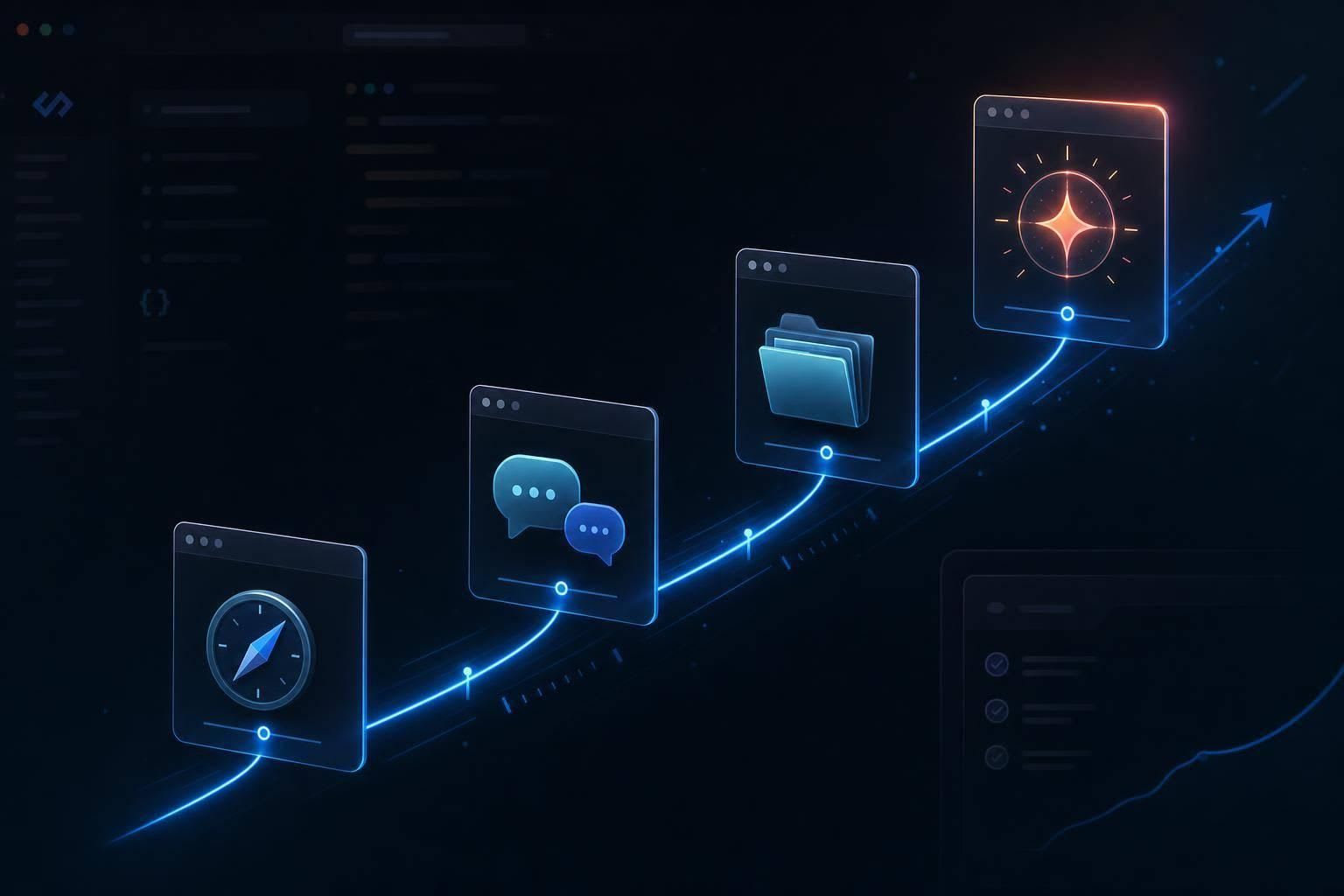
90-day roadmap to build judgment, communication, and ownership to become a senior developer in the AI era.
Senior in 2026 means this: I solve messy problems, make tradeoffs, and own results after launch - not just code.
If I want to move from junior to senior, I need to get better at judgment, communication, and ownership. That means taking on fuzzy work, writing down decisions, handling incidents, and explaining risk in plain English. It also means using AI with care. AI can write boilerplate and tests, but it can’t decide what work matters.
Here’s the short version:
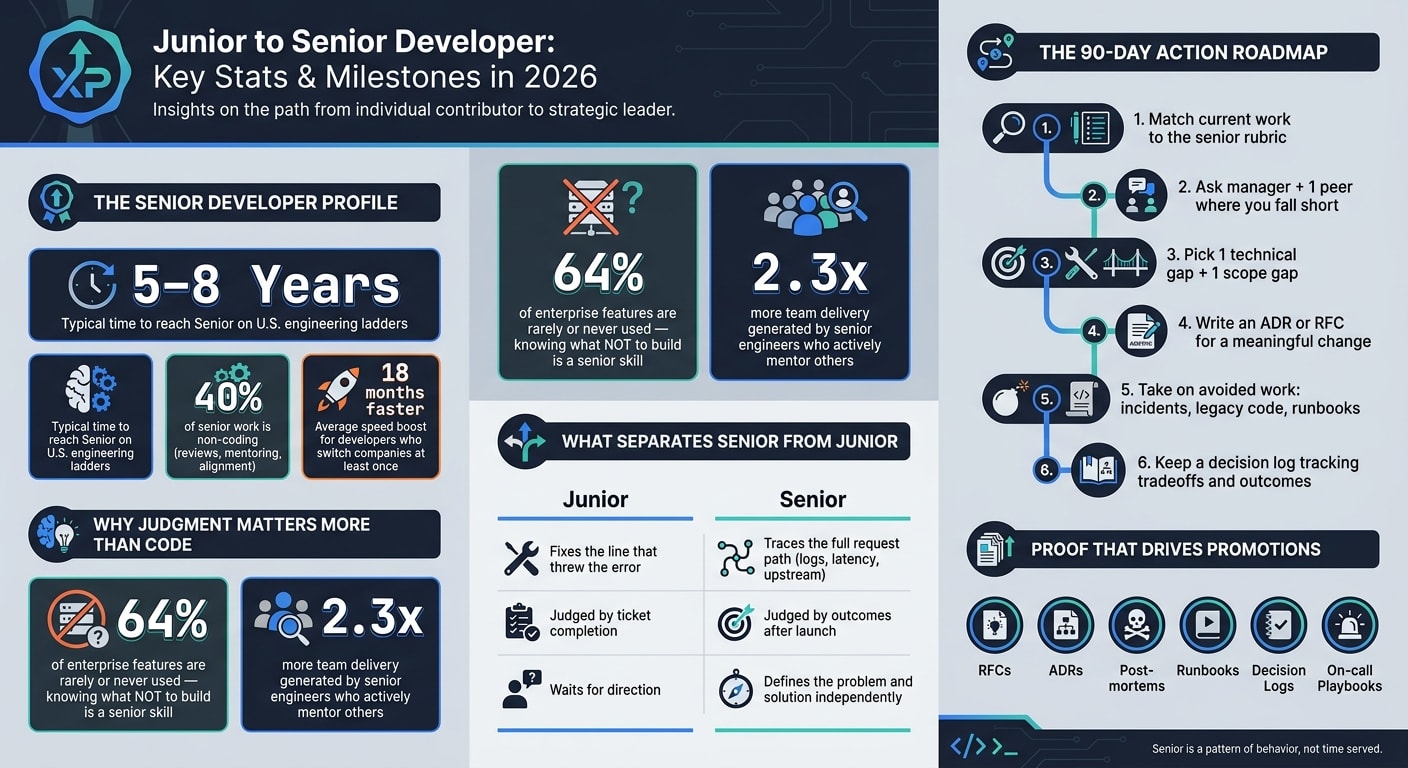
- Senior scope is bigger. I own features or systems end to end.
- AI changed the bar. Raw coding output matters less; decision-making matters more.
- Promotion usually takes 5 to 8 years in U.S. engineering ladders.
- Company changes can speed things up by about 18 months on average.
- About 40% of senior work is non-coding work like reviews, mentoring, and alignment.
- Mentoring has team impact. Engineers who mentor can drive 2.3x more team delivery.
- A lot of feature work is wasted. Around 64% of features are rarely or never used.
- Proof matters. In 2026, RFCs, ADRs, post-mortems, runbooks, and decision logs help promotion cases.
What I take from this is simple: I don’t get promoted by waiting. I get there by showing that I can define the problem, choose what not to build, deal with failure, and help the team move with less confusion.
A simple 90-day path looks like this:
- Match my work to the senior rubric
- Ask my manager and a peer where I fall short
- Pick one technical gap and one scope gap
- Write an ADR or RFC for a change that matters
- Take on work others avoid, like incidents, legacy code, or runbooks
- Keep a short log of decisions, tradeoffs, and outcomes
That’s the core idea of the article: senior is a pattern of behavior, not just time served or more tickets closed.
What Actually Separates Senior from Junior
With AI taking on more routine coding, seniority now leans more on judgment at a bigger scope. You can usually spot it in three behaviors: judgment, communication, and ownership.
Judgment: Making Tradeoffs Instead of Chasing Clever Code
Junior engineers often lean toward clever code. Senior engineers lean toward outcomes that are readable, easy to maintain, and dependable.
The clearest sign of that? Knowing what not to build.
Before asking how to build something, seniors ask whether it should exist at all. They also push back on low-ROI work by making the tradeoff plain: “We can ship A or B by the deadline, but not both.” That kind of call matters more than most teams admit. Around 64% of features in the average enterprise application are rarely or never used . So the skill of cutting work can matter just as much as the skill of shipping it.
"The most senior thing a developer can do? Delete code. Or prevent it from being written in the first place." - Nico Brandt, Solid Web
Of course, judgment on its own isn’t enough. It only helps if you can explain the tradeoff in a way other people can act on.
Communication and Influence Across the Team
Senior engineers spend about 40% of their time on non-coding work like design reviews, mentoring, and stakeholder alignment . That shift catches a lot of people off guard. The job stops being just about writing code and starts being about helping the whole team make better decisions.
A big part of that is learning to speak to different audiences.
- With engineers, you talk through tradeoffs and implementation risk.
- With a PM, you tie technical choices to user impact.
- With leadership, you translate complexity into business risk or cost.
Senior engineers also write things that last: RFCs, architecture decision records (ADRs), and post-mortems. These documents help your thinking travel farther than one meeting or one Slack thread. A solid design doc can stop the same question from coming up again and again.
Mentoring matters too. Senior engineers who actively mentor others generate 2.3 times more team delivery than those who focus only on their own code .
Then comes the part that separates talk from action: staying on the hook for what happens next.
Ownership: Being Accountable for Outcomes, Not Tickets
Junior work is often judged by whether the ticket got done. Senior work is judged by what happened after it shipped.
That includes incidents, root-cause analysis, runbooks, telemetry, and on-call playbooks - the stuff that keeps systems healthy long after launch . Ownership means you don’t walk away when the code merges. You stay tied to incident response, root cause, runbooks, and long-term reliability after launch.
These behaviors turn into promotion material when you do them over and over. They’re habits, not titles. Next: the skills and daily practices that build them.
Skills and Habits That Move You Toward Senior
Build Deeper Technical Skills in Systems, Debugging, and Reliability
That judgment needs to show up in your technical calls too. Seniority is about systems thinking, not writing more syntax. If you own a system, you should be thinking about failure before users feel it.
A good place to start is with failure modes before you write code. Ask: What happens when this breaks? And: What happens at 10x traffic? That habit changes how you build. It pushes you to add caching before traffic turns a slow path into a bottleneck. That's the kind of call that separates someone who ships features from someone who ships systems people can rely on.
Debugging follows the same pattern. When a 500 error pops up, a junior might fix the line that threw the error. A senior traces the whole request path: logs, latency, upstream service settings, and anything else in the chain. A try-catch block can hide the symptom. Tracing the logs back to the wrong timeout fixes the cause.
Design docs, RFCs, and Architecture Decision Records (ADRs) matter here too. In 2026, those written records are a main source of proof in promotion calibrations.
Technical judgment matters because it keeps systems steady when traffic jumps, systems get messier, or failures hit.
Practice Product Thinking and Clearer Communication
Senior scope means solving the right problem, not just the one written in a ticket. Senior engineers define the problem before they define the fix. Start with the user outcome the work should change. That frame shapes what gets built and what gets cut.
"The single biggest predictor of promotion to senior level was not technical proficiency... It was 'scope expansion,' the ability to take on ambiguous problems and define the solution without being told what to do." - LinkedIn Economic Graph Study, 2025
When a requirement is vague, pin down the user problem behind it. In status updates, call out risks, blockers, and decisions that need attention. In pull request reviews, look past syntax and ask whether the code will be easy to maintain. These habits show up in performance reviews because they reduce friction for everyone around you.
The biggest communication step up is learning how to explain tradeoffs. Don't jump straight to your favorite framework or database. Lay out the options, the risks, and the timeline cost. That kind of recommendation builds trust with PMs and engineering leads.
Use AI and daily.dev as tools, not crutches
AI makes execution faster, but it also makes shallow review more expensive. When code gets cheaper to produce, review, tradeoff analysis, and risk spotting matter more.
The trap is treating AI output like it's right by default. If you accept it without understanding the system underneath, you'll miss edge cases. And those misses turn into reliability and security debt over time.
"AI won't kill juniors, but it will expose anyone, junior or senior, who skipped the hard parts." - Julien Danjou, CEO, Mergery
Use AI as a fast assistant, not as a stand-in for understanding. It's useful for scaffolding, generating tests, trying refactors, and drafting docs. Then review the output like someone who owns the system. Check for observability gaps, performance under scale, and security-sensitive logic that needs human judgment.
Use daily.dev to keep up with the tools, patterns, and risks shaping your stack.
How Long It Takes and What Holds Juniors Back
Typical Timelines on U.S. Engineering Ladders
If the last section showed what senior behavior looks like, this one gets into timing and the things that slow people down.
On U.S. engineering ladders, reaching senior often takes 5 to 8 years, though the range can vary a lot . The main difference isn’t just time on the job. It’s scope. Engineers who take on stretch work and messy, unclear problems tend to move up faster. And developers who switch companies at least once reach senior about 18 months faster on average than those who stay with one employer .
It helps to treat the title as a side effect, not the main goal. Look for the signals that point to senior-level work: setting direction, owning outcomes, and working without constant oversight. Those are the signs that matter most .
The Skill Gaps That Stall Promotions
The blockers are usually pretty plain: waiting to be told what to do, dodging ownership during incidents, staying stuck in one framework, and struggling to explain tradeoffs to non-technical stakeholders .
There’s also a newer trap in the AI era: shipping code you don’t understand. If you push generated code without knowing the security, privacy, or performance risks, that can hurt your path to promotion . The problem isn’t the tool. It’s whether you can judge the output and take responsibility for what goes live.
Another common plateau shows up after people reach senior and stay there for years. A lot of engineers keep doing more feature work, but that alone doesn’t move them forward. The next jump usually comes from shaping systems, mentoring other people, and clearing blockers for the team .
Work like this tends to matter more:
- Writing RFCs
- Running post-mortems
- Unblocking teammates
Personal output still counts, of course. But by itself, it usually won’t get someone past that plateau.
That’s why the next move is to map your gaps and start taking on work that shows senior behavior.
A Practical Roadmap to Start Acting Like a Senior
Map Your Gaps to Senior Expectations
If these gaps are holding you back, use the next 90 days to prove the reverse. Put your current work next to your company’s senior rubric. Then ask your manager and one trusted peer what you still need to show. Pick one technical gap and one scope or impact gap. After that, create visible proof for both - like writing an Architecture Decision Record (ADR) for a meaningful change or leading a cross-team project . Keep a short decision log that shows the tradeoffs and your reasoning. That log can later support your promotion case.
Once you know where the gaps are, choose work that pushes you to use judgment, take ownership, and communicate well. If the work is fuzzy, write the spec yourself. Before you start coding, spend 30 minutes defining the scope and acceptance criteria. Step into the work other people tend to avoid: legacy systems, incident follow-ups, undocumented services, or on-call runbooks . Then use runbooks, PR reviews, and onboarding to help the whole team get better.
In the AI era, promotion comes from making better decisions and having more impact, not just writing code faster. Start with your gaps, take on the messy work, and let steady behavior - not tenure alone - make the case for the title.
FAQs
How do I prove senior-level impact?
Show system-level responsibility, not just your own output. That’s how you make senior-level impact visible. Promotion calls usually come down to one thing: clear written proof that your work changed how the system and the team operate over time.
Put your energy into two areas: technical depth and team impact. Write things down in artifacts like RFCs, ADRs, and post-mortems. Use them to show how you unblocked other people, made tradeoffs clear, and steered work away from low-impact tasks.
And don’t leave this to your manager’s gut feel. Ask directly what would be hard to defend in your promotion case. That question tends to cut through the fog fast.
Can AI slow down my path to senior?
Yes - if you use AI as a crutch instead of a growth tool.
It can speed up execution. But it can't speed up understanding. And when you skip the hard parts, you also skip the troubleshooting reps and judgment that senior engineers build over time.
A better way to use it: treat AI like a tutor, not a shortcut. Ask it to explain the why, the trade-offs, and the failure modes behind what it gives you.
Should I switch companies to reach senior faster?
Not necessarily. Switching companies isn't a sure shortcut to seniority. Senior growth has more to do with ownership, judgment, and impact on the team than with tenure or the name of the company on your resume.
The better move is to show senior-level behavior where you already are. Take on messy, unclear problems. Help other people grow. Push back when work doesn't need to be done or isn't the right use of time.
If your current role gives you no room to own work in a bigger way, moving can make sense. But aim for real impact, not just a new title.