Master one stack, core web skills, and real projects—depth and learning speed beat knowing every framework.
No - you do not need to know every framework to get hired. If I were job hunting today, I’d put my time into one stack, core web skills, and projects that show I can ship code instead of trying to list 10 tools on my resume.
Here’s the short version:
- Job posts are often wish lists. A long list of frameworks does not always mean I need every item.
- Hiring teams screen for problem-solving. They want to see how I debug, write code, use Git, and explain decisions.
- One framework is often enough. For many frontend roles, one major framework plus JavaScript or TypeScript goes a long way.
- Core skills matter more. HTTP, SQL, HTML, CSS, JavaScript, and Git often carry more weight than surface-level framework knowledge.
- Learning speed counts. If I can learn a new framework in a few weeks and build something with it, that helps.
A simple rule I’d follow: go deep before I go wide.
Here’s a quick snapshot:
| What matters most | What matters less |
|---|---|
| Shipping features | Listing many frameworks |
| Debugging skill | Memorized syntax |
| Git habits | Tutorial-only work |
| Core web knowledge | Chasing every new tool |
| One stack I can explain well | Light exposure to everything |
There’s also a market angle here. In the U.S., many frontend roles still ask for React, full-stack roles often lean on TypeScript + Node.js, and Python stays common for backend and AI work. That does not mean I need all of them. It means I should pick the one that fits the jobs I want.
Bottom line: I’d focus on one language, one stack, and a few solid projects. That gives me a better shot than spreading my time across every framework I see.
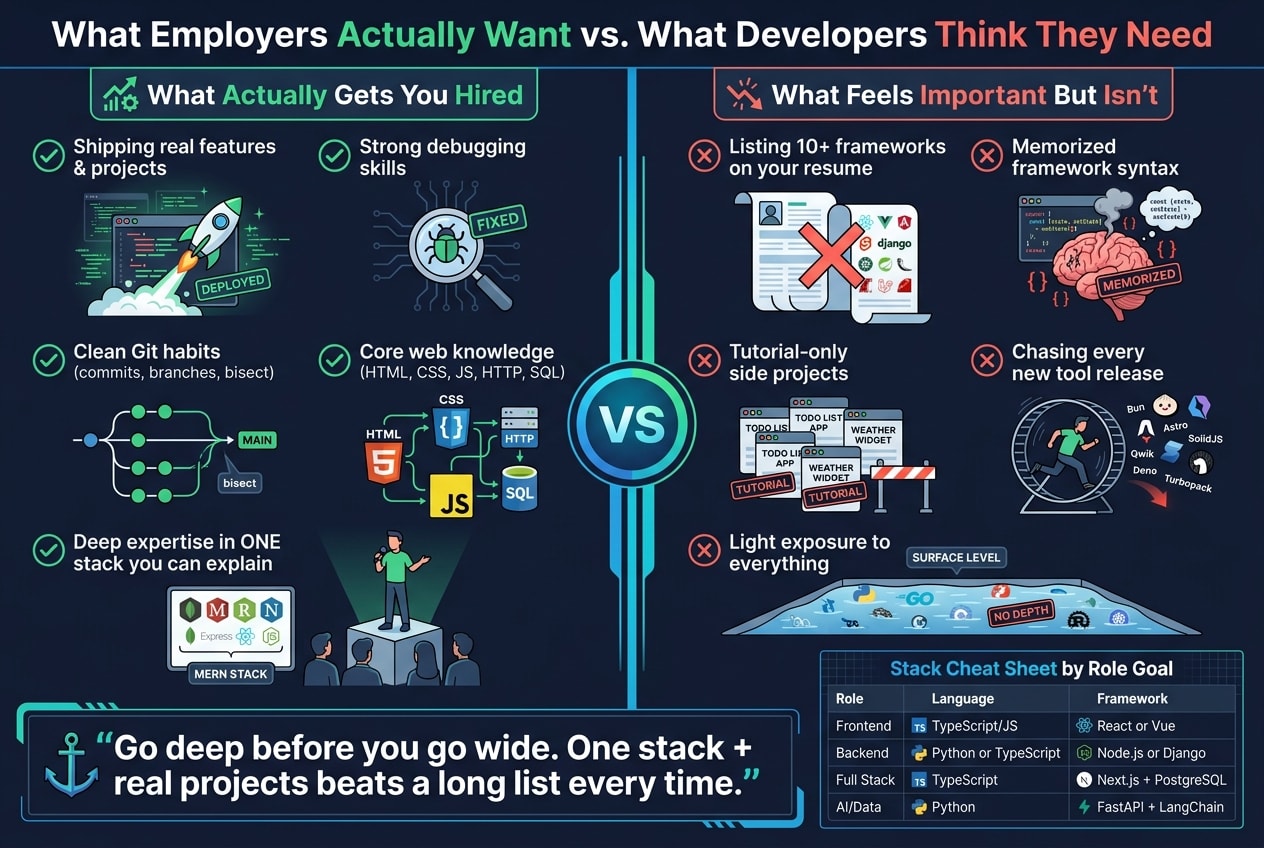
Why the 'know every framework' myth persists
The anxiety kicks in as soon as you open a job listing. You see React, Angular, Vue, Node.js, Django, and a handful of other tools packed into one role. No wonder this myth feels convincing.
Job listings are often wish lists, not hard requirements
Most long framework lists aren't strict requirements. They're much closer to a wish list than a hard checklist.
"Too many hiring processes are driven by rigid requirement lists, often crafted by people who don't truly understand how the web works. They treat frameworks like qualifications, not tools." - Michaël Vanderheyden, Lead UX Engineer
That shift matters. Tools get turned into checkbox items, and keyword scans can turn job posts into long tool lists instead of clear role descriptions. So if you know one similar tool well, you can still be a strong candidate. That's the gap many people miss: the list on the page doesn't always match what the team is trying to measure.
Hiring managers want proof you can solve problems in one ecosystem
What hiring managers usually want to know is simple: can you ship reliable software and work through hard problems? Framework names start the conversation. They don't end it.
"Recruiters are scanning for keywords, sure, but their primary goal is to see if you can solve problems. They're not trying to hire a JavaScript framework connoisseur." - Samaresh Das, Full Stack Developer
That's why interviews tend to move past framework names pretty fast and into how you think. Depth in one ecosystem sends a strong signal. It shows you've dealt with production issues, worked through state management at scale, handled performance trouble, and seen the kind of bugs that beginner tutorials never touch.
That kind of experience carries over when the stack changes. The core engineering skills behind it, especially debugging and understanding how data moves through an app, transfer across frameworks. Those skills don't disappear just because the library name changes.
What employers actually screen for in developer interviews
Interviews move past keywords fast. Hiring managers want to see how you think, how you debug, and how you ship code.
Fundamentals matter more than knowing many frameworks
That matters because interviews reward skills that transfer, not memorized framework syntax. Under pressure, the stuff that holds up is the stuff you can use in almost any stack: HTML, CSS, JavaScript, HTTP, SQL, and basic data structures. Those are often the signals interviewers use to tell the difference between real understanding and surface-level familiarity.
Framework syntax can be taught. Tracking down a network bug, fixing a slow query, or sorting out a rendering issue is much harder to fake.
One framework is usually enough for frontend and full stack roles
You don't need React, Angular, and Vue on your resume. In most cases, one framework plus solid project depth reads better than a long list of tools you've only touched lightly. For many frontend roles, employers expect one major framework. For full stack roles, they usually look for one frontend framework paired with one backend framework.
Projects, Git habits, and learning speed are real hiring signals
After fundamentals, employers look for proof that you can work inside a real codebase. Clean commits, useful branches, and tools like git bisect tell a stronger story than a pile of tutorial projects. They suggest you've dealt with code the way teams do in actual work.
A project with real complexity says more than a long list of names. If you can explain why you used local state instead of global state, that's much stronger than saying you copied a tutorial step by step.
Learning speed is the last part. Employers know their stack won't stay the same forever. If you can show that you picked up a new tool fast and used it in a project, that lands well in interviews.
Once you know what employers screen for, choosing one stack gets a lot simpler. Having a clear strategy for choosing your next tech stack allows you to focus on building depth rather than chasing every new tool.
How to choose a stack without chasing everything
Use employer demand to pick one stack. That turns stack choice into a job-market call, not a popularity contest.
How many languages does a developer actually need to know?
For most entry-level and mid-level roles, the honest answer is simple: one primary language. Then add basic familiarity with one or two others if the role asks for it.
A good target is one deep specialty, plus working knowledge of HTTP, SQL, and Git. For most jobs, one main language is enough. Breadth starts to matter more after you can ship in one stack.
If you're aiming for frontend or full stack work, TypeScript deserves a close look because it runs on both the frontend and backend through Node.js . In plain English, that means you can cover more of the stack without dividing your time between two separate language ecosystems.
Pick one frontend framework or one backend ecosystem and go deep
For frontend roles, choose the framework that shows up most often in your target job listings. For backend roles, choose the stack that lines up with the kind of work you want to do.
For frontend, React fits high-demand generalist roles, Vue works well for beginners, and Angular fits enterprise settings. For backend, Node.js with TypeScript lets you stay in one language across the stack, while Python is a strong fit for AI or data-focused roles.
Here’s a quick reference:
| Role Goal | Primary Language | Framework/Stack |
|---|---|---|
| Frontend | TypeScript / JavaScript | React (High Demand) or Vue (Ease of Use) |
| Backend | Python or TypeScript | Node.js (Express/Fastify) or Django |
| Full Stack | TypeScript | Next.js + PostgreSQL |
| AI/Data Focused | Python | FastAPI + LangChain |
Once you choose a path, the upside is simple: it becomes much easier to learn nearby frameworks fast.
Use daily.dev to stay current without spreading yourself thin
After you commit to one stack, you still need a way to keep up without running after every new tool. Use daily.dev to follow updates on your chosen stack and avoid drifting into stuff that doesn't help your goal.
Once your stack is set, the next skill is learning new frameworks fast when a job asks for them.
How to learn a new framework fast when a job requires it
Once you’ve picked a stack, the next question is simple: how fast can you switch gears when a job wants another one? If a role asks for a framework you haven’t used yet, your edge is speed. So the goal isn’t to know everything. It’s to learn the right things fast.
Start from shared concepts, not framework-specific syntax
Start with the patterns most frameworks share: state, routing, data flow, and component structure. If you already get the DOM, HTTP, and async code, you’re not starting from scratch. You’re translating ideas from one system to another.
"Frameworks are career accelerators. Fundamentals are career foundations." - Kirill Tolmachev, Senior Backend Engineer
A simple 5-step process for picking up any framework
When a role asks for a framework you haven’t used, this process tends to work well:
- Read the official docs first. Focus on the framework’s philosophy and how it handles data flow.
- Build a small CRUD project. A task manager or profile editor is enough. The point is to run into actual implementation problems instead of just copying a tutorial.
- Go back to the docs and review the parts you used. Pay attention to the why, not just the syntax.
- Refactor and test your code so you can show that you can ship clean code.
The target is functional confidence, not mastery. That’s why going deep in one stack still beats light coverage across many.
Conclusion: Focused depth is the smarter path
Employers care far more about fundamentals, clean code, and work you’ve actually shipped than a long list of framework names.
That’s why the edge isn’t knowing more frameworks. It’s having deeper skill in one stack. Going deep shows you can do the job. Light familiarity with ten different tools usually doesn’t.
And when a role calls for something new, strong fundamentals make it much easier to learn an unfamiliar framework fast. That’s the part people often miss. If you understand the core ideas, the tool itself is usually the easier part.
Chasing every new release can feel productive, but it often turns into motion without progress. One stack, paired with real projects, tends to move you ahead faster.
"Stop running on the treadmill. Start building a foundation." - Daniil Kornilov, Indie Maker
That’s the practical path: depth first, then breadth when the work asks for it. Pick one stack. Build real things. Depth compounds faster than breadth.
FAQs
How do I choose the right stack for my goals?
Prioritize the job market and long-term use over trends. For most developers, a widely used stack like React offers a stable, mature ecosystem. Vue may be a good fit if you want something easier to pick up, and Angular makes sense if you like TypeScript.
Once you choose one, go deep instead of spreading yourself thin. Build complex, production-ready projects that solve real problems. That tends to matter more to employers than listing a bunch of frameworks you’ve only touched on the surface.
What if a job asks for frameworks I don't know?
Don’t panic. Most employers aren’t hunting for someone who knows every single tool under the sun. They want strong problem-solvers with solid fundamentals.
If you understand core ideas like state management, component architecture, and the DOM, you can usually pick up a new framework in a matter of weeks. That’s the part that matters most.
So put your focus where it counts: show that you learn fast and can solve actual problems. If you’ve mastered one stack, a lot of that knowledge carries over. Then it’s just a matter of filling in the syntax gaps with official docs and AI tools.
How many languages should I know to get hired?
There’s no magic number here. Most employers care far more about whether you can solve problems, write clean code, and pick things up fast than whether you can list a dozen languages or frameworks on your resume.
That’s why it usually makes more sense to get good at one stack and build strong fundamentals around it. Learn how the browser works. Understand HTTP. Get comfortable with SQL. That kind of depth tends to matter more than surface-level familiarity with a long list of tools.