
Explore the top 9 object-oriented databases of 2026, their features, and how they excel in handling complex data structures.
Object-oriented databases (OODBs) offer unique advantages for handling complex data in 2024. Here's an overview of the top 9:
- ObjectDatabase++: Best for wireless server apps
- ObjectStore: Excels in high-performance data processing
- GemStone/S: Ideal for scalable business applications
- Perst: Perfect for embedded systems and mobile apps
- ZODB: Tailored for Python-based projects
- Wakanda: Great for web and mobile applications
- ObjectDB: Optimized for Java enterprise apps
- ODABA: Suited for complex data modeling
- Objectivity/DB: Designed for large-scale, complex data systems
Related video from YouTube
Quick Comparison
Database
Language Support
Key Feature
Best For
ObjectDatabase++
C++, TScript
Embedded, GUI Editor
Wireless server apps
ObjectStore
C++, Java
Efficient object management
High-performance processing
GemStone/S
Smalltalk
Persistent, multi-user
Scalable business apps
Perst
Java, C#
Small footprint
Embedded systems, mobile
ZODB
Python
Object indexing
Python projects
Wakanda
JavaScript
Full-stack platform
ObjectDB
Java
Advanced querying
Java enterprise apps
ODABA
C++, .NET
Terminology-oriented
Complex data modeling
Objectivity/DB
C++, C#, Java, Python
Distributed architecture
Large-scale data systems
OODBs excel at handling complex data relationships without slow "joins" common in relational databases. They're useful for CAD/CAM systems, multimedia databases, and scientific simulations. When choosing, consider your data complexity, programming language, scalability needs, and budget.
What changed since this list was written
Object-oriented databases occupy a niche corner of the data ecosystem, and that niche has gotten more complicated since this was written. Graph databases (Neo4j, Amazon Neptune) and vector databases (Pinecone, pgvector, Weaviate) now handle many of the complex-relationship and semantic-similarity use cases that OODBs were historically pitched for — and they come with active communities, cloud-managed options, and modern tooling. The nine entries here are still real technologies, but some are showing their age: Wakanda has been discontinued, Perst has had no active releases in years, and ODABA's community activity is difficult to verify. Read the annotations below before adopting any of these for a new project.
What are Object-Oriented Databases?
Object-oriented databases (OODBs) store data as objects, mirroring object-oriented programming. Unlike relational databases with tables, OODBs treat data as complete objects with properties and methods.
Key features:
- Data persistence
- Complex data handling
- Direct object manipulation
OODBs vs relational databases:
Aspect
Object-Oriented Databases
Relational Databases
Data structure
Objects with properties and methods
Tables with rows and columns
Query language
Object-oriented query languages
SQL
Data retrieval
Direct object access
Composition from multiple table queries
Programming alignment
Matches object-oriented languages
Requires object-relational mapping
OODBs are useful for:
- CAD and CAM
- Multimedia systems
- Real-time systems
- Scientific research
While OODBs offer advantages for complex data, they're less widely adopted than relational databases.
How We Chose These Databases
We evaluated databases based on:
- Performance and scalability
- Language support
- Query capabilities
- Market presence and growth
- Industry application
- Cost-effectiveness
- ACID compliance
- Specific features like transparent persistence and complex object handling
We prioritized databases with proven track records in industries relying on complex data management.
1. ObjectDatabase++
ObjectDatabase++ is designed for server-side applications, excelling in wireless server apps.
Key features:
- Language support: C++, VB.NET, C#
- Query language: TScript
- Indexing: B+Tree, spatial, full-text, biometric
- Real-time recovery
- Scalability: 64-bit object identifiers
Advantages:
- Minimal maintenance
- GUI Editor for schema and data management
Feature
Description
Programming Languages
C++, VB.NET, C#
Query Language
TScript
Index Types
B+Tree, Spatial, Full-text, Biometric
Object Identifiers
64-bit
Maintenance
Minimal external upkeep
GUI Tools
Table schema and data editor
ObjectDatabase++ is ideal for complex data management in engineering or telecommunications.
2. ObjectStore
ObjectStore is a powerful OODBMS for C++ and Java developers.
Key features:
- Direct integration with Java and C++ apps
- Distributed and cross-platform solutions
- Cloud and on-premise deployment
- ACID compliance
- Flexible programming models
ObjectStore excels in handling complex data structures without object-relational mapping.
Feature
Description
Initial Release
1988
Latest Stable Release
2013 Update 1 (April 1, 2014)
Programming Languages
C++, Java
Operating Systems
Windows, Linux
License
Proprietary
Deployment Options
On-premise, Cloud
ObjectStore is ideal for high-performance, scalable applications in telecommunications, finance, travel, and GIS.
3. GemStone/S
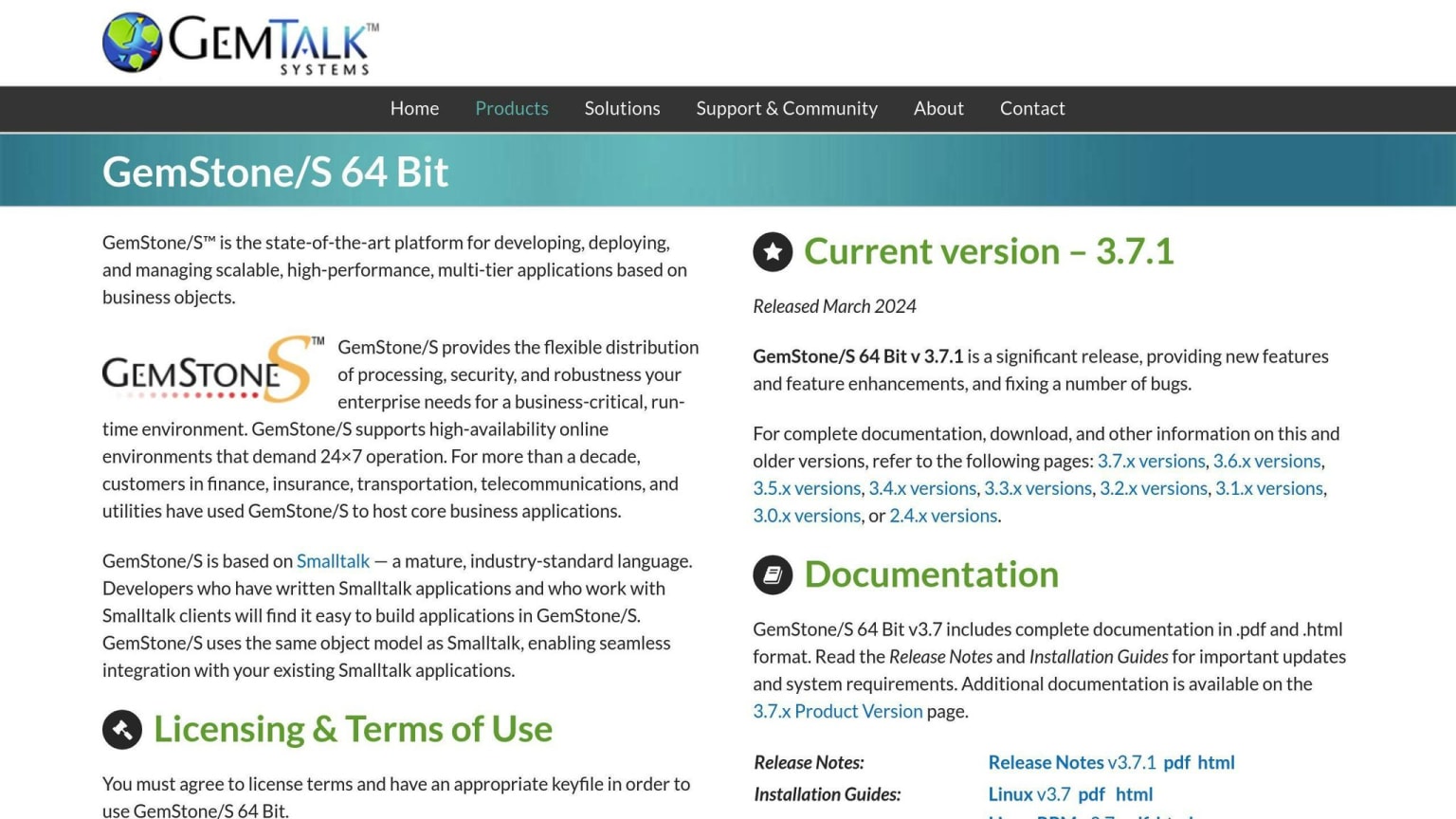
GemStone/S is a powerful OODBMS for scalable, high-performance business applications.
Key features:
- Seamless Smalltalk integration
- 24/7 high-availability support
- Flexible distribution of processing and security
- Multi-user and multi-tier application support
GemStone/S can model data in various formats:
- Tables
- Hierarchies
- Networks
- Queues
Feature
Description
Latest Version
GemStone/S 64 Bit v 3.7.1 (March 2024)
Programming Language
Smalltalk
Supported Platforms
AIX, Linux, macOS, Solaris
Licensing
Proprietary (Free version available)
GemStone/S is used across finance, insurance, transportation, telecommunications, and utilities industries.
4. Perst
⚠️ Perst (by McObject) has had no active releases in years. For embedded object persistence in Java, the more actively maintained paths are Spring Data with an embedded H2 or SQLite backend, or object persistence layers built on top of a lightweight relational store. For C# and .NET, LiteDB is a maintained embedded NoSQL option worth evaluating instead.
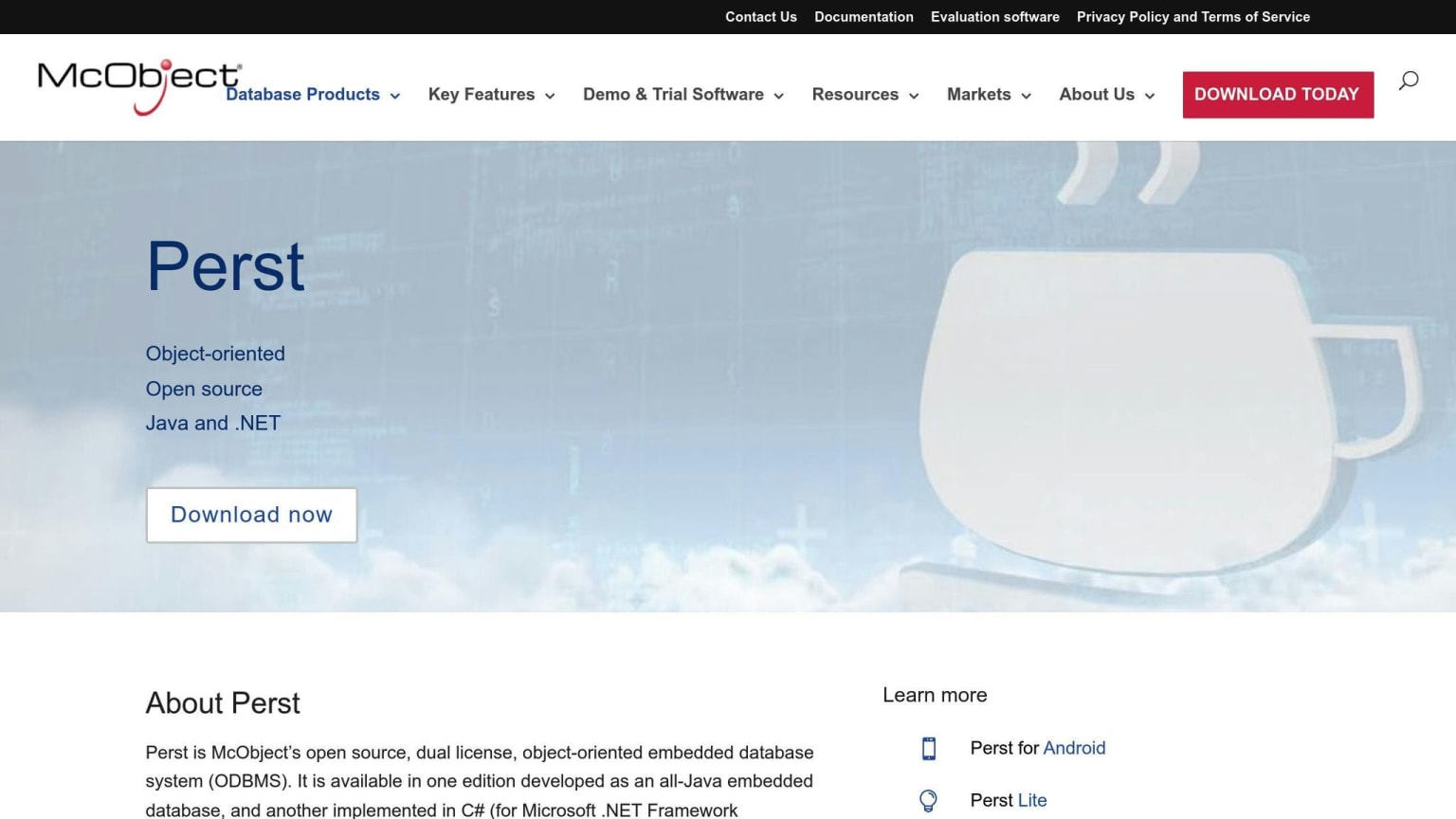
Perst is an open-source, embedded OODBMS for Java and C# apps needing high performance and small footprint.
Key features:
- Dual licensing (commercial and GPL)
- Java and C# support
- Compact size (30K to 300K runtime RAM)
- ACID compliance with automatic recovery
Perst outperforms competitors in benchmarks:
Product
Language
Create (ms)
Search (ms)
Remove (ms)
Perst
Java
3,775
1,683
3,275
ObjectStore PSE Pro
Java
8,272
9,413
3,104
FastObjects J2
Java
13,399
10,856
38,435
db4o-4.0
Java
18,457
6,279
38,886
Perst is ideal for resource-constrained projects and mobile environments.
5. ZODB
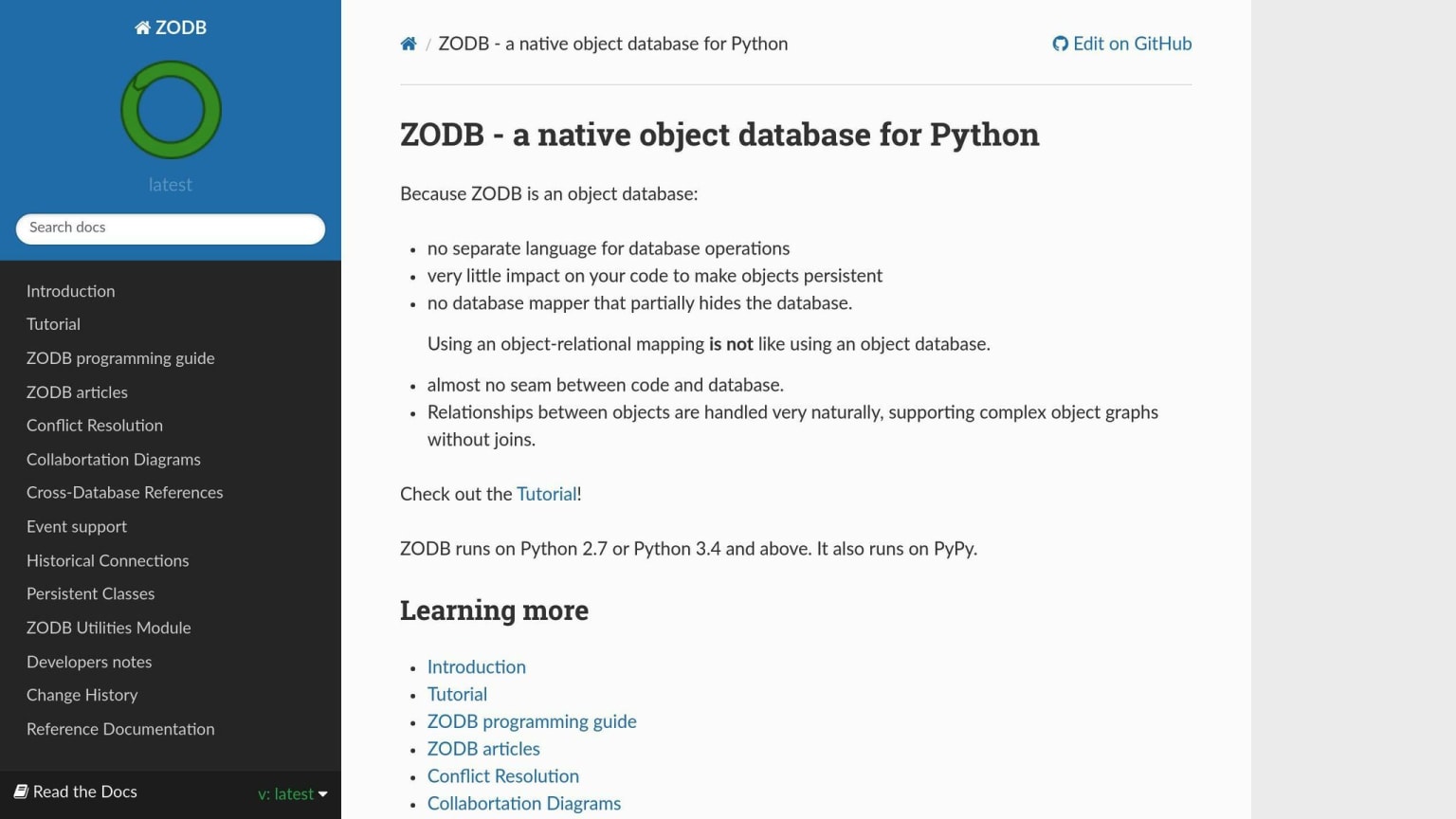
ZODB is a Python-specific OODBMS allowing direct storage of Python objects.
Key features:
- Seamless Python integration
- Transparent persistence
- Complex object support
- ACID transactions
- Pluggable storage options
ZODB is well-suited for applications with complex data structures and frequent reads.
To use ZODB, subclass persistent.Persistent:
class Book(persistent.Persistent):
    def __init__(self, title):
        self.title = title
        self.authors = persistent.list.PersistentList()

    def add_author(self, author):
        self.authors.append(author)
ZODB offers various BTree modules for efficient indexing.
6. Wakanda
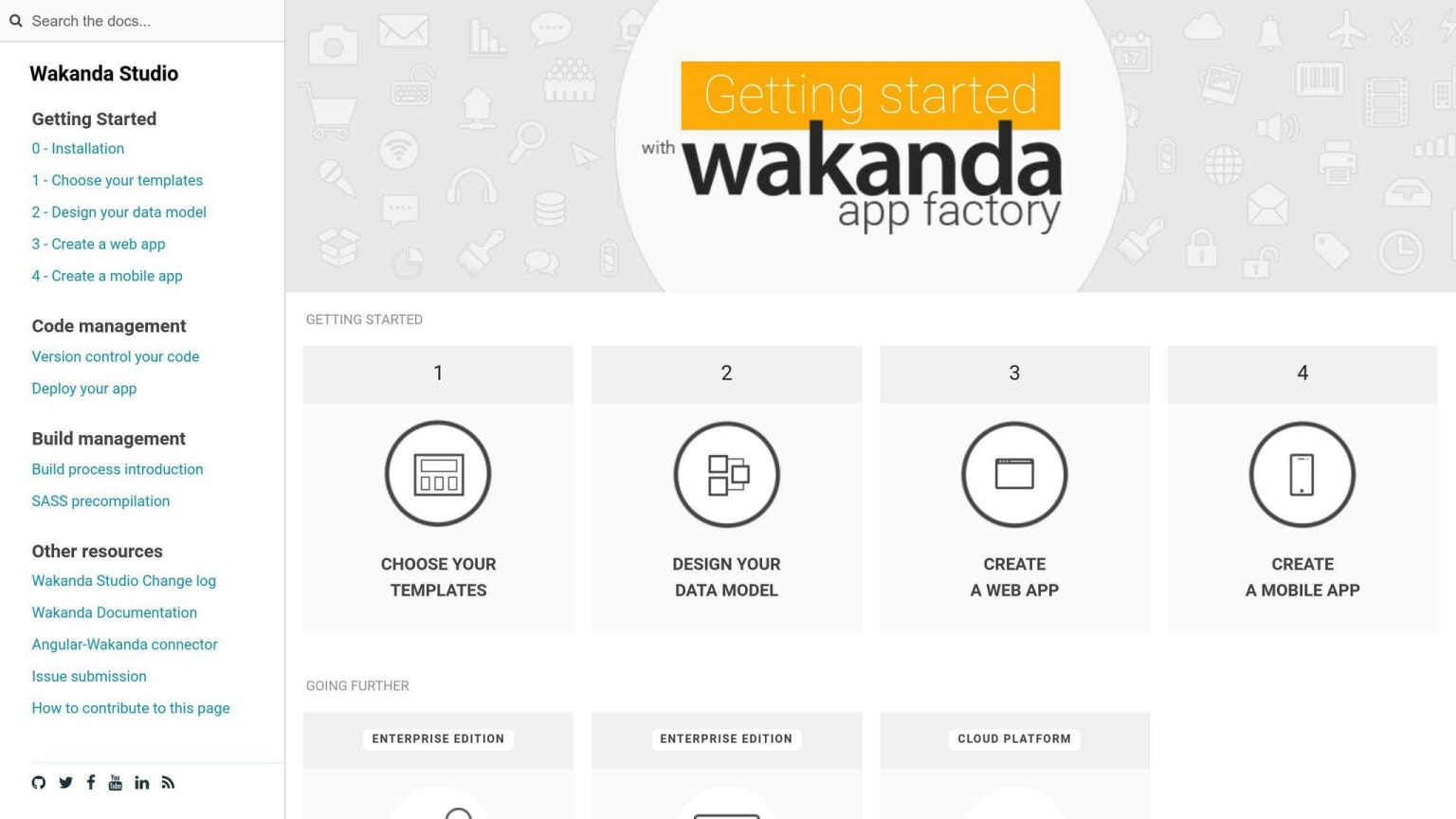
⚠️ Wakanda has been discontinued. The project is no longer actively maintained and should not be used for new development. If you are looking for a JavaScript-centric data layer with a similar embedded database approach, consider alternatives with active communities such as LowDB (for lightweight local storage) or a managed Postgres instance with an ORM.
Wakanda is an open-source platform combining an OODBMS with a full-stack development environment for web and mobile apps.
Key features:
- WakandaDB: Embedded OODBMS
- REST API for easy data access
- Server-side JavaScript (V8 engine)
- Wakanda Application Framework (WAF)
- Wakanda Studio IDE
Wakanda's components:
Component
Purpose
Key Benefit
WakandaDB
Data storage and management
Object-oriented approach
REST API
Data access
Easy integration
WAF
Client-side development
Streamlined UI creation
Wakanda Studio
Development environment
Rapid Application Development
Wakanda is ideal for JavaScript-centric projects requiring rapid development and complex data relationships.
7. ObjectDB
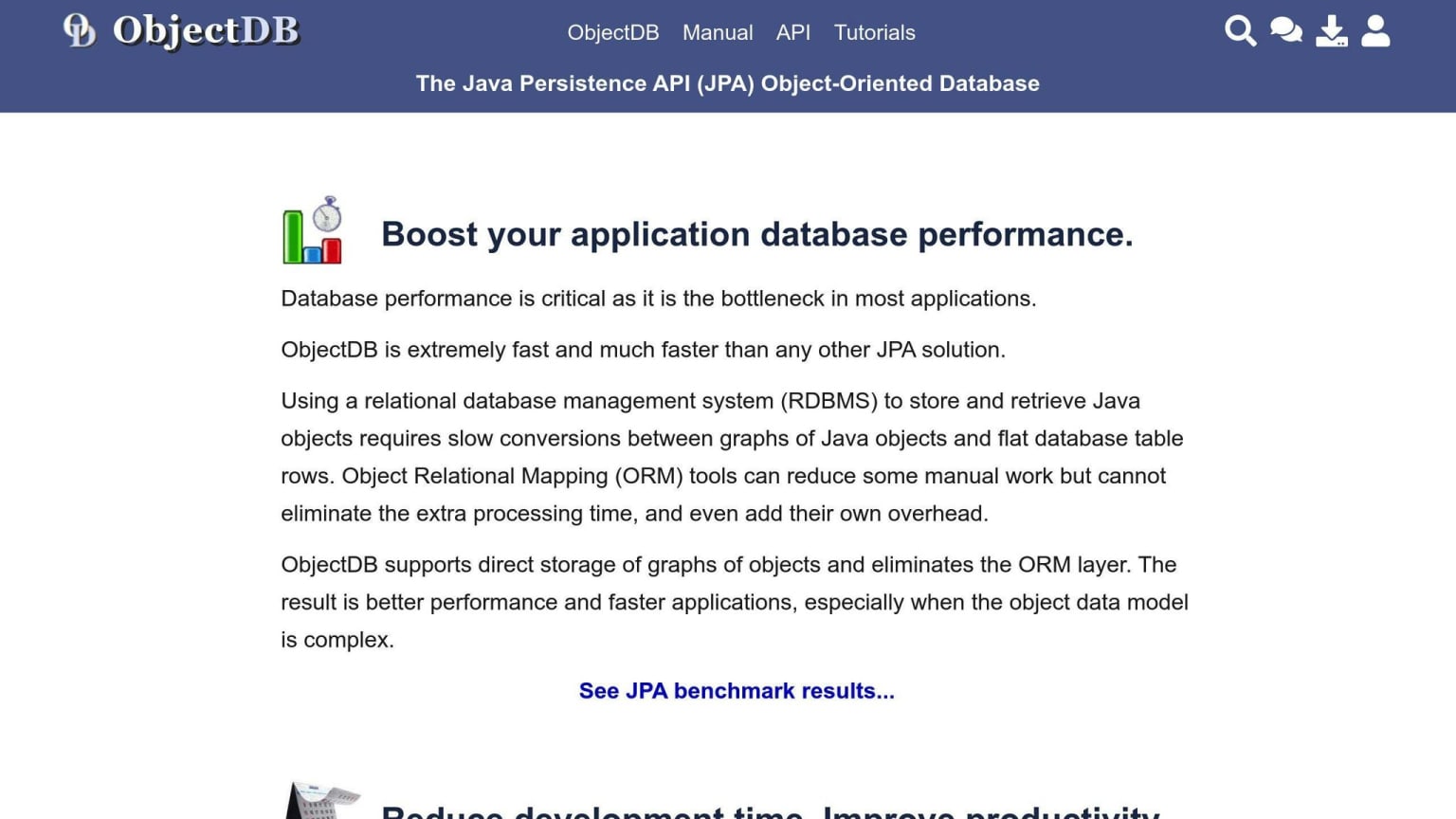
ObjectDB is a high-performance OODBMS for Java applications.
Key features:
- Native Java support
- JPA compliance
- Cache-based storage
- ACID compliance
- Scalability (vertical and horizontal)
ObjectDB capabilities:
Feature
Capacity
Max database file size
128 TB
Max entity classes per file
2,147,483,648
Max entity objects per file
9,223,372,036,854,775,808
Database connections
Unlimited (OS-dependent)
ObjectDB is ideal for Java-centric organizations dealing with complex data models and high-concurrency environments.
8. ODABA
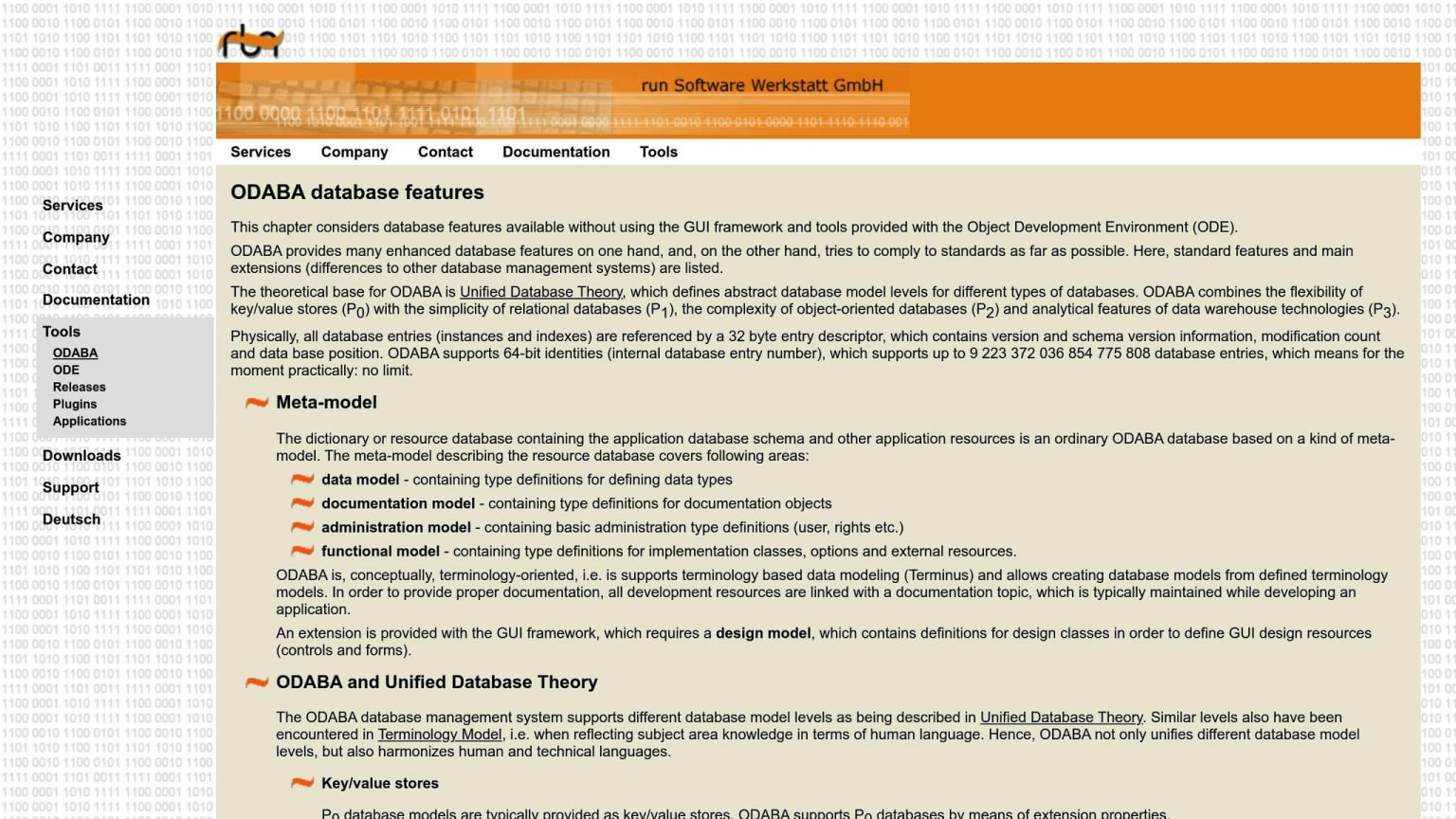
ODABA is a unique OODBMS combining features from various database types.
Key features:
- C++ and .NET support
- SQL subset and Database Query Language (DQL)
- Multiple inheritance and weak typing
- GPL licensing
ODABA's architecture handles massive data:
Feature
Capacity (64-bit version)
Max database entries per main base
9,223,372,036,854,775,808
Max main bases
32,767
File size limit
Dependent on OS
ODABA is suited for complex data modeling scenarios and applications requiring flexibility in database structure.
9. Objectivity/DB
Objectivity/DB is a powerful OODBMS for large-scale, complex data systems.
Key features:
- Distributed architecture
- ACID transactions
- Flexible schema
- High availability and fault tolerance
- Data partitioning and replication
- Query optimization and indexing
Objectivity/DB capabilities:
Feature
Capability
Max Data Volume
Exabytes
Ingest Rate
>1 TB/hour
Supported Languages
C++, C#, Java, Python
Platforms
Linux, macOS, UNIX, Windows
Largest Reported Deployment
>1 Petabyte
Objectivity/DB is ideal for businesses dealing with large volumes of interconnected data, particularly in fields requiring high-performance data processing and analysis.
Where OODBs lost ground to graph and vector databases in 2025–2026
The two categories that have most directly absorbed OODB use cases are graph databases and vector databases. Graph databases like Neo4j and Amazon Neptune handle deeply connected data — social graphs, knowledge graphs, dependency trees — with a query model (Cypher, Gremlin) purpose-built for traversing relationships. For CAD/CAM and simulation data, which is where OODBs historically had a foothold, graph models often fit better and come with far more active ecosystems. Vector databases (Pinecone, Weaviate, pgvector as a Postgres extension) handle the semantic similarity and embedding storage use cases that have exploded with AI/ML workloads — a use case OODBs were never designed for. If you are evaluating an OODB for a new project, the first question to ask is whether a graph database covers your actual query patterns, because the tooling gap between the two categories has widened significantly.
Wrap-up
Object-oriented databases offer unique advantages for handling complex data structures in 2024. When choosing an OODB, consider:
- Data complexity
- Performance requirements
- Programming language compatibility
- Scalability needs
- Budget constraints
While OODBs may not be as widely adopted as relational databases, they continue to evolve and find their niche in specific industries and applications.