
Discover the top F# community sites and forums in 2024 for learning, networking, and career growth in functional programming.
F# developers have plenty of online resources to learn, connect, and grow. Here's a quick overview of the best F# community platforms in 2024:
- F# Software Foundation (FSSF): Central hub for official resources and mentorship
- Stack Overflow F# Tag: Go-to for technical Q&A with 20,000+ users
- Reddit r/fsharp: Active subreddit for news and discussions
- GitHub F# Projects: Collaborate on open-source F# development
- F# Weekly Newsletter: Curated roundup of F# content and updates
- Twitter #fsharp: Real-time updates and code sharing
- LinkedIn F# Groups: Professional networking and job opportunities
Key benefits of engaging with F# communities:
- Learn from experienced developers
- Stay updated on language developments
- Contribute to open-source projects
- Find job opportunities
Quick Comparison:
| Platform | Users | Main Focus | Key Feature |
|---|---|---|---|
| FSSF | 5,000+ | All F# topics | Official resources |
| Stack Overflow | 20,000+ | Technical Q&A | Reputation system |
| Reddit r/fsharp | 15,000+ | News, discussions | User-driven content |
| GitHub | 10,000+ | Open-source dev | Code collaboration |
| F# Weekly | N/A | News roundup | Curated content |
| Twitter #fsharp | Varies | Quick updates | Real-time interaction |
| LinkedIn Groups | Varies | Networking | Job postings |
The F# community is known for being friendly and helpful. Don't hesitate to ask questions and get involved!
Related video from YouTube
Types of F# Community Platforms
F# developers have access to various community platforms, each serving different purposes:
Forums and Q&A Sites: Platforms like Stack Overflow's F# tag allow developers to ask questions and share knowledge.
Social Media Groups: Twitter (#fsharp) and LinkedIn F# groups provide spaces for quick updates and networking.
Open-Source Hubs: GitHub hosts numerous F# projects, fostering collaboration and contribution.
User Groups: Local and online meetups organized through platforms like Meetup.com.
Project Incubation Spaces: Initiatives like "fsprojects" on GitHub provide a neutral environment for F# projects to grow.
Engaging with these platforms can boost your skills and career prospects by:
- Enhancing your F# coding skills through open-source contributions
- Getting help with specific issues on forums and Q&A sites
- Networking with other F# developers, potentially leading to job opportunities
- Staying updated with the latest F# developments and tools
- Contributing to community projects and helping others learn
As Ody Mbegbu, an F# enthusiast, states:
"We should stop complaining and build what we want to see. Create what we want and contribute back to the community that's how this great language was started and that's how we will sustain it."
This sentiment underscores the community-driven nature of F# development and the importance of active participation.
What Makes a Good F# Community Site
A good F# community site is crucial for knowledge sharing and collaboration. Key features include:
Active Users
Having many engaged users is vital for:
- Knowledge sharing
- Faster responses to questions
- Diverse perspectives on F# programming
To combat the "90% lurker" phenomenon, community leaders can:
- Encourage key contributors to post regularly
- Promote forum posts on social media platforms
Helpful Discussions
Good F# community sites foster in-depth conversations by:
- Encouraging detailed explanations with context and code samples
- Celebrating members who consistently provide helpful answers
Effective Moderation
Good moderation maintains a healthy F# community:
| Moderation Aspect | Description |
|---|---|
| Tone Setting | Moderators lead by example |
| Clear Guidelines | Well-defined community policies |
| Quick Responses | Addressing issues promptly |
| Private Handling | Dealing with infractions via private messages |
Moderators should focus on encouraging community and upholding terms of service rather than policing.
Official F# Resources
The F# Software Foundation (FSSF) provides essential resources for F# developers:
F# Software Foundation Website
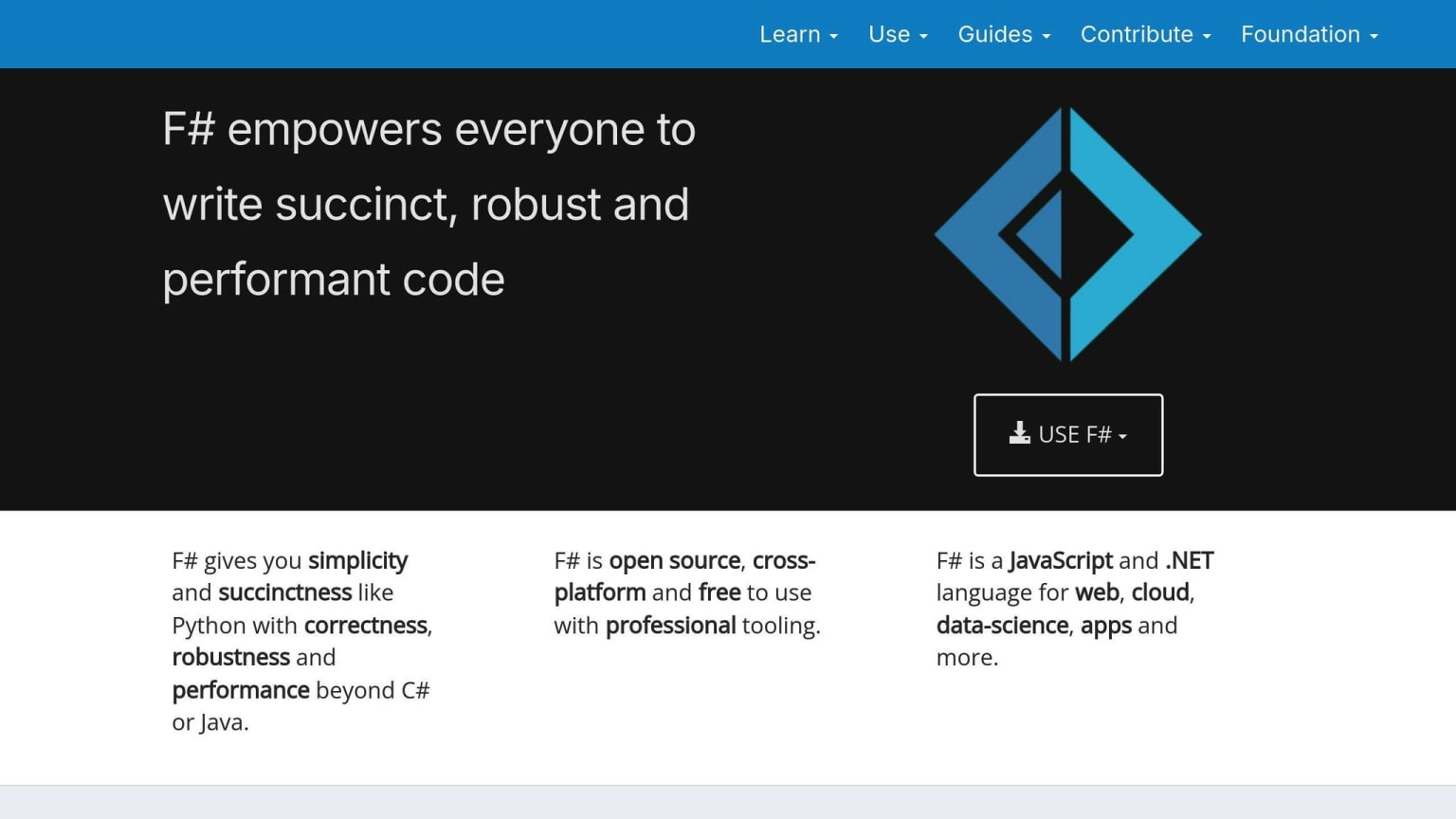
The FSSF's website offers:
| Resource | Description |
|---|---|
| Documentation | Comprehensive guides on F# |
| Learning Materials | Free tutorials and courses |
| F# Cheat Sheet | Concise syntax guide |
| Component Design Guidelines | Best practices for F# programming |
| FSharp.Core Library Reference | Detailed core F# functionality docs |
Official Forums
FSSF-supported forums play a crucial role in:
- Knowledge sharing
- Community updates
- Problem-solving
These forums complement the static resources by providing dynamic, community-driven support.
Popular F# Forums
Two of the most popular forums for F# discussions are Stack Overflow and Reddit.
Stack Overflow F# Tag
Stack Overflow's F# tag is known for:
- Quick response times
- High-quality, detailed answers
- Friendly and passionate members
- Technical proficiency
Reddit r/fsharp
Reddit's r/fsharp community offers:
- Discussions on various F# topics
- News and updates about the language
- Code sharing and review
- Community-driven support
| Feature | Stack Overflow F# Tag | Reddit r/fsharp |
|---|---|---|
| Focus | Technical Q&A | General discussions |
| Format | Structured Q&A | Threaded conversations |
| Audience | Professional developers | Mix of pros and hobbyists |
| Content | Specific coding problems | Broad range of F# topics |
| Reputation system | Yes (upvotes and badges) | Yes (karma) |
Both platforms play crucial roles in fostering the F# community, offering complementary spaces for developers to connect and grow.
F# on Social Media
F# developers use social media to share information and stay updated. Two main platforms stand out:
Twitter #fsharp Hashtag
Developers use the #fsharp tag to:
- Share code snippets and solutions
- Ask questions and get quick answers
- Announce new F# projects or libraries
- Discuss language features and updates
LinkedIn F# Groups
LinkedIn offers a professional networking space for F# developers, providing:
- Job postings for F# positions
- Industry news and trends
- Discussions on F# in enterprise environments
- Networking opportunities
| Platform | Main Uses | Audience |
|---|---|---|
| Twitter (#fsharp) | Quick updates, code sharing, Q&A | Developers, enthusiasts |
| LinkedIn Groups | Professional networking, job opportunities | Industry professionals |
Both platforms play crucial roles in connecting F# developers globally and promoting community growth.
F# Open-Source Projects
GitHub is the primary hub for F# open-source projects. The F# community maintains various projects, including:
| Category | Notable Projects |
|---|---|
| Compiler and Core Library | dotnet/fsharp |
| Editing Tools | Visual F# Tools, Ionide |
| Development Tools | FAKE (F# Make) |
| Data Access | FSharp.Data |
| Data Science | Deedle, Math.NET Numerics |
The "Awesome F#" GitHub repository is a curated list of F# frameworks, libraries, and resources.
To contribute to F# open-source projects:
- Fork the repository on GitHub
- Make changes in your forked version
- Submit a pull request with your modifications
When contributing, keep these tips in mind:
- Read the project's
contributing.mdfile - Start with small contributions
- Use the
#fsharptag on Twitter or join the FSSF Slack for support
F# Blogs and News
F# developers have access to various blogs and news sources:
F# Weekly Newsletter
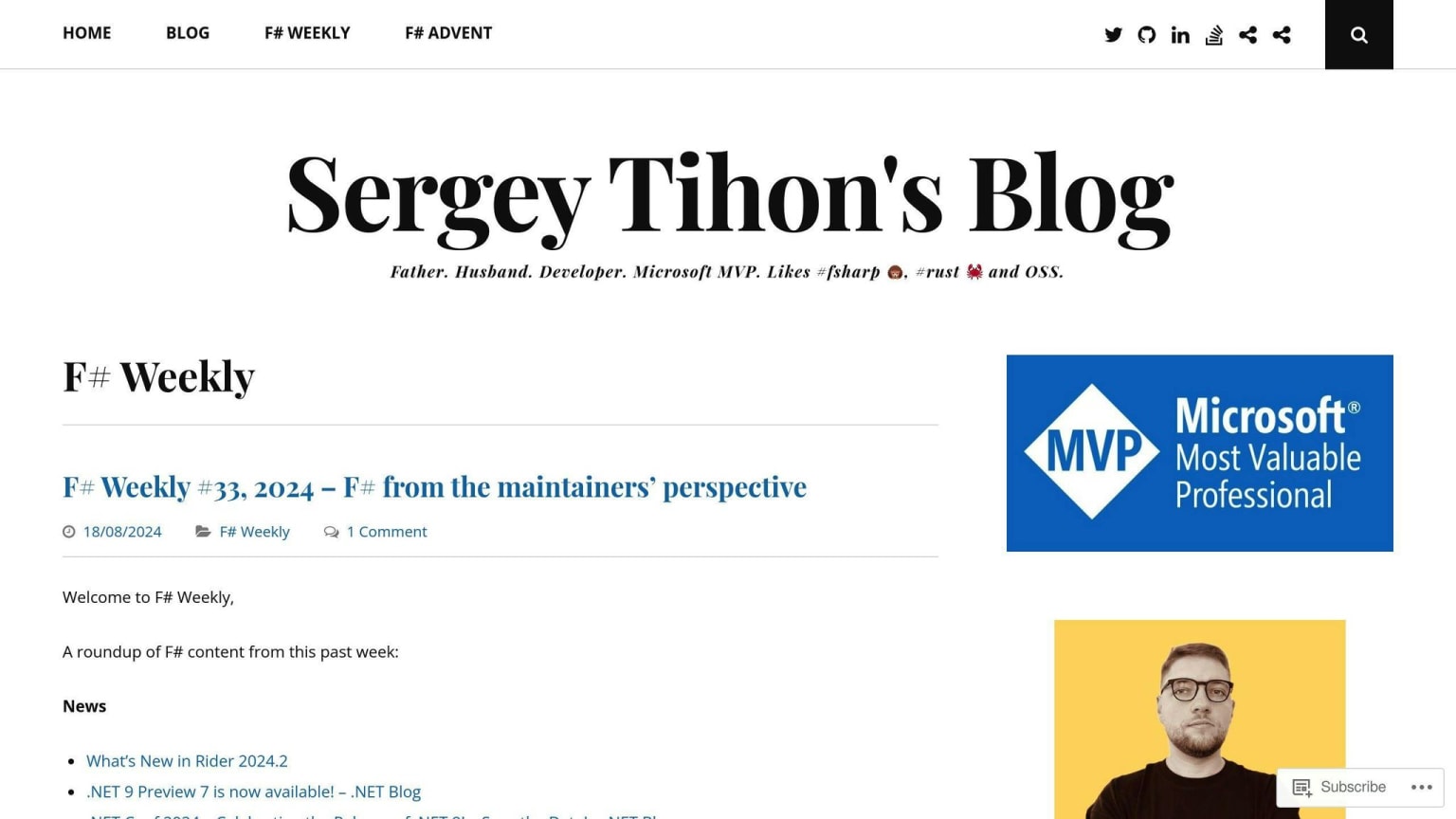
Curated by Sergey Tihon, it covers:
- News about F# tools and libraries
- Updates on .NET releases
- Community projects and open-source contributions
- Blog posts and articles
- Videos and tutorials
Notable F# Blogs
| Blog Name | Author | Focus | Posting Frequency |
|---|---|---|---|
| Ploeh Blog | Mark Seemann | Code maintainability | 1 post/week |
| Sergey Tihon's Blog | Sergey Tihon | F# programming | 1 post/week |
| Mathias Brandewinder Blog | Mathias Brandewinder | .NET and F# development | 3 posts/quarter |
| Tomas Petricek's Blog | Tomas Petricek | F# trainings and talks | 1 post/quarter |
| Thinkbeforecoding | Jérémie Chassaing | Domain Driven Design with F# | Varies |
| Fsharp.org Blog | Various | F# as a mature, open-source language | 4 posts/year |
To make the most of these resources:
- Subscribe to the F# Weekly newsletter
- Follow specific blogs that align with your interests
- Engage with the community by commenting on posts
- Use the content as inspiration for your own projects
F# Events
F# developers can connect through various events and meetups:
F# Meetups
The F# Software Foundation has over 1,622 members across 5 Meetups worldwide, offering:
- Experience sharing
- Discussions on new F# features
- Networking opportunities
F# Conferences
Notable F# conferences include:
| Conference | Date | Location | Key Features |
|---|---|---|---|
| fsharpConf | Annual | Virtual | Community-organized, single-day event |
| LambdaConf | May 6-7, 2024 | Boulder, USA | Multi-disciplinary, pre-conference activities |
| Functional Conf | Nov 21-23, 2024 | Bengaluru, India | Asia's Premier Functional Programming Conference |
These events provide opportunities to:
- Learn about the latest developments in functional programming
- Network with professionals in the field
- Gain insights from experts across various programming languages
F# Learning Resources
F# offers various learning resources for developers at all skill levels:
F# for Fun and Profit
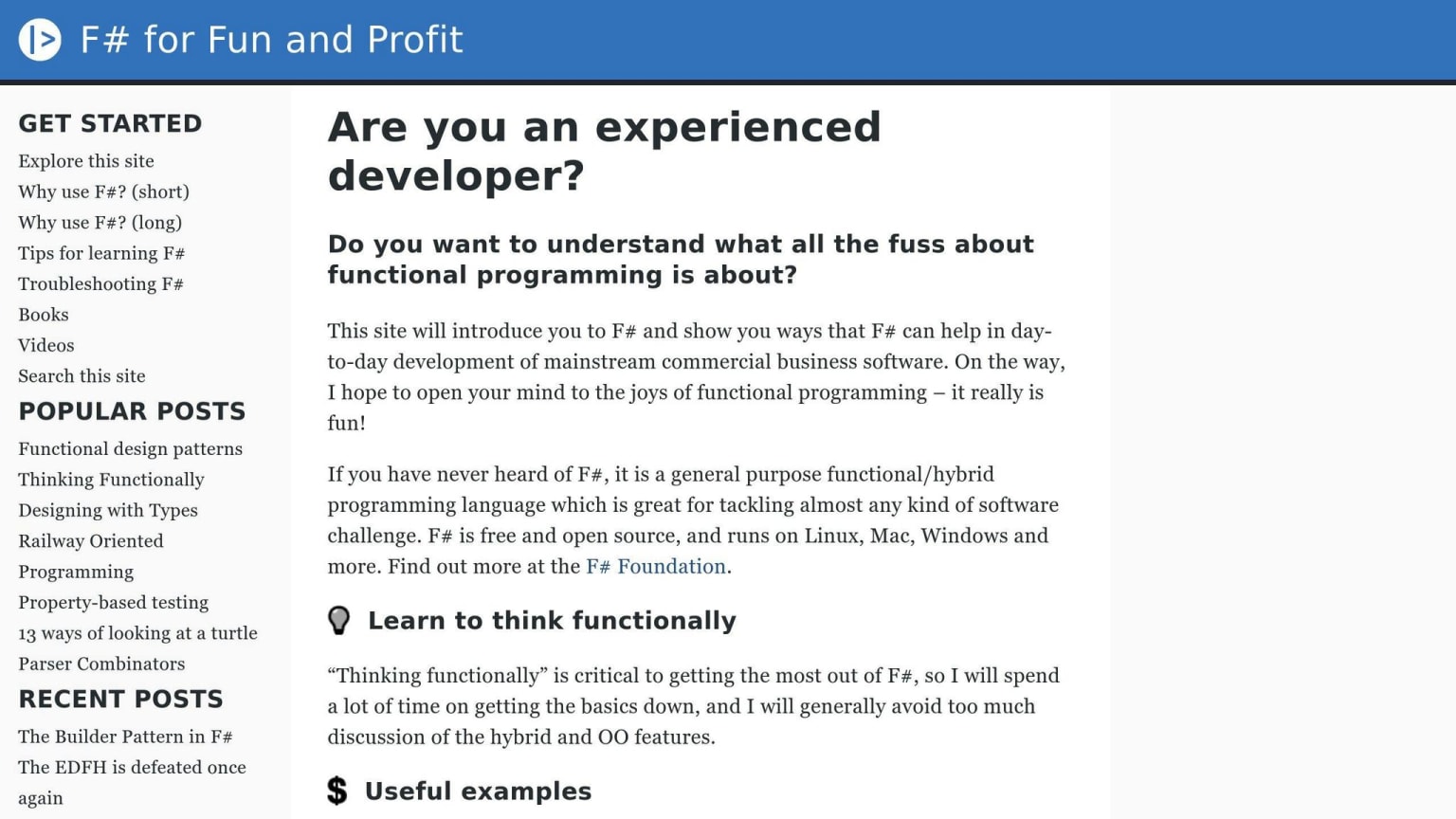
This comprehensive platform provides:
- Tutorials for beginners and advanced users
- In-depth explanations of F# concepts
- Practical examples and code snippets
Online Learning Platforms
| Platform | Features | Best For |
|---|---|---|
| Exercism | 134 coding exercises, mentoring | Hands-on practice |
| fsharp.org | Official documentation, tutorials | Comprehensive learning |
| Beginning F# (Video Series) | 10-minute introductory videos | Quick start |
| F# from the Ground Up | Basic computer literacy required | Complete beginners |
Interactive Learning with F# Interactive
F# Interactive (dotnet fsi) allows developers to:
- Run F# code interactively at the console
- Execute F# scripts with the
.fsxfile extension - Reference NuGet packages using the
#r "nuget:"syntax
Quick Reference Materials
The F# Cheat Sheet is available in HTML and PDF formats, offering a concise guide to F# syntax.
F# Job Resources
Several platforms cater to F# job seekers:
| Platform | Features | Notes |
|---|---|---|
| Indeed.com | 29 F# jobs available | Includes various software engineering roles |
| Dice.com | 9 F# jobs listed | Requires free profile creation |
| Arc | Network of 350,000+ developers | Specializes in freelance F# engineers |
When job hunting:
- Look for titles like "Software Engineer" with F# in the requirements
- Consider remote options, which are common for F# roles
The U.S. Bureau of Labor Statistics reports a median annual wage of $120,730 for software developers (May 2021), translating to roughly $70-100 per hour.
Comparing F# Community Sites
Here's a comparison of top F# community sites:
| Platform | Users | Main Topics | Key Features |
|---|---|---|---|
| F# Software Foundation | 5,000+ | All F# topics | Official resources, mentorship program |
| Stack Overflow F# Tag | 20,000+ | Technical Q&A | Reputation system, code snippets |
| Reddit r/fsharp | 15,000+ | News, discussions | User-driven content, AMAs |
| GitHub F# Projects | 10,000+ | Open-source development | Code collaboration, issue tracking |
| Ionide (VS Code) | 100,000+ | F# development in VS Code | Syntax highlighting, IntelliSense |
Choose platforms based on your goals:
- For learning and mentorship: F# Software Foundation
- For quick problem-solving: Stack Overflow
- For F# news and discussions: Reddit's r/fsharp
Picking the Right F# Community
Consider these factors when choosing an F# community:
- Alignment with your goals
- Activity level
- Quality of discussions
- Available resources
- Networking opportunities
| Community Feature | Example Platform | Benefit |
|---|---|---|
| Mentorship | F# Software Foundation | Personalized guidance for beginners |
| Quick Q&A | Stack Overflow F# Tag | Rapid solutions to coding problems |
| Diverse Discussions | Reddit r/fsharp | Exposure to various F# topics |
| Open-Source Collaboration | GitHub F# Projects | Hands-on experience with real projects |
| Regular Updates | F# Weekly Newsletter | Stay informed about F# developments |
Remember, you're not limited to a single community. Many F# developers engage with multiple platforms for a well-rounded experience.
F# Community Rules
Follow these guidelines when participating in F# communities:
How to Ask Questions
- Be specific and provide relevant code snippets
- Explain what you've already tried
- Use appropriate tags (e.g., "f#", "dotnet")
- Follow the community's format
- Be patient with responses
| Do | Don't |
|---|---|
| Be civil and respectful | Make personal attacks |
| Focus on the topic at hand | Discuss unrelated subjects |
| Use community tools (likes, flags) | Post AI-generated content |
| Flag inappropriate behavior | Engage with bad behavior directly |
The F# Software Foundation Code of Conduct governs many F# communities, emphasizing respect, constructive criticism, and avoiding discrimination.
Using F# Communities for Your Career
Leverage F# communities for career growth:
- Engage actively in F# Slack, Twitter, and forums
- Contribute to open-source F# projects
- Share knowledge through blog posts or videos
- Attend F# meetups and conferences
- Offer support to other community members
| Activity | Career Benefit |
|---|---|
| Open-source contributions | Showcases skills, builds portfolio |
| Knowledge sharing | Establishes expertise, increases visibility |
| Event participation | Builds network, learns industry trends |
| Community support | Creates goodwill, potential job referrals |
Remember, networking in F# communities is about give and take. Active participation can lead to job opportunities and professional growth.
What's Next for F# Communities
The F# community is evolving with new platforms and focuses:
- Discord is gaining popularity for real-time collaboration
- GitHub is changing its feedback mechanism for content
- There's a shift towards promoting F# for domain programming while embracing interoperability
| Language/Framework | Use Case |
|---|---|
| F# | Domain programming |
| React/TypeScript | UI development |
| C#/Rust/Python | Server-side services |
| Elmish | React component state management |
The community is working on improving documentation to better communicate real-world usage of F#, making the language more accessible and versatile for developers across different domains.
Conclusion
F# community sites and forums offer valuable resources for developers at all levels. By engaging with these platforms, you can learn from experts, stay updated on F# developments, contribute to projects, and find job opportunities.
The F# Software Foundation (FSSF) is a key hub, offering:
- A Slack community with over 1,200 members
- Mentorship programs
- Opportunities to contribute to community projects
To make the most of F# communities:
- Join the FSSF for networking and mentorship
- Use Stack Overflow and Reddit's r/fsharp for problem-solving
- Follow #fsharp on Twitter for real-time updates
- Contribute to open-source projects on GitHub
Active participation in these communities can significantly enhance your F# skills and career prospects.