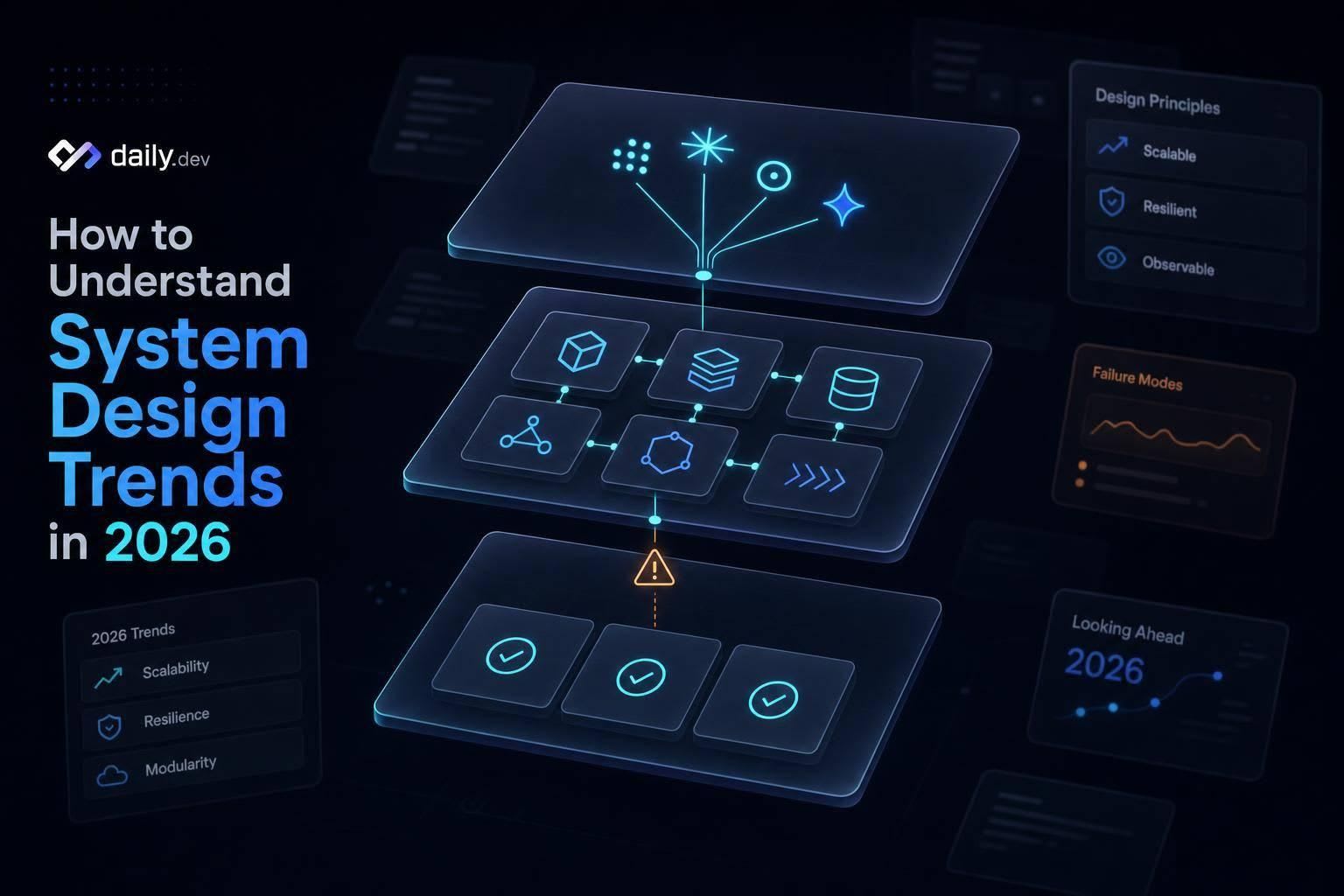
A principle-first framework to evaluate 2026 system design trends—map ideas to core patterns, failure modes, and operational readiness.
Most system design trends in 2026 are just old trade-offs with new names. When I want to judge a new idea, I ask 5 plain questions: What problem does it solve? Which system quality does it improve? What new failure modes does it add? What extra work does it create for the team? Can we run it safely right now?
If I can’t answer those questions, I treat the trend as noise.
Here’s the short version:
- Start with first principles: scalability, reliability, availability, performance, security, and maintainability
- Map new ideas to old patterns: fault isolation, async work, replication, stateless compute, idempotency
- Break each trend into parts: traffic, compute, storage, and async processing
- Judge by failure modes: latency spikes, retry storms, backlogs, model drift, cross-region lag
- Use proof, not hype: case studies, postmortems, migration stories, and production writeups
- Track 2026 focus areas: modular monoliths, event-driven systems, platform engineering, distributed SQL, sidecarless meshes, and AI systems such as RAG and vector search
A simple rule helps: if a pattern does not fix a clear bottleneck, skip it. That matters more in 2026 because teams now deal with multi-region systems, edge runtimes, AI pipelines, and tighter cost limits at the same time.
One fact stands out: the article points to 3 main pressures behind today’s trend cycle - more complex deployments, tighter cost control, and AI moving into production. So instead of chasing every new label, I tie each one back to the same system questions engineers have dealt with for years: latency, consistency, scale, reliability, and cost.
Quick comparison
| What I check | What I’m looking for |
|---|---|
| Problem | What breaks without this? |
| System quality | Does it improve scale, uptime, speed, safety, or maintainability? |
| Base pattern | Is this fault isolation, async work, replication, stateless compute, or idempotency? |
| Team fit | Do we have the skills, tooling, and on-call capacity today? |
| Proof | Are there postmortems or production writeups behind it? |
The main point is simple: learn trends by linking them to durable design ideas, not by memorizing new tools. That gives me a calmer way to follow system design in 2026 without getting pulled into every fad.
Start with the principles that outlast trends
Core quality attributes and trade-offs
Every system - monolith, serverless backend, or AI pipeline - comes down to six qualities: scalability, reliability, availability, performance, security, and maintainability. If a trend matters, it should make at least one of these trade-offs better.
That’s where the hard part starts. The tension between these qualities is where architecture decisions get real.
Latency vs. throughput is the classic case. Latency is how fast one request finishes. Throughput is how many requests the system can handle per second. Push one up, and you often put pressure on the other.
The same goes for CAP. During a network partition, the CAP theorem forces a choice between consistency and availability. Financial systems usually choose consistency. Social feeds often accept eventual consistency so they can stay up and keep serving users. And when teams need fault tolerance and room to grow, horizontal scaling is still the default move.
Use these qualities as your filter. They help you see whether a trend fixes a real limit or just puts a new label on old ideas.
Building blocks that keep showing up
Under every architecture trend, the same parts keep showing up: load balancers, stateless services, databases, caches, and message queues or event streams. Tools come and go. The jobs those tools do barely change.
That’s a handy gut check. When a new trend shows up, ask what building blocks are doing the work.
Cell-based architecture still relies on compute, cache, and partitioned data. It just groups them in a way that limits blast radius. An AI-native stack adds vector search and RAG, but it still leans on cache and queues to keep things moving.
"Compute should be replaceable. Data should be durable." - Iamakashrout, Software Engineer
Durable principles vs. trendy implementations
A fast way to judge any trend is to map the old principle to the current implementation. The principle stays. The tooling changes.
| Timeless Principle | Common Implementation | What Stays the Same |
|---|---|---|
| Fault Isolation | Cell-based architecture / Multi-cell regions | Limiting the blast radius of a single failure |
| Async Communication | Event-driven streams (Kafka/CDC) | Decoupling producers from consumers to improve resilience |
| Replication | Distributed SQL / Multi-region active-active | Keeping multiple copies of data for availability and durability |
| Statelessness | Serverless functions / Containerized pods | Separating compute from durable state so instances can be replaced safely |
| Idempotency | Idempotency keys in API gateways | Preventing duplicate requests from causing duplicate side effects |
If you can’t trace a trend back to one of these principles, there’s a good chance it isn’t fixing a long-term problem. Once you can connect the trend to a principle, it becomes much easier to judge whether it’s worth adopting.
A simple framework to evaluate new system design ideas
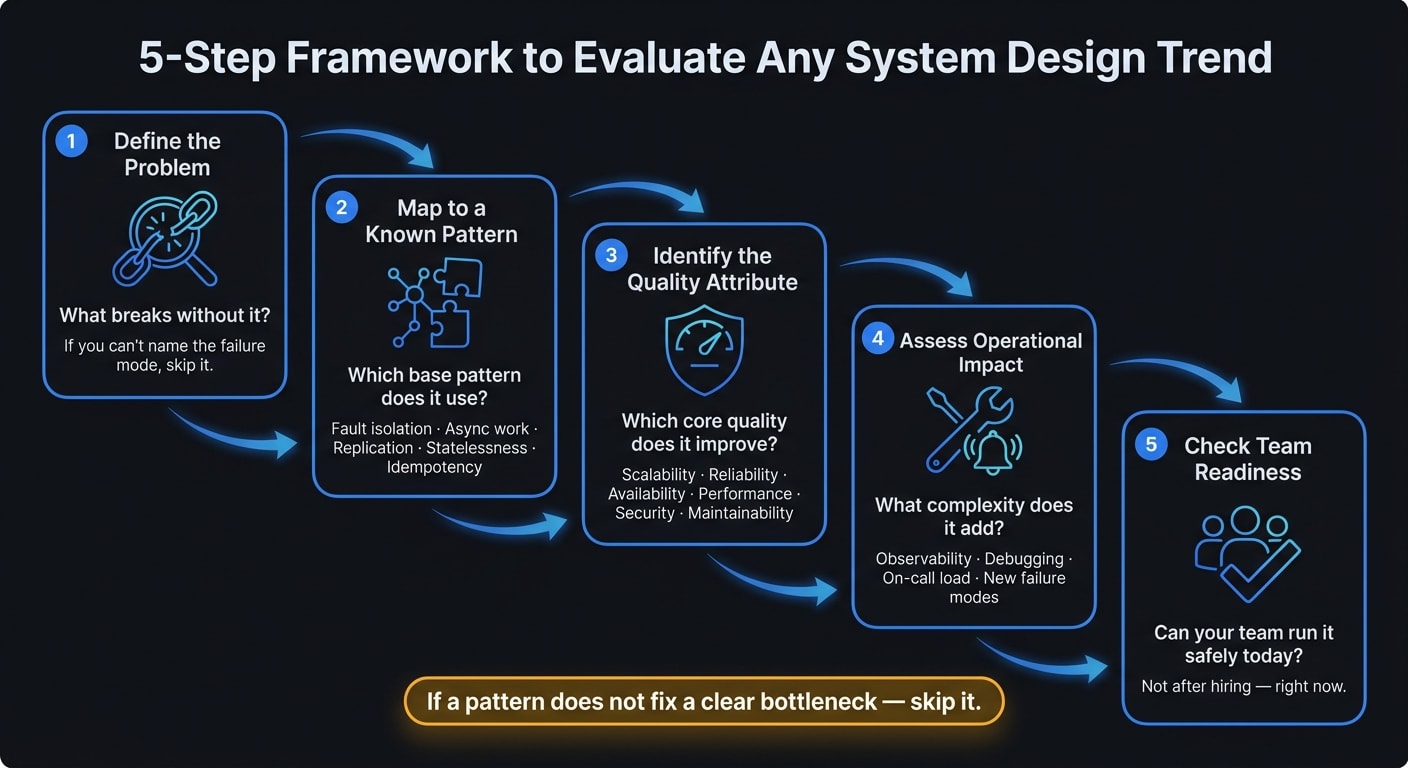
Principles tell you what matters. This framework shows you how to test each new idea. Once the principles are clear, run every new idea through this three-step filter before you spend time on it.
Separate the problem from the solution
Start with one blunt question: "What breaks without it?"
If you can't point to the failure mode it prevents, don't adopt it. Mentally remove the pattern and check whether the system still works. If it does, the extra complexity may not earn its keep.
It also helps to watch for tool-first language. A pitch like "build a scalable event platform" sounds nice, but it's fuzzy. A plain outcome statement like "provide auditable delivery status" gives you something you can test against actual requirements.
That gets you to the requirement itself, not the buzzword.
Map the trend back to known patterns
Once the problem is clear, strip the idea down to its base parts. Break any trend into traffic, compute, storage, and async work.
Take AI-native service meshes or edge-native logic. The implementation may shift, but the same core questions stay put: how traffic gets routed, where compute runs, where data lives, and which work stays async. Event-driven systems work the same way. At bottom, they're still about decoupling producers from consumers, handling async processing, and dealing with back-pressure when consumers fall behind.
"Systems die from coupling, not from Java vs Go." - Yevhen Stuzhuk
If a trend doesn't map cleanly to those blocks, slow down.
Once you can see the pattern clearly, the next step is simple: can your team run it safely?
Check maturity, operations, and team impact
Even if the pattern fits the problem, it still has to fit your team. Test whether your team can operate it without adding risk. Maturity decides whether a pattern belongs in production today. Look at production case studies, postmortems, and migration stories - not launch announcements.
Here's a quick screen for adoption risk:
| Trend Category | Maturity | Operational Risk | Skill Requirements |
|---|---|---|---|
| Cell-based Architecture | High (standard for mid-size+) | Low (reduces blast radius) | High (advanced routing/sharding) |
| Distributed SQL | Moderate | Moderate (cross-region latency) | Moderate (SQL + distributed tuning) |
| Wasm Microservices | Emerging | High (new debugging/tooling) | High (Rust/Go + Wasm runtimes) |
| Edge Inference | Experimental | High (state management traps) | Very High (MLOps + edge networking) |
| Sidecarless Service Mesh | Moderate | Low (reduces resource overhead) | Moderate (platform engineering focus) |
Before you reject a trend, set revisit triggers. Write down the exact condition that would make the idea worth another look, such as "throughput exceeds 70% of validated peak for 30 days". That keeps the decision tied to evidence instead of drifting back toward hype .
The 2026 trends worth tracking and how to learn them
Cloud-native, event-driven, and AI-native patterns
Use the same filter from earlier and focus on patterns that fix actual production limits, not ones that just sound new.
The big shifts in 2026 come from three pressures: more complex deployments, tighter cost control, and AI moving into production.
Modular monoliths are a response to the drag that comes with distributed systems. They keep strict internal boundaries without the coordination work and latency cost that often come with microservices. At the same time, mature teams are standardizing platform engineering with golden paths and policy as code. A simple rule works well here: don't split a service until scale or deployment bottlenecks force it.
Event-driven architecture isn't just for analytics anymore. Streaming now powers search indexes, materialized views, and cross-region state replication .
AI-native patterns - RAG pipelines, vector search, agentic workflows, and AI-aware routing layers - are shifting from experiments into normal system architecture. The big mindset change is this: treat AI-native systems as probabilistic systems. They fail in different ways, and those failure modes need to be part of the design from day one.
Apply the same test from the previous section: if you can't name the failure mode a pattern prevents, you're not ready to adopt it.
Best resources for system design in 2026
Once you know which patterns matter, learn them from production writeups and sharp summaries that get to the point.
- Designing Data-Intensive Applications by Martin Kleppmann is a strong foundation for trade-offs between consistency, availability, and latency .
- Engineering blogs from Netflix, Cloudflare, GitHub, and Stripe show what architecture choices look like under production load. Public postmortems from Cloudflare and AWS help you spot failure modes like thundering herds and retry storms .
- ByteByteGo gives you structured, visual breakdowns of scalability, reliability, and capacity planning.
The best learning material usually comes from teams that got burned, figured out why, and wrote it down.
Use daily.dev as your system design radar
daily.dev helps bring those writeups into one place. It pulls engineering posts into a single personalized feed that shifts with your stack and interests, so you can catch the posts worth your time without turning learning into a second job.
| Resource Type | Depth | Recency | Practicality | Effort Required |
|---|---|---|---|---|
| Classic Material (e.g., DDIA) | Very High | Low | High | High |
| Engineering Blogs (Netflix, Cloudflare) | High | High | Very High | Medium |
| ByteByteGo | Medium | High | High | Low |
| daily.dev | Low (Radar) | Very High | High | Very Low |
Conclusion: A checklist for following system design trends
A principle-first adoption checklist
Use the framework above as your last filter before adoption. Put every new pattern through five questions first.
- What specific problem does this solve? If you can't point to a documented bottleneck, stop there.
- Which core quality attribute does it improve? Scalability, availability, reliability, or consistency - pick one.
- What operational complexity does it add? Think observability, debugging, and on-call load.
- What failure modes does it add? Event backlogs and model drift are easy to miss until they get expensive.
- Can your team run it safely today? Not after hiring two new specialists - today.
"The best architecture reviews are the ones where someone walks in and says 'here is what I considered, here is what I ruled out, and here is why this approach wins.'" - Malay Mehta, Software Architect
If a trend fails the first question, it doesn't matter how many hyperscaler engineering blogs support it. Architecture mistakes stack up fast in production.
Build a steady learning loop
Once a trend clears the filter, keep an eye on it with a simple weekly reading habit. Read a small number of high-signal sources on a steady basis. A 30-minute weekly routine spent on post-mortems and engineering blogs from strong production teams helps you spot patterns over time. For each post, tie it back to the constraint it solved and the trade-off the team made.
Use daily.dev as your system design radar - five minutes each morning to catch strong posts as they appear. After a while, you'll start to see which patterns keep showing up and which failure modes hit teams again and again. That's the signal worth following.
| Learning Activity | Frequency | Goal |
|---|---|---|
| Post-mortems & engineering blogs | 30 mins/week | Build failure mode pattern recognition |
| daily.dev feed | Daily (5 mins) | Maintain high-signal flow of new patterns |
| Use AI to stress-test designs | Per project | Stress-test architectural assumptions |
FAQs
How do I tell hype from a real system design trend?
Look past the buzz and stick to the basics: performance under load, operational complexity, cost, and portability. Most trends are just new packaging for the same core jobs, like data storage, communication, and fault tolerance.
Judge a pattern by its trade-offs, not by how popular it is. If it brings distributed-system complexity before your team actually needs it, it’s probably hype. Put observability and simplicity first, and scale only when the data says it’s time.
When should a team choose a modular monolith over microservices?
Choose a modular monolith when you want some of the same upsides people chase with microservices - like clear domain boundaries and safer refactoring - without taking on the extra work that comes with distributed systems.
For teams of 3 to 15 developers, it’s often the better fit. The same goes for companies that don’t have a dedicated platform team, especially if the current deployment pipeline is already fast and free of conflicts. You still get one deployable unit, which keeps day-to-day work simpler, while leaving the door open to split out services later if that makes sense.
What new failure modes should I watch for in AI-native systems?
Watch for failures that come from AI's probabilistic behavior. Unlike deterministic systems, AI can give different answers to the same input, and response time can shift based on model inference time.
You also need to plan for LLM rate limits and treat models like complex dependencies, not black boxes. Without evaluation, cost monitoring, and fallback mechanisms, behavior can turn unpredictable fast, and operating costs can spiral.