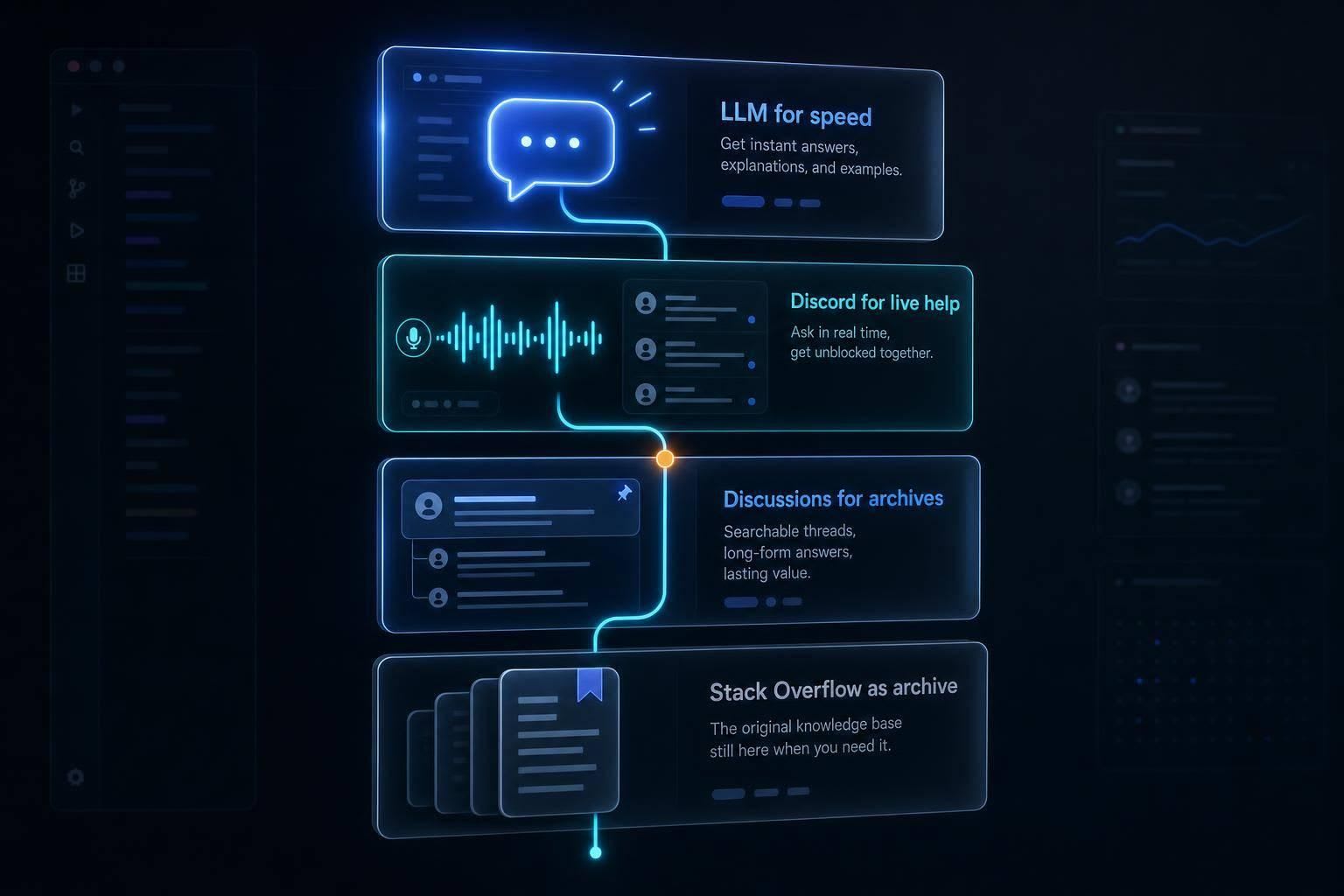
How developers split Q&A in 2026: LLMs for speed, Discord for live help, GitHub Discussions for archives, Stack Overflow as archive.
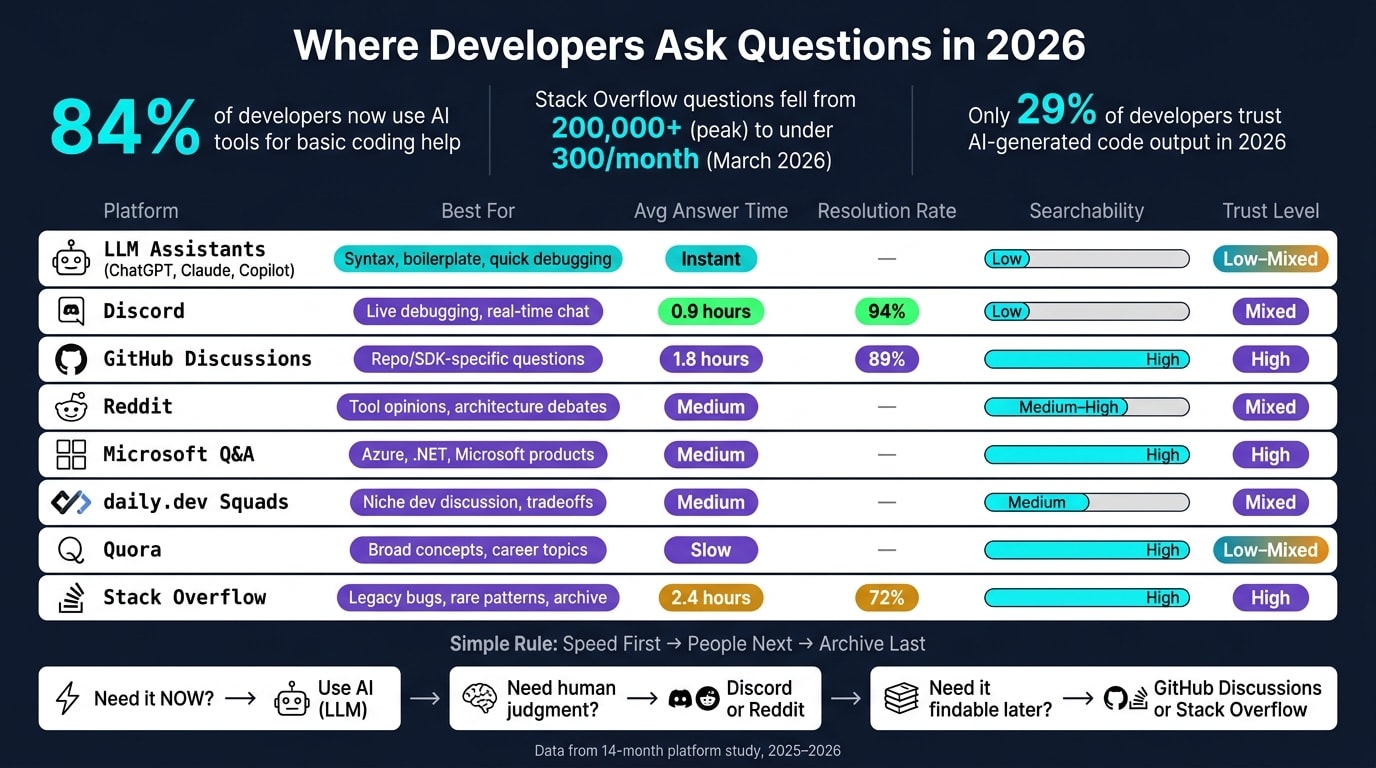
Most developers no longer use one site for every coding question. In 2026, I’d split it like this: use LLMs for instant help, Discord for live back-and-forth, GitHub Discussions for repo-specific problems, Reddit for opinions, Microsoft Q&A for Microsoft products, daily.dev Squads for niche discussion, Quora for broad explanations, and Stack Overflow for older edge-case answers.
Here’s the short version:
- AI tools for developers now handle basic coding help for 84% of developers
- Stack Overflow question volume fell from over 200,000 at its peak to under 300 by March 2026
- In one 14-month study, average answer times were:
- Discord: 0.9 hours
- GitHub Discussions: 1.8 hours
- Stack Overflow: 2.4 hours
- In that same study, resolution rates were:
- Discord: 94%
- GitHub Discussions: 89%
- Stack Overflow: 72%
If I need a fast answer, I start with an LLM. If I need a human take, I go to Reddit or Discord. If I need something I can find again later, I look at GitHub Discussions, Microsoft Q&A, or Stack Overflow. That’s the whole shift in one line: speed first, people next, archive last.
Quick Comparison
| Platform | Best for | Answer time | How much I’d trust it | Easy to find later |
|---|---|---|---|---|
| LLM assistants | Syntax, boilerplate, simple debugging | Instant | Low to mixed | Low |
| Discord | Live debugging, fast chat | 0.9 hours | Mixed | Low |
| GitHub Discussions | Repo and SDK questions | 1.8 hours | High | High |
| Tool choices, job-tested opinions | Medium | Mixed | Medium to high | |
| Microsoft Q&A | Azure, .NET, Microsoft support | Medium | High | High |
| daily.dev Squads | general programming communities and niche dev discussion | Medium | Mixed | Medium |
| Quora | Broad concepts, career topics | Slow | Low to mixed | High |
| Stack Overflow | Old patterns, rare bugs, archive search | 2.4 hours | High | High |
A simple rule works well: ask AI for code, ask people for judgment, and use archives for proof.
1. LLM assistants (ChatGPT, GitHub Copilot Chat, Claude, Gemini)
LLM assistants work best for boilerplate, syntax help, code explanations, and quick debugging. This is the kind of stuff developers ask all day: "How do I parse JSON in Python?" or "Write me a React component that does X." They’re fast, and that matters.
But there’s a catch. These tools tend to struggle with edge cases, version-specific bugs, and calls that depend on judgment. Ask an LLM whether a framework is worth using, and you’ll often get a fuzzy answer . So yes, the speed helps. It just doesn’t replace public discussion on programming forums when context and nuance matter.
Answer speed
The big draw is simple: answers show up instantly, right inside the IDE. GitHub Copilot Chat and Cursor have pushed Q&A straight into the code editor. That’s a huge shift when you compare it with the 0.9-hour average on Discord or the 1.8-hour average on GitHub Discussions .
Reliability and verification
That speed comes with risk. Only 29% of developers trust AI-generated output to be accurate in 2026, down from 40% the year before, and just 3% report high trust in AI coding assistants . That’s a sharp drop, and it says a lot.
The top complaint, named by 66% of developers, is answers that are "close, but wrong in a critical detail" . If you’ve ever pasted in code that looked fine, compiled fine, and still caused problems two files later, you know the feeling. That’s why many developers still check the docs, read the source code, or consult top dev resources before shipping. AI-generated code can look correct on the surface while breaking behavior somewhere else in the codebase .
Searchable record
LLM chats are private and non-searchable, which means they don’t leave behind a public record other developers can find later. That’s fine for quick help. It’s less helpful when the problem needs human judgment, debate, or a trail others can reuse.
When developers need an answer that can be searched, challenged, and revisited, they usually move to public threads.
2. Reddit programming communities
When an LLM gives you a vague answer, Reddit is often the next stop. It shines when you need a judgment call, a tool comparison, or input from people who’ve used something on the job. So if an LLM gives you a confident answer but skips the context, Reddit is usually where the missing detail shows up.
Best question type
Reddit is especially useful for framework tradeoffs, hands-on tool reviews, architecture debates, and figuring out whether a tool holds up in production. Subreddits tied to one topic, like r/learnprogramming or r/webdev, tend to handle these questions well .
Reliability, verification, and persistence
Reddit doesn’t have an accepted answer system, so quality comes from upvotes, comments, and pushback. That’s part of the appeal. You’re not getting one official response; you’re seeing a spread of views from people with different levels of experience.
Developers also more often use specialized search engines for developers or add site:reddit.com to searches when they want human opinions instead of AI-generated summaries . Still, treat Reddit code snippets with care. There’s no editorial review, so check anything technical against the official docs before you use it in production.
Searchability is a mixed bag. Threads can sink over time, but the same questions come up again and again, which means newer threads can add context that older ones missed .
If you need faster back-and-forth than a Reddit thread can give you, Discord is usually the next stop for developers.
3. Discord programming servers
Best question type
Discord is at its best when you need live troubleshooting, a quick gut check, or an answer that depends on human judgment. As routine questions shift to LLMs, Discord is picking up more of the messy cases where back-and-forth matters. That makes it a strong fit for interactive debugging, but a poor fit for answers you want to store, search, and reuse later.
Answer speed
Discord was fast in the data: it averaged 0.9 hours to get an answer, with a median of 0.3 hours. For the same kinds of questions, Stack Overflow averaged 2.4 hours .
One Node.js SDK case study showed the same pattern. A team moved support to Discord plus GitHub Discussions and cut p99 resolution latency from 14.2 hours to 3.1 hours, while reaching a 94% query resolution rate within 24 hours .
Reliability and verification
Discord gives you real-time feedback from maintainers and peers, which is great when you're stuck and need someone to look at the problem with fresh eyes. But there's a catch: there are no accepted answers or voting signals. So even when a reply sounds right, you still need to test and verify it yourself.
Knowledge persistence
This is where Discord starts to crack. Conversations are hard to search later, so good answers can vanish into the scroll . If a team doesn't have a habit of cross-posting or writing things down elsewhere, the same questions keep coming back.
When an answer from Discord needs a durable, searchable home, GitHub Discussions is usually the next step.
4. GitHub Discussions
Best question type
If Discord fixes the problem right now, GitHub Discussions is where that answer should end up after. It works best for how-to questions, setup problems, and weird edge cases that are too tied to one project for AI tools to handle well. It’s also a better fit when you want input from the people who maintain the repo, not just a general reply from a big public forum.
Answer speed
Because Discussions lives inside the repo, replies tend to come more slowly than chat. But there’s a trade-off: those answers are much easier to find later. The average response time is 1.8 hours, with a median of 0.8 hours .
Reliability and verification
GitHub Discussions tends to feel more dependable than broad forums for a simple reason: you can often see when a maintainer replied, which answers got upvotes, and whether a solution was accepted or marked as verified. That helps cut through the noise. It also shows up in the numbers, with an 89% query resolution rate versus 72% for Stack Overflow .
Knowledge persistence
Unlike Discord, GitHub Discussions stays indexed and searchable right next to the repository. That makes it a strong home for those hard-to-track edge cases that AI tools often miss. By 2026, an estimated 60% of the top 1,000 GitHub repositories will deprecate Stack Overflow links in favor of native Discussions .
That change points to a larger shift away from developer forums and toward repo-native support, where a one-off answer can stick around as searchable project knowledge.
When the question moves beyond repository-specific support and into Microsoft or Azure products, Microsoft Q&A is the next stop.
5. Microsoft Q&A
For Microsoft-specific questions, the official channel usually matters more than a general community thread.
Best question type
Microsoft Q&A is a good fit for Microsoft-specific API, versioning, and support questions that need an official answer.
Answer speed
Think of Microsoft Q&A as a validation-first channel, not a fast-turnaround one. That makes it better for confirming an answer than for getting immediate back-and-forth.
Reliability and verification
Its main strength is credibility. If you're about to change production code or make a versioning call, this is the place to confirm behavior first.
Knowledge persistence
Answers stay searchable, which makes fixes easy to find again later.
6. daily.dev Squads
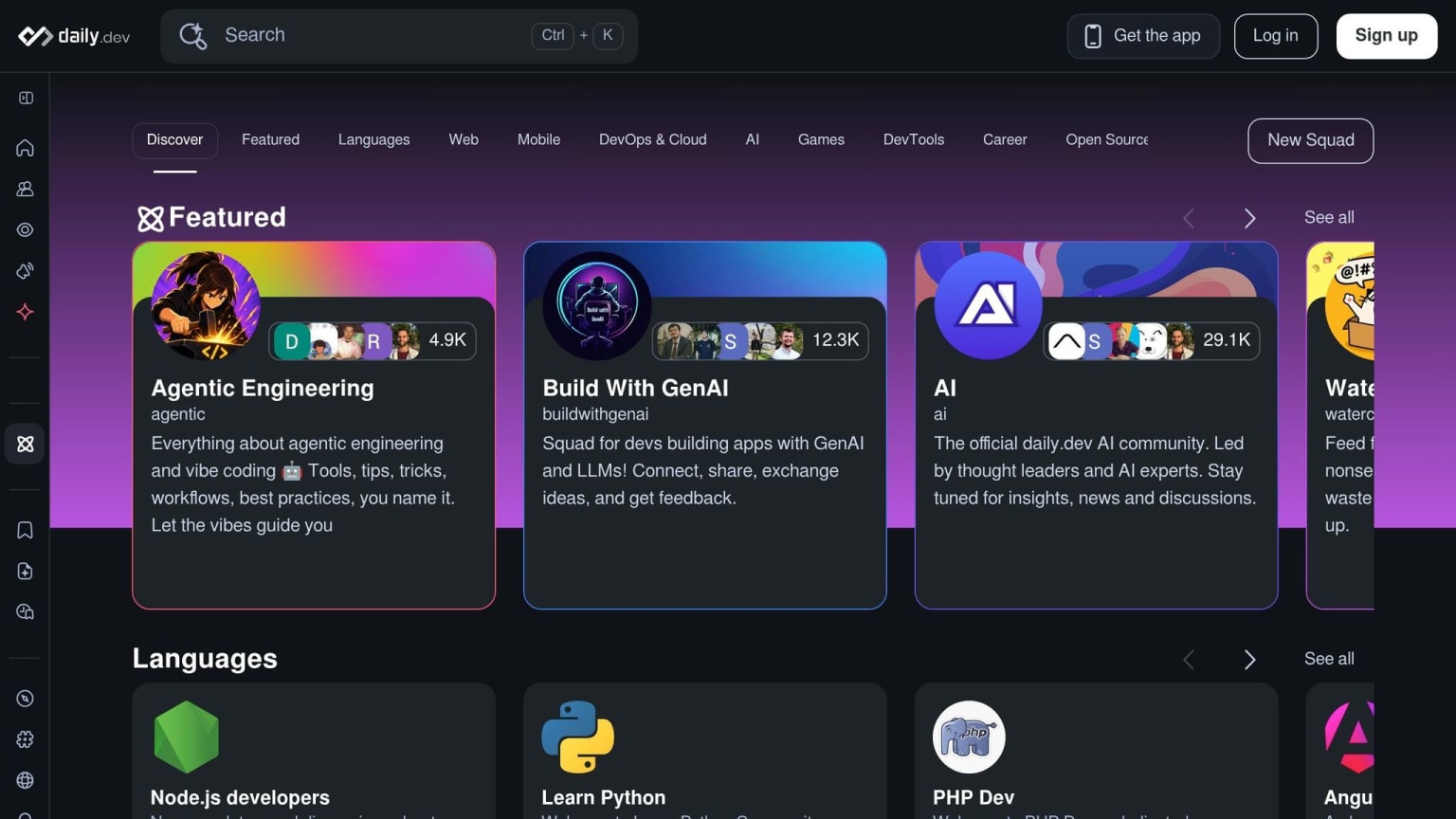
When your question needs discussion more than an official answer, Squads give you a faster, lighter place to ask.
Best question type
Squads are a good fit for questions that need judgment, not just a plain factual answer. Think architectural tradeoffs, framework comparisons, or calls that depend on hands-on experience. That makes them useful when you already know the basics and want a practical read from other developers.
Answer speed
Posts go straight to people who already follow the topic, which can help you get replies faster than posting cold in a general forum.
Reliability and verification
Reliability here comes from the discussion around the question, not from an accepted-answer system. So Squads tend to work best when the quality of the back-and-forth matters more than getting one verified response. That's often the case with tradeoffs, where experience and context shape the answer.
Knowledge persistence
Squads are a discussion space, not a reference archive. Treat good threads as temporary input, not long-term documentation.
For broader, non-project-specific questions, the next stop is a more general community source.
7. Quora
For broader questions that aren't tied to one project, Quora still has a role. But in 2026, it's usually not the first place developers go for code help.
The main reason is simple: most developers ask LLMs first for basic coding questions. So Quora gets fewer of those quick, direct code prompts than it used to.
Where Quora still does okay is with:
- broad explanations
- career questions
- older searchable threads
That said, it's not the best place for active debugging. If you're trying to fix a bug right now, Quora often feels a step behind. And for answers developers may want to come back to later, indexed Q&A sites still tend to hold up better over time.
So Quora works more like a fallback for explanation than a main tool for debugging.
8. Stack Overflow
Stack Overflow is the legacy archive in this mix. It works best for old, hard problems that need a public, checked answer. At this point, Stack Overflow is more of a searchable archive than an active help desk.
Best question type
Use Stack Overflow for rare bugs, legacy code, and long-tail patterns that need a verified public record.
Reliability and verification
Stack Overflow still has an edge here. Its main strength is community correction: wrong answers get challenged, edited, and voted down over time. The accepted answer system and community voting still add a layer of accountability that no LLM currently matches.
Knowledge persistence
Its archive is still searchable in Google, so old answers can keep helping with new problems. That makes Stack Overflow a reference layer, not a first-stop support channel.
How the options compare in practice
In 2026, most developers split their questions across three places: AI for speed, human Q&A for judgment, and searchable archives for reuse. Fit matters more than rank. The main difference isn't which platform is "best." It's which kind of question each one handles well.
AI assistants vs. human Q&A sites
AI gives you an answer in seconds, and you don't have to worry about how your question will land. Human Q&A sites still offer something AI can't fully match: production experience, blunt opinions, and correction from other people who have seen the same mess before. AI is the fastest option. Human Q&A sites are better when you need tradeoffs, debate, or peer correction.
That's why speed, trust, and searchability matter more than the brand name.
| Criterion | AI Assistants (ChatGPT, Claude, Copilot) | Human Q&A Sites (Reddit, Discord, GitHub Discussions) |
|---|---|---|
| Response speed | Instant (seconds) | Minutes to hours |
| Accuracy | Risk of hallucinations; answers that sound right but are wrong in a detail | Corrected by other developers, but not formally verified |
| Context | High - can read your local codebase | Low - requires manual explanation |
| Tone | Neutral, non-judgmental | Varies; can be hostile or very supportive |
| Best for | Syntax, boilerplate, common errors | Tradeoffs, opinions, production war stories |
Fast answers vs. searchable records
If you need an answer right now, use a real-time source. If you want that answer to stick around for the next developer who runs into the same wall, use a searchable place. That's a big reason urgent questions drift into chat, while longer-lasting answers end up in GitHub Discussions.
Where to send each type of question
A simple way to think about it: use AI for narrow, well-scoped issues; use people when the answer depends on experience or context that isn't written down cleanly.
| Question type | Primary destination | Secondary destination |
|---|---|---|
| Syntax and boilerplate | AI assistant (Copilot, ChatGPT) | - |
| Debugging a specific error | AI assistant (Claude, ChatGPT) | Stack Overflow archive |
| Framework behavior | Framework Discord (e.g., Reactiflux) | Reddit (r/programming) |
| Project / SDK support | GitHub Discussions (project-specific) | Official tool Discord |
| Architectural tradeoffs | Reddit (r/programming) | - |
| Cloud / CI/CD issues | GitHub Discussions | Microsoft Q&A |
Those tradeoffs become easier to see once you look at the pros and cons side by side in the next section.
Pros and cons of each option
Routine questions often start in LLMs now, so the real decision is simpler than it looks: where is human help still worth the extra time? That usually comes down to three things - speed, trust, and whether the answer will still be easy to find later.
Here’s how the main options stack up:
| Platform | Strongest Use Case | Main Advantage | Main Limitation | Best Follow-up When It Fails |
|---|---|---|---|---|
| LLM Assistants (ChatGPT, Claude, Copilot) | Quick debugging and syntax fixes | Instant, personalized help | Hallucinations - confident but wrong | Check docs; re-prompt with more context |
| Architectural tradeoffs and war stories | Real human opinions and debate AI can't replicate | Poor long-term visibility; voting can bury nuanced takes | Search older threads; ask specifically for "what went wrong" stories | |
| Discord | Real-time framework help | Fastest response time, averaging 0.9 hours | Very low archival value | Move it to GitHub Discussions |
| GitHub Discussions | Framework-specific and project-specific support | Native integration with code and issues; 89% resolution rate | Siloed by repo, so hard to discover unless you already follow it | Open a GitHub Issue with a minimal reproduction |
| Stack Overflow | Established patterns and edge cases | 17-year searchable archive | Strict moderation; many beginners find it intimidating | Check answer comments for corrections; use an LLM for a friendlier start |
A simple way to think about it: LLMs are fast, forums are human, and archives are what save you later. If you need an answer in seconds, LLM Assistants are hard to beat. If you're weighing tradeoffs or trying to learn from someone else's scars, Reddit tends to give you the kind of back-and-forth that a chatbot still can't match. If you're stuck in the middle of building something and need live help, Discord is often the fastest path, with average response time at 0.9 hours .
But speed isn't the whole story. Discord replies can disappear into the scroll, and Reddit threads often fade fast unless they hit the right audience. GitHub Discussions sits in a middle lane: tied closely to code, easier for maintainers to answer well, and posting an 89% resolution rate . The catch is discoverability. If you don't already know the repo, you may never find the thread .
Stack Overflow still plays a different game. It isn't always the friendliest place for a first question, but when you need an old edge case, a strange error, or a pattern that's been around forever, that 17-year searchable archive matters . Sometimes the best move is mixed: start with an LLM for a plain-English draft, then verify with docs, GitHub Discussions, or Stack Overflow comments if the answer feels shaky.
Conclusion
In 2026, no single platform wins every question.
LLMs are the go-to for speed. Discord and Reddit are better when you need human judgment. GitHub Discussions keeps project-specific answers close to the code. And Stack Overflow still has a job as a searchable archive.
That’s the big change: developers now use a stack of tools, not one place for everything. The deciding factors haven’t changed much. It still comes down to speed, trust, and whether the answer should remain easy to find later.
| Scenario | Best Destination |
|---|---|
| Basic syntax / how-to | LLM (ChatGPT, Claude) |
| Live debugging help | Discord |
| Architectural opinions | |
| Library-specific bugs | GitHub Discussions |
| Microsoft ecosystem | Microsoft Q&A |
| Rare or legacy errors | Stack Overflow |
Developer Q&A didn’t disappear in 2026. It just split into layers, and the right layer depends on the question.
FAQs
When should I trust an LLM answer?
Trust LLMs with routine work like syntax help, boilerplate, or plain-English explanations of standard error messages. They’re handy when you need fast, context-aware help for common questions.
That said, treat the output as a first draft, not the final answer. If you’re dealing with security-sensitive code, performance-heavy systems, messy legacy setups, or anything unusual, stop and verify it. Check sources that have been reviewed by people, like GitHub Discussions or Discord communities.
How do I choose between Discord and GitHub Discussions?
It comes down to speed vs. searchability.
Use Discord when you want fast, real-time help. It works well for back-and-forth questions, casual troubleshooting, and community support. The trade-off is simple: useful answers can get buried, and they're often harder to find later.
Use GitHub Discussions for project-specific questions that need code context, maintainer input, and a permanent record. Because discussions are tied to a repository, they’re easier to search later and make more sense when the question depends on the project itself.
Is Stack Overflow still worth using in 2026?
Yes. Stack Overflow still matters in 2026, but the job it does looks different now.
It’s not the default first stop for most coding questions anymore. A lot of developers now turn to AI tools for quick answers, boilerplate help, and basic syntax checks. That shift is pretty clear.
But Stack Overflow still shines when the problem gets messy.
It’s especially useful for:
- complex, nuanced issues
- obscure library internals
- production edge cases
- questions where you want community consensus
- cases where expert disagreement is part of the answer
That last point matters more than it may seem. AI can give you a fast answer. Stack Overflow can show you how experienced developers think through a problem, where they disagree, and what tradeoffs they’re weighing.
So while it’s no longer the go-to place for every small coding question, it still has a strong place when the issue isn’t simple and the answer shouldn’t be, either.