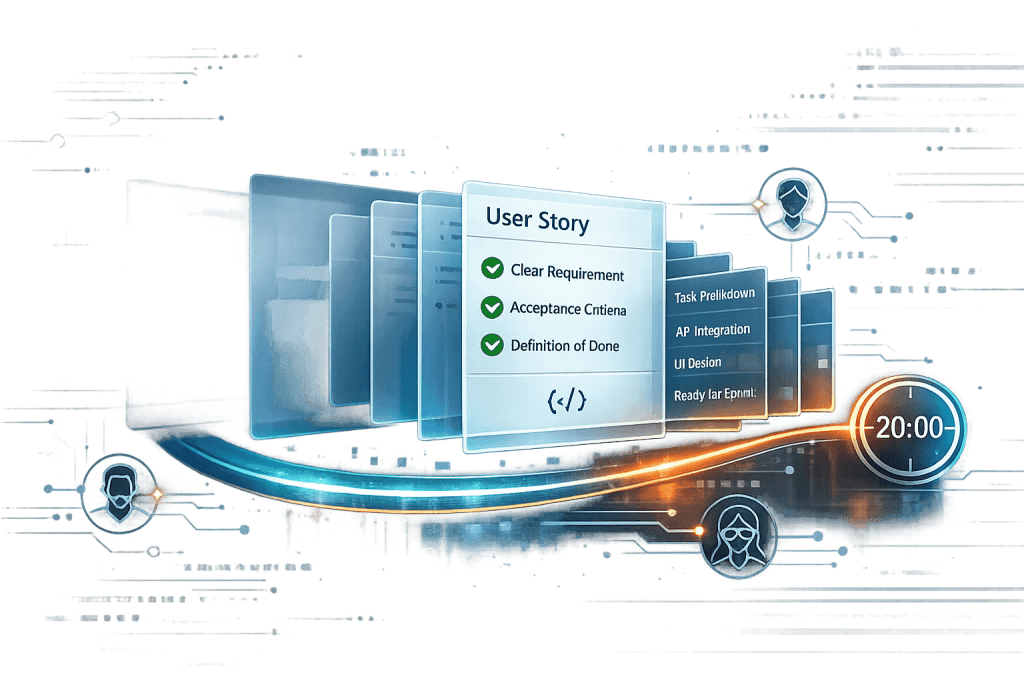
Explore the top 12 Agile KPIs for 2024 to measure and enhance value delivery in software development, ensuring team alignment with business objectives.
Agile Key Performance Indicators (KPIs) are measurable values that track how well an organization achieves its business goals using Agile project management. In today's fast-paced software development environment, Agile KPIs play a vital role in ensuring teams deliver business value.
Here are 12 essential Agile KPIs to measure value delivery in 2024:
- Business Value Delivered: Measures the amount of business value delivered per sprint, helping teams prioritize work and track the impact of their efforts on business objectives.
- Value Delivery Speed: Measures how quickly teams can deliver value to customers, enabling them to meet customer needs quickly, stay ahead of the competition, and drive business growth.
- Task Completion Time: Measures how long it takes to complete a task from start to finish, helping teams identify inefficiencies and streamline their development cycle.
- Concept to Deployment Time: Measures how efficiently an organization can take a concept from idea to deployment, showing how quickly teams can respond to changing customer needs and market demands.
- Code Quality (Defect Density): Measures the number of bugs or defects per unit of code, indicating better software reliability, reduced maintenance costs, and enhanced customer satisfaction.
- Test Coverage: Measures the percentage of source code tested by automated tests, helping reduce the risk of defects post-deployment and ensuring high-quality software.
- Release Frequency: Measures how often new code is successfully released, showing an Agile team's ability to deliver incremental value reliably and frequently.
- Incident Recovery Time: Measures how quickly a team can resolve and recover from incidents or outages, minimizing the impact on customers and business operations.
- Workflow Visualization: Provides a clear visual representation of project progress, enabling teams to identify bottlenecks, optimize resource allocation, and make data-driven decisions.
- Work Completed: Measures the amount of work a team finishes in a sprint, helping teams refine their sprint planning and make informed decisions.
- Customer Satisfaction: Measures how well your product or service meets customer needs and expectations, ensuring that your Agile practices deliver value to your customers.
- Business Impact: Measures the final value delivered to stakeholders and customers, ensuring that the delivered value meets customer needs and expectations.
By measuring these Agile KPIs, teams can identify areas of improvement, optimize their processes, and align their efforts with business objectives, driving business success and staying ahead in the competitive landscape.
Related video from YouTube
What changed since this guide was written
The twelve KPIs here are durable measurement fundamentals — business value delivered, cycle time, defect density, release frequency, customer satisfaction, and the rest have not been displaced by anything more relevant. A few things in the tooling and context layer are worth noting. The guide describes Workflow Visualization (KPI 9) primarily through the lens of Kanban boards; the tooling category has expanded significantly, with platforms like LinearB, Jellyfish, and Allstacks now providing engineering analytics that track many of these KPIs automatically from version control and ticketing data rather than requiring manual tracking. The NPS framing for Customer Satisfaction (KPI 11) remains valid but is increasingly supplemented by continuous in-product feedback tools and session analytics. On the DORA metrics side: Release Frequency and Incident Recovery Time map directly to two of the four DORA metrics (Deployment Frequency and Mean Time to Recovery). The DORA research program, now maintained by Google Cloud, added a fifth metric — Reliability — in its 2023 report and has published updated benchmark data since this article was written; teams benchmarking their delivery performance should reference the current DORA State of DevOps report rather than older figures.
1. Business Value Delivered
Business Value Delivered measures the amount of business value delivered per sprint. It helps Agile teams prioritize work and track the impact of their efforts on business objectives.
What is Business Value Delivered?
Business Value Delivered answers the question, "How do we know we are delivering value, and how do we know we are doing the right thing?" To measure it, teams assign value points to stories and calculate Earned Value. This metric enables teams to focus on the highest value items in the backlog, ensuring they work on the most valuable features that drive business outcomes.
Example:
| Scope Delivered | Budget Spent | Business Value Delivered |
|---|---|---|
| 40% | 50% | 20% (40% x 50%) |
Why Business Value Delivered Matters
- It helps teams prioritize work based on business value
- It ensures teams are aligned with business objectives
- It enables teams to track the impact of their efforts on business outcomes
- It helps teams identify areas for improvement and optimize their workflow
By tracking Business Value Delivered, Agile teams can ensure they are aligned with business objectives and delivering value to customers and stakeholders. It's a vital KPI that helps teams stay focused on what matters most – delivering business value.
2. Value Delivery Speed
Value Delivery Speed measures how quickly teams can deliver value to customers. It's a critical Agile KPI that helps teams identify bottlenecks, streamline processes, and increase speed.
What is Value Delivery Speed?
Value Delivery Speed is the time it takes to deliver a feature or functionality from concept to deployment. It's essential in today's fast-paced business environment, where speed and agility are crucial for staying competitive.
Why Value Delivery Speed Matters
Fast Value Delivery Speed has a direct impact on customer satisfaction, revenue, and market share. It enables teams to:
- Meet customer needs quickly
- Stay ahead of the competition
- Drive business growth
- Respond quickly to changing market conditions and customer feedback
Measuring Value Delivery Speed
To measure Value Delivery Speed, teams can use metrics such as:
| Metric | Description |
|---|---|
| Lead Time | Time from concept to deployment |
| Cycle Time | Time from start to finish of a feature or functionality |
| Deployment Frequency | How often features are deployed to production |
By tracking these metrics, teams can identify areas for improvement, optimize their workflow, and increase their Value Delivery Speed.
By prioritizing Value Delivery Speed, Agile teams can deliver value to customers faster, improve customer satisfaction, and drive business success.
3. Task Completion Time
Task Completion Time measures how long it takes to complete a task from start to finish. This Agile KPI helps teams identify inefficiencies and streamline their development cycle to enhance productivity and project momentum.
What is Task Completion Time?
Task Completion Time, also known as Cycle Time, is the time taken to complete a task. It's essential for Agile teams to track, as it directly impacts the speed and quality of delivery.
Why Task Completion Time Matters
Measuring Task Completion Time allows teams to:
- Identify tasks that take longer than expected
- Analyze the causes of delays
- Implement process improvements to reduce cycle time
- Enhance the overall efficiency of the development cycle
Measuring Task Completion Time
| Metric | Description |
|---|---|
| Cycle Time | Time from start to finish of a task |
| Lead Time | Time from concept to deployment |
By tracking these metrics, teams can gain insights into their development cycle and make data-driven decisions to improve their productivity and delivery speed.
By prioritizing Task Completion Time, Agile teams can deliver high-quality products faster, improve customer satisfaction, and drive business success.
4. Concept to Deployment Time
Concept to Deployment Time, also known as Lead Time, measures how efficiently an organization can take a concept from idea to deployment. This metric shows how quickly teams can respond to changing customer needs and market demands.
What is Concept to Deployment Time?
Concept to Deployment Time is the time taken from the initial idea or concept to the final deployment of a feature or product. It includes all stages of the development cycle, such as planning, design, development, testing, and deployment.
Why Concept to Deployment Time Matters
A shorter Concept to Deployment Time indicates a more efficient development process, enabling teams to:
- Respond quickly to changing customer needs and market demands
- Improve customer satisfaction
- Drive business success
| Metric | Description |
|---|---|
| Lead Time | Time from concept to deployment |
| Cycle Time | Time from start to finish of a task |
By monitoring and optimizing Concept to Deployment Time, Agile teams can enhance their delivery speed, improve customer satisfaction, and drive business success.
5. Code Quality
Code Quality is a critical aspect of Agile development. One key metric to measure Code Quality is Defect Density.
What is Defect Density?
Defect Density measures the number of bugs or defects per unit of code. It's calculated by dividing the total number of defects by the size of the codebase, typically measured in thousands of lines of code (KLOC).
Why Defect Density Matters
A lower Defect Density indicates better Code Quality, which leads to:
- Improved Software Reliability: Fewer bugs and defects result in more reliable and stable software.
- Reduced Maintenance Costs: Less time and effort spent on bug fixes and maintenance lead to lower overall development costs.
- Enhanced Customer Satisfaction: High-quality software with fewer defects provides a better user experience, increasing customer satisfaction and loyalty.
- Efficient Development Process: Monitoring Defect Density helps identify areas of the codebase that require attention, allowing teams to prioritize and focus their efforts on improving Code Quality.
Optimizing Defect Density
To optimize Defect Density and improve Code Quality, Agile teams can implement the following practices:
| Practice | Description |
|---|---|
| Automated Testing | Implement comprehensive automated testing frameworks to catch defects early in the development cycle. |
| Code Reviews | Conduct regular code reviews to identify potential issues, enforce coding standards, and share knowledge among team members. |
| Continuous Integration (CI) and Continuous Deployment (CD) | Adopt CI/CD practices to automate the build, testing, and deployment processes, ensuring that code changes are thoroughly tested and integrated seamlessly. |
| Static Code Analysis | Utilize static code analysis tools to identify potential issues, such as code smells, security vulnerabilities, and performance bottlenecks, before they become defects. |
| Refactoring | Regularly refactor the codebase to improve its structure, readability, and maintainability, reducing the likelihood of introducing new defects. |
By monitoring Defect Density and implementing these practices, Agile teams can continuously improve Code Quality, enhance software reliability, and deliver a superior product to their customers.
6. Test Coverage
Test Coverage measures the percentage of source code tested by automated tests. It's a key indicator of code quality and helps reduce the risk of defects post-deployment. By ensuring thorough test coverage, teams can identify and fix defects early in the development cycle, resulting in higher-quality software and reduced maintenance costs.
Measuring Test Coverage
Test coverage can be measured in three ways:
| Metric | Description |
|---|---|
| Code Coverage | Percentage of code lines executed during automated testing |
| Feature Coverage | Percentage of features or requirements tested |
| Risk Coverage | Percentage of high-risk areas of the codebase tested |
Importance of Test Coverage
Test coverage is crucial in Agile development because it:
- Reduces Defect Density: Thorough testing helps identify and fix defects early, resulting in fewer defects per unit of code.
- Improves Code Quality: Test coverage ensures that code is thoroughly tested, leading to higher-quality software.
- Enhances Customer Satisfaction: By delivering high-quality software, teams can improve customer satisfaction and loyalty.
Optimizing Test Coverage
To optimize test coverage, Agile teams can implement the following practices:
| Practice | Description |
|---|---|
| Automated Testing | Implement comprehensive automated testing frameworks to catch defects early in the development cycle. |
| Test-Driven Development (TDD) | Write automated tests before writing code to ensure thorough testing and high-quality code. |
| Code Reviews | Conduct regular code reviews to identify potential issues and ensure thorough testing. |
By prioritizing test coverage and implementing these practices, Agile teams can ensure high-quality software, reduce the risk of defects, and improve customer satisfaction.
7. Release Frequency
Release Frequency measures how often new code is successfully released to staging or production. This KPI shows an Agile team's ability to deliver incremental value reliably and frequently.
What Release Frequency Means
High release frequency means teams can respond quickly to changing customer needs, reduce the risk of defects, and improve overall customer satisfaction.
Measuring Release Frequency
Release frequency can be measured in several ways:
| Metric | Description |
|---|---|
| Deployment Frequency | Number of deployments per unit of time (e.g., daily, weekly, monthly) |
| Cycle Time | Time it takes to complete a deployment cycle (e.g., development, testing, deployment) |
| Lead Time | Time it takes for a feature or update to go from concept to deployment |
Why Release Frequency Matters
High release frequency offers several benefits:
- Faster Time-to-Market: Teams can deliver new features and updates quickly, reducing the time it takes to get new products or services to market.
- Improved Customer Satisfaction: By releasing small, incremental updates regularly, teams can respond quickly to customer feedback and improve overall customer satisfaction.
- Reduced Defect Density: Frequent releases enable teams to identify and fix defects early, resulting in fewer defects per unit of code.
Optimizing Release Frequency
To optimize release frequency, Agile teams can implement the following practices:
| Practice | Description |
|---|---|
| Continuous Integration and Delivery (CI/CD) | Automate testing, building, and deployment to reduce cycle time and improve release frequency. |
| Automated Testing | Implement comprehensive automated testing frameworks to catch defects early and reduce the risk of failed deployments. |
| Small, Incremental Updates | Break down large updates into smaller, incremental releases to reduce the risk of defects and improve overall release frequency. |
8. Incident Recovery Time
Incident Recovery Time measures how quickly a team can resolve and recover from incidents or outages. This KPI shows how well a team can restore service after an incident, minimizing the impact on customers and business operations.
What Incident Recovery Time Means
Incident Recovery Time is a key metric for measuring a team's ability to quickly identify and resolve incidents. A low Incident Recovery Time indicates that the team can quickly restore service, reducing downtime and improving overall system reliability.
Measuring Incident Recovery Time
| Metric | Description |
|---|---|
| Mean Time to Recovery (MTTR) | Average time taken to resolve and recover from incidents |
| Mean Time Between Failures (MTBF) | Average time between incidents or failures |
| Incident Resolution Rate | Percentage of incidents resolved within a specified timeframe |
Why Incident Recovery Time Matters
Quick incident recovery is critical to maintaining customer satisfaction, reducing revenue loss, and ensuring business continuity. By optimizing incident recovery time, teams can:
- Minimize Downtime: Reduce the impact of incidents on customers and business operations
- Improve Customer Satisfaction: Quickly resolve incidents to maintain customer trust and satisfaction
- Reduce Revenue Loss: Minimize revenue loss due to downtime and improve overall business performance
9. Workflow Visualization
Workflow visualization is a crucial aspect of Agile project management. It helps teams streamline their workflows, enhance collaboration, and provide visibility into project progress. By visualizing the workflow, teams can identify bottlenecks, optimize resource allocation, and make data-driven decisions to improve project outcomes.
What is Workflow Visualization?
Workflow visualization is a technique used to illustrate the workflow process. It provides a clear and concise visual representation of project progress, enabling teams to track work items as they move through different stages.
Benefits of Workflow Visualization
| Benefits | Description |
|---|---|
| Improved Collaboration | Enhances teamwork and communication among team members |
| Increased Visibility | Provides a clear understanding of project progress and bottlenecks |
| Data-Driven Decision Making | Enables teams to make informed decisions based on visual data |
| Bottleneck Identification | Helps teams identify and address workflow bottlenecks proactively |
| Enhanced Customer Satisfaction | Ensures that customers are informed and aligned with project progress |
By incorporating workflow visualization into their Agile practices, teams can unlock the full potential of their project management efforts, driving improved outcomes, increased customer satisfaction, and enhanced collaboration.
10. Work Completed
Work Completed measures the amount of work a team finishes in a sprint. This metric helps teams refine their sprint planning and make informed decisions.
What is Work Completed?
Work Completed is calculated as a percentage of the total work committed to in a sprint. This metric considers work items added or removed during the sprint, providing a realistic view of the team's accomplishments.
Why Measure Work Completed?
| Reason | Description |
|---|---|
| Better Sprint Planning | Helps teams plan realistic sprint goals and allocate resources effectively |
| Improved Team Performance | Encourages teams to focus on delivering high-quality work and meeting commitments |
| Informed Decision Making | Provides insights into team performance, enabling data-driven decisions to improve workflows and delivery processes |
| Increased Transparency | Offers stakeholders a clear understanding of the team's progress and accomplishments |
By tracking Work Completed, teams can optimize their workflows and delivery processes, leading to improved outcomes, increased customer satisfaction, and enhanced collaboration.
11. Customer Satisfaction
Customer satisfaction measures how well your product or service meets customer needs and expectations. It's crucial to track customer satisfaction to ensure that your Agile practices deliver value to your customers.
Measuring Customer Satisfaction
One popular way to measure customer satisfaction is by using the Net Promoter Score (NPS). NPS gauges customer loyalty and satisfaction by asking one simple question: "On a scale of 0 to 10, how likely are you to recommend our product or service to a friend or colleague?"
| NPS Score | Description |
|---|---|
| 0-6 | Detractors (unhappy customers) |
| 7-8 | Neutral customers |
| 9-10 | Promoters (happy customers) |
Why Customer Satisfaction Matters
Customer satisfaction directly impacts customer loyalty, retention, and revenue growth. Satisfied customers are more likely to become repeat customers, provide positive reviews, and recommend your product or service to others.
Benefits of Measuring Customer Satisfaction
| Benefit | Description |
|---|---|
| Improved Customer Loyalty | Increased customer satisfaction leads to higher customer loyalty and retention |
| Better Customer Experience | Measuring customer satisfaction helps identify areas for improvement, leading to a better customer experience |
| Increased Revenue Growth | Satisfied customers are more likely to become repeat customers, leading to increased revenue growth |
| Competitive Advantage | High customer satisfaction scores can be a differentiator in a competitive market |
12. Business Impact
Business Impact measures the final value delivered to stakeholders and customers. It goes beyond mere feature completion, focusing on the actual business outcomes achieved through Agile delivery. This KPI helps align Agile teams with business objectives, ensuring that the delivered value meets customer needs and expectations.
What is Business Value Realization?
Business Value Realization is the process of measuring the actual value created by an Agile project. It involves tracking the benefits achieved through the project, such as increased revenue, improved customer satisfaction, or enhanced operational efficiency.
Measuring Business Impact
To measure Business Impact, Agile teams can track key metrics that indicate the value delivered to stakeholders and customers. These metrics include:
| Metric | Description |
|---|---|
| Return on Investment (ROI) | Financial return on investment for a project or feature |
| Customer Satisfaction | Level of customer satisfaction with the delivered product or service |
| Revenue Growth | Increase in revenue generated through the project or feature |
| Operational Efficiency | Improvement in operational efficiency achieved through the project or feature |
By tracking these metrics, Agile teams can gain insights into the actual business value delivered and make data-driven decisions to optimize their delivery processes.
Why Business Impact Matters
Measuring Business Impact is essential for Agile teams to demonstrate the value they deliver to stakeholders and customers. It helps teams stay focused on business objectives, prioritize features and projects that drive the most value, and continuously improve their delivery processes. By prioritizing Business Impact, Agile teams can ensure that their efforts are aligned with the organization's strategic objectives, leading to increased customer satisfaction, revenue growth, and operational efficiency.
Engineering analytics platforms and automated KPI tracking
The guide describes each KPI as something teams measure manually or configure in their project management tools. A category of tooling has matured since this was written that automates much of that work. Engineering analytics platforms — LinearB, Jellyfish, Allstacks, Swarmia, and others — connect to your version control system, issue tracker, and CI/CD pipeline and derive cycle time, deployment frequency, incident recovery time, and code quality metrics from the data you are already generating. The practical effect is that KPIs 3, 7, and 8 (Task Completion Time, Release Frequency, and Incident Recovery Time) can be tracked continuously without manual data entry or spreadsheet maintenance. The trade-off is that these platforms surface engineering activity metrics more naturally than business outcome metrics — KPI 12 (Business Impact) and KPI 1 (Business Value Delivered) still require deliberate instrumentation and alignment with product and finance teams, which no tool can fully automate. For teams starting a KPI measurement program, a reasonable approach is to use an engineering analytics platform for the technical delivery metrics and build separate instrumentation for the business value metrics — rather than trying to track all twelve with the same system.
Conclusion: Why Agile KPIs Matter
Measuring Agile KPIs is crucial for software development teams to deliver value efficiently and effectively. By tracking these metrics, teams can identify areas of improvement, optimize their processes, and align their efforts with business objectives.
The Importance of Agile KPIs
Agile KPIs serve as a guiding force, enabling teams to:
- Adapt to changing requirements
- Prioritize features
- Make data-driven decisions
By measuring Agile KPIs, teams can demonstrate the value they deliver, ensuring that their efforts are recognized and appreciated by stakeholders and customers.
Key Takeaways
In conclusion, Agile KPIs are critical tools for measurement and improvement, guiding Agile teams towards efficient and valuable software delivery. By embracing these metrics, teams can:
| Benefits | Description |
|---|---|
| Drive business success | Align efforts with business objectives |
| Stay ahead in the competitive landscape | Demonstrate value delivered to stakeholders and customers |
By using Agile KPIs, teams can unlock their full potential and deliver value to stakeholders and customers.
FAQs
What is value delivered metrics in Agile?
Value delivered metrics in Agile focus on measuring how customers are impacted by the work done. Instead of tracking what or how much is being done, these metrics show how customers benefit from the delivered value.
What are crucial Agile metrics?
Here are some essential Agile metrics:
| Metric | Description |
|---|---|
| Sprint Burndown Report | Tracks progress during a sprint |
| Velocity | Measures the average work done during a sprint |
| Epic and Release Burndown | Shows progress towards larger goals |
| Control Chart | Helps identify trends and patterns |
| Cumulative Flow Diagram | Visualizes workflow and progress |
| Lead Time | Measures time from concept to delivery |
| Value Delivered | Tracks the value delivered to customers |
| Net Promoter Score | Measures customer satisfaction |
These metrics help Agile teams stay focused on delivering value to customers and stakeholders.