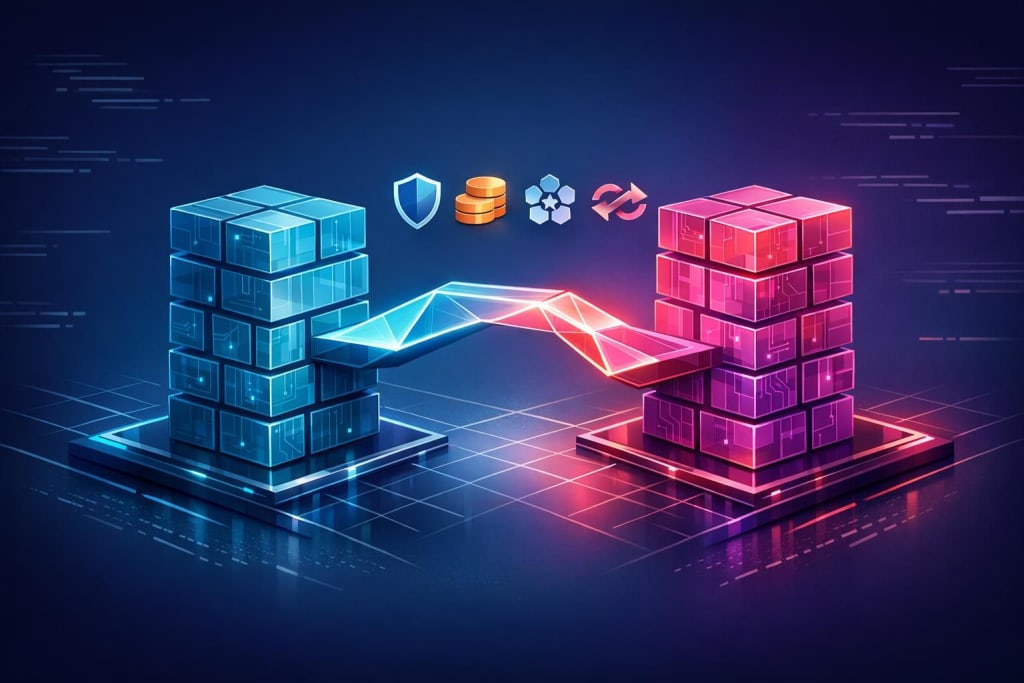
Explore innovative blockchain scalability solutions, including Layer 1, Layer 2, and new technologies to enhance speed, cost, and security.
Blockchain networks face a major hurdle: they're slow and expensive when lots of people use them. Here's a quick rundown on how experts are trying to fix this:
Layer 1 Solutions: Tweaking the base blockchain
- Bigger blocks
- New consensus methods
- Sharding (splitting the network)
Layer 2 Solutions: Building on top of existing blockchains
- State channels (off-chain transactions)
- Sidechains (connected blockchains)
- Rollups (bundling transactions)
Cross-Chain Solutions: Helping different blockchains work together
- Protocols for sharing data
- Bridges for moving assets
New Tech: Fresh approaches to the problem
- DAG structures (faster than traditional blockchains)
- Quantum-resistant designs
Quick Comparison:
| Solution | Speed | Cost | Decentralization |
|---|---|---|---|
| Layer 1 | Moderate | Moderate | High |
| Layer 2 | Fast | Low | Varies |
| Cross-Chain | Varies | Moderate | Moderate |
| New Tech | Very Fast | Very Low | Varies |
The goal? Make blockchains as fast as Visa (1,700+ transactions per second) instead of as slow as Bitcoin (7 transactions per second).
It's not easy. Making blockchains faster often means making them less secure or less decentralized. But solutions are improving. In 5-10 years, we might see blockchain tech that's fast, cheap, and safe enough for everyday use.
Related video from YouTube
Blockchain Scalability Issues
Blockchain networks can't handle tons of transactions quickly or cheaply. Why? It's baked into how they're built. And it's a big problem for users.
Slow as Molasses
Blockchain networks are SLOW. Here's how slow:
- Bitcoin: 7 transactions per second
- Visa: 1,700 transactions per second
That's a massive difference. Blockchain has a long way to go to catch up.
Why is Bitcoin so slow? It takes about 10 minutes to create a new block. When things get busy, it gets even worse:
"Bitcoin transactions can take days or just sit there forever if you don't pay enough in fees." - Jesse Zhou, Geek Culture
Traffic Jams and Expensive Rides
More users = more problems. When blockchain networks get crowded:
You wait longer
You pay more
Bitcoin fees went crazy during the 2017 crypto frenzy:
| When | How Much? |
|---|---|
| 2017 Crypto Boom | Almost $60 |
| April 15, 2020 | $21 |
Ethereum's not much better. After September 2022, fees bounced between a few bucks and $30.
Who wants to pay $30 in fees for a $5 coffee? Not me.
Blockchain folks are trying to fix this by:
- Making blocks bigger
- Building "Layer 2" solutions on top
- Creating new blockchain designs from scratch
If they don't figure it out soon, blockchain might stay a niche tech toy instead of changing the world.
Layer 1 Solutions
Layer 1 solutions tweak the base blockchain layer. Here's how:
Bigger Blocks
More transactions per block? Just make blocks bigger. Simple, right?
- Bitcoin Cash: 1 MB → 32 MB blocks
- Result: 100+ transactions/second (Bitcoin does 7)
But hold up. Bigger blocks can mean fewer nodes. That's not great for decentralization.
Better Consensus Methods
How nodes agree matters. A lot.
| Method | What It Does | Who Uses It |
|---|---|---|
| Proof of Work (PoW) | Math puzzles | Bitcoin |
| Proof of Stake (PoS) | Coin lockup | Ethereum 2.0 |
PoS is faster and greener. Ethereum's PoW to PoS switch? 10 → 32 transactions/second.
Sharding
Think of sharding as blockchain multitasking:
- Split network into shards
- Each shard does its own thing
- Nodes only store their shard's data
1000 nodes → 10 shards of 100 nodes = 10x more transactions.
Ethereum 2.0, Zilliqa, and Tezos are giving it a shot. It's not easy, though.
Layer 1 Solutions: The Good and The Bad
| Solution | Upsides | Downsides |
|---|---|---|
| Bigger Blocks | Easy to do | Less decentralized |
| Better Consensus | More efficient | Big network changes |
| Sharding | Massive capacity boost | Tricky to keep secure |
There's no perfect fix. Each blockchain has to weigh its options.
Layer 2 Solutions
Layer 2 solutions supercharge blockchains. They make things faster and cheaper. Here's the rundown:
State Channels
Think of state channels as private chats. Users do lots of transactions off-chain, then post the final tally.
Here's how it goes:
- Lock up some funds
- Do your thing off-chain
- Post the end result on-chain
The Lightning Network for Bitcoin? That's a state channel in action. Zap! Instant, cheap transactions.
Sidechains
Sidechains are like blockchain cousins. They're connected, but they play by their own rules.
What's cool about them?
- They're linked to the main chain
- They have their own way of doing things
- Transactions are faster and cheaper
Check out the Liquid Network for Bitcoin. It's a sidechain that lets you trade fast and keep things hush-hush.
Rollups
Rollups are all about bundling. They pack a bunch of transactions into one neat package.
There are two flavors:
Optimistic Rollups
- They trust first, verify later
- There's a waiting period for extra safety
Zero-Knowledge (ZK) Rollups
- They use math magic to prove everything's legit
- Faster than their optimistic cousins
| Rollup Type | Example | What's Great About It |
|---|---|---|
| Optimistic | Optimism | Works with Ethereum stuff you already know |
| ZK | zkSync | Transactions are final, faster |
Layer 2 Solutions Face-Off
| Solution | Speed | Cost | Security |
|---|---|---|---|
| State Channels | Lightning fast | Dirt cheap | So-so |
| Sidechains | Pretty quick | Cheap | Depends |
| Optimistic Rollups | Quick | Cheap | Solid |
| ZK Rollups | Super quick | Cheap | Rock solid |
Each solution has its own quirks. Pick the one that fits your need for speed, penny-pinching, and peace of mind.
Connecting Different Blockchains
Blockchains often work alone. But new tools are changing that. Let's see how blockchains can talk to each other.
Cross-Chain Protocols
These protocols are like translators for blockchains. They help networks share info and assets directly.
What they do:
- Let users on different networks chat
- Enable token swaps without middlemen
- Move data across chains
Example: Polkadot connects many blockchains (parachains) using its XCM format. This lets apps on one chain use features from another.
Blockchain Bridges
Bridges link separate blockchain networks. Think of them as highways between blockchain cities.
How they work:
- Lock assets on one chain
- Make equal tokens on another chain
- Let users use those tokens
- Burn tokens when moving back
Key players:
| Bridge | Function | Networks |
|---|---|---|
| Wormhole | Asset transfers | Ethereum, Solana, Avalanche |
| Multichain | Easy transfers | Many major blockchains |
| Avalanche Bridge | Quick, cheap transfers | Avalanche and Ethereum |
Warning: Bridges can be risky. In 2022, hackers took $320 million from Wormhole. Always do your homework before using a bridge.
The Big Picture
Connecting blockchains is key for a unified crypto world. It lets users:
- Trade assets across networks
- Use dApps on different chains
- Access features from various blockchains
But it's not perfect. Challenges include:
- Security risks (like bridge hacks)
- Possible centralization
- Network traffic jams
As tech gets better, we'll likely see smoother blockchain connections. This could spark new markets and business ideas in crypto.
New Scalability Tech
Blockchain networks are growing. But they face speed and capacity issues. Here's how new tech aims to fix that:
DAG Structures
DAGs handle transactions differently than traditional blockchains.
How they work:
- Transactions link directly, not in blocks
- Process multiple transactions at once
- No miners, cutting energy use and fees
DAGs vs. Blockchain:
| Feature | Blockchain | DAG |
|---|---|---|
| Speed | Slower | Faster |
| Scalability | Limited | Higher |
| Energy Use | High | Lower |
| Fees | Higher | Lower/None |
Real-world examples:
- IOTA: For IoT devices. Hit 10,000+ TPS in tests.
- Nano: Instant, free transactions.
- Hedera Hashgraph: Smart contracts under $0.01, vs. several dollars on Ethereum.
Quantum-Ready Blockchains
Quantum computers threaten current blockchain security. New designs aim to resist future attacks.
The problem:
- Quantum computers might break current crypto methods
- New blockchains use different math to stay secure
Approaches:
- Lattice-based cryptography
- Hash-based signatures
- Multivariate polynomial equations
Examples:
- QRL: Launched in 2018, uses XMSS signatures
- Nervos Network: Built to add quantum-resistant features as needed
"Quantum-resistant blockchain aligns with enhancing cybersecurity as threats become more sophisticated." - Blockchain Security Expert
These new techs show promise. As they improve, we might see faster, more secure blockchains handling more users and complex apps.
Challenges of Scaling
Scaling blockchain networks is tough. As they grow, two big problems pop up:
Security Risks
Scaling often means tweaking the blockchain. This can create new weak spots.
Some key risks:
- More complex code
- New attack targets
- Centralization creep
In 2022, Ronin Network lost $625 million in a hack. Why? They changed their system to handle more users, but it made things less secure.
Centralization Risks
Many scaling fixes can make blockchains less decentralized. That's a problem.
Here's how centralization sneaks in:
| Scaling Method | Centralization Risk |
|---|---|
| Bigger blocks | Fewer full nodes |
| Sidechains | Small group manages transfers |
| Layer 2 solutions | Need trusted operators |
Take the Lightning Network for Bitcoin. It's faster, but needs "watchtowers" to watch transactions. That's new trust in the system.
"Scaling solutions may accidentally introduce centralization, undermining blockchain's core principles." - Vitalik Buterin, Ethereum co-founder
It's a balancing act. The "Blockchain Trilemma" sums it up:
- Decentralization
- Scalability
- Security
Boost one, and you might hurt another. EOS handles 4,000 transactions per second (Bitcoin does 7), but uses only 21 main nodes. Faster? Yes. As decentralized? No.
As blockchain grows, finding the right mix of speed, safety, and decentralization is key.
Real-World Examples
Ethereum 2.0 Scaling Plan
Ethereum 2.0 is all about making the network faster and able to handle more transactions. The big idea? Sharding - breaking the blockchain into smaller chunks.
Here's the plan in a nutshell:
| Feature | What it does | Why it matters |
|---|---|---|
| Sharding | Splits blockchain into 1024 pieces | 1000x more transactions |
| Casper | New proof-of-stake system | Uses way less energy |
| Ewasm | Better smart contract execution | Speeds things up |
The end game? Jumping from 13.5 transactions per second to a whopping 10,000+.
"We're aiming for 10,000+ transactions per second without turning every node into a supercomputer or a data hoarder." - Ethereum Sharding FAQ
Bitcoin's Lightning Network
Bitcoin's Lightning Network (LN) is like an express lane for transactions. It's faster and cheaper because it takes some traffic off the main road (blockchain).
Here's how LN is shaking things up:
- Shops and Restaurants
CashApp's 40 million users can now zap payments through Lightning. In South Africa, you can grab groceries at Pick n Pay using LN.
- Online Shopping
Web stores are jumping on the Lightning bandwagon to woo Bitcoin-savvy shoppers. It's quick and cuts risks for sellers.
- Giving and Global Payments
Unicef's using LN to make donations a breeze. It's nearly free and instant - a far cry from traditional cross-border transfers that cost an arm and a leg and crawl along for days.
- Banking the Unbanked
Projects like Bitcoin Beach (El Salvador) and Bitcoin Ekasi (South Africa) are using Bitcoin and LN to bring financial services to those left out of the traditional system.
- Pay-As-You-Go Content
LN enables micro-payments, letting you pay per minute for things like podcasts instead of flat monthly fees.
The Lightning Network isn't just changing how we use Bitcoin - it's opening doors to new ways of moving money in our daily lives.
What's Next for Blockchain Scaling
Next 5-10 Years
Blockchain's about to level up. Here's the scoop:
Layer 2 Solutions: The New Backbone
Layer 2 isn't just an upgrade - it's a total game-changer. Check this out:
| Solution | What It Does | Why It's Cool |
|---|---|---|
| Arbitrum | Optimistic Rollup for Ethereum | Speed up, pay less |
| zkSync | ZK Rollup for Ethereum | Fort Knox security, penny fees |
| Polygon | Sidechain and Layer 2 mix | Swiss Army knife for apps |
Arbitrum's already crushing it. They hit 1 million transactions in a day back in early 2023. That's HUGE.
Playing Nice Together
Different Layer 2s need to work together. It's like getting your phone to talk to your laptop - crucial stuff. Chainlink's CCIP is making this happen.
Tokenizing the Real World
Layer 2 is opening doors to turn real stuff into tokens. Think houses, art, you name it. It's gonna shake things up.
Mixing It Up
We're seeing cocktails of Layer 2 tech. Imagine zk-Rollups and State Channels had a baby. You'd get instant finality AND high speed. Nice, right?
Going Mainstream
As this tech gets better, more people will use it. El Salvador's Bitcoin move? That's just the start.
"Blockchain's gonna change tech like the internet changed the world in the 90s and 2000s." - John Zanni, Acronis Foundation President
Beyond Digital Cash
Blockchain's not just for crypto anymore:
| Where | What It Could Do |
|---|---|
| Cybersecurity | Make data tamper-proof |
| Government | Voting systems that actually work |
| Healthcare | Track drugs so you know they're legit |
| Marketing | See if your ads are doing their job |
Show Me the Money
Gartner says blockchain's gonna be BIG business:
- 2026: $360 billion+
- 2030: Over $3.1 trillion
That's not chump change.
In a few years, blockchain won't just be solving scaling issues. It'll be creating ecosystems that are easy to use, super efficient, and all connected. Buckle up - it's gonna be a wild ride.
Wrap-Up
Blockchain scalability is crucial for widespread adoption. Here's what we've covered:
Layer 1 vs Layer 2: Two Approaches
| Solution | Examples | Purpose |
|---|---|---|
| Layer 1 | Bigger blocks, Sharding | Enhances base blockchain |
| Layer 2 | Lightning Network, Rollups | Builds on existing chains |
Ethereum 2.0 focuses on sharding, while Bitcoin uses the Lightning Network.
Speed Matters
Current transaction speeds:
- Bitcoin: 7 TPS
- Ethereum: 20-30 TPS
- Visa: Up to 24,000 TPS
Layer 2 solutions are catching up fast. The Lightning Network claims over 1 million TPS, and Ethereum's Arbitrum hit 1 million daily transactions in early 2023.
Real-World Results
Uniswap's Optimism integration shows the impact:
"Optimism's Layer 2 solution dramatically increased transaction speeds and slashed fees. It's a game-changer for our users." - Hayden Adams, Uniswap Founder
What's Next?
Scalability research continues with:
Hybrid solutions combining Layer 2 technologies
Cross-chain protocols like Chainlink's CCIP
Quantum computing integration
Gartner predicts a $360 billion blockchain market by 2026. Ongoing scalability research is key to reaching this goal.
Scalability isn't just about speed - it's about preparing blockchains for real-world demands. We've only scratched the surface of potential solutions.
Key Terms
Here's a quick guide to important blockchain scalability terms:
| Term | Definition |
|---|---|
| Throughput | Transactions processed per second |
| Latency | Time to process a transaction |
| Sharding | Splitting blockchain into smaller pieces |
| Layer 1 | Base blockchain protocol |
| Layer 2 | Solutions built on Layer 1 |
| Sidechain | Separate chain for faster transactions |
| State Channel | Off-chain method for multiple transactions |
| Rollup | Bundles off-chain transactions into one on-chain |
| Plasma | Layer 2 creating smaller blockchains |
| Lightning Network | Layer 2 for fast Bitcoin transactions |
| DAG | Alternative to traditional blockchain structure |
Blockchain Scaling Approaches:
- On-chain scaling
Changes the base protocol. For example, Bitcoin Cash upped its block size from 1 MB to 32 MB. More transactions per block? You bet.
- Off-chain scaling
Handles transactions outside the main blockchain. Take the Lightning Network. It's like a superhighway for Bitcoin, zooming through 1 million transactions per second. Compare that to Bitcoin's 7 transactions per second, and you'll see why it's a big deal.
- Layer 2 solutions
These are like blockchain boosters. Polygon, for instance, is Ethereum's sidekick. It can handle about 65,000 transactions per second. Not too shabby, right?