Assess if you're truly behind as a developer: four checks, fix real gaps with a 90-day plan, and cut FOMO with curated learning.
Most developers who feel behind are dealing with noise, not a career problem. I’d judge it with 4 checks: can I ship work, do I understand the basics under the tools, can I think through trade-offs, and do I help my team move faster?
Here’s the short version:
- Feeling behind is not the same as being behind
- I’d treat a skill gap as real only when my current role or next target role needs it
- If a core skill is weak, I’d pick 1 skill for 90 days by structuring your journey, not 10
- If it’s mostly feed-driven stress, I’d cut inputs and use a time-boxed reading habit and other daily habits to improve
- In a market where tools shift fast, depth in a few areas matters more than chasing every new launch
A simple way to check myself:
- Delivery: Can I take code to production and handle issues?
- Basics: Can I explain how and why my tools work?
- Trade-offs: Can I weigh speed, clarity, scale, and upkeep?
- Teamwork: Do I help others, or do I slow work down?
One line matters most: not knowing a trending tool does not mean I’m behind. What matters is whether I can do the job in front of me, spot my weak points, and fix them without panic.
That’s the frame I’d use for this topic: measure the gap, cut the FOMO, and learn on purpose.
How to tell whether you are actually behind
Use a short self-check instead of doomscrolling. First, figure out whether the gap is real. Then decide if it’s worth fixing.
Check yourself against four signals: delivery, fundamentals, systems thinking, and collaboration
These four areas give you a better read on your situation than whatever your feed is hyping today.
Delivery is about whether you can take work from writing code all the way to production. A clear gap here looks like freezing during a production incident: you don’t know how to triage, you don’t check logs or metrics, and you don’t look at recent deploys first.
Fundamentals is about knowing the why behind your tools, not just the syntax. Maybe you can use a useEffect hook, but you can’t explain stale closures, race conditions, or what happens when a component unmounts. That’s the kind of gap worth fixing.
Systems thinking is whether you can judge trade-offs like performance vs. readability or simplicity vs. flexibility, instead of just closing tickets. Collaboration is whether you help the team get more done or quietly turn into a bottleneck.
Tell the difference between critical gaps and optional curiosity
Not every gap needs your attention right now. Rate your core skills on a scale from 1 to 5.
| Rating | Meaning | Action Required |
|---|---|---|
| 1 | Never heard of it | Start from scratch; this is a critical gap if your role needs it |
| 2 | Know the term | Learn the basics through reading or videos |
| 3 | Built a small example once | Build something small from scratch without a guide |
| 4 | Can use it | Go deeper into the why and the mechanics underneath |
| 5 | Can teach it | You’ve got it down; move to the next gap |
If a required skill is below 4, that’s a real gap. Everything else falls into optional curiosity.
Do a short, time-boxed review instead of a spiral
Keep this review short and honest. Ask yourself:
- Can you explain your work clearly to a nontechnical person?
- When was the last time you were genuinely stuck?
- Could you write a recipe that gets a new hire up to speed on your job in three months?
- What would break if you left tomorrow?
- Do you know your current blind spots?
If you haven’t been stuck in months, you may be coasting. If you’re getting stuck every week, you’re probably in a healthy growth zone.
If the gap is real, the next move is a narrow 90-day plan.
What to do when the gap is real
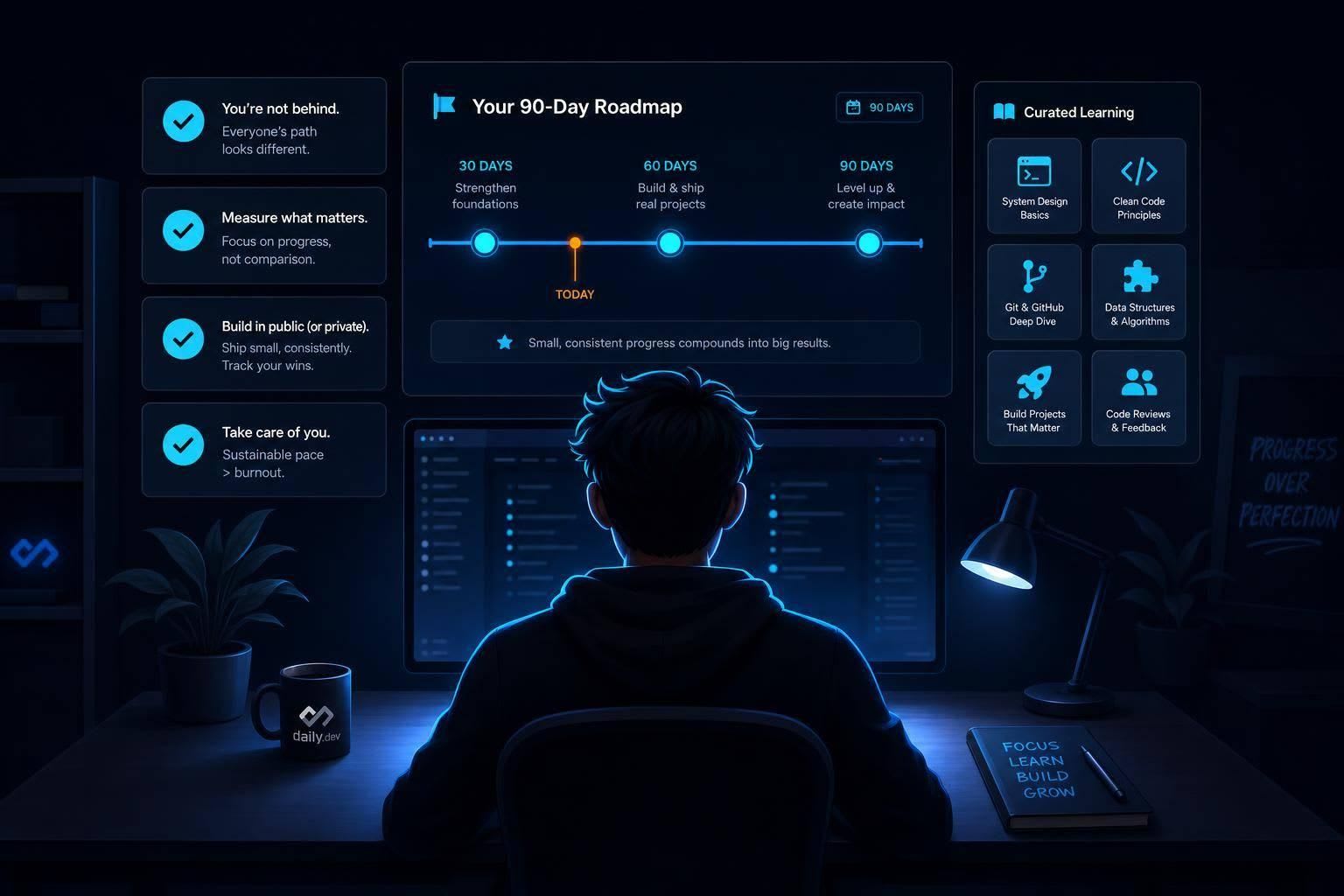
If the gap is real, don't open ten tabs or sign up for five courses. Pick one skill and one plan for the next 90 days. That's it.
A real gap means your role needs a skill you don't yet have right now. It does not mean you're behind in every area.
Pick one or two skills that matter most in the next 90 days
One major skill per quarter is enough. Depth builds confidence; breadth without doing the work builds anxiety. Go back to your self-assessment from the previous section and pick the skill rated below 4 that matters most in your current role or the role you want next.
Focus on skills that keep paying off across many projects and still matter when tools change. Think SQL, system design, browser rendering, event loops, state management, or network behavior. When a new tool starts trending, put it on a not-now list and check it again after 90 days.
Choose a learning method that fits your time and stress level
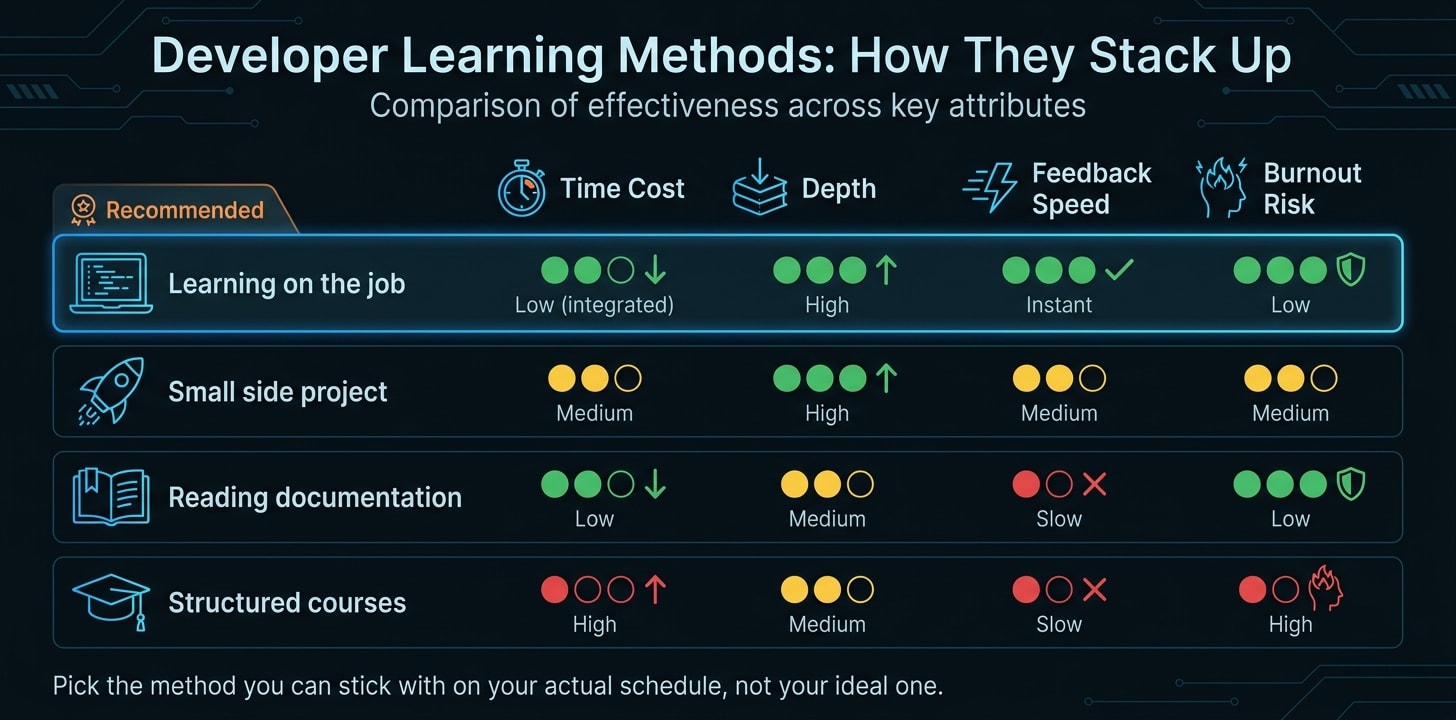
Pick the method you can stick with on your actual schedule, not your ideal one. Here's how the most common options stack up:
| Method | Time Cost | Depth | Feedback Speed | Burnout Risk |
|---|---|---|---|---|
| Learning on the job | Low (integrated) | High | Instant | Low |
| Small side project | Medium | High | Medium | Medium |
| Reading documentation | Low | Medium | Slow | Low |
| Structured courses | High | Medium | Slow | High |
Learning on the job is usually the best option: low overhead, high depth, and instant feedback. If you can tie your gap to a task at work, you get practice, feedback, and progress without having to carve out extra hours.
Build feedback into the plan so progress is visible
Don't track progress by how much you read. Track it by what you can do now that you couldn't do before.
Use the plain-English test: if you can't explain it simply, you don't understand it deeply enough. Then compare your current work with where you were six months ago. Can you debug faster? Can you explain trade-offs more clearly? Do you design before coding more often than you did six months ago?
What to do when it is mostly FOMO
If the gap is real, the next issue is usually noise, not skill. A lot of developer anxiety starts in the feed, not in any actual weakness.
Cut the noise: not every announcement needs your attention
Most announcements aren't worth your time. Your job is to stay sharp on what matters for your work, not to track every shiny new thing that pops up.
That’s why the next step is using a source that filters for relevance.
Use a personalized feed to stay informed without chasing everything
Most broad sources are generic, so they don’t help much. Social media tends to push what’s popular, not what fits your stack.
daily.dev gives you a personalized feed based on your stack, so you can see updates that matter to you without drowning in noise.
Anxious browsing vs. a curated reading system
The difference is structure, not willpower. Anxious browsing is reactive and scattered. A curated system is intentional, time-boxed, and tied to what you need to learn.
The goal is simple: build a filtered habit you can keep up with.
A filtered feed makes steady learning easier to repeat.
Conclusion: Staying current is a habit, not a race
Once you separate real gaps from FOMO, the takeaway is simple: staying current is a habit, not a scramble. Feeling behind is emotional; being behind is measurable . A lot of that stress comes from amplified noise, not from what your job actually asks of you.
When the gap is real, focus beats breadth. Strong fundamentals and honest self-checks will take you farther than chasing trending backend frameworks. As AI tools for developers get better at handling shallow, general knowledge, your value shifts. It’s less about knowing everything and more about judging what deserves depth .
Staying current works best as a steady habit, not a sprint. Keep one primary skill area and one secondary support area. Everything else is optional, not urgent . Use a not-now list to park trending tools and come back to them later . Stay aware of the ecosystem without reacting to every new thing. That’s where a curated feed helps. daily.dev keeps that habit low-friction by surfacing relevant updates in one place.
Stay current by focusing on what matters, not on everything that moves.
FAQs
How do I know if I’m actually behind or just overwhelmed?
Feeling behind in tech is almost universal. Most of the time, it’s not that you’re failing to move forward. It’s overload.
That shows up in familiar ways: you bounce from tool to tool, save tutorials you never get around to using, feel guilty when you take a break, or measure your own messy middle against someone else’s highlight reel.
A better way to check where you stand is simpler: Are you going deeper in the areas that matter for your goals? That matters a lot more than how many tabs you opened, courses you saved, or shiny new tools you tried.
Which skill should I focus on first?
Don’t chase the latest trends first. Put your time into foundational skills that still matter after the next framework wave rolls through: understanding how computers work, how memory behaves, and how networks move data; learning data structures; debugging with a clear process; and getting better at reading code and explaining it to other people.
Those skills carry across tech stacks, and they make new frameworks a lot easier to pick up. Figure out your main axis of value, then go deeper in one primary area and one secondary area.
How can I keep up without burning out?
You’re not going to learn everything, and that’s fine. The goal isn’t to consume every article, video, or hot new tool. It’s to learn on purpose.
A better approach is to make learning a small habit you can stick with. That might mean 30 minutes a day or one set session each week using curated sources like daily.dev. Small, steady blocks beat random binge sessions.
It also helps to spend more time building and debugging than just reading or watching. That’s where ideas start to click. And when you choose what to study, put the fundamentals first. New tools can wait unless they fix a real problem you have right now.