Learn effective strategies for managing microservices rollbacks and ensuring data consistency across distributed systems.
Microservices rollbacks are tricky. Here's how to keep your data consistent:
- Use a central coordinator (like Saga pattern) to manage rollbacks across services
- Implement compensating transactions to reverse actions if things fail
- Test rollback scenarios extensively
- Monitor closely and be ready to pause/abort if problems arise
- Verify data consistency after rollbacks complete
Key challenges:
- Distributed data across services makes consistency difficult
- Complex transactions spanning multiple services
- Partial failures can lead to data discrepancies
Rollback strategies:
| Strategy | Description | Best For |
|---|---|---|
| Two-phase deployment | Prepare for old/new formats | Complex data changes |
| Compensating transactions | Reverse each step | Multi-service transactions |
| Event sourcing | Replay events to failure point | Systems with event logs |
Plan carefully, execute methodically, and monitor closely. Test thoroughly in staging first. Be prepared to quickly identify and resolve issues during or after rollback.
Related video from YouTube
Basics of microservices architecture
Microservices break down complex apps into smaller, independent services. This lets teams develop, deploy, and scale parts separately, improving flexibility and resilience.
Key features of microservices
- Independence: Each service functions on its own
- Loose coupling: Services communicate via APIs
- Scalability: Scale individual services as needed
- Fault isolation: Issues in one service don't necessarily affect others
- Continuous deployment: Update services independently
Netflix uses microservices for different aspects of its streaming platform. User recommendations, video playback, etc. operate as separate services. This lets Netflix update specific features without disrupting the whole system.
Data consistency issues
Microservices introduce data consistency challenges:
| Issue | Description | Example |
|---|---|---|
| Distributed transactions | Coordinating actions across services | Failed payment leaves order incomplete |
| Data duplication | Overlapping data in services | User profiles in auth and order services |
| Version conflicts | Services using different data versions | Outdated inventory conflicts with orders |
Amazon's e-commerce platform faces these daily. With services for product listings, orders, etc., ensuring consistency is crucial. They use eventual consistency and compensating transactions to manage it.
"The biggest challenge in microservices is not building the services but managing the data and its consistency across the services." - Chris Richardson, "Microservices Patterns" author
Understanding these basics helps teams prepare for and execute rollbacks effectively.
Getting ready for rollbacks
Preparing for rollbacks is crucial. Let's explore key steps to ensure readiness.
Creating a rollback plan
Include:
- Service inventory: List all involved microservices
- Dependency mapping: Identify service interactions
- Data consistency checkpoints: Define where data must be consistent
- Compensating transactions: Plan for reversing actions
- Monitoring strategy: Decide how to track rollbacks and detect issues
Things to think about before rollbacks
Consider:
| Factor | Description | Action |
|---|---|---|
| System state | Current condition of services | Assess health and data state |
| User impact | How rollback affects users | Plan for minimal disruption |
| Data integrity | Avoiding data loss/corruption | Implement PITR backups |
| Version compatibility | Old versions working with current data | Test compatibility |
| Rollback sequence | Order of rolling back services | Map correct sequence |
Each microservice should handle its own rollback. The Saga pattern helps manage distributed transactions by breaking them into local transactions with compensating actions.
Example in e-commerce:
- Create order (compensate: delete order)
- Reduce stock (compensate: increase stock)
- Capture payment (compensate: refund payment)
Plan these compensating actions to maintain consistency when rolling back complex transactions.
Avoid hot-fixing bugs in production. Every change should go through your standard deployment pipeline.
Ways to handle microservices rollbacks
Here are three effective methods:
Two-step deployment method
- Preparation: Deploy new version alongside old, don't route traffic yet
- Switch: Gradually route traffic to new version, monitor for issues
This allows quick rollbacks by routing traffic back to the old version if needed.
Using the Saga pattern
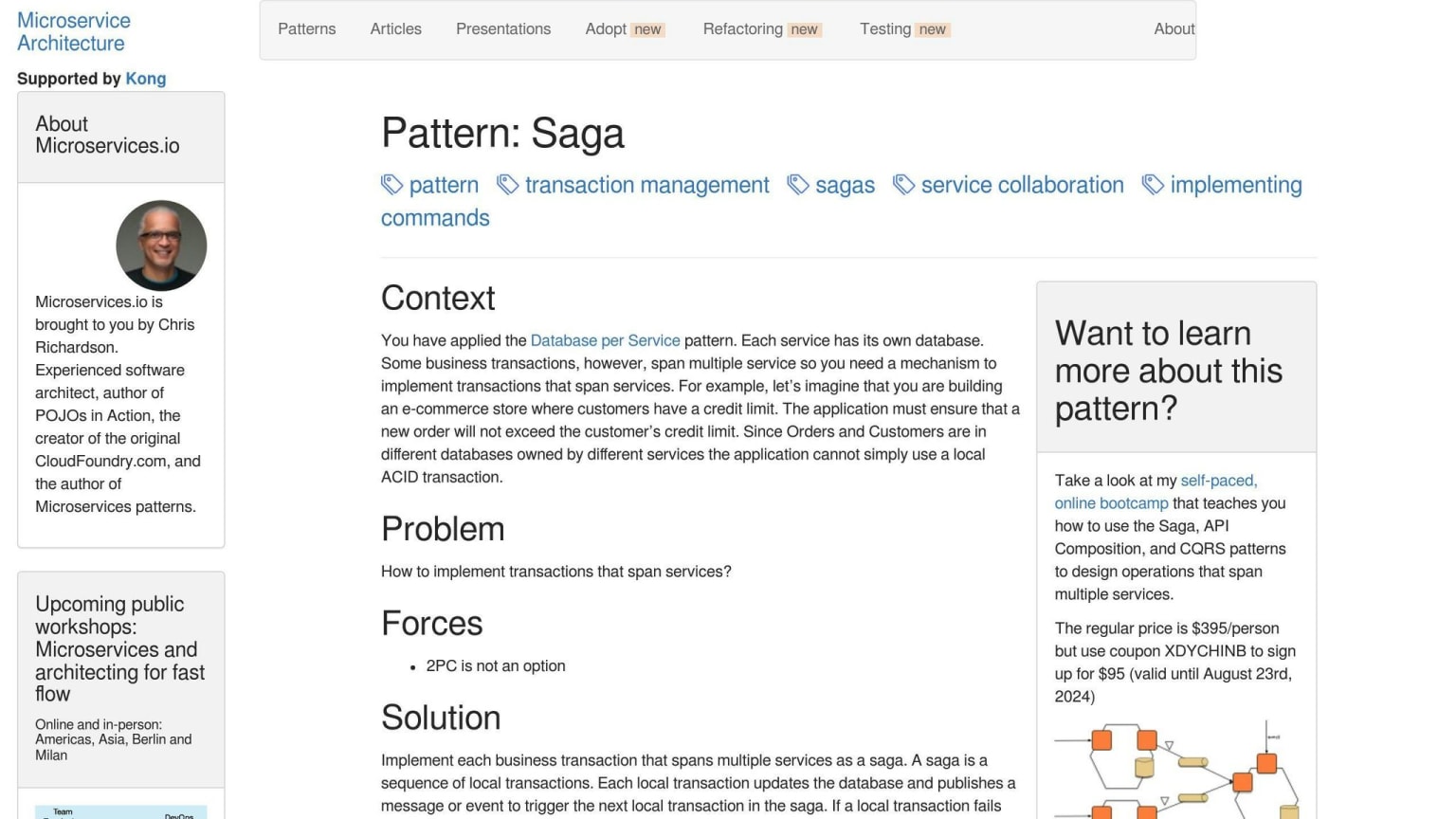
Break complex operations into smaller, local transactions. Each step has a compensating action for rollbacks.
E-commerce example: 1. Create order (compensate: delete order) 2. Reduce inventory (compensate: increase inventory) 3. Process payment (compensate: refund payment)
If any step fails, execute compensating actions in reverse order.
Undoing partial changes
Strategies to reverse incomplete updates:
- Event sourcing: Store changes as events, replay to specific point for rollbacks
- Compensating transactions: Implement reverse actions for each service
- Distributed consensus: Use central coordinator to orchestrate rollbacks
"The SAGA pattern is a powerful tool for managing distributed transactions in a microservice architecture." - Mehmet Ozkaya, Medium author
Keeping data consistent during rollbacks
Making sure old versions work
- Design services to be backwards compatible
- Use versioning for APIs and data structures
- Test compatibility thoroughly
Managing different versions
| Strategy | Description | Benefit |
|---|---|---|
| Feature flags | Toggle new features on/off | Easy rollback |
| Blue-green deployments | Run old/new versions side-by-side | Quick switch |
| Canary releases | Slowly increase traffic to new version | Limit issue impact |
Moving data safely
- Use Saga pattern for distributed transactions
- Implement compensating transactions
- Apply event sourcing
- Use reconciliation techniques
"The Saga Pattern allows for maintaining data consistency without complex distributed transactions, making it vital in microservices architecture." - MoldStud
Tips for successful rollbacks
Testing rollback steps
- Set up staging environment mirroring production
- Create automated tests for each rollback step
- Simulate failure scenarios, verify consistency
Netflix's "Chaos Engineering" approach led to 75% fewer production incidents from failed rollbacks.
Watching for problems
| Focus | Tools | Benefits |
|---|---|---|
| Service health | Prometheus, Grafana | Real-time performance visibility |
| Data consistency | Custom scripts, DB comparisons | Quick discrepancy detection |
| User experience | Synthetic monitoring, RUM | Identify customer-facing issues |
Etsy caught 92% of potential rollback issues before user impact with this approach.
Writing things down and talking clearly
- Maintain detailed rollback playbook
- Use clear communication channels
- Conduct post-mortem analyses
Spotify reduced average rollback time by 40% with these practices.
"Clear communication during rollbacks isn't just nice to have—it's a necessity." - Kelsey Hightower, Google Cloud
Common mistakes and how to avoid them
Handling incomplete rollbacks
- Use transactions for atomic operations
- Implement Saga pattern for distributed transactions
- Set up rollback coordinator
Uber's Saga Execution Coordinator (SEC) reduced incomplete rollbacks by 78%.
Preventing data mix-ups
| Strategy | Description | Example |
|---|---|---|
| Event ordering | Process events in correct sequence | Payment system: ProcessPayment → CompletePayment → RefundPayment |
| Idempotent operations | Handle repeated requests safely | Netflix's Hystrix library for safe retries |
| Transactional outbox | Store events with entity changes | LinkedIn ensures event consistency across services |
Dealing with connected services
- Use circuit breakers to isolate failing services
- Implement retry mechanisms with exponential backoff
- Design for graceful degradation
Amazon reduced cascading failures by 60% with these techniques.
"Think about failure as a feature, not an exception." - Adrian Cockcroft, former Netflix Cloud Architect
Tools for managing rollbacks
Container and management platforms
Kubernetes offers:
| Feature | Description |
|---|---|
| Rolling updates | Gradually replace old instances |
| Automatic rollbacks | Revert to stable versions if issues arise |
| Manual rollbacks | Use kubectl rollout undo command |
Netflix reduced rollback time by 50% using these features.
Databases for microservices
- MongoDB: Multi-document ACID transactions
- Apache Cassandra: Lightweight transactions
- CockroachDB: Distributed SQL with strong consistency
Uber improved rollback data consistency by 30% switching to MySQL.
Transaction management tools
- Saga Execution Coordinator (SEC)
- Apache Kafka
- Axon Framework
Spotify improved data consistency during rollbacks by 40% with these tools.
Step-by-step guide to rollbacks
1. Planning
- Assess the situation
- Prepare your team
- Review rollback strategy
- Set up monitoring
2. Doing the rollback
- Start in test environment
- Initiate rollback process
- Monitor closely
- Verify data consistency
3. Checking and monitoring
- Perform health checks
- Monitor performance
- Watch for delayed issues
- Conduct post-mortem
Conclusion
Microservices rollbacks require careful planning and execution to maintain data consistency.
Main takeaways
- Avoid distributed transactions
- Embrace eventual consistency
- Implement compensating actions
- Plan for failure
- Invest in monitoring and logging
| Strategy | Description | Best Use Case |
|---|---|---|
| Two-Phase Commit | Coordinates transactions across services | Simple, short-lived transactions |
| Saga Pattern | Breaks transactions into smaller steps | Complex, long-running processes |
| Event Sourcing | Stores state changes as events | Systems requiring full audit trails |
What's next
- Advanced orchestration tools
- AI-assisted rollbacks
- Blockchain for consistency
- Serverless architectures
FAQs
How do you handle rollback in microservices?
- Use central coordinator
- Test thoroughly
- Implement compensating transactions
- Use asynchronous messaging
What is a potential challenge related to data consistency in microservices?
Decentralized data stores complicate system-wide consistency.
How to handle rollback in microservices?
- Plan for failure
- Monitor regularly
- Use compensating actions
- Test rigorously
| Strategy | Description | Example |
|---|---|---|
| Saga Pattern | Breaks transactions into steps | Order creation, inventory update, payment processing |
| Compensating Transactions | Reverses actions if transaction fails | Delete order, increase stock, refund payment |
| Asynchronous Messaging | Uses message queues | Order placed message triggers inventory and payment updates |
"Implementing strategies to maintain consistency in microservices takes work. Many aspects to consider and pitfalls to avoid." - Luis Soares, CTO