
Compare Kong, NGINX, Tyk, KrakenD, Express Gateway, and Apache APISIX — features, performance, and which fits microservices, high traffic
Looking for the best open-source API gateway? Here's a quick rundown of the top 6:
These frameworks offer key features like:
- Request routing
- Authentication
- Rate limiting
- Load balancing
- Protocol translation
Quick Comparison:
| Framework | Language | Key Feature | Best For |
|---|---|---|---|
| Kong | Lua | Many plugins | Large deployments |
| NGINX | C | Speed | High-traffic sites |
| Tyk | Go | User-friendly dashboard | Easy management |
| Express Gateway | JavaScript | Node.js compatible | JS dev teams |
| KrakenD | Go | No database required | Microservices |
| Apache APISIX | Lua | Cloud-native | Kubernetes setups |
When choosing, consider:
- Your team's skills
- Current tech stack
- Specific project needs
- Scalability requirements
- Security features
Remember: Always test before committing to a framework.
Related video from YouTube
API Gateway Basics
API gateways are the traffic cops of modern software. They're especially crucial in microservices setups. Let's break down what they do and why they matter.
Main Functions
Think of an API gateway as a bouncer at a club. It's the first point of contact for all API requests. Here's what it does:
- Routes requests: Sends incoming calls to the right service
- Balances load: Spreads traffic to keep things running smoothly
- Keeps things secure: Checks IDs, controls access, and fights off bad guys
Take Netflix. They use an API gateway to handle requests from all their different apps. It's like having one door that leads to many rooms.
Microservices Magic
In the world of microservices, API gateways are the glue that holds everything together. They:
Make life easier for clients: One door, many services
Allow for behind-the-scenes changes: Swap out services without the client noticing
Speak multiple languages: Translate between different protocols
Martin Buhr, CEO of Tyk, puts it this way:
"A microservices API gateway is necessary for a range of reasons. The additional layer of security that it provides is one, as is the fact that implementing a gateway can reduce the complexity of your microservices architecture and management."
What to Look For
When shopping for an API gateway, keep an eye out for these features:
| Feature | What It Does |
|---|---|
| Routing | Sends requests where they need to go |
| Security | Keeps the bad guys out |
| Traffic Control | Manages the flow of requests |
| Observability | Lets you see what's happening |
| Transformation | Translates between different formats |
| Scalability | Handles lots of traffic without breaking a sweat |
Some gateways, like Kong, can handle hundreds of thousands of API calls at once. That's like being able to serve everyone in a packed stadium simultaneously.
How to Evaluate API Gateway Frameworks
Choosing the right API gateway framework is crucial. Here's what to focus on:
Speed and Growth
API gateways need to handle heavy traffic. Look for:
- High-volume performance
- Ability to scale
For instance, Kong processes over 400 billion API calls daily. That's serious scalability.
User Support and Guides
Good support can make your life easier:
- Check community responsiveness
- Look for clear, updated docs
ABAX found that user-friendly gateways cut training time, speeding up their market moves.
Safety Measures
Security is a must. Key features include:
| Feature | Purpose |
|---|---|
| Access control | Blocks unauthorized users |
| Bot detection | Stops automated attacks |
| Threat protection | Guards against cyber threats |
With API attacks expected to skyrocket by 2030, solid security is non-negotiable.
Don't just read about features - test them. Axione saved hours monthly by picking a gateway that made quick, downtime-free config updates.
6 Top Open-Source API Gateway Frameworks
Let's dive into six leading open-source API gateway frameworks:
Kong
Kong's built on NGINX and uses Lua. Here's what you need to know:
- It's fast and scalable
- Uses plugins for extra features
- Works well with microservices
- BUT: Needs a database for config (adds complexity)
NGINX
NGINX is a popular choice. Why?
- It's FAST (2.6x more API calls/second than Kong for 1-KB responses)
- Uses less CPU (40% less than Kong at 5,000 API calls/second)
- Handles load balancing out of the box
Fun fact: Capital One uses NGINX for over 12 billion daily API calls.
Tyk
Tyk's built with Golang. It offers:
- A built-in API developer portal
- Multiple auth methods
- Uses Redis or MongoDB for storage
It's got fewer GitHub stars than Kong, but users love its interface.
Express Gateway
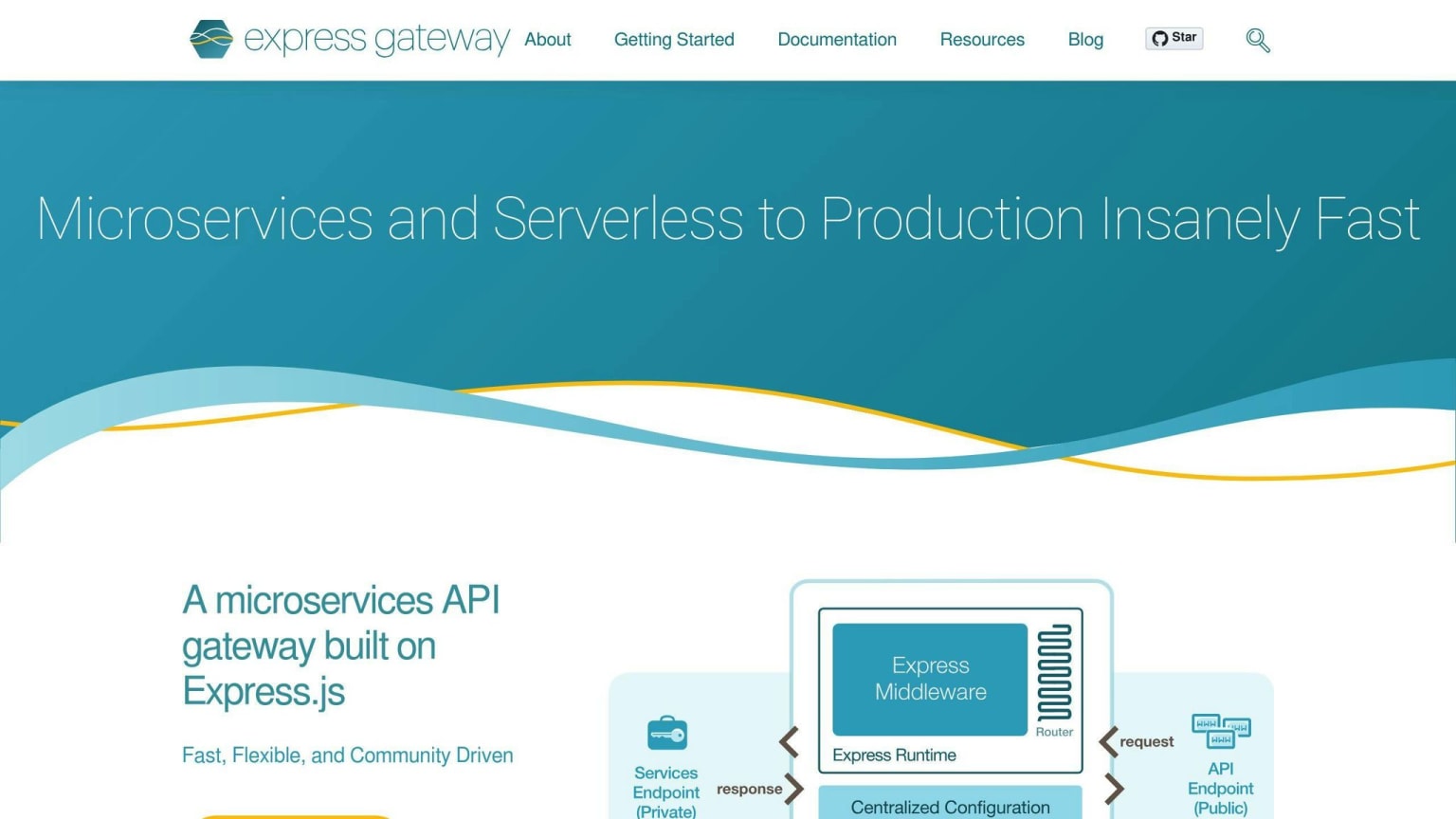
Based on Express.js, this one's great if you're into Node.js:
- Familiar Node.js environment
- Quick to set up
- Lightweight design
KrakenD
KrakenD's a bit different:
- No database needed (it's stateless)
- High performance
- Comes with KrakenDesigner (a visual tool)
It's popular for Backend for Frontend (BFF) in mobile and web apps.
Apache APISIX
The new kid on the block:
- Built for the cloud
- Supports multiple protocols
- Works as a Kubernetes ingress controller
Here's a quick comparison:
| Framework | Language | Standout Feature | Ideal Use Case |
|---|---|---|---|
| Kong | Lua | Tons of plugins | Big deployments |
| NGINX | C | Speed | High-traffic sites |
| Tyk | Golang | Easy-to-use dashboard | Simple management |
| Express Gateway | JavaScript | Node.js friendly | JS dev teams |
| KrakenD | Go | No database needed | Microservices |
| Apache APISIX | Lua | Made for the cloud | Kubernetes setups |
Choosing an API gateway? Think about what you need, what your team knows, and what you're already using. And don't forget to test before you commit!
Framework Comparison
Let's compare six open-source API gateway frameworks:
Speed Tests
Performance matters. Here's how they stack up:
| Framework | Requests/Second | Latency (95th percentile) |
|---|---|---|
| API7 (Apache APISIX) | 167,019 | 2.16 ms |
| Kong | 137,850 | 3.82 ms |
| NGINX Plus | 30,000 | 13 ms |
| Tyk | N/A | N/A |
| Express Gateway | N/A | N/A |
| KrakenD | N/A | N/A |
API7 tops the charts. Kong's not far behind. NGINX Plus? Steady, even under pressure.
Feature Comparison
What can these frameworks do?
| Feature | API7 | Kong | Tyk | NGINX Plus | Express Gateway | KrakenD |
|---|---|---|---|---|---|---|
| GraphQL Support | Yes | Limited | Strong | No | No | No |
| Kafka Support | Yes | Limited | Limited | No | No | Yes |
| gRPC Support | Yes | Limited | Not specified | Yes | No | Yes |
| WebSocket Support | Yes | Minimal | Partial | Yes | No | No |
| Developer Portal | Yes | Enterprise only | Enterprise only | No | No | No |
Tyk shines with GraphQL. API7 and KrakenD? They're protocol powerhouses.
User Support
Community can make or break your API gateway experience:
- Kong: 300,000+ monthly instances, 15 million+ Docker downloads. It's BIG.
- Tyk: 4.8 stars on Gartner (77 reviews). Users love it.
- API7: The new kid on the block, but gaining steam fast.
- NGINX Plus: Handles 10% of global internet traffic. That's no joke.
- Express Gateway and KrakenD: Smaller crowds, but dedicated fans.
Choosing a framework? Consider your team's skills, your tech stack, and your needs. And ALWAYS test before you commit.
Picking the Best Framework
What to Think About
When choosing an API gateway framework, look at:
- Your current tech setup
- Your team's skills
- Your project's specific needs
For example, if your team knows Lua, Kong might work well. If you use Spring Framework, Spring Cloud Gateway could be a good fit.
How to Decide
Use this checklist:
| Factor | Questions |
|---|---|
| Deployment | Self-hosted or SaaS? |
| Installation | Easy to set up? |
| Features | Meets core needs? |
| Customization | Can you extend it? |
| Upgrades | Easy to update? |
| Community | Good support? |
| Performance | Handles your traffic? |
| Security | Has needed safeguards? |
| Scalability | Grows with you? |
| Cost | Fits your budget? |
Pro tip: Test your top picks. It'll show you how they really work.
There's no perfect solution for everyone. Pick what fits YOUR needs and long-term plans.
If speed is key, API7 or Kong might be best. Need GraphQL? Tyk could be your go-to.
Don't forget about monitoring. Choose a framework with tools to track API use and performance. It'll help you fix issues fast and keep things running smooth.
Setting Up and Improving API Gateways
Setup and Settings
When setting up an API gateway, focus on these key areas:
- HTTPS Communication
Use HTTPS. It's non-negotiable. It keeps your data safe from prying eyes and sneaky attacks.
- Authentication and Authorization
Go for token-based auth with short-lived tokens. OAuth 2.0 is great for big apps. Use RBAC to keep users in check.
- Request Validation
Validate ALL inputs. Use allowlists. Reject everything else. No exceptions.
- Rate Limiting
Prevent DoS attacks and keep things fair. Here's how:
| Method | What it does |
|---|---|
| Fixed Window | Caps requests in a set time |
| Sliding Window | Smooths out traffic spikes |
| Token Bucket | Allows short traffic bursts |
- Monitoring and Logging
Set up real-time monitoring. Get alerts for weird stuff. It's your early warning system.
- Performance Tuning
Make your gateway sing:
- Set trace levels to
FATAL - Turn off real-time and traffic monitoring
- Ditch transaction logging
- Match database pooling to client numbers
- Use HTTP keep-alive
Keeping Things Safe
Boost your API gateway security:
- Web Application Firewall (WAF)
It's your shield against common threats. Use it.
- API-led Connectivity
Separate gateways for different uses. Keep internal stuff internal.
- Manage Old APIs
Track all APIs. Dump the unused ones. Update the oldies.
Run code snippets in safe spaces. Less exposure, less risk.
- Smart Scaling
Split traffic between gateways. Beef up memory for more requests per second.
- Cache Responses
Use LocalResponseCache filter. It'll speed up those GET requests.
What's Next for API Gateways
API gateways are evolving to fit cloud and serverless setups. This shift is making developers rethink API management.
Here's what's changing:
- Multiple Gateways
Companies now use several gateways from different providers. This means we need better ways to monitor and control API traffic across these gateways.
- Easier to Use
As more non-tech folks work with APIs, gateways are getting simpler. Self-service features are becoming the norm.
- AI and Machine Learning
These are now crucial for API security. They help spot and stop attacks in real-time, which is key as API breaches become more common.
New gateways work better with cloud setups. They're fully declarative and fit well with GitOps practices.
- Speed Boost
Some gateways, like those based on OpenResty, use Lua scripts for speed and flexibility. Kong, built on OpenResty, offers fast routing and security features.
Gateways like Spring Cloud Gateway use reactive models. This helps handle lots of connections at once, which is great for busy APIs.
Real-world impacts:
| Trend | Example | Impact |
|---|---|---|
| High-Performance Gateways | Apache APISIX | Handles over 1 trillion API calls daily |
| AI-Driven Security | Not specified | Helps block high-volume cyberattacks |
| Cloud-Native Design | Not specified | Allows for quick config changes without full reloads |
When choosing an API gateway:
- Check how well it works with cloud systems
- Look at its security features, especially AI-based ones
- See if it's easy for your team to use and change
- Make sure it can grow with your needs
Staying on top of these trends will help you build better, safer, and more scalable API systems.
Wrap-Up
Picking the right API gateway framework is crucial. Open-source options give you the power and flexibility to manage APIs in today's complex digital world.
Why does it matter? Let's break it down:
- Security: API attacks are skyrocketing. A good gateway is your shield. (API cyberattacks might jump 1,000% by 2030!)
- Performance: Handle massive traffic. Apache APISIX? It processes over 1 trillion API calls daily.
- Cost: Save your team time. Less manual work = more efficiency.
When choosing a gateway, think about:
| Factor | Why It Matters |
|---|---|
| Scalability | Can it grow with you? |
| Security | How well does it protect? |
| Cloud-ready | Works in all environments? |
| User-friendly | Easy to tweak and manage? |
Here's a wild stat: The API management market could grow sixfold by 2030. APIs are taking over the digital world.
So, what's next?
- Figure out what YOU need. How complex are your APIs? How much traffic do you expect?
- Look at the numbers. How does each gateway perform? How secure is it?
- Will it play nice with your current setup?
Choose wisely. Your API gateway is the backbone of your digital strategy.
FAQs
Which of the following is an open source API gateway?
Tyk is an open-source API gateway. Here's the scoop:
- It's 100% open-source. Not open-core, not freemium. The real deal.
- You can mix and match with third-party stuff or build your own plugins.
- Tweak it to fit your company like a glove.
Adam DuVander, a dev communicator, puts it this way:
"Tyk is a modular, open-source API gateway. It's flexible and open-source, so you can integrate third-party middleware or deploy customized plugins, adapting your Tyk implementation for your company's needs."
Tyk's got some cool features:
| Feature | What it does |
|---|---|
| Speed | Handles millions of requests/second |
| Plays nice | Works with old stuff, GraphQL, and REST |
| Keeps things safe | Lots of auth options, rate limiting |
| Keeps an eye out | Built-in analytics and monitoring |
You can run it yourself or let them handle it. They've got a free tier with 250 API calls and 2.5GB throughput monthly. Need more? Paid plans go up to 1B calls and 10TB throughput per month.