A practical survival plan to stay relevant in tech: filter trends, learn 30 minutes daily, build projects, and avoid burnout.
Feeling overwhelmed by the constant pace of tech changes? You're not alone. As a developer, keeping up with new tools, frameworks, and trends can feel like an impossible task. But staying current doesn’t mean mastering everything - it’s about focusing on what matters most to your career without burning out.
Here’s what you’ll learn in this guide:
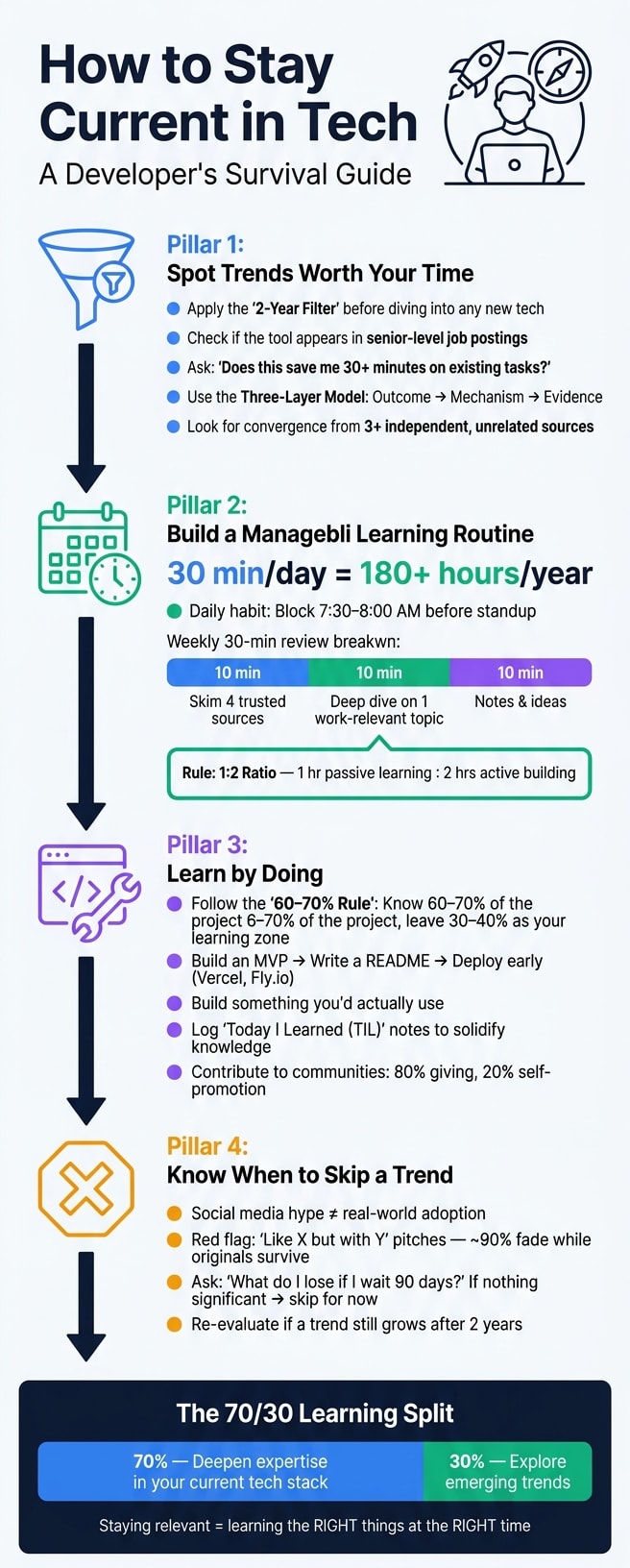
- Spot trends worth your time. Use the "2-year filter" to avoid wasting energy on fleeting hype.
- Build a manageable learning system. Dedicate just 30 minutes a day to improving your daily habits to stay informed and productive.
- Learn by doing. Side projects and hands-on work teach more than tutorials ever will.
- Know when to skip trends. Not every new tool is worth your attention - learn how to filter the noise.
Understanding the Tech Landscape: Focus on What Matters
Not every shiny new tool showing up in your feed deserves your time. The trick is to be selective - focus on trends that will stand the test of time. This means figuring out which technologies will still matter in a couple of years and which ones are just fleeting hype.
How to Spot Tech Trends Worth Following
Senior Software Developer Jefferson S. Motta suggests using what he calls the "2-year filter":
"The 2-year filter remains an excellent option... wait at least two years before diving deep into any new technology." - Jefferson S. Motta, Senior Software Developer
Why two years? The first year is typically full of buzz and surface-level reviews. By the second year, the real-world challenges start to emerge, giving you a better sense of whether the tech is worth your time .
Another good indicator is job postings. If you see a technology popping up in senior-level job descriptions across multiple industries, it’s a strong sign that it’s gaining traction . And here’s a practical tip: ask yourself if this tool will save you at least 30 minutes on a task you already do. If adopting it means a complete overhaul of your workflow, it might be better to wait . These simple criteria can help you filter out the noise and focus on what’s worth your attention.
Separating Signal From Noise
Once you’ve identified a potential trend, dig deeper by examining the motivations behind it. Understanding who benefits from a trend can help you see it more clearly. For example, vendors often profit from migrations, platforms from ecosystem lock-ins, and media outlets from clicks .
To evaluate tech claims, try the Three-Layer Model: Outcome, Mechanism, Evidence . Software engineer Abhishek Gautam puts it bluntly:
"If you cannot point to evidence in plain language, you do not have a belief. You have a mood." - Abhishek Gautam, Software Engineer
When you hear about a new claim, spend 15 minutes searching for the original source - whether it’s a research paper, release note, or official documentation. If you can’t find it in that time, consider the claim too premature to act on .
A trend becomes more credible when independent, unrelated sources - like a security blog, a VC newsletter, and a developer community - start discussing the same topic without obvious coordination . When different corners of the industry converge on a theme, it’s a much stronger signal than a single echo chamber repeating the same narrative. By applying these strategies, you can stay informed without falling into the trap of chasing every new buzzword.
Building a Learning System That Fits Your Schedule
Spotting trends is just part of the equation; carving out time to actually learn them is the real challenge. Since most developers can’t magically add hours to their day, your learning system needs to be practical - something you can stick with.
Daily and Weekly Learning Habits
A great way to stay consistent is to weave learning into your daily routine. For instance, you could block off 7:30–8:00 AM before your standup meeting. This eliminates decision fatigue and ensures you start your day productively. Over time, just 30 minutes a day adds up to more than 180 hours a year!
For deeper learning, a weekly review can work wonders. Many developers dedicate 30 minutes on Sunday mornings to stay sharp. During this time, you can break it down like this:
- Spend 10 minutes skimming four trusted sources for updates.
- Use another 10 minutes diving into one topic closely tied to your work.
- Reserve the final 10 minutes for jotting down notes or ideas.
One rule to keep in mind is the 1:2 learning ratio: for every hour of passive learning (like reading or watching tutorials), aim to spend two hours actively applying what you’ve learned - whether that’s building, debugging, or solving problems. Developer Ajay Mudettula summed it up perfectly:
"Reading about swimming is not swimming. You internalize knowledge by actively building, debugging, and solving problems, not when you watch videos."
And as .NET Architect Ayman Atif wisely points out:
"Consistency is not exciting. It is repetitive. Quiet. Sometimes boring. But it is the only thing that works."
This framework not only keeps you learning but also helps you avoid the dreaded tech burnout. With this structure in place, you’re ready to fine-tune your system with a curated news feed.
Using daily.dev as Your Learning Hub
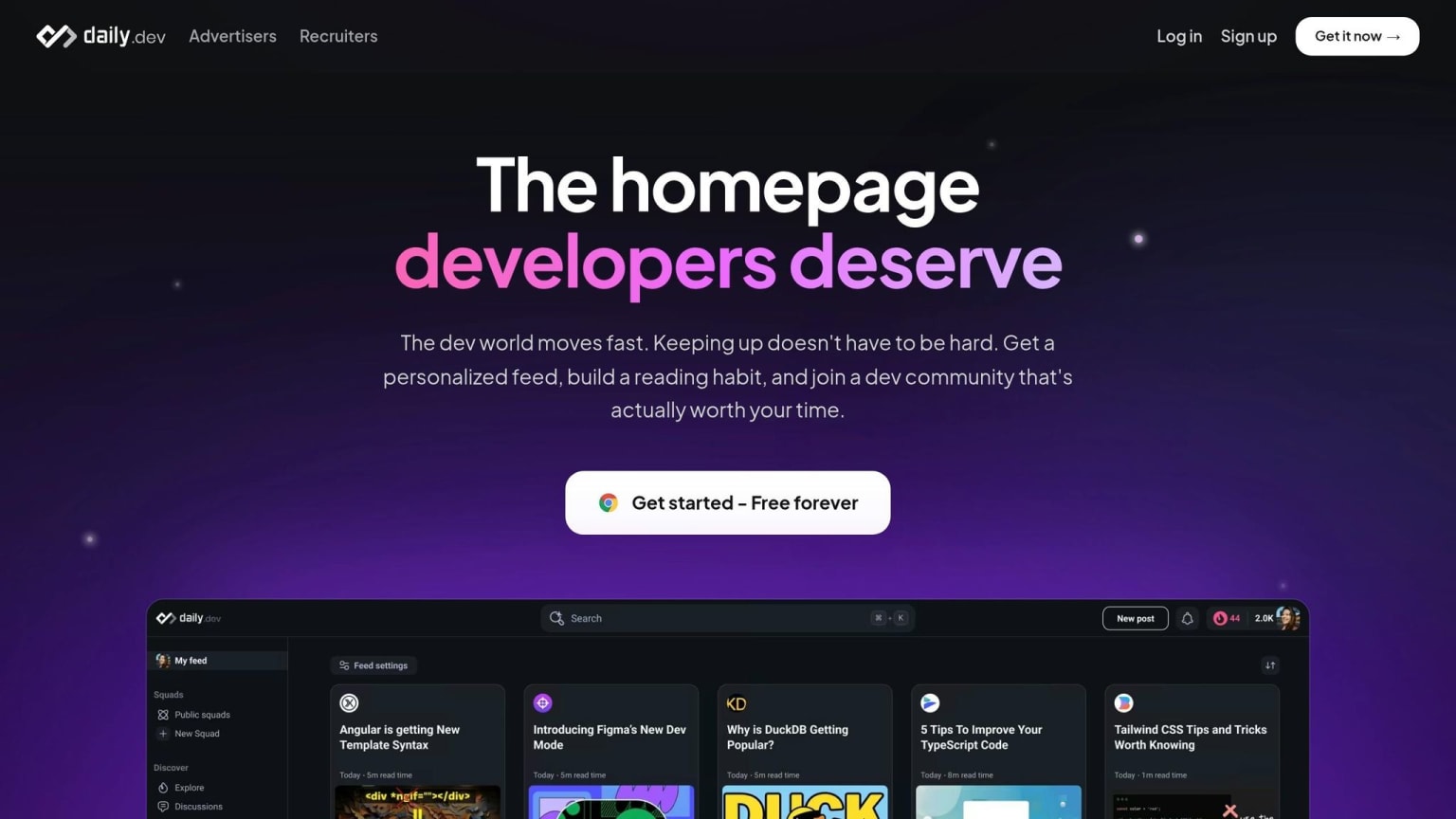
Once you’ve carved out your learning time, tools like daily.dev can help you stay focused. This platform offers a personalized feed tailored to your interests. By customizing your tags, you can cut through the noise and focus on what truly matters. This is crucial because research shows it takes about 23 minutes to regain focus after a single interruption.
When you find something interesting, resist the urge to dive in immediately. Instead, bookmark it for later. During your weekly review, you can batch-process these saved items, creating a reading list that’s both relevant and manageable. Over time, this approach helps you build a habit of intentional, focused learning that aligns with your career goals.
Learning by Building and Connecting With Others
Why Side Projects Accelerate Learning
Reading articles and watching tutorials can only take you so far. The real growth happens when you roll up your sleeves and start building. Tutorials might teach you syntax, but side projects teach you how to think like an engineer - they expose you to the kinds of challenges you won’t encounter in a controlled learning environment.
Here’s a handy way to choose your project: follow the 60–70% rule. Pick something where you already know about 60–70% of what’s required, leaving the rest as your learning zone. If it’s too easy, you won’t grow. If it’s too hard, you’ll likely get frustrated and abandon it.
Start small. Build a minimum viable product (MVP) with a clear README file, and deploy it early. Platforms like Vercel or Fly.io are great for this because they introduce you to real-world challenges like managing environment variables or debugging live environments - things you won’t pick up from tutorials. It’s in these moments of friction that the most valuable lessons emerge.
Another tip? Build something you’d actually use. When you care about the outcome, you’re much more likely to see the project through to completion. And as you learn new concepts along the way, jot them down in a quick "Today I Learned" (TIL) post - just a few sentences will do. This not only helps solidify your understanding but also quietly builds your credibility in the tech community.
If you’re looking to level up even faster, collaborate with others. Working with peers brings fresh perspectives and often leads to quicker problem-solving.
Getting More From Developer Communities
There’s only so much you can achieve in isolation. Engaging with other developers pushes your thinking in ways solo work simply can’t. Take daily.dev, for example. Their Squads feature creates focused community spaces where developers discuss real projects, share articles, and ask questions. These Squads are organized by topics like React, Kubernetes, AI, and DevOps, making it easy to find a group that aligns with your interests.
To get the most out of any community, follow the 80/20 rule: spend 80% of your time contributing - answering questions, sharing tips, and engaging in discussions - and just 20% on promoting yourself. The most successful learners in these spaces are those who give more than they take. Watch how top contributors interact and use their approach as a guide for your own participation.
When to Skip a Trend Entirely
Signs a Trend Is Not Worth Your Time
Not every shiny new framework or tool deserves your attention. One of the most valuable skills in tech is learning what to ignore. The industry is constantly buzzing with hype, and it’s easy to confuse popularity with actual relevance.
There are a few warning signs to keep in mind. Social media hype is not a reliable indicator. Just because a tool is trending on X (formerly Twitter) or LinkedIn doesn’t mean it’s widely adopted in real-world projects. Often, this buzz is driven by influencers or marketing campaigns, not actual usage. If companies aren’t actively hiring for skills related to the tool, it’s probably just noise.
This is where the 2-Year Filter comes into play. As Jefferson S. Motta, a Senior Software Developer, advises:
"Wait at least two years before diving deep into any new technology... If technology is still growing and being adopted after two years, it has passed trial by fire."
Another red flag is the "Like-X-but-with-Y" pitch - tools that claim to be improved versions of established frameworks like React or Rails. The reality? About 90% of these alternatives fade away while the original continues to thrive . If you’re already familiar with the original, it’s often more productive to deepen your expertise there than to chase the latest variation.
When evaluating a trend, ask yourself a straightforward question: What will I lose if I wait 90 days to revisit this? If the answer is “nothing significant,” it’s safe to put it on hold and focus on more pressing priorities .
If you’ve decided to skip a trend for now, tools like daily.dev can help you keep an eye on its progress without getting distracted.
Using daily.dev to Confirm Your Decisions
daily.dev makes it easier to validate your decision to pass on a trend. Its Happening Now feature highlights major updates and time-sensitive stories without overwhelming your main feed. If a tool or framework consistently appears in meaningful, practical articles over several months, it might be worth revisiting. On the other hand, if the initial excitement fades and no substantial updates follow, you’ve likely made the right call.
You can also track specific tags on daily.dev to monitor a trend’s longevity. A tag that regularly features high-quality, production-oriented content is a good sign. Conversely, if it peaks with announcement posts and then goes quiet, it’s a clear signal that the trend didn’t have staying power. By relying on daily.dev’s curated feeds, you can see how productivity and the developer community intersect before committing your time. This approach ensures your learning efforts remain focused on trends that prove their worth.
Conclusion: How to Stay Relevant Without the Overwhelm
Technology evolves at a breakneck pace, and it’s impossible for any developer to master everything. That’s not a shortcoming - it’s just how the industry works. Many developers experience this pressure to keep up . What you need is a smarter approach to learning.
The most successful developers don’t chase every trend. Instead, they focus on building a strong foundation in core skills while keeping an eye on emerging tools and technologies. Skills like data structures, algorithms, and system design stand the test of time, making it easier to adapt to new frameworks and tools down the line .
One practical strategy is to divide your learning time wisely: dedicate about 70% to deepening your expertise in your main tech stack and 30% to exploring new trends on the horizon . This approach keeps you sharp without overwhelming you.
Consistency is key. Small, regular efforts - like a 10-minute daily tech digest or a 30-minute weekly review - are far more effective than cramming over the weekend. Tools like daily.dev can simplify this process by delivering curated, relevant content tailored to your stack. Instead of spending hours searching through countless sources, your personalized feed does the heavy lifting for you, for free.
Staying relevant doesn’t mean knowing it all - it’s about learning the right things at the right time. With good judgment, steady habits, and the right resources, you can stay ahead without feeling overwhelmed.
FAQs
How do I pick one tech trend to learn next?
When planning your career path, the first step is to get clear about your goals. Are you looking to develop a specific expertise, or do you prefer to keep your skills broad and adaptable? Focus on trends that not only spark your interest but also address practical challenges or enhance your professional growth. It’s wise to prioritize skills that are in demand or tools that your company already relies on.
To strike the right balance between ambition and feasibility, consider the 60–70% rule: aim for challenges that stretch your abilities but remain within reach. Instead of chasing every new trend, dedicate yourself to mastering one area thoroughly. This focused approach often delivers better results than trying to juggle multiple trends at once.
What’s the best way to learn if I only have 30 minutes a day?
If you’ve got only 30 minutes a day, make those minutes count. Concentrate on topics that align closely with your projects or career ambitions. Consistency is key - set aside the same time each day to build a habit. Focus on active learning: skim for key points, summarize what you read, and stick to reliable sources. Minimize distractions to stay on track. Tools like daily.dev can help you find relevant, high-quality content quickly, so you stay informed without losing precious time.
How do I avoid burnout while staying relevant as a developer?
Avoid burnout by embracing intentional learning instead of trying to master everything at once. Technology moves too quickly for anyone to keep up with it all, so focus on building deep knowledge in a few key areas while maintaining a general awareness of broader trends. Develop a manageable routine - like setting aside 30 minutes each week for quick updates or dedicating short, focused sessions to high-priority topics. To stay motivated and avoid feeling swamped, set clear milestones and track your progress along the way.