
Explore 10 open source policy templates and examples for managing risks associated with open source software. Choose the best template for your organization's needs.
If your codebase pulls in even a handful of npm or PyPI packages, you already have an open source policy. It's just unwritten, which means it's inconsistent. A written policy turns ad-hoc decisions into something auditable, and the choice between permissive (MIT, Apache 2.0, BSD-3-Clause) and copyleft (GPL, AGPL, MPL) is a strategic call, not a religious one. Pick Apache 2.0 over MIT when patents are in play; pick MPL over GPL when you want file-level copyleft without infecting the whole product.
A good policy covers three things: using OSS, contributing to OSS projects, and releasing your own. The drivers worth naming are concrete: supply chain security through SBOM generation, scope-3 license compliance for anything you redistribute, and contributor IP clarity so a future acquirer's diligence doesn't surface surprises.
The risks it should address:
Risk
Description
Codebase
Vulnerabilities or quality issues in OSS code
Data Leakage
Sensitive data exposure through OSS usage
Dependency
Risks from relying on external OSS dependencies
Legal
License compliance and intellectual property issues
Operational
Operational risks from using unsupported OSS
Reputational
Damage to the organization's reputation
The following templates provide guidelines for open source usage, contributions, and governance:
Template
Focus
Key Features
Collaborating with community
Contributor expectations, OSPO role
Citi Guidelines
Contributing to projects
Contributor rules, license compliance, IP protection
eBay Open Source Website
Managing projects
Project management, community engagement, license compliance
GitLab Team Handbook
Collaborating on projects
Collaboration guidelines, contributor expectations, community engagement
Google OSPO Policies
Governing projects
Policy governance, license compliance, IP protection
Linux Foundation Template
Approving projects
Project approval, license compliance, IP protection
Microsoft Program
Managing projects
Project management, community engagement, license compliance
Red Hat Guidelines
Participating in projects
Participation guidelines, contributor expectations, community engagement
SUSE Policy
Governing projects
Policy governance, license compliance, IP protection
Yahoo Guide
Community collaboration
Contributor expectations, OSPO role
Choose the template that best aligns with your organization's open source strategy and requirements.
Related video from YouTube
1. Buffer Open Source Guide
Policy Scope
Buffer's Open Source Guide outlines the company's approach to:
- Developing open source software
- Contributing to open source projects
- Using open source software
Key Points
- Buffer encourages contributing to existing open source projects over creating new ones.
- Employees can have their names attached to their contributions while Buffer retains the copyright.
- Projects are released under appropriate open source licenses.
Implementation
To implement this policy, Buffer:
Develops software openly whenever possible.
Releases code under suitable open source licenses.
Obtains copyright transfer when procuring code development.
Worth copying from Buffer: the default-to-open posture and the explicit copyright assignment from contractors. Most small teams forget the second part, then discover during an acquisition that a freelancer technically owns a slice of the codebase.
2. Citi Free and Open Source Software Contribution Guidelines
Policy Scope
Citi's guidelines cover:
- Contributing to open source projects
- Using open source software
- Developing free and open source software
Key Points
Guideline
Details
Employee Contributions
Employees are encouraged to contribute to open source projects, fostering collaboration and innovation.
Approval Required
Employees must obtain approval before contributing to open source projects.
Copyright Ownership
Citi retains the copyright to all employee contributions.
Implementation
To implement these guidelines, Citi:
- Has a review process for open source project contributions. 2. Ensures employees understand open source license terms and conditions. 3. Monitors and tracks employee contributions to open source projects.
Citi's model fits regulated environments where every external commit is a potential disclosure event. The pre-approval gate adds friction, but for banks, healthcare, and defense it's the right trade. Outside those industries it's overkill and will kill contribution velocity.
3. eBay Open Source Website
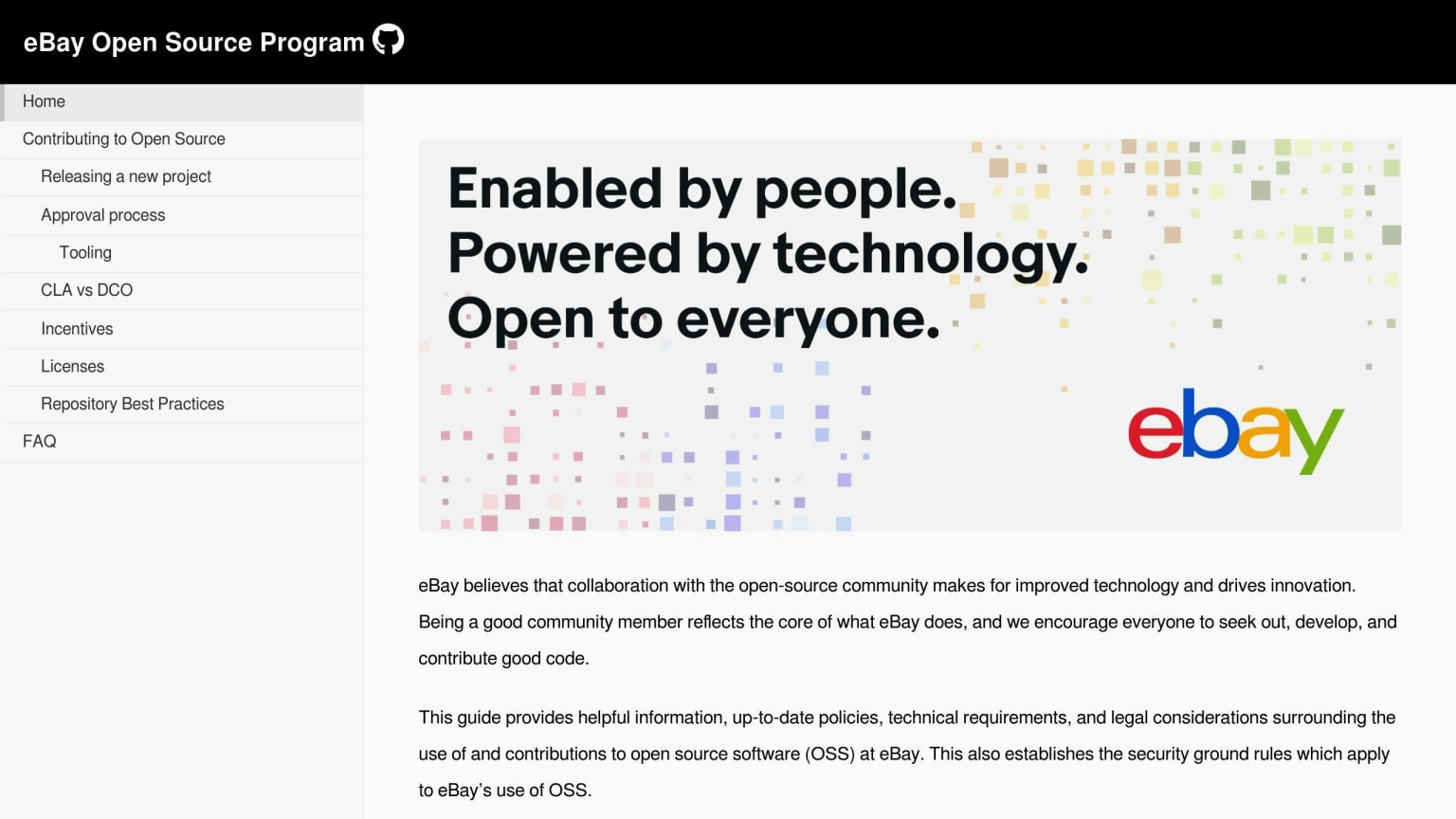
What It Covers
eBay's open source website is a hub for developers to contribute to the company's open source projects. It promotes open source development and collaboration.
Key Features
The website features a collection of eBay's open source projects that are open for contributions from developers. It provides resources and guidelines to help developers get started with contributing.
How It Works
To implement its open source policy, eBay:
Encourages Contributions: Developers are encouraged to contribute to eBay's open source projects, fostering a culture of collaboration and innovation.
Provides Resources: The website offers resources and guidelines to help developers contribute to eBay's open source projects.
Fosters Community-Driven Development: Contributions are reviewed and approved in a timely manner, promoting a community-driven approach to open source development.
Feature
Description
Project Collection
A collection of eBay's open source projects open for contributions.
Getting Started Guides
Resources and guidelines to help developers contribute to projects.
Contribution Review
Contributions are reviewed and approved, fostering community-driven development.
eBay's approach is the lightweight end of the spectrum: a public hub, clear contribution paths, and not much policy machinery. It works because most of their flagship projects (NMState, Beam, tsv-utils) ship under Apache 2.0, which handles patent grants and attribution without a lot of additional paperwork.
4. GitLab Team Handbook

Open Source Policy Overview
GitLab's Team Handbook provides guidelines for employees on open source development, contributions, and usage. The policy covers:
- Open-sourcing projects
- Contributing to third-party open source projects
- Using open source libraries
Key Guidelines
Open-Sourcing Projects
- Considerations for licensing, publication, and approvals
- Procedures for open-sourcing projects
Contributing to Open Source
- Contributor license agreements
- Merge request processes for third-party projects
Using Open Source Libraries
- List of acceptable and unacceptable licenses
- Email address for inquiries about license usage
Implementation
To implement their open source policy, GitLab:
- Encourages Open Source Development
- Provides resources and guidelines for open-sourcing projects
- Promotes Community Collaboration
- Timely contribution reviews and approvals
- Community-driven approach to open source development
- Offers Clear Licensing Guidelines
- Outlines acceptable and unacceptable licenses
- Ensures awareness of implications when using open source libraries
Guideline
Details
Open-Sourcing
Guidelines for licensing, publication, and approvals
Contributing
Contributor agreements and merge request processes
Using Libraries
List of acceptable/unacceptable licenses, inquiry email
5. Google OSPO Policies
What the Policies Cover
Google's Open Source Program Office (OSPO) policies provide guidelines for:
- Open-sourcing code
- Contributing to open-source projects
- Using open-source libraries
- Participating in hackathons
The policies ensure Google's open-source activities align with the company's goals and values.
Key Guidelines
Guideline
Details
Open-Sourcing Code
Detailed guidelines for open-sourcing code
Contributing
Guidelines for contributing to open-source projects
Using Libraries
Acceptable and unacceptable licenses for open-source libraries
Inclusive Language
Using inclusive language in open-source projects and communities
Code of Conduct
Code of conduct for open-source projects and communities
Security
Security policy for open-source projects and libraries
Implementation
- Resources and Guidelines
Google provides resources and guidelines for employees to:
- Open-source code
- Contribute to open-source projects
- Use open-source libraries
- Community Collaboration
Google encourages community collaboration and participation in open-source projects and communities.
- Review and Approval
Google reviews and approves open-source projects to ensure they align with the company's goals and values.
6. Linux Foundation Open Source Approval Form Template

What It Covers
The Linux Foundation Open Source Approval Form Template helps companies establish a process for reviewing and approving the use of Free and Open Source Software (FOSS) in their products.
Key Details
The template requires the following information for FOSS usage requests:
Information
Description
FOSS Component
The open source software being requested
Product Usage
The product and context where it will be used
Licensing
The licensing terms and conditions
Risks and Mitigation
Potential risks and strategies to address them
How to Use It
To implement this template, companies should:
- Establish a Review Process
- Set up an Open Source Review Board (OSRB) to evaluate FOSS requests
- Define a clear process for submitting and reviewing requests
- Provide Training and Resources
- Train developers and reviewers on using the template
- Offer resources on FOSS compliance and risk management
- Document and Track Approvals
- Maintain records of all approved FOSS components
- Track usage to ensure compliance with licensing terms
7. Microsoft Open Source Program
What It Covers
The Microsoft Open Source Program provides guidelines for using and contributing to open source software within the company. It aims to:
- Allow employees to contribute to open source projects
- Protect Microsoft's intellectual property
- Ensure compliance with open source licenses
Key Features
Feature
Description
Registration & Approval
All open source components must be registered and approved before use.
Distribution Requirements
Employees must comply with requirements like generating NOTICE files and providing source code when distributing open source components.
Contribution Guidelines
Guidelines for contributing to open source projects, including contribution policy, small changes, and larger changes.
Compliance
Ensures all open source components comply with relevant licenses and regulations.
Implementation Guidelines
- Establish a Clear Policy
Develop a clear policy for using and contributing to open source software within the company.
- Provide Training and Resources
Offer training and resources to employees on:
- Open source compliance
- Risk management
- Contribution guidelines
- Establish a Review Process
Set up a review process for open source requests, including:
- A clear process for submitting requests
- A process for reviewing requests
- Document and Track Approvals
- Maintain records of all approved open source components
- Track usage to ensure compliance with licensing terms
Microsoft's program is the heaviest of the ten and reads that way. The registration-before-use gate plus mandatory NOTICE file generation is the right model when you're shipping commercial software at scale. For an early-stage startup, lifting Microsoft's policy wholesale will create more review queues than shipped code.
8. Red Hat Open Source Participation Guidelines

What the Guidelines Cover
The Red Hat Open Source Participation Guidelines outline the company's approach to contributing to and participating in open source projects. The guidelines cover:
- Contributing changes and improvements to open source projects before including them in Red Hat products ("upstream first")
- Contributing to existing open source projects, including those led by competitors
- Considering existing open source alternatives before starting new projects
Key Points
Guideline
Details
Upstream First
Red Hat aims to contribute changes and improvements to open source projects before including them in their products.
Contributing to Existing Projects
Red Hat associates are free to participate in and contribute to existing open source projects, even those led by competitors.
Starting New Projects
Associates are encouraged to consider existing open source alternatives before starting new projects.
Implementation
- Understand the Guidelines
Familiarize yourself with the Red Hat Open Source Participation Guidelines to ensure compliance with the company's open source policies.
- Participate Actively
Encourage active participation in open source projects, including:
- Contributing code
- Reporting bugs
- Engaging with the community
- Respect Upstream Projects
Ensure that contributions to upstream projects follow the project's guidelines and governance model.
- Document Contributions
Maintain records of contributions made to open source projects, including:
- Code changes
- Bug reports
- Community engagement
9. SUSE Open Source Policy
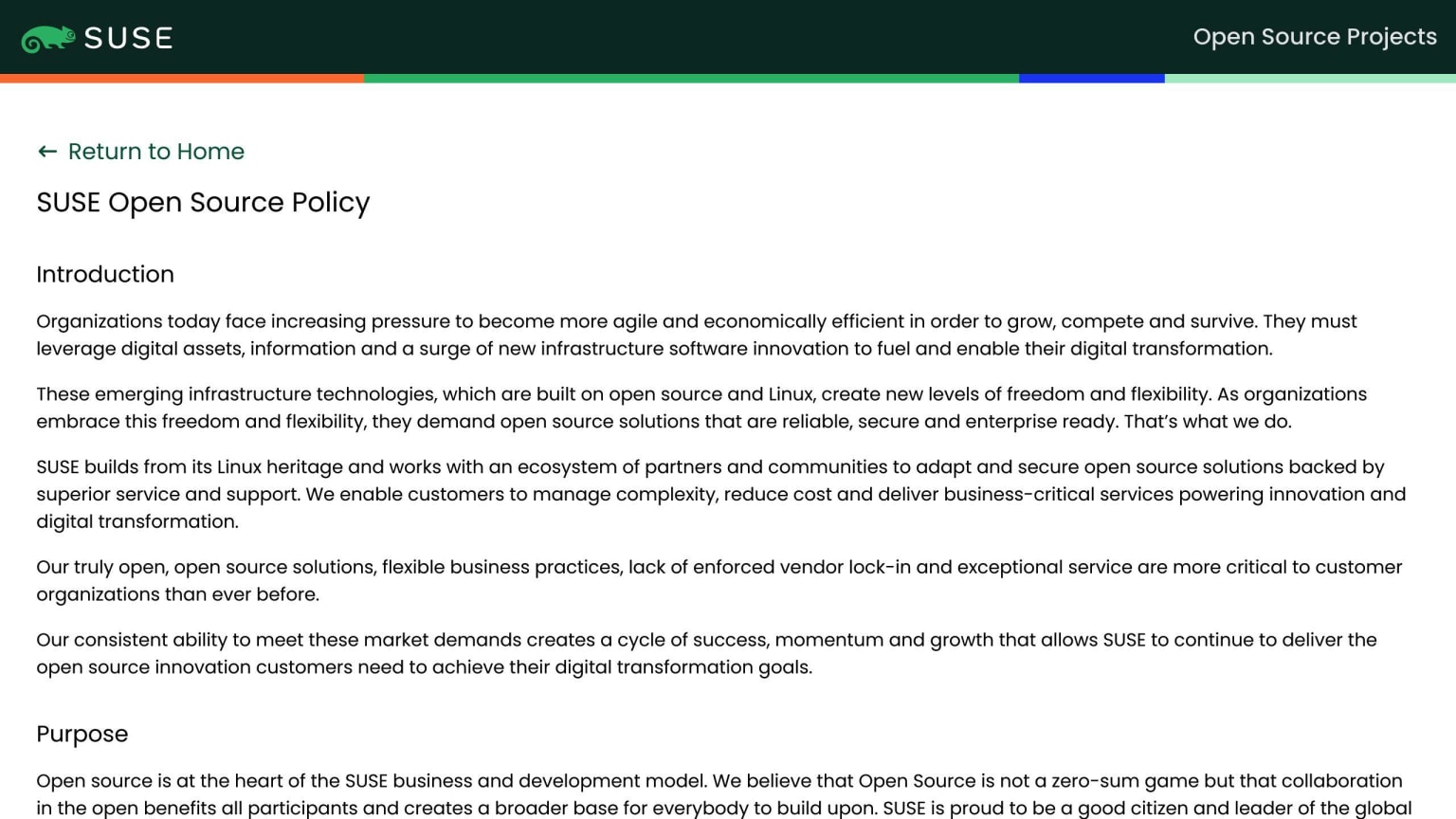
What It Covers
The SUSE Open Source Policy provides guidelines for:
- Managing open source software code
- Using the Open Build Service
- Conducting legal reviews
Key Points
Guideline
Details
Source Code Management
Keep a copy of the source code for all redistributed software. Create a bill of materials. Follow the "Upstream First" approach.
Open Build Service
Use the Open Build Service to reduce maintenance effort and leverage the community ("Factory First" approach).
Legal Reviews
Conduct legal reviews of distributed code to ensure compliance with open source licenses and identify any legal issues.
Implementation
To follow the SUSE Open Source Policy, contributors should:
- Study Project Guidelines
- Understand the contribution guidelines for the specific project.
- Familiarize yourself with the project structure, upstream, and related processes.
- Contribute to Upstream Projects
- Follow the guidelines for contributing to open source projects for all individual upstream projects.
- Conduct Legal Reviews
- Review the code being distributed to ensure compliance with open source licenses.
- Identify and address any legal issues.
10. Yahoo Open Source Guide
What It Covers
The Yahoo Open Source Guide provides a framework for managing open source projects within the company. It covers:
- Collaborating with the open source community
- Expectations for contributors
- The role of the Open Source Program Office (OSPO)
Key Features
Feature
Description
Community Collaboration
Encourages working with the open source community to solve shared problems
Contributor Expectations
Outlines expectations for contributors, including following the Code of Conduct and open source principles
OSPO Role
Defines the OSPO's role in governing, managing, and supporting open source projects
Implementation Guidelines
To effectively implement the Yahoo Open Source Guide:
- Collaborate with the Community: Encourage open communication and collaboration with the open source community to drive innovation and solve shared problems.
- Set Clear Contributor Expectations: Ensure contributors understand the expectations and guidelines for participating in open source projects, including following the Code of Conduct.
- Utilize the OSPO: Use the OSPO to provide governance, management, and support for open source projects, ensuring compliance with open source licenses and company policies.
Policy Feature Comparison
When choosing an open source policy template, consider the key features and guidelines of each option. Here's a comparison:
Template
Policy Focus
Key Features
Implementation Guidelines
Buffer Open Source Guide
Collaborating with open source community
Community collaboration, contributor expectations, Open Source Program Office (OSPO) role
Collaborate with community, set contributor expectations, utilize OSPO
Citi Guidelines
Contributing to open source projects
Contributor guidelines, license compliance, intellectual property protection
Follow contributor guidelines, comply with licenses, protect intellectual property
eBay Open Source Website
Managing open source projects
Project management, community engagement, license compliance
Manage projects, engage community, comply with licenses
GitLab Team Handbook
Collaborating on open source projects
Collaboration guidelines, contributor expectations, community engagement
Collaborate effectively, set contributor expectations, engage community
Google OSPO Policies
Governing open source projects
Policy governance, license compliance, intellectual property protection
Govern policies, comply with licenses, protect intellectual property
Linux Foundation Template
Approving open source projects
Project approval, license compliance, intellectual property protection
Approve projects, comply with licenses, protect intellectual property
Microsoft Program
Managing open source projects
Project management, community engagement, license compliance
Manage projects, engage community, comply with licenses
Red Hat Guidelines
Participating in open source projects
Participation guidelines, contributor expectations, community engagement
Participate effectively, set contributor expectations, engage community
SUSE Policy
Governing open source projects
Policy governance, license compliance, intellectual property protection
Govern policies, comply with licenses, protect intellectual property
Yahoo Guide
Collaborating with open source community
Community collaboration, contributor expectations, OSPO role
Collaborate with community, set contributor expectations, utilize OSPO
This table provides an overview of each template's key features and implementation guidelines. Compare these to choose the best fit for your organization's open source policy needs.
Choosing the Right Open Source Policy
Don't pick a template by company size or brand recognition. Pick by where your friction lives.
If the friction is contribution velocity (developers want to push fixes upstream and bureaucracy is in the way), start with GitLab's handbook or Red Hat's upstream-first guidelines. Both assume contribution is the default and define the exceptions.
If the friction is license risk in your distributed product (you ship binaries, firmware, or installers and a GPL component would force source disclosure), start with the Linux Foundation approval template plus SUSE's source-management practices. Pair that with an SBOM workflow (Syft, CycloneDX) so you can answer license-audit questions in minutes, not weeks.
If the friction is IP clarity for a future fundraise or acquisition, copy Citi's pre-approval gate and Buffer's copyright-assignment language. The diligence team will thank you.
If you don't have an OSPO yet and won't for two years, skip Google's policies. They assume staffing you don't have. Yahoo's lighter framework is closer to your reality.
One practical rule: write your acceptable-license list before you write anything else. "Apache 2.0, MIT, BSD-2/3-Clause, ISC, MPL 2.0 are allowed; GPL/AGPL require legal review; any license not on this list is forbidden by default" closes 90% of the decisions you'll otherwise have to make case by case.
Comparing Policy Templates
To help you choose, here's a comparison of the key features and implementation guidelines for each template:
Template
Focus
Key Features
Implementation Guidelines
Buffer Open Source Guide
Community collaboration
Contributor expectations, OSPO role
Collaborate with community, set contributor rules, utilize OSPO
Citi Guidelines
Contributing to projects
Contributor guidelines, license compliance, IP protection
Follow contributor rules, comply with licenses, protect IP
eBay Open Source Website
Managing projects
Project management, community engagement, license compliance
Manage projects, engage community, comply with licenses
GitLab Team Handbook
Collaborating on projects
Collaboration guidelines, contributor expectations, community engagement
Collaborate effectively, set contributor rules, engage community
Google OSPO Policies
Governing projects
Policy governance, license compliance, IP protection
Govern policies, comply with licenses, protect IP
Linux Foundation Template
Approving projects
Project approval, license compliance, IP protection
Approve projects, comply with licenses, protect IP
Microsoft Program
Managing projects
Project management, community engagement, license compliance
Manage projects, engage community, comply with licenses
Red Hat Guidelines
Participating in projects
Participation guidelines, contributor expectations, community engagement
Participate effectively, set contributor rules, engage community
SUSE Policy
Governing projects
Policy governance, license compliance, IP protection
Govern policies, comply with licenses, protect IP
Yahoo Guide
Community collaboration
Contributor expectations, OSPO role
Collaborate with community, set contributor rules, utilize OSPO
Review this table to identify the template that best aligns with your organization's open source strategy and requirements.