

Niche job boards and developer communities often beat LinkedIn—use specialized platforms to reach passive, higher-quality engineering talent.
LinkedIn isn’t the most effective platform for hiring developers anymore. Overcrowding, high costs, and low-quality applications make it challenging for recruiters. Developers, especially senior ones, prefer platforms that align with their interests, like technical communities and open-source networks. Here’s a breakdown of the best platforms to source software developers beyond LinkedIn in 2026:
- daily.dev Recruiter: Targets passive developers through a double opt-in system. Ideal for senior and specialized roles. Subscription-based pricing.
- Stack Overflow Jobs: Connects with 23M+ users and highlights technical expertise through community contributions. Costs $299 per listing.
- GitHub: Focuses on live coding contributions instead of resumes. Free to browse profiles but requires manual vetting.
- Hacker News: Free monthly job posts in a highly technical community. Best for startups and niche roles.
- RemoteOK: Exclusively for remote jobs with global reach. Costs $299–$498 per post.
- We Work Remotely: Remote-only platform with strong US/EU focus. Costs $299–$498 per post.
- Wellfound (AngelList): Startup-focused with equity-seeking candidates. Free tier available; promoted listings start at $200.
- key.dev: Matches developers with companies based on shared values. Best for teams highlighting workplace culture.
- InfoSecJobs: Specialized in cybersecurity roles. Focuses on pre-qualified candidates.
- DataSciJobs: Dedicated to data and machine learning positions. Lower cost-per-hire for analytics roles.
Quick Comparison
| Platform | Best For | Cost | Key Features |
|---|---|---|---|
| daily.dev Recruiter | Senior/specialized engineers | Subscription-based | Double opt-in system, passive talent focus |
| Stack Overflow Jobs | Technical expertise | $299 per listing | Community contributions and reputation scores |
| GitHub | Live coding contributions | Free | Manual vetting, global reach |
| Hacker News | Startups/niche roles | Free | Monthly thread, manual responses |
| RemoteOK | Remote positions | $299–$498 per post | Developer-specific filters, global audience |
| We Work Remotely | Remote-first teams | $299–$498 per post | US/EU focus, async-ready talent |
| Wellfound (AngelList) | Startups, equity roles | Free/$200+ | Direct connections with founders |
| key.dev | Value-driven hiring | Employer-paid | Focus on workplace alignment |
| InfoSecJobs | Cybersecurity professionals | Employer-paid | Pre-qualified candidates |
| DataSciJobs | Data/ML roles | Employer-paid | Targeted for analytics positions |
Recruiters should diversify their hiring strategy by using platforms that reach developers where they actively engage, ensuring better quality candidates and lower hiring costs. Using a developer hiring checklist can further streamline this process.
::: @figure 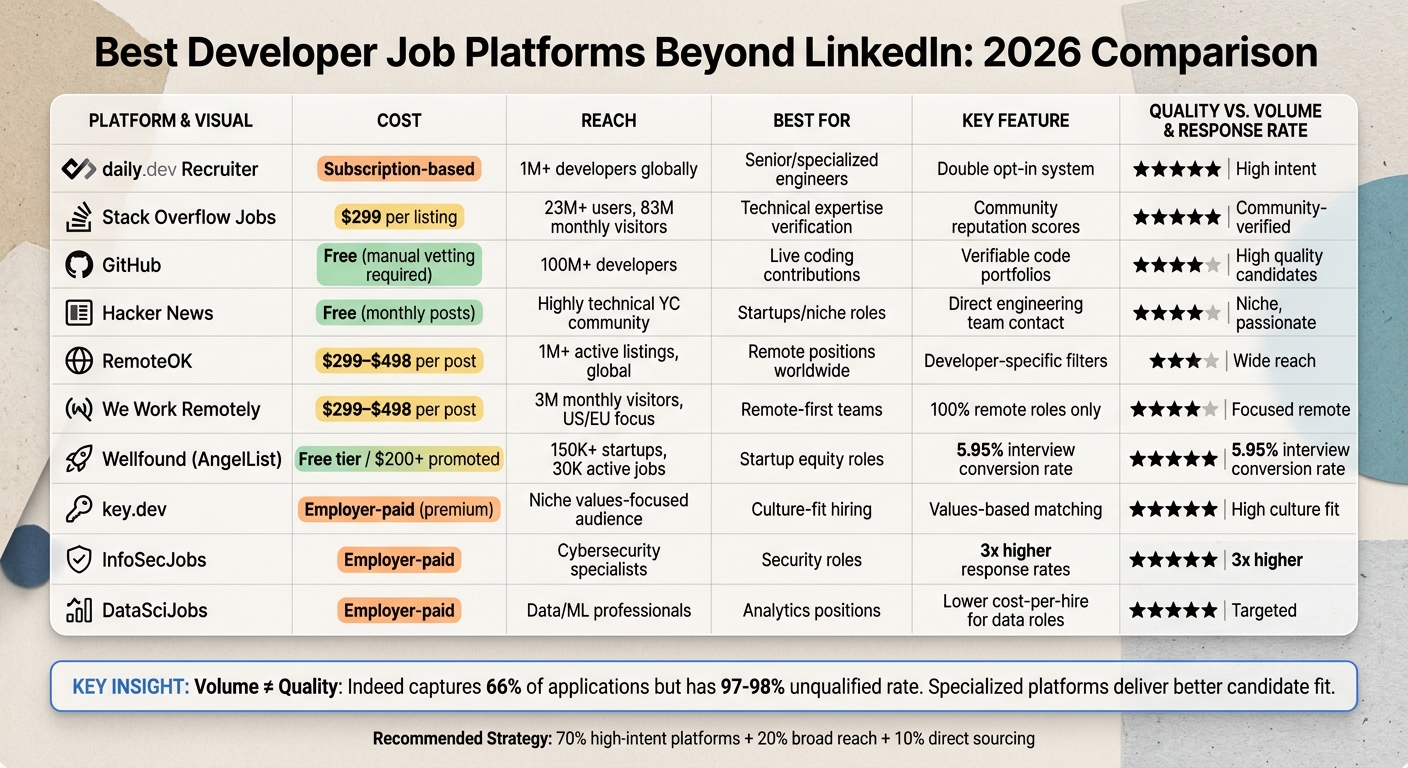 {Developer Job Platforms Comparison: Cost, Reach, and Best Use Cases 2026}
1. daily.dev Recruiter
daily.dev Recruiter takes a fresh approach to hiring. Instead of relying on traditional job boards where you post openings and wait, it connects you with passive developers - professionals already immersed in the daily.dev community, staying updated on technical trends and content.
Reach
This platform provides access to a global network of over 1 million developers who use daily.dev regularly to sharpen their skills and keep up with industry changes. Unlike mass-market job boards where your listing competes with endless others, daily.dev focuses on a specific audience: engineers who are open to the right opportunity. As Joveo Marketing explains:
daily.dev Recruiter sits atop a network where developers read technical news and build skills daily – giving recruiters context on what a candidate is currently learning, not just where they've worked .
Thanks to this real-time engagement data, you gain insight into the technologies developers are currently exploring - not just what’s on their resumes. This precise targeting ensures a cost model that values quality over sheer volume.
Cost
Unlike platforms like LinkedIn (which charges $7–$10/day) or Indeed ($5/day) , daily.dev Recruiter uses a subscription-based model. This means you’re not paying for random clicks from unqualified candidates. Instead, you’re investing in meaningful connections with pre-screened developers who fit your needs.
Applicant Quality
One standout feature is its double opt-in system. Developers only enter your pipeline after confirming mutual interest, ensuring a much higher level of relevance. This approach eliminates the overwhelming 97–98% rate of unqualified applications typically seen on general job boards . Instead of sifting through piles of irrelevant resumes, you’re engaging directly with developers who are genuinely interested.
Best Use Case
daily.dev Recruiter shines when you’re looking for senior or specialized engineers, particularly those not actively seeking jobs. It’s an excellent option for remote-first companies building global teams or industries like fintech and healthcare, where domain expertise is critical. By targeting passive talent actively involved in technical communities, it brings you closer to the right candidates with less effort.
sbb-itb-d1e6221
2. Stack Overflow Jobs
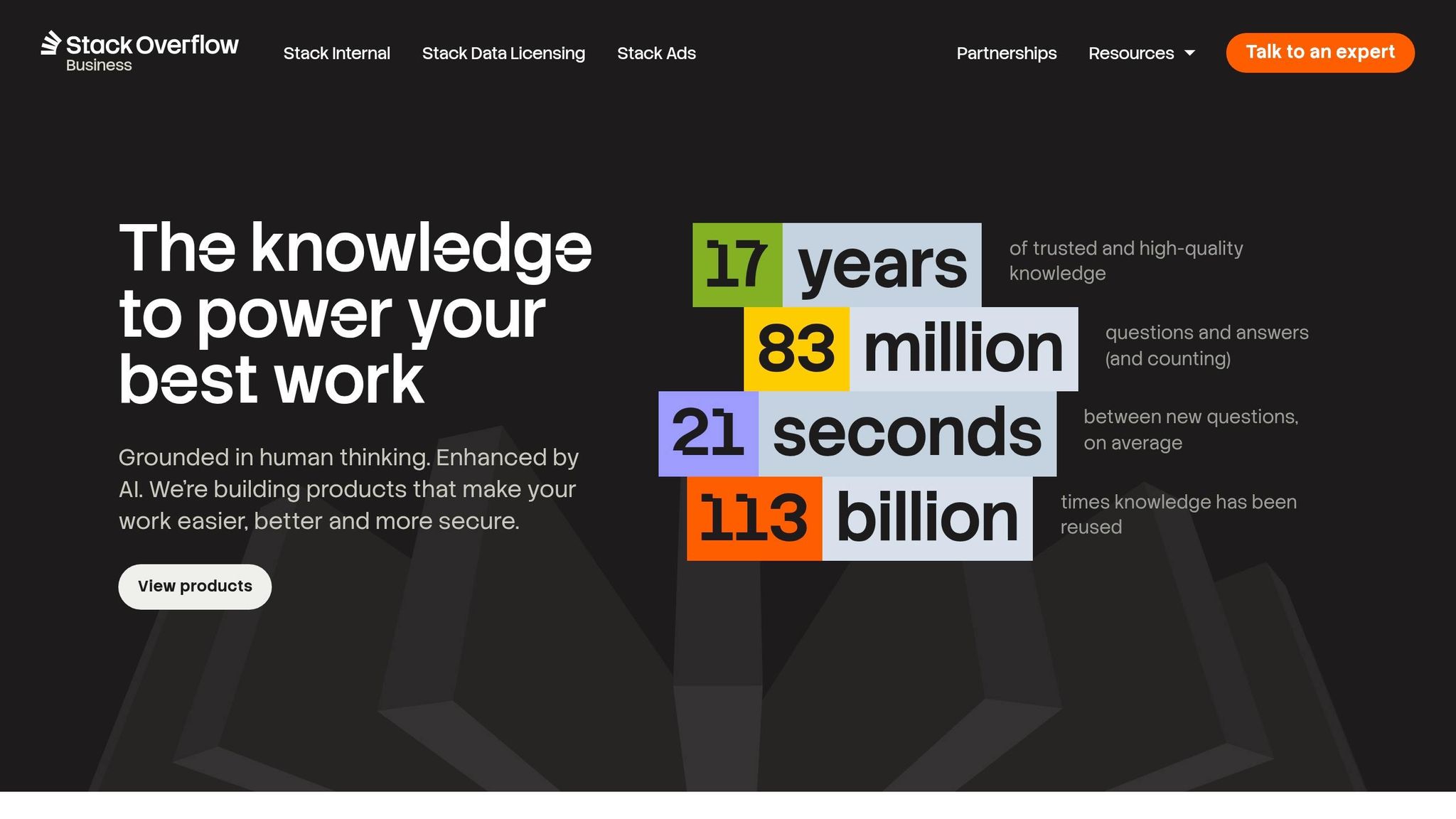
Stack Overflow Jobs is a platform designed for hiring developers with proven technical expertise. It stands out by offering insights into candidates' actual coding skills through their contributions to the Stack Overflow community.
Reach
Stack Overflow connects you with a massive audience of over 23 million registered users and garners approximately 83 million monthly visitors . Unlike platforms that aim for sheer volume, Stack Overflow focuses on developers actively solving technical problems. Many of these users are passive candidates - professionals who aren't actively job hunting but are open to the right opportunity that aligns with their skills.
Cost
Posting a job on Stack Overflow costs $299 per listing . While this price might seem higher than some general job boards, it reflects the platform's emphasis on quality over quantity. Your listing reaches developers whose community contributions demonstrate their expertise, making it a worthwhile investment for targeted hiring.
Applicant Quality
One of Stack Overflow's unique strengths is its ability to showcase candidates' actual technical contributions. Through features like reputation scores, answers to technical questions, and problem-solving approaches, you get a clear view of a candidate's skills. This transparency is hard to replicate with traditional resumes and leads to a significantly lower rate of unqualified applications compared to general job boards .
Best Use Case
Stack Overflow Jobs is ideal for hiring roles that demand strong technical skills and real-world problem-solving ability. Whether you're searching for a senior backend engineer to fine-tune database performance or a security specialist to handle complex challenges, this platform connects you with the right talent. It's particularly effective for finding developers with niche expertise who may not actively promote themselves but have a proven track record of tackling tough technical problems .
3. GitHub Jobs
GitHub may no longer have a formal job board, but it remains a go-to platform for recruiters looking to find top engineering talent. Instead of relying on job postings, companies now source candidates by reviewing their live contributions. Even in 2026, GitHub continues to stand out as a powerful tool for connecting with skilled developers .
Reach
GitHub boasts a global community of over 100 million developers . Interestingly, 37% of developers prefer showcasing their skills on GitHub, compared to just 14% who use traditional professional profiles . This makes GitHub more than just a resume - it’s a live portfolio that gives recruiters a real-time view of a developer's abilities.
"GitHub shut down its formal jobs board, but the platform is still one of the best places to find engineering talent."
– Nimrod Kramer, CEO & Co-Founder, daily.dev
Cost
There’s no fee to post jobs on GitHub since the platform operates differently now. Instead, your investment comes in the form of time spent manually browsing profiles, reviewing contributions, and vetting candidates. Public profiles are freely accessible, allowing you to evaluate code quality and activity at no cost [5,7]. While this requires more effort upfront, it offers a more accurate assessment of technical skills than traditional job boards.
Applicant Quality
One of GitHub’s strongest advantages is its transparency. Recruiters can review contribution graphs, analyze pull requests, and assess how candidates solve real-world problems - all before making contact . This approach significantly reduces the noise of unqualified applications, a problem that plagues platforms like Indeed, where 97–98% of applications may not meet the mark . With GitHub, you’re reaching out to developers based on verified work, not just self-reported credentials.
"The trend is clear: the market is moving toward verifiable output over self-reported credentials."
– Nimrod Kramer, CEO, daily.dev
Best Use Case
GitHub shines when sourcing passive candidates - those who aren’t actively job hunting but might be open to the right opportunity. This group makes up about 70% of engineers [7,10]. If you’re looking for developers with niche technical skills, GitHub allows you to search for contributors to repositories that align with your tech stack. This is one of several sourcing strategies that work for modern engineering teams. By reviewing their work and reaching out with personalized messages that reference their contributions, you can build trust from the start . This method not only respects developers' time but also aligns with the growing preference for verified technical skills over traditional resumes.
4. Hacker News Who's Hiring
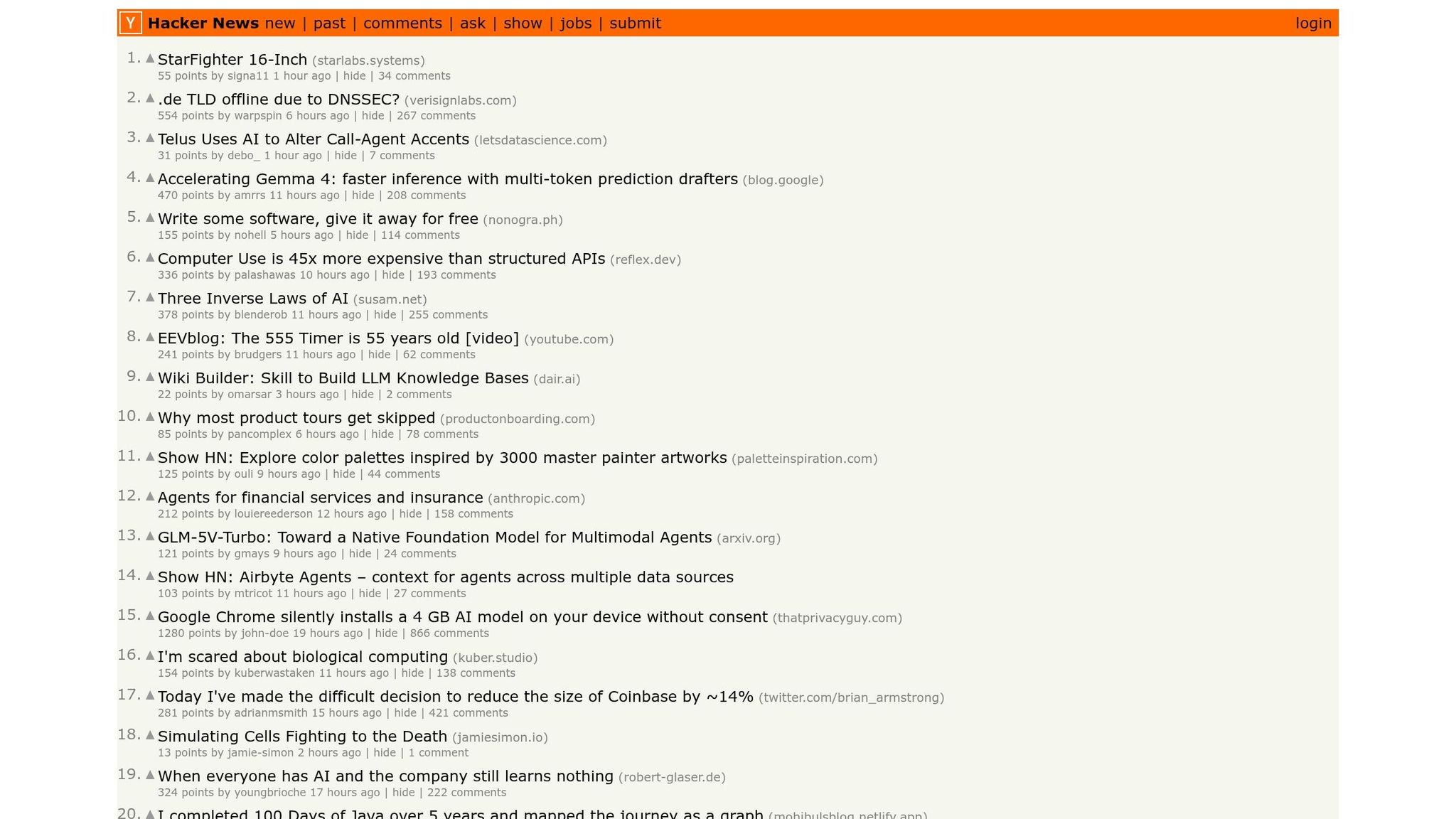
Hacker News takes a unique approach to job postings. On the first weekday of every month, an automated "Who is Hiring?" thread appears. Companies can share plain text descriptions about their projects, tech stacks, and a contact email.
Reach
Hacker News is home to one of the most technically skilled audiences online. Its community includes senior engineers, hackers, and self-taught developers who value technical depth over polished corporate messaging . Most users are passive candidates - engaging in discussions and exploring ideas rather than actively job-hunting. This is why many recruiters are turning to behavioral hiring platforms to reach engineers where they already learn and interact.
Cost
Posting on Hacker News is completely free. There are no paid options for boosting visibility, so your post's reach depends on timing and relevance. Keep in mind that you'll need to handle responses manually, as there’s no built-in applicant tracking system .
Applicant Quality
The platform draws candidates with exceptional technical expertise, which means fewer irrelevant applications. However, transparency is key. Posts that lack salary details or provide vague descriptions often fail to attract attention. To stand out, include specifics about your tech stack, role responsibilities, and compensation. This approach increases the chances of receiving applications from highly motivated candidates .
"It's raw text. Companies post exactly what they are building, the stack they use, and an email address to send your GitHub/resume directly to the engineering team."
– Dan Poller, Dev Community
The caliber of applicants makes Hacker News a strong choice among the top platforms for hiring software developers.
Best Use Case
Hacker News works best for startups, especially those creating developer tools, Y Combinator–backed companies, or roles with niche technical requirements like Rust, blockchain, or AI research. To maximize visibility, post early in the thread. Be sure to include your tech stack, a clear salary range (e.g., $150,000–$180,000), and direct contact information for your engineering team. Tools like HNHIRING.com can help candidates filter posts by location or technology, ensuring your listing remains accessible even after the initial posting.
5. RemoteOK
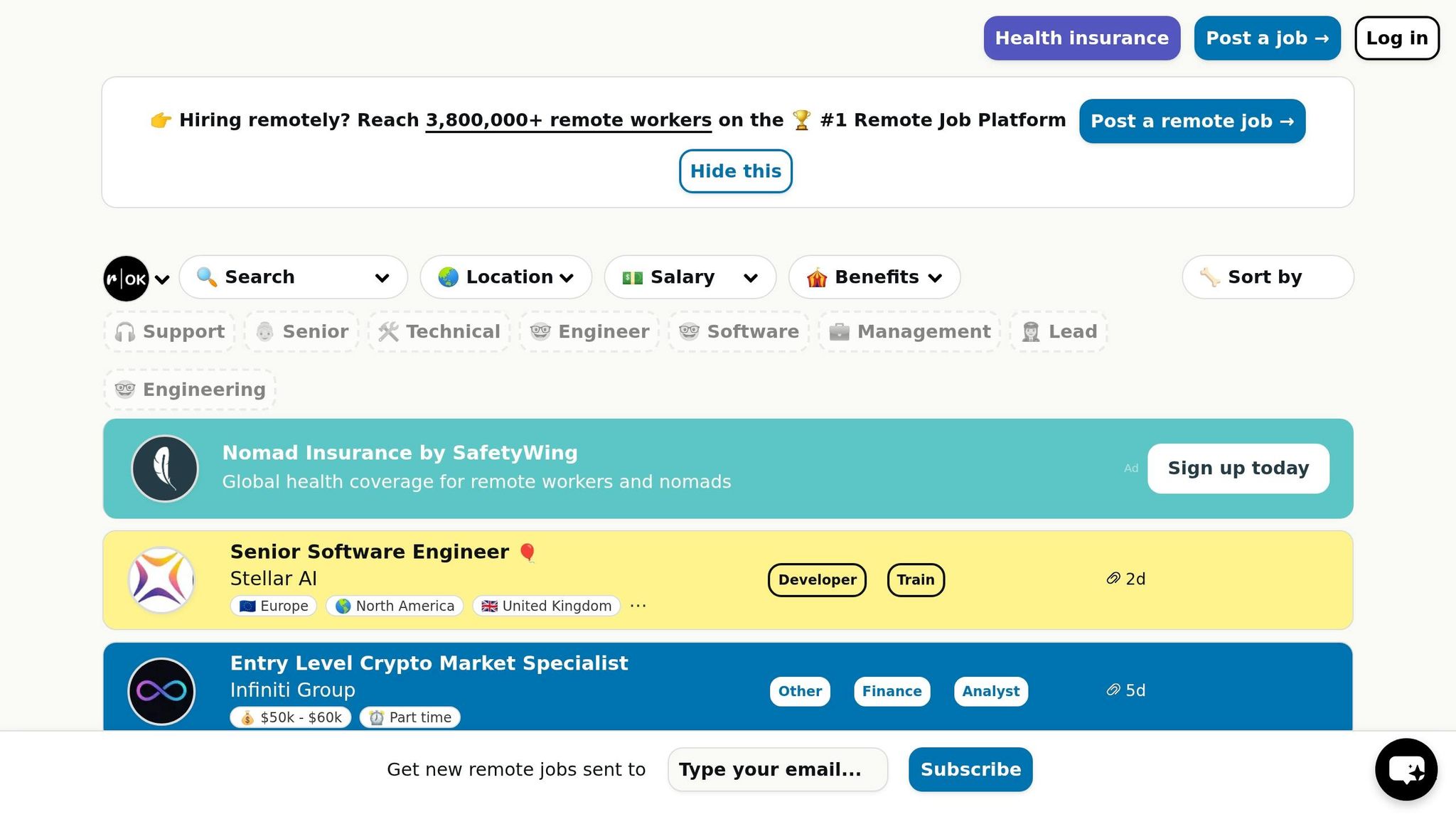
RemoteOK is a job board designed exclusively for remote positions, catering to companies hiring talent from around the globe. With over 1 million active listings, it’s a trusted platform for tech giants like Amazon, Microsoft, Stripe, and Y Combinator.
Reach
RemoteOK connects employers with a worldwide talent pool spanning Europe, Asia, and the Americas. Unlike traditional job boards that mix remote, hybrid, and on-site roles, every listing on RemoteOK is remote by design. This eliminates unnecessary filtering and appeals to candidates already accustomed to asynchronous communication and managing time zone differences. The platform also offers developer-specific filters for technologies like React, Rust, and Go, along with a "hiring worldwide" badge that highlights opportunities open to global applicants. This focus on remote work ensures clarity and attracts the right audience.
Cost
Posting a job on RemoteOK costs between $299 and $498 for 30 days, with no additional fees tied to successful hires. The platform features a "Hot" ranking system that boosts visibility for jobs gaining traction. This means that posting early or frequently can enhance exposure without incurring extra charges.
Applicant Quality
RemoteOK appeals to candidates who are fully committed to remote work, ensuring better alignment with the roles offered. Employers can expect applications from engineers who are already prepared for the unique demands of remote positions. However, salaries for remote roles on such platforms often trend 15-25% lower than equivalent on-site roles, reflecting global market adjustments. To stand out, detailed and precise job descriptions are essential, as candidates often use tech-specific tags to bypass generic listings.
Best Use Case
RemoteOK is ideal for companies operating fully remote or asynchronous teams, especially those hiring without geographic restrictions. It’s particularly useful for avoiding irrelevant on-site listings found on broader job boards. To maximize results, include specific tech stack tags in your job post to attract specialized senior talent. Highlighting benefits like asynchronous workflows and flexibility with time zones will resonate strongly with the remote tech community.
6. We Work Remotely
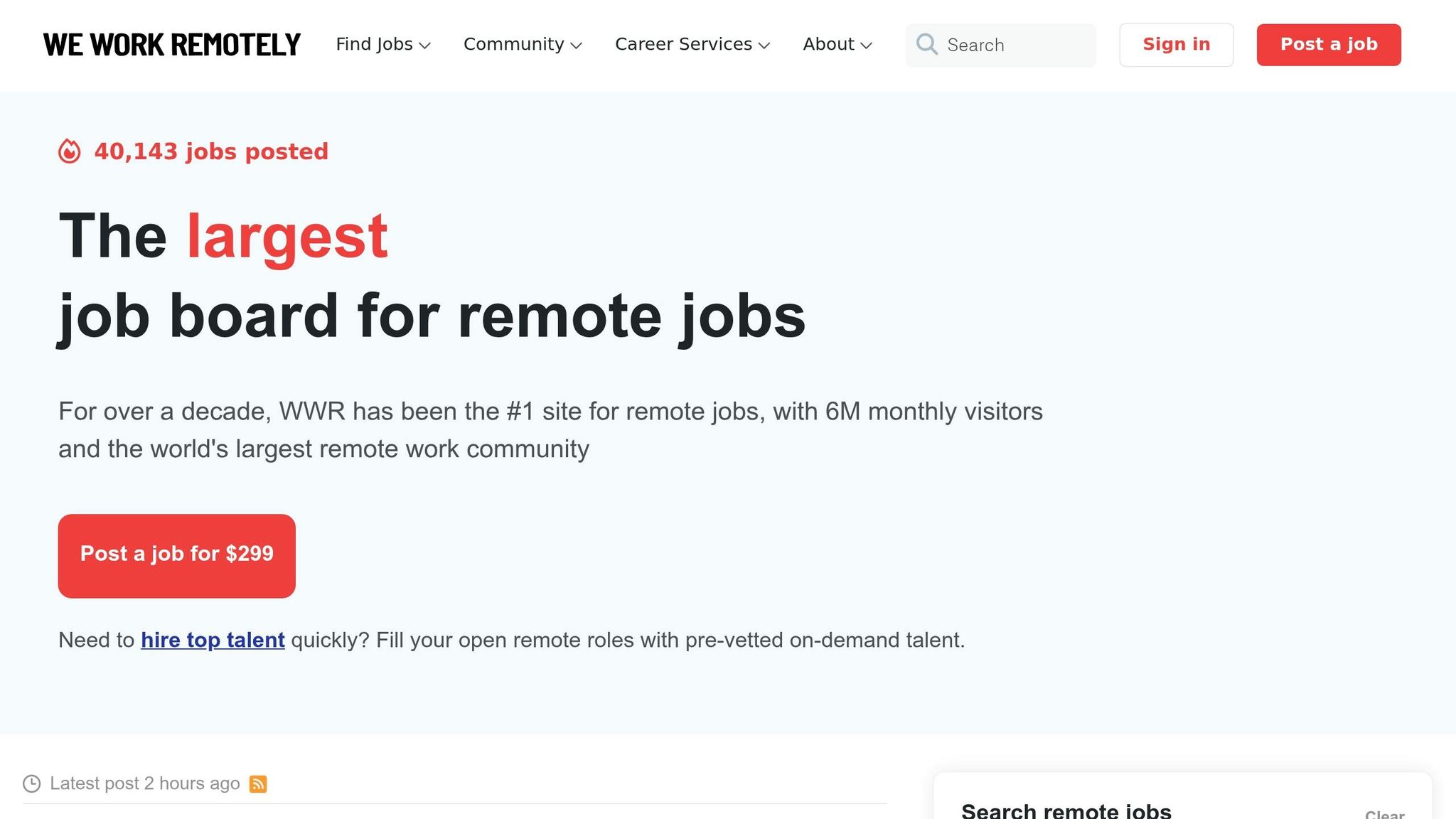
We Work Remotely (WWR) is one of the longest-standing job boards dedicated entirely to remote work. It boasts an impressive audience of 3 million monthly visitors and 4.5 million remote professionals from over 3,000 companies worldwide .
Reach
WWR exclusively lists remote positions - no hybrid or on-site roles - making it a go-to platform for candidates who consider remote work a baseline expectation rather than a bonus. Its strongest reach is in the US and Europe, which may limit its effectiveness for hiring developers in Asian time zones like Vietnam or Malaysia . Candidates typically respond within 24–48 hours, offering a faster turnaround compared to traditional job boards . This speed, combined with its focus on remote roles, often results in more relevant applicants, particularly for technical positions.
"We Work Remotely is probably the most visible of the bunch. It attracts companies that are serious about distributed teams, not companies offering 'remote with mandatory quarterly onsites'." – Nimrod Kramer, CEO, daily.dev
Cost
Posting a job on WWR costs between $299 and $498 for a 30-day listing, with no additional commissions or placement fees . For companies hiring at scale, a $199 candidate filtering service is available to simplify the screening process. The estimated cost per qualified candidate falls between $100 and $200 .
Applicant Quality
WWR tends to attract mid-to-senior level developers, particularly those skilled in Ruby on Rails, Python, and frontend development . These professionals usually have dedicated remote work setups and are well-versed in distributed workflows, making them ideal for remote-first teams . To ensure you draw top-tier candidates, it’s crucial to highlight a "remote-first" culture in your job description, specify the required tech stack, and include transparent developer job posts with clear salary ranges.
Best Use Case
WWR is ideal for companies building fully distributed engineering teams without geographical limitations. It’s especially effective for hiring experienced remote developers who can work independently across time zones. If your primary candidate pool is in the US or Europe and you’re looking to fill roles in Ruby, Python, or frontend development, this platform can deliver strong results within 1 to 2 weeks . For a comparison, consider exploring platforms that focus on emerging tech talent next.
7. AngelList/Wellfound
AngelList, now rebranded as Wellfound, serves as a bridge for over 150,000 startups and candidates eager to join early-stage companies, often in equity-based roles . Unlike traditional job boards, Wellfound allows candidates to skip HR and directly connect with CTOs or technical founders .
Reach
Wellfound is a tier 2 niche platform tailored for startup hiring, particularly in tech-focused roles. At any given time, the platform features around 30,000 active job listings . With a response rate of 5.33%, it outperforms Indeed's 4.7% for similar positions . Its strongest presence is in U.S. and European startup hubs, though it has less traction in Asian markets . Typical salary expectations for candidates range from $120,000 to $200,000, often paired with 0.1–1% equity for early-stage roles . This makes it especially attractive for full-stack developers, Web3 engineers, and product-focused engineers working at Seed to Series C startups [1, 3, 6].
"If you want to build things from the ground up and care about tech stacks and equity, Wellfound is your go-to. It is the absolute best place to find engineering roles at startups." – Dan Poller, Dev
Cost
Wellfound offers a free tier that allows unlimited job postings, as long as salary and equity details are shared upfront [3, 15]. For more visibility, promoted listings start at $200, while the Recruit Pro Plan, priced at $499 per month, provides advanced sourcing tools and coding-focused candidate sourcing tools and insights into candidates. On average, the cost per qualified candidate ranges from $50 to $150 .
Applicant Quality
The platform boasts a 5.95% interview conversion rate, nearly double LinkedIn's 3.10% for similar roles . Startups using Wellfound are required to disclose equity percentages upfront, typically ranging from 0.1% to 1% for early-stage positions .
Best Use Case
Wellfound shines for hiring in early-stage companies (Seed to Series C) where equity plays a key role in compensation. It’s particularly effective for roles like full-stack and Web3 engineers, where candidates prioritize modern tech stacks and direct engagement with founders [1, 6]. This targeted focus addresses the unique needs of startup hiring and complements the broader landscape of developer job boards.
8. key.dev
key.dev (formerly Key Values) sets itself apart among tier 2 platforms by focusing on cultural values. Instead of zeroing in on just technical skills, it connects candidates with companies that share their core beliefs and priorities.
Reach
key.dev appeals to a niche audience of developers who care deeply about workplace culture, team collaboration, and working on meaningful projects. These candidates tend to be selective, evaluating what developers want and company values carefully before applying. While the user base might be smaller, it’s highly engaged and intentional.
Cost
The platform operates on an employer-paid model, positioning itself as a premium service for finding quality matches. Pricing specifics depend on the employer's needs.
Applicant Quality
Developers using key.dev often stand out for their commitment to cultural alignment. The platform’s focus on team culture, preferred tech stacks, and impactful projects attracts candidates who are thoughtful in their job searches. This results in a pool of applicants who genuinely connect with a company’s values, making cultural fit a natural outcome.
Best Use Case
key.dev works best for companies with a strong engineering culture that want to showcase their values throughout the hiring process. If your team emphasizes work-life balance, cutting-edge methodologies, or mission-driven goals, this platform can help you find candidates who share those same priorities.
9. InfoSecJobs
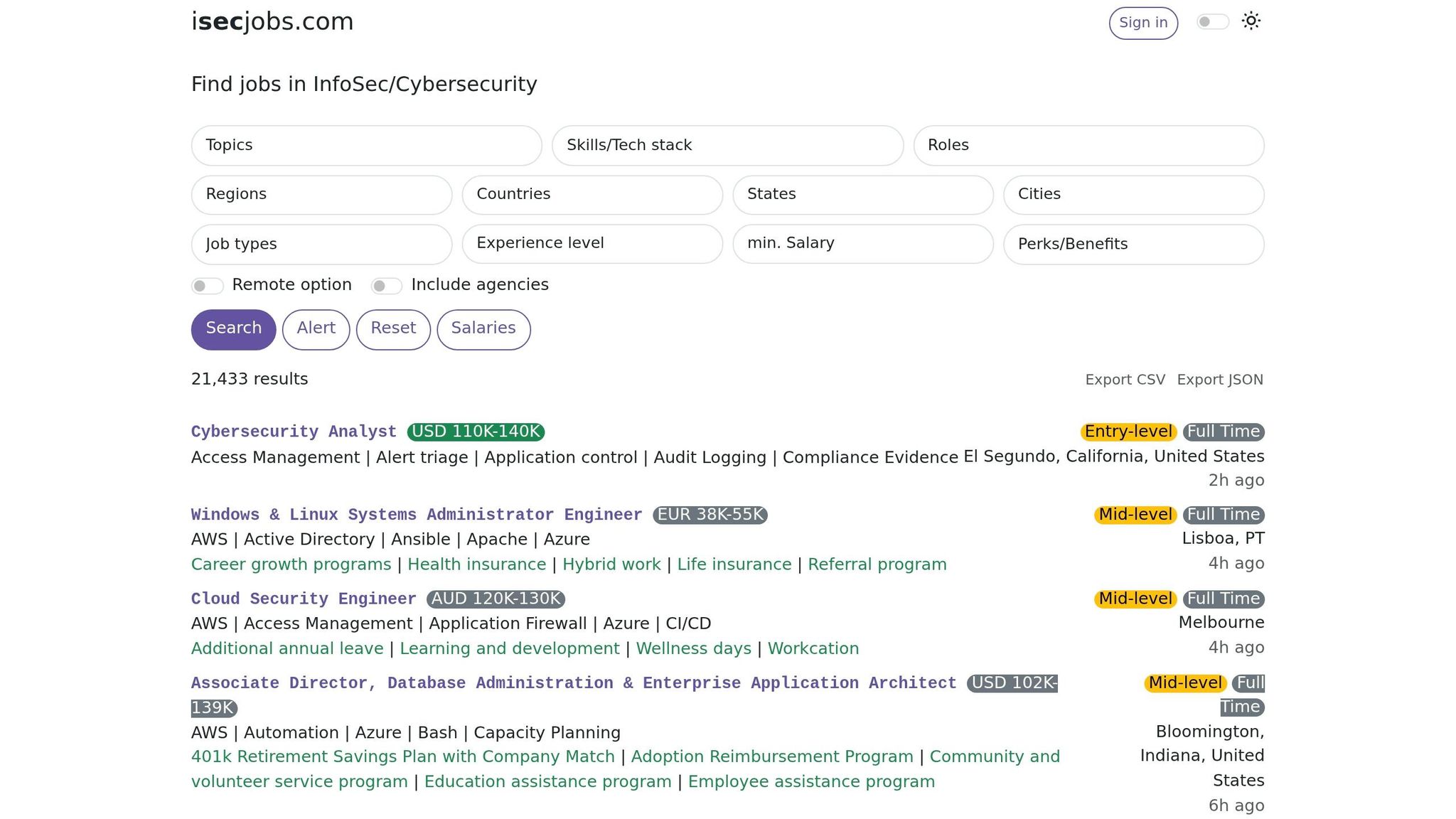
InfoSecJobs is a platform designed specifically for cybersecurity and information security roles. Whether you're looking for security engineers, penetration testers, or security researchers, this niche job board helps cut through the noise often found on general platforms.
Reach
Security roles require a targeted approach, and InfoSecJobs delivers just that. It connects employers with professionals who are deeply involved in the cybersecurity world. This platform focuses on reaching individuals who are actively engaged in specialist communities or technical networks, rather than those casually browsing mainstream job boards. Many of these professionals are passive candidates, meaning they aren't actively job hunting but are open to the right opportunity . This makes InfoSecJobs a go-to platform for finding cybersecurity talent.
Cost
InfoSecJobs follows an employer-paid model tailored to its niche audience. While pricing depends on the package you choose, the platform often provides a better return on investment compared to general job boards. Why? Because you're connecting directly with pre-qualified candidates, saving time and effort by avoiding unqualified applicants.
This cost-effective model is paired with a strong track record of delivering high-quality candidate responses, making it a reliable choice for employers.
Applicant Quality
Specialized platforms like InfoSecJobs consistently outperform general job boards when it comes to applicant quality. In fact, they report 3x higher response rates . The platform’s focus on security roles ensures a better signal-to-noise ratio, which is crucial when hiring for "difficult-to-fill technical roles" like security researchers . Companies also benefit from a lower cost-per-hire while securing better-fit candidates . For technical roles requiring advanced security expertise, this platform is a clear winner.
Best Use Case
InfoSecJobs is ideal for hiring specialized security professionals such as security engineers, penetration testers, threat analysts, and security researchers. It’s particularly effective for roles that require specific certifications, experience with specialized tools, or expertise in areas like penetration testing, threat intelligence, or security architecture. When you need highly qualified candidates for niche security roles, InfoSecJobs delivers better results than broad job boards.
Next, we’ll take a look at another niche platform tailored for data-related roles.
10. DataSciJobs
Now let’s shift focus to DataSciJobs, a platform dedicated to data and machine learning roles. Unlike broader job boards, this site zeroes in on targeted listings, making it easier for employers to connect with and identify qualified technical candidates without wading through irrelevant applications . Here’s a closer look at its reach, cost, applicant quality, and ideal use cases.
Reach
DataSciJobs is tailored for professionals in data-centric roles, going beyond the standard "data scientist" job title. It connects employers with talent specializing in areas like data engineering, machine learning, and analytics .
Cost
The platform operates on an employer-paid model, with pricing depending on the package selected. This approach often translates to a lower cost-per-hire, making it appealing for companies looking to optimize their hiring budget .
Applicant Quality
By focusing exclusively on data-related positions, DataSciJobs ensures that applicants already possess the necessary skills. This specialization can save employers valuable time during the screening process .
Best Use Case
DataSciJobs is particularly effective for hiring professionals in specialized analytics and data roles. Whether you’re building a data-focused team or filling niche positions, this platform helps cut through the clutter found on more general job boards.
Platform Comparison: Strengths and Weaknesses
To help you navigate the differences between platforms, here's a quick breakdown of their key strengths and limitations. Whether you're prioritizing budget, hiring speed, or targeting specific developer communities, this comparison table highlights the essentials to guide your decision.
| Platform | Key Strengths | Main Limitations |
|---|---|---|
| daily.dev Recruiter | Warm, double opt-in introductions; connects with passive developers engaging with technical content | Less established compared to traditional job boards |
| Stack Overflow | Access to over 23M technical problem-solvers; credibility through activity-based signals | High competition for visibility; some contexts lack a dedicated jobs tab |
| GitHub Jobs | Showcases verifiable coding activity through repositories; reaches a global audience of 100M+ developers | No built-in applicant tracking system; requires manual profile browsing |
| Hacker News | Engages a highly technical, YC-affiliated community | Limited to one post per month; lacks an ATS; short post visibility |
| RemoteOK | 1M+ active listings; no fees per successful hire; global reach | High noise-to-signal ratio; requires manual candidate vetting |
| We Work Remotely | 100% remote-focused; attracts async-ready talent; 3M+ monthly visitors | No free tier for employers; leans heavily toward US/EU candidates |
| Wellfound | Startup-focused; equity-seeking candidates; 5.33% response rate (higher than Indeed's 4.7%) | Smaller talent pool compared to LinkedIn; limited reach in Asia |
| key.dev | Targets senior engineers with specific tech stack expertise | Niche audience limits overall reach |
| InfoSecJobs | Specializes in cybersecurity talent; pre-qualified professionals | Exclusively for security roles; smaller candidate pool |
| DataSciJobs | Tailored to data-centric roles; lower cost-per-hire for analytics positions | Narrow focus; unsuitable for general engineering hires |
As Elton Chan, Co-Founder of Second Talent, aptly states:
"Volume is not quality. Indeed captures 66% of all applications but posts a 97-98% unqualified rate" .
Platforms like Hacker News and Wellfound cater to transparency-focused hiring, requiring salary ranges upfront. This approach screens out less-serious candidates and attracts those genuinely aligned with your offer. Meanwhile, daily.dev Recruiter emphasizes quality over quantity with its double opt-in model, ensuring mutual interest from the start and eliminating cold outreach. This shift requires understanding developer needs to ensure long-term engagement.
This comparison underscores the importance of matching recruiting software platforms to your specific hiring strategy, whether that's speed, precision, or reaching niche talent pools.
Conclusion
Hiring the right developers in 2026 requires aligning your platform strategy with your specific hiring goals. For a remote-first team, platforms like We Work Remotely and RemoteOK are ideal. If you're targeting specialized roles such as cybersecurity or data science, InfoSecJobs and DataSciJobs can connect you with pre-qualified candidates without unnecessary distractions. Early-stage startups looking for engineers willing to work for equity should focus on Hacker News and Wellfound, while enterprise teams hiring for DevOps or infrastructure roles may benefit from platforms with deeper technical expertise. By diversifying your approach, you can expand your candidate pool and improve quality by targeting the places where top talent actually gathers.
Relying on a single platform limits both your reach and the quality of candidates. Specialized platforms attract developers who are genuinely interested in the roles you’re offering, which is why a layered approach is often the most effective.
Consider using a 70-20-10 strategy: dedicate 70% of your efforts to high-intent platforms where your target candidates are most active, 20% to broader channels like LinkedIn to increase reach, and 10% to direct sourcing or referrals . To measure success, focus on your cost per qualified candidate rather than just cost per application. This approach, combined with the platform comparisons discussed earlier, ensures a well-rounded strategy for acquiring tech talent. Tools like daily.dev Recruiter, which offer warm, double opt-in introductions, can further streamline your hiring process.
The best recruitment strategies involve multiple touchpoints. Pair high-intent platforms like daily.dev Recruiter with hiring in developer communities like GitHub or Stack Overflow to verify technical skills. This method respects developers’ time while giving you access to both active job seekers and passive candidates who might not frequent traditional job boards.
Ultimately, your choice of platforms should reflect where developers actively showcase their skills, not just where they upload outdated resumes. By focusing on where talent thrives, you can build a stronger, more capable team.
FAQs
How do I pick the best platform for my developer role?
To select the right platform, start by identifying your hiring objectives and the kind of candidates you're targeting. Pay attention to factors like how far the platform can reach, the quality of candidates it attracts, and how quickly candidates respond. For specialized roles, niche platforms such as Stack Overflow Jobs or GitHub can be highly effective. On the other hand, community-focused channels like Reddit or Discord are excellent for connecting with active and engaged developers. Using a mix of platforms can help you find candidates that better match your needs while staying within your budget.
What should I include to attract high-quality developer applicants?
To bring in top-notch developer talent, focus on creating job postings that are clear and to the point. Start by including transparent salary ranges - this builds trust and saves time for everyone. Be upfront about the technical requirements, listing out the tech stack and tools they'll use, along with realistic day-to-day responsibilities. Developers also appreciate seeing details about meaningful projects they'll be working on, so make sure to include that.
Want to boost your chances of connecting with the right candidates? Share your job postings on platforms developers already frequent, like GitHub or Stack Overflow. These are spaces where engineers actively engage, making them ideal for finding skilled professionals who align with your needs.
How can I measure ROI for job posts beyond LinkedIn?
Tracking the return on investment (ROI) in recruitment means paying close attention to metrics like cost per qualified applicant and time to the first quality candidate. These figures help you understand how efficiently your resources are being used.
To refine your approach, compare response rates and conversion rates across different platforms. This will reveal which channels are bringing in the best candidates for the lowest cost. Additionally, monitor the number of applicants, their progress through interviews, and eventual hires from each source. This data will guide you in prioritizing the platforms that consistently deliver strong results and trimming efforts on underperforming ones.


