

Hire and scale a developer marketing team: which roles to prioritize, key skills, hiring order, and metrics to reduce time-to-value.
Developers don't respond to traditional marketing tactics. Instead, they value technical accuracy, trust, and hands-on resources. Building a developer marketing team requires understanding these needs and hiring roles that blend technical expertise with marketing skills. Here's a quick breakdown:
- Key Roles: Developer Advocate, Technical Content Writer, Community Manager, Growth Marketer, Product Marketer.
- Hiring Priorities: Align the first hire with your go-to-market strategy - Growth Marketer for product-led models, Developer Advocate for sales-led, or Technical Content Writer for a hybrid approach.
- Skills to Look For: Technical knowledge (APIs, backend systems), content creation, and community engagement.
- Team Growth: Start with a generalist for early-stage companies, then expand to specialists as revenue grows.
The focus should always be on creating resources and strategies that help developers quickly adopt and trust your product. Each role should directly contribute to improving metrics like Time-to-Value, active user growth, or revenue influence.
Why Developer Marketing Teams Are Different from B2B Marketing Teams
Developer marketing operates on a completely different wavelength compared to traditional B2B marketing. While B2B marketing leans heavily on persuasive, benefit-driven content to generate leads, developer marketing prioritizes technical credibility. This audience demands accuracy and hands-on expertise - often requiring marketers to have a background in engineering themselves - to earn their trust. Developers can quickly spot fluff or inaccuracies, so authenticity is non-negotiable .
This fundamental difference affects everything, from goals to content strategies. For instance, traditional B2B teams focus on metrics like Marketing Qualified Leads (MQLs) and top-of-funnel signups. Developer marketing, on the other hand, zeroes in on Time-to-Value (TTV) and active product usage. A key example? Instead of tracking contact form submissions, they measure how quickly a developer can get to a "hello world" moment with the product .
When it comes to content, the contrast is just as stark. B2B marketers typically create high-level materials like case studies, whitepapers, and sales presentations targeted at executives. Developer marketing skips the fluff and goes straight to the technical core, offering tutorials, code samples, and API documentation. This type of content speaks directly to the developer's needs and workflow .
Engagement tactics differ, too. Traditional B2B teams often rely on LinkedIn InMail, cold outreach, and industry conferences to connect with decision-makers. In contrast, developer marketers meet their audience where they already are - platforms like GitHub, Stack Overflow, Reddit, and Discord. And since over 60% of developers use ad-blockers, traditional display ads are largely ineffective for this group .
The growth strategy flips the usual B2B playbook as well. Instead of a top-down, sales-led approach, developer marketing thrives on a bottom-up strategy. It encourages individual developers to experiment with tools on side projects, eventually becoming advocates for broader adoption within their companies. This approach also emphasizes streamlining self-serve signup flows and making in-product activation as seamless as possible .
Understanding these differences is essential for building a developer marketing team that truly resonates with its audience. The focus isn’t just on selling - it’s about creating genuine value and reducing barriers for developers to engage with and adopt the product.
5 Core Roles in a Developer Marketing Team
::: @figure 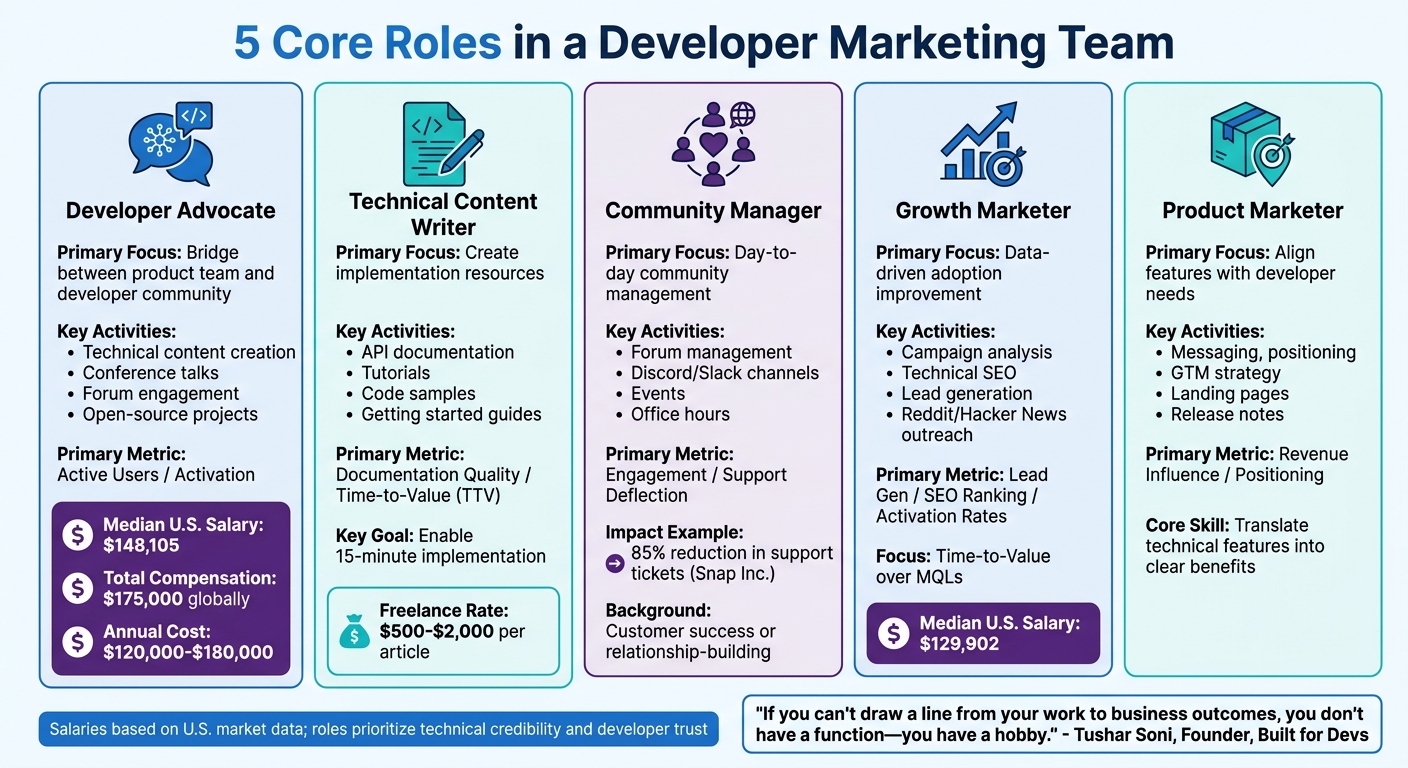 {Developer Marketing Team Roles: Responsibilities, Metrics, and Salaries Comparison}
Assembling a developer marketing team means bringing together experts who can bridge the gap between technical know-how and marketing strategy. Each role plays a key part in guiding developers through their journey - from discovering your product to becoming loyal advocates. Knowing what each role entails helps you build a team that connects with developers on a deeper level.
These roles combine technical expertise with a focus on community, creating a well-rounded approach to developer marketing. Each position brings something essential to the table.
Developer Advocate
Developer Advocates act as the bridge between your product team and the developer community . Their work is split between creating technical content - like tutorials and conference talks - and engaging with developers on forums, open-source projects, and platforms like Discord . They also provide valuable feedback to product teams, ensuring developer needs are represented. For instance, at SendGrid, Developer Evangelists manage API wrapper libraries and open-source documentation to keep integrations functional and supported .
In the U.S., the median base salary for a Developer Advocate is $148,105, with total compensation averaging $175,000 globally . Hiring an in-house advocate typically costs between $120,000 and $180,000 annually .
"Your first DevRel should scale what's already working, not completely start from scratch." - Josh Dzielak, Co-Founder and CTO, Orbit
Technical Content Writer
Technical Content Writers are responsible for creating the resources that help developers quickly implement your product. This includes API documentation, guides, tutorials, and code samples that reduce Time-to-Value (TTV) - the time it takes a developer to go from discovery to successful implementation .
Good documentation is critical for adoption. A well-written "Getting Started" guide should enable developers to implement a solution in as little as 15 minutes . These writers focus on delivering practical, in-depth content without unnecessary fluff . Freelance writers in this field typically charge $500 to $2,000 per article, depending on the complexity .
Community Manager
Community Managers handle the day-to-day management of forums, Discord servers, Slack channels, and in-person events. Their goal is to create an environment where developers can collaborate, share feedback, and help each other . For example, Snap Inc.'s DevRel team launched a community forum and hosted office hours for their Camera Kit SDK between 2021 and 2023, reducing support tickets by 85% and uncovering issues like unclear SDK methods .
These managers often have backgrounds in customer success or relationship-building. They also track engagement metrics to identify common challenges developers face .
Growth Marketer
Growth Marketers, sometimes called Technical Marketing Managers, focus on using data and experimentation to improve how developers find, adopt, and stick with your product. They work on campaign analysis, SEO for technical terms, and lead generation through platforms like LinkedIn, Reddit, and Hacker News . Unlike traditional marketers, they prioritize metrics like Time-to-Value, activation rates, and active user growth over typical B2B metrics like marketing-qualified leads (MQLs) .
Their analytical approach and understanding of developer-focused channels make them essential for connecting with technical audiences. In the U.S., the average salary for a Technical Marketing Manager is about $129,902 per year .
Product Marketer
Product Marketers focus on aligning your product's features with developer needs through messaging, positioning, and go-to-market strategies . They ensure that resources like landing pages, READMEs, and release notes resonate with developers. To do this, they need to understand what motivates developers to adopt specific tools . By translating technical features into clear benefits, Product Marketers help ensure your product solves real problems .
Below is a summary of each role's key focus and median U.S. salary, where available:
| Role | Primary Metric | Median U.S. Salary |
|---|---|---|
| Developer Advocate | Active Users / Activation | $148,105 |
| Technical Writer | Documentation Quality / TTV | - |
| Community Manager | Engagement / Support Deflection | - |
| Growth Marketer | Lead Gen / SEO Ranking | $129,902 |
| Product Marketer | Revenue Influence / Positioning | - |
Which Role to Hire First: Decision Framework
When deciding on your first developer marketing hire, align the choice with your go-to-market (GTM) strategy. Start by identifying your primary bottleneck: Is it a lack of organic traffic, poor self-service conversion rates, or stalled enterprise deals due to low technical credibility? This will help you determine the skill set you need most. For companies in the $1M–$5M ARR range, it's often best to begin with a generalist - someone who can handle content creation, manage basic paid campaigns, and oversee community engagement - before diving into specialized roles .
"If you can't draw a line from your work to business outcomes, you don't have a function - you have a hobby." - Tushar Soni, Founder, Built for Devs
Here’s how different roles align with specific GTM strategies:
| GTM Strategy | Primary Goal | Recommended First Role | Salary Range |
|---|---|---|---|
| Product-Led Growth (PLG) | Drive self-service activation and reduce Time-to-Value | Growth Marketer / Marketing Generalist | $85,000–$125,000 |
| Sales-Led | Build technical credibility and support enterprise deals | Developer Advocate | $175,000 median |
| Hybrid / Content-Led | Build organic traffic and documentation foundation | Technical Content Writer | $80,000–$110,000 |
Product-Led Growth: Hire a Growth Marketer First
If your product allows developers to sign up and start using it without needing sales interaction, your first hire should focus on improving activation metrics and reducing Time-to-Value - the time it takes for users to achieve their first successful API call or deployment . A Growth Marketer helps optimize onboarding flows and tracks key metrics like self-service signups and active user rates . They can identify where users drop off and make adjustments, such as improving the "Getting Started" guide or refining the pricing page. Salaries for this role typically range from $90,000 to $125,000 .
Sales-Led: Hire a Developer Advocate First
For sales-led organizations, deals often stall when developers question your product's technical credibility. A Developer Advocate bridges this gap by engaging developers through forums, creating technical resources, and gathering feedback . They are essential for building trust and overcoming skepticism toward traditional marketing efforts.
However, Developer Advocates come at a premium - median compensation is around $175,000 globally. The talent pool is also quite limited; for example, in San Francisco, there are only 500 DevRel professionals compared to 100,000 software engineers . Despite the cost, this role is critical for sales-led GTM strategies, as technical credibility can make or break enterprise deals.
"We found 100,000 software engineers, but only 500 people in DevRel. So the talent pools are really small compared to a lot of bigger industries." - Owen Parker, Founder & Director, DevRel Talent
Hybrid Model: Hire a Technical Content Writer First
For companies relying on both self-service adoption and sales support, a Technical Content Writer is the ideal first hire. This role focuses on creating high-quality documentation that enables developers to implement your product independently while also serving as a resource for the sales team .
Start by crafting a "Getting Started" guide that allows users to achieve a working implementation in under 15 minutes . With salaries ranging from $80,000 to $110,000 annually , Technical Content Writers are a cost-effective option compared to Developer Advocates and deliver strong returns by improving both user experience and sales enablement.
Regardless of the role, clear writing skills are non-negotiable for success in developer marketing .
4 Key Skills to Evaluate in Developer Marketing Candidates
Hiring for developer marketing requires a more specialized approach compared to traditional marketing roles. The ideal candidate needs to balance technical understanding with marketing expertise while connecting authentically with a developer audience. These skills are essential for producing content that is both technically accurate and engaging for developers.
Technical Credibility
While candidates don’t need to be full-time developers, they must grasp the core concepts developers work with daily. This includes understanding APIs, backend versus frontend systems, databases, HTTP protocols, and testing frameworks. For example, you might ask them to review your company’s tech stack and identify areas where they’d need to expand their knowledge.
"Learn the key pieces and terminology: APIs, backend, frontend, database, HTTP, test, etc. This is critical for a solid software marketing strategy."
One of the best ways to assess technical credibility is through content evaluation. Can they accurately review code snippets? Do they know when to involve an engineer to verify technical claims? With 60% of developers having the authority to approve or reject tools , even the slightest misstep in technical understanding could damage your brand’s credibility.
During interviews, ask candidates to explain a recent technical concept they’ve encountered and translate it into simpler terms. Look for candidates who show curiosity and can explain complex ideas clearly, rather than relying on jargon or vague descriptions.
Next, assess their ability to create actionable and developer-focused content.
Content Creation
Developer content should address specific problems and offer practical solutions. Ask candidates to provide a portfolio that includes examples like tutorials, implementation guides, documentation, or blog posts published on platforms such as Dev.to, HackerNoon, or GitHub.
"The most effective content marketing to developers is written by developers."
- Draft.dev
Consider adding a practical task to the interview process. For example, ask them to outline a tutorial for a specific use case involving your product. Strong candidates will focus on creating clear, efficient documentation that reduces time to first implementation. They might propose a framework that identifies a coding challenge, describes the ideal solution, and demonstrates how your product resolves the issue. DigitalOcean is a great example of this approach, having built its reputation by publishing thousands of detailed tutorials written by developers for developers.
Community Management
Technical knowledge and content creation are important, but community engagement is equally critical. Managing a developer community means fostering trust through consistent, meaningful interactions - not just pushing announcements. Look for candidates who are active on platforms like Stack Overflow, Reddit, Hacker News, GitHub Discussions, or specialized Slack and Discord groups. Bonus points if they’ve organized meetups, run community programs, or contributed to open-source projects.
"A community without rituals is just a quiet Slack channel."
- Jono Bacon, Founder and CEO, Stateshift
Effective community managers create structures for regular engagement, such as weekly office hours, contributor updates, or technical deep-dive sessions. They also ensure developer feedback is passed along to the product team. During interviews, ask candidates to share examples of how they’ve handled tough technical questions or mediated between community members and internal teams.
To test their real-world community management skills, you might assign a task where they respond to actual forum questions or draft community guidelines. With San Francisco boasting roughly 100,000 software engineers but only about 500 DevRel professionals , finding the right candidate is well worth the effort.
Engineering vs Marketing Background: What to Expect
When hiring for developer marketing, you're often faced with a choice: bring on an engineering specialist or a marketing expert. Each brings valuable skills to the table, but neither fully covers the diverse demands of the role. The truth is, developer marketing requires a mix of both technical and marketing expertise, and specialists from either side often find it challenging to meet all the requirements.
"A master of only marketing or engineering won't be able to do the full job."
- Darren Yuen, Director of Marketing Programs, Iron Horse
Engineers come with built-in technical credibility. They understand the challenges developers face, can create code samples, build demos, and tackle complex technical questions - things developers trust only a peer to handle. However, they often need to play catch-up on skills like SEO, PPC campaigns, conversion optimization, and stakeholder management. As PJ Hagerty, Founder of DevRelate, puts it, transitioning from engineering to marketing is like moving from "a closed system" focused on one task to a role where "you have many plates to spin all at once" .
On the other hand, marketing professionals excel at distribution, analytics, and running multi-channel campaigns. They know how to leverage tools like Google Analytics, optimize landing pages, and drive lead generation programs. However, traditional marketers often rely on sales-heavy language and broad messaging - approaches that developers tend to reject outright. Without a strong technical foundation, marketers risk being perceived as disconnected or inauthentic. If you hire someone from a marketing background, be prepared to invest in their technical education - teaching them APIs, backend systems, databases, and HTTP protocols - and make sure their technical content is reviewed by actual developers before it goes live .
Here’s a side-by-side look at how candidates from these two backgrounds stack up:
Engineering vs Marketing Background Comparison
| Feature | Engineering Background | Marketing Background |
|---|---|---|
| Technical Depth | High; can write code and create in-depth tutorials | Low to moderate; often shallow understanding |
| Marketing Skills | Steep learning curve for SEO, PPC, and GTM | High; skilled in distribution and analytics |
| Credibility | Immediate; developers see them as peers | Must be earned; often met with skepticism |
| Communication | May lean too technical or verbose | Can include "fluff" or overly salesy language |
| Role Fit | Ideal for Developer Advocacy and Technical Writing | Ideal for Growth Marketing and Lead Generation |
Given the limited talent pool and the high cost of hiring in this field, promoting from within can often be the smartest move. Look for a senior engineer, solutions architect, or technical lead who already knows your product and has shown an interest in engaging with the developer community . This approach highlights the importance of blending technical know-how with marketing savvy to build an effective developer marketing team.
Team Structure at 3 Growth Stages
Stage 1: Solo Developer Marketer (0-1 hire)
When you're just starting out, your first developer marketing hire can't tackle everything. So, focus their efforts on activities that tap into existing demand rather than building long-term content strategies. A developer shared that targeting demand interception - like tracking phrases such as "I wish there was" or "alternative to" on platforms like Reddit, Dev.to, and Hacker News - produced quicker results. In fact, one person found 437 matches in just two weeks using this method .
At this stage, your solo marketer should balance their time between engaging with the developer community (answering questions, sharing code samples) and producing technically accurate content. Developers value trust and precision, so this is critical. Stick to the 40/40/20 rule: 40% of success comes from targeting the right audience, another 40% from the offer itself, and only 20% from creative execution . Instead of building a complex content operation, consider tools like daily.dev for Business. This platform offers targeted awareness campaigns that require minimal effort - perfect for a lean setup. Over time, this approach can scale into a small, focused team to handle both strategy and execution.
Stage 2: Team of 3 (1-3 hires)
At this stage, the ideal setup is a strategic lead supported by two specialists focused on execution. This team might include a Head of Marketing ($130,000–$170,000), a Content Marketing Manager ($85,000–$115,000), and either a Demand Generation Manager ($95,000–$130,000) or a Developer Advocate, depending on your company's go-to-market strategy . If you're product-led, demand generation is key to driving self-serve signups. For sales-led teams, a Developer Advocate can support high-touch technical sales.
Focus on hiring versatile team members who can write, analyze data, and manage tools. Specialists with narrow expertise won't be as effective at this stage . Regardless of their roles, everyone must be able to produce clear, technical content. If a candidate can't write a solid blog post, they'll likely struggle to connect with developers. A Developer Advocate should split their time between creating tutorials and engaging with the community, while the Content Lead focuses on producing high-impact documentation and in-depth content . As revenue grows, you'll need to adjust the team structure to meet new demands.
Stage 3: Team of 10+ (3-10 hires)
When your company reaches $10M–$20M in ARR, it's time to shift from generalists to specialists. Your team should now include a VP or CMO ($160,000–$250,000) overseeing directors for key areas: Director of Content ($110,000–$150,000), Director of Demand Gen ($130,000–$170,000), and Director of Product Marketing ($140,000–$180,000) .
At this scale, it's crucial to implement clear workflows and collaboration processes that tie your team's efforts directly to business outcomes. Every role should have a measurable impact on metrics like Time-to-Value, developer active users, or revenue influence . Consider forming a Technical Advisory Board to gather product feedback and identify pain points in the developer journey. Shift your focus from activity-based metrics (e.g., number of blog posts) to results-driven metrics. To keep your core team focused on strategic work, outsource repetitive tasks to agencies or contractors. This allows each specialist to concentrate on driving growth in their specific area of expertise.
Tools Your Developer Marketing Team Needs
To effectively market to developers, your tools must align with their needs for precision and ease of use. Developers are a discerning audience: over 60% use ad-blockers, they avoid generic landing pages, and they trust documentation far more than sales pitches . Your tech stack should prioritize technical accuracy and developer-friendly workflows.
Content Management Systems
Choose platforms that can manage both marketing content and technical documentation seamlessly. HubSpot is a great option for hosting blogs, planning content strategies, and automating social media posts. To increase visibility, free platforms like Dev.to, HackerNoon, and DZone can help spread your message . For technical documentation, Atlassian Confluence is tailored for developers, making it a solid choice for publishing guides and API references . GitHub is indispensable for hosting code samples, READMEs, and open-source documentation . If you need interactive or dynamic content without requiring heavy developer input, Ceros allows you to create engaging landing pages and technical content .
"For devtools, documentation is the highest-converting marketing asset. Clear docs with runnable examples produce more signups than any ad." - Louis Corneloup, Founder at Dupple
After setting up your content, it’s crucial to measure its performance using analytics tools.
Analytics and Tracking Tools
Google Analytics is a reliable choice for tracking custom events, and pairing it with a tailored CRM can provide deeper insights into developer behavior and funnel progression . For example, while leading Developer Relations at Snap, Mary Thengvall developed a custom CRM to analyze how developers used the Camera Kit SDK. This revealed that education - not gaming or retail - was the primary use case for live apps. By launching a community forum populated with experienced users, Snap reduced developer support tickets by 85% .
Community Management Platforms
Engaging with developers where they already spend time is key. Platforms like Discord, Slack, and Discourse are ideal for hosting discussions . For technical support and feedback, Stack Overflow and GitHub Discussions are invaluable . If you’re organizing local developer meetups, Meetup.com remains a go-to platform . It’s important to meet developers on their preferred platforms - asking them to adopt a new one often backfires. Once you’ve established a community space, you can monitor engagement and refine your outreach strategies.
Developer Advertising Platforms
Traditional display ads don’t resonate with developers - they often block them. Instead, newsletter sponsorships can deliver better results. In fact, they often outperform LinkedIn ads by 5-10x in terms of cost-per-click . For instance, in April 2026, DigitalOcean ran a newsletter sponsorship campaign with Techpresso. With 8 ad placements, they achieved over 1 million impressions and an average cost-per-click of $1.70 . For ongoing awareness campaigns, daily.dev for Business offers targeted advertising that reaches developers based on their interests, seniority, and preferred technologies.
KPIs to Track at Each Growth Stage
As your developer marketing team grows, the key performance indicators (KPIs) you track should evolve to match your objectives. For a solo marketer, the focus is on awareness and validation. At this stage, track metrics like branded search volume, homepage traffic, initial signups, and content engagement time to gauge early traction . Pay close attention to documentation page views - developers often scrutinize these to verify your product's claims .
When your team expands to 3–5 members, the focus shifts to demand generation and community health. Track metrics such as "Qualified Signups" (for product-led growth) or "Demo Requests" (for a sales-led approach), aligning closely with your sales and product teams . Other important KPIs include SERP rankings for technical queries, documentation views, and growth in community platforms like Slack or Discord. Adding a free-text "How did you find out about us?" field during registration can help capture dark social touchpoints that traditional software attribution might overlook .
For teams of 10 or more, the emphasis moves to revenue efficiency and expansion. At this stage, focus on metrics like self-serve revenue, trial-to-paid conversion rates (which typically range from 15–25% for developer tools), and Net Dollar Retention, which often averages between 110–130% for developer products . Shift your attention to Product Qualified Leads (PQLs), such as developers who integrate your API or execute code samples. PQLs tend to convert 3–5 times better than Marketing Qualified Leads, making them a more effective indicator of success .
"You treat it as a product and measure ROI at a program level. You optimize activities within the programs but don't report ROI on them."
– Jakub Czakon, CMO, Neptune.ai
Avoid relying on what Shawn Wang, Head of Developer Experience at Airbyte, calls "yuck" metrics - like GitHub stars on demos, raw traffic numbers, or conference badge scans. These metrics prioritize quantity over quality and provide limited actionable insights . Instead, focus on distinguishing between lagging metrics (like Qualified Signups and revenue pipeline) for executive reporting and leading metrics (such as website visits and social engagement) for day-to-day optimization .
Conclusion
Building a developer marketing team requires a strategy that prioritizes technical credibility over conventional sales tactics. The best approach? Start small and focused - experiment with developer marketing tactics yourself before expanding. Once you identify what works, hire someone to scale those efforts rather than beginning from scratch.
"Your first DevRel should scale what's already working, not completely start from scratch." – Josh Dzielak, Co-Founder and CTO, Orbit
Your first hire should align closely with your go-to-market (GTM) approach. For product-led strategies, a growth marketer makes sense. Sales-led models benefit from developer advocates. And for hybrid approaches, a technical content writer can bridge the gap. No matter the role, technical credibility is non-negotiable - coding skills, debugging expertise, and the ability to communicate effectively with developers are key to earning trust and driving results.
As your efforts grow, you’ll need to scale your team intelligently. Start with generalists and gradually shift to specialists as you expand from a single hire to a team of ten or more. The earlier sections outline how to structure your team for maximum impact.
Keep in mind, the talent pool for DevRel professionals is limited - there are only about 500 compared to 100,000 software engineers in tech hubs like San Francisco . To overcome this challenge, consider creative hiring strategies like promoting engineers who already create content, offering paid trials to assess candidates, or developing talent internally. Above all, every initiative should clearly contribute to revenue, active user growth, or reducing time-to-value - anything else isn’t a strategic use of resources .
For consistent developer engagement as you scale, tools like daily.dev for Business can help your small team run ongoing awareness campaigns with minimal effort.
FAQs
What should my first developer marketing hire do in the first 90 days?
In the first 90 days, your new developer marketing hire should focus on balancing immediate tasks with laying the groundwork for long-term strategy.
During the first 30 days, they should review existing content, tools, and community engagement efforts. This is also the time to identify any "quick wins" that can generate immediate value.
From days 31 to 60, they can start validating key opportunities, outlining the customer journey, and drafting strategic plans to guide their efforts.
By the final phase (days 61 to 90), their focus should shift to defining clear success metrics, securing necessary resources, and building a roadmap designed to achieve sustainable results.
How do I prove ROI for developer marketing without relying on MQLs?
To demonstrate ROI for developer marketing without leaning on MQLs, it's essential to prioritize metrics that showcase technical adoption, community engagement, and revenue contribution. Key indicators to focus on include:
- API call frequency: A clear signal of how often developers are actively using your platform.
- GitHub activity: Contributions, stars, forks, and issues indicate community interest and involvement.
- Documentation views: Reflects how often developers are seeking guidance or learning about your product.
- SDK implementation rates: Tracks how many developers are integrating your tools into their projects.
- Feature activation: Highlights the adoption of key product functionalities.
Additionally, monitoring product usage metrics like active users, retention rates, and onboarding completion can provide a solid picture of how developer marketing efforts are driving engagement and encouraging product adoption. These data points collectively help paint a more accurate picture of marketing's impact on technical and business outcomes.
When should I split one generalist into DevRel, content, and growth roles?
When your developer marketing strategy grows more intricate and demands specialized skills, it’s time to divide a generalist’s responsibilities into DevRel, content, and growth roles. Here’s how these roles break down:
- DevRel (Developer Relations): Focused on building and maintaining relationships within the developer community, this role emphasizes engagement, advocacy, and fostering a sense of connection.
- Content Roles: These team members handle technical writing, creating resources like blogs, tutorials, and documentation that resonate with developers and address their needs.
- Growth Roles: Dedicated to scaling efforts, this role zeroes in on driving adoption, finding new opportunities, and optimizing strategies to expand your reach.
This shift often aligns with the evolution of your Go-To-Market (GTM) approach and team expansion. By specializing, each role can deliver more precise and impactful results.


