

2026 pay ranges for frontend, backend, AI/ML, security, and remote roles, plus equity and location effects to guide competitive offers.
In 2026, developer salaries are shaped by experience, specialization, and work flexibility. Backend developers consistently earn more than frontend and full-stack roles, with AI/ML engineers and security experts commanding the highest premiums. Remote roles now pay 70–90% of onsite rates, with equity and bonuses significantly boosting total compensation. Here's what to know:
- Backend Developers: Senior roles earn $185,000–$260,000, mid-level $135,000–$185,000.
- Frontend Developers: Senior roles earn $160,000–$220,000, mid-level $120,000–$160,000.
- AI/ML Engineers: Senior roles earn $250,000–$400,000, 30–50% higher than general developers.
- Remote Work: Salaries hover below onsite roles but often include equity and bonuses.
- Equity Impact: Can add 20–100% to base pay, especially in senior roles at top tech firms.
Location matters: San Francisco offers 30–40% higher pay than the U.S. average, while remote roles are increasingly tied to national benchmarks. Use salary data to align job offers with developer goals, close hiring gaps, and retain top talent.
How We Collected and Analyzed 2026 Salary Data
Where the Salary Data Comes From
The salary benchmarks featured in this guide come from verified compensation data. We cross-referenced sources like Levels.fyi, Glassdoor, Blind, and the Stack Overflow 2024 Developer Survey, which included responses from 65,437 developers worldwide .
In addition to surveys, we analyzed actual payment data from contract platforms. For instance, Lemon.io reviewed over 2,500 software engineer contracts spanning 71 countries, providing verified hourly rate insights . Similarly, Zumo's database - tracking over 10.8 million developer profiles and 128 million GitHub contributions - uses a "code-verified" approach to link technical skills with market value .
"Information asymmetry kills deals. When developers and companies both know real market rates, matching is faster, negotiations are cleaner, and projects start on solid ground."
- Anastasiia Andriienko, Matching Lead, Lemon.io
By combining survey results, contract data, and skill verification, we’ve ensured these benchmarks reflect 2026 earnings accurately. Updates are made quarterly to account for rapid changes, particularly in high-demand fields like AI/ML, where salaries have grown 15–20% annually .
This solid data foundation underpins the salary range interpretations provided below.
How to Read Salary Ranges
Now that we’ve covered how the data was collected, let’s break down how to interpret the salary figures. Understanding the sources helps you use these ranges effectively when crafting competitive offers.
The salary ranges represent total compensation, not just base pay. A typical compensation package includes the base salary, equity (which can add 20–100%), annual bonuses (usually 10–20%), and signing bonuses .
For example, a range like "$180,000–$280,000" for Senior Software Engineers reflects the US median base salary. When equity and bonuses are factored in, total compensation at major tech companies often climbs to $350,000–$450,000 . Using this data strategically during negotiations can help developers secure an extra $10,000–$20,000 .
To ensure fair comparisons across cities and remote roles, we adjust salaries using Cost of Living Index data .
What Frontend, Backend, and Full-Stack Developers Earn in 2026
::: @figure 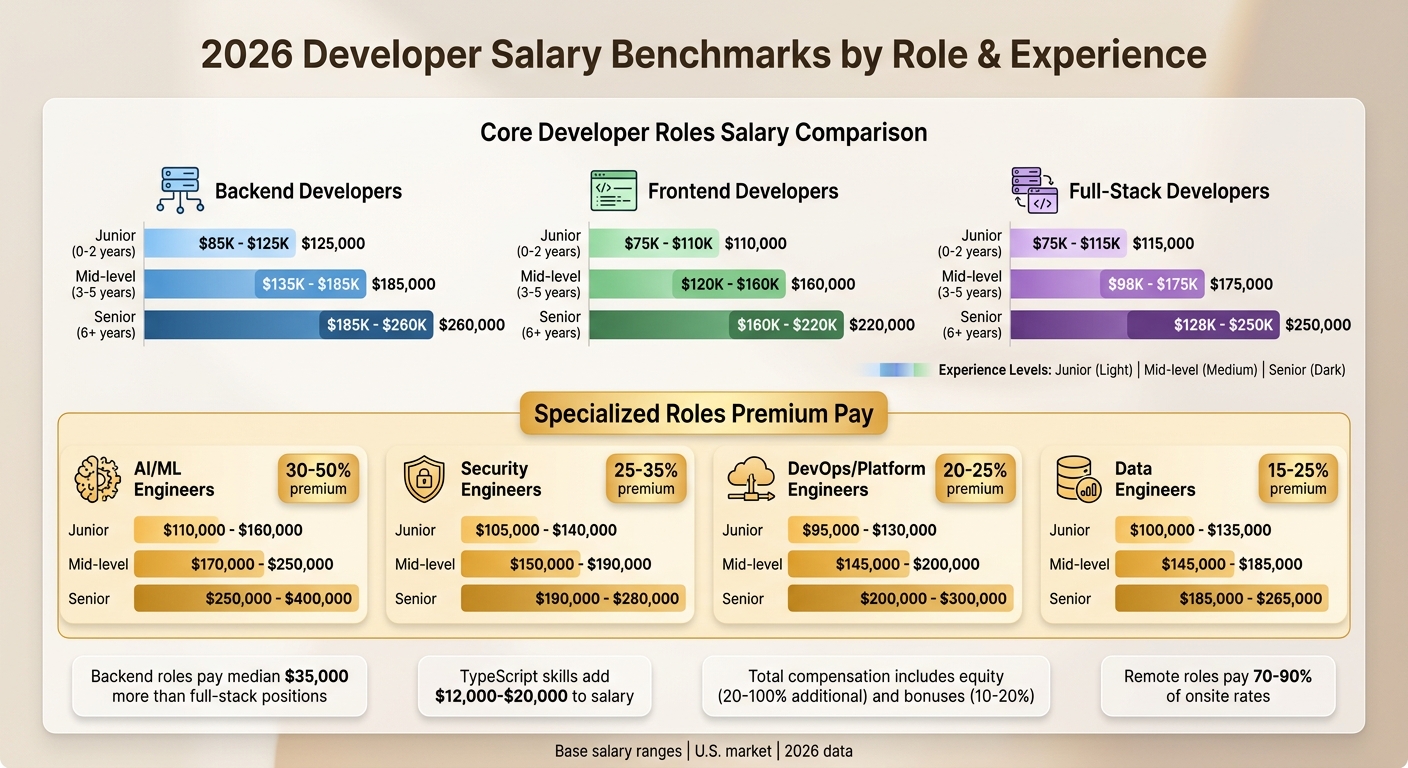 {2026 Developer Salary Ranges by Role and Experience Level}
Salary Ranges by Experience Level
When it comes to earnings, backend developers consistently lead the pack compared to frontend and full-stack developers, regardless of experience level. For junior developers (0–2 years), backend roles offer salaries between $85,000 and $125,000, while frontend developers earn $75,000 to $110,000, and full-stack developers fall in the range of $75,000 to $115,000 .
As developers gain experience, the gap becomes more pronounced. At the mid-level (3–5 years), backend specialists earn $135,000 to $185,000, while frontend developers make $120,000 to $160,000, and full-stack developers see $98,000 to $175,000 . Backend roles often pay a median of $35,000 more than full-stack positions, as expertise in areas like distributed systems and database optimization often commands higher compensation .
Senior-level developers (6+ years) see backend salaries climb to $185,000 to $260,000, while frontend developers earn $160,000 to $220,000, and full-stack developers range from $128,000 to $250,000 . Interestingly, the gap between frontend and backend roles is shrinking. Modern frontend development has become increasingly complex, with tools like React Server Components and performance budgeting driving demand - and pay - for specialized frontend skills .
"Frontend in 2026 is a specialization that pays. Full stack in 2026 often means generalist, and generalism caps out lower than depth."
- Tom Kenaley, Senior Partner, KORE1
The technology stack a developer specializes in also plays a big role in determining pay. For instance, mid-level developers working with React and Next.js earn a median salary of $122,000, while those using Java Spring Boot earn $115,000, and PHP/Laravel paired with Vue fetches around $85,000. Additionally, skills in TypeScript can boost pay by $12,000 to $20,000 . These differences highlight how technology choices can influence compensation by as much as $20,000–$30,000.
How Location Affects Developer Pay
Location continues to be one of the largest factors influencing developer salaries. In high-demand areas like San Francisco and the Bay Area, developers can expect premiums of +27% to +40% above the national average. Seattle offers +18% to +30%, while New York City provides +15% to +28% . Other cities like Austin and Boston offer more modest premiums of +10% to +15% .
For example, a senior full-stack developer earning $165,000 in Austin would need to make $280,000 in San Francisco to achieve the same purchasing power, thanks to cost-of-living differences . This disparity has led many developers to seek remote roles with salaries tied to high-paying markets while living in regions with lower expenses.
Remote work has also reshaped salary trends. Remote developer salaries now hover between 70% and 90% of on-site rates, regardless of the developer’s location . Many companies have shifted to benchmarking remote pay against national averages instead of local costs, making remote work an increasingly appealing option for developers outside major tech hubs.
Premium Pay for Specialized Developer Roles
AI/ML, DevOps, and Security Engineer Salaries
By 2026, AI/ML engineers command salaries that are 30–50% higher than general software engineers with similar experience levels . Here's a breakdown of their earnings:
- Junior roles: $110,000–$160,000
- Mid-level roles: $170,000–$250,000
- Senior positions: $250,000–$400,000
Security engineers also see a 25–35% salary premium as companies work to protect themselves from growing cyber threats . Salaries for these roles are as follows:
- Junior roles: $105,000–$140,000
- Mid-level roles: $150,000–$190,000
- Senior positions: $190,000–$280,000
The demand for cybersecurity professionals is immense. The global workforce gap in this field increased by 19% year-over-year, with 4.8 million additional professionals needed worldwide . Security engineers with TS/SCI clearance earn even more, receiving an extra $20,000–$40,000 .
DevOps and Platform Engineers are also highly sought after, with salaries reflecting a 20–25% premium due to the complexity of managing Kubernetes and cloud-native infrastructure . Their pay ranges are:
- Junior roles: $95,000–$130,000
- Mid-level roles: $145,000–$200,000
- Senior positions: $200,000–$300,000
Platform Engineers, in particular, are among the top earners in software development, with senior-level salaries reaching up to $251,000 .
"The gap isn't about difficulty. It's about scarcity."
- Robert Ardell, KORE1
The demand for specialized skills is clear. 87% of technology leaders are offering higher salaries to candidates with expertise in AI, cybersecurity, and cloud architecture to address critical business needs . Moreover, 90% of technology leaders are open to negotiating higher starting salaries for roles that support key initiatives like AI implementation or security upgrades . These trends help recruiters align their offers with market expectations.
What Data Engineers Make in 2026
Data engineers are another group benefiting from salary premiums. Their work in building robust data pipelines to support AI initiatives earns them 15–25% more than general developer roles . Here's what they can expect:
- Junior roles: $100,000–$135,000
- Mid-level roles: $145,000–$185,000
- Senior positions: $185,000–$265,000
Roles requiring AI expertise tend to pay nearly 25% higher wages than those without . Data engineers, who often create the infrastructure for AI systems, are well-positioned to take advantage of this trend. Meanwhile, data scientists - a closely related role - reported an average total compensation of $154,250 in early 2026. Specializing in AI/ML pushes this figure to $168,500, reflecting an 18.2% year-over-year increase .
How Work Location Affects Developer Salaries
Remote Developer Salaries in 2026
By 2026, remote roles are paying 70–90% of US onsite rates for global positions . While remote salaries tend to be lower than onsite roles, they follow distinct compensation strategies.
For US-based remote developers, salaries are 5–15% higher than those of global remote employees . Factors like tax compliance and timezone alignment make domestic hires more appealing to employers. A senior US-based remote developer earns a median base salary of $185,000, with the top quartile reaching $215,000 .
Here’s a breakdown of remote salaries for US-based developers in 2026:
| Experience Level | Base Salary Range | Total Compensation |
|---|---|---|
| Junior (0-2 years) | $78,000 - $130,000 | $95,000 - $145,000 |
| Mid (3-5 years) | $115,000 - $185,000 | $140,000 - $220,000 |
| Senior (6+ years) | $155,000 - $240,000 | $185,000 - $310,000 |
| Staff (10+ years) | $230,000 - $320,000+ | $270,000 - $450,000+ |
Early 2026 data shows base salaries rising by 6–9% compared to late 2025, with 40% of offers including sign-on bonuses ranging from $5,000 to $25,000 .
Companies adopt one of three pay models for remote work:
- Location-Agnostic: Offers a flat global rate.
- Location-Tiered: Adjusts pay based on geographic cost tiers.
- Local-Market Benchmarked: Bases pay on the median salary in a specific city .
For example, Airbnb and Basecamp pay top-tier San Francisco rates regardless of location, while companies like GitLab and Stripe use transparent, tiered systems that adjust for local markets .
"Your location no longer determines the ceiling. A senior engineer in Austin competes for the same roles as one in London." - CareerCheck
Remote work also offers financial perks beyond salary. Developers relocating to states with no income tax, like Texas or Florida, can save $15,000–$40,000 annually . Additionally, remote work eliminates commuting costs, saving $3,000–$8,000 per year, and many developers value the flexibility of remote work at $10,000–$20,000 .
Total compensation for remote roles often includes equity and bonuses, making these factors key in understanding overall pay trends. These numbers provide a foundation for comparing hybrid work arrangements.
What Hybrid Work Pays
Hybrid work models offer a balance between remote and onsite roles. In 2026, the median total compensation for hybrid workers is $170,000, compared to $178,500 for office workers and $164,000 for remote workers .
Interestingly, when comparing roles within the same company, level, and location, remote positions actually show a 1.1% premium . The idea of a "remote discount" often stems from smaller or mid-market companies (Series B to Series D), which tend to pay less than larger tech giants like FAANG, where hybrid or onsite work is more common .
Remote-first companies are challenging traditional pay norms, offering salaries that are 12% higher on average than their office-based counterparts . This shows that salary differences are more about the company and role than the work model itself .
When negotiating hybrid or remote offers, focus on total compensation, not just base salary. Remote salaries may be fixed by tier, but there’s often room to negotiate higher equity grants or sign-on bonuses . With many companies shifting from stock options to RSUs ahead of potential IPOs in 2026, understanding equity structures is crucial .
If you’re considering relocating, ask recruiters how pay adjusts with location changes. Companies with tiered pay systems may cut salaries by 15–25% when moving from Tier 1 to Tier 2 cities . Knowing your company’s location policy upfront can save you from surprises later.
Equity, Bonuses, and Total Compensation Packages
How Equity and Bonuses Add Up
In 2026, bonuses and equity can increase developer base pay by anywhere from 20% to 100% . The median total compensation for software engineers in the U.S. stands at $190,417 . To fully understand these numbers, it’s important to look beyond just base salaries and dive into how equity and bonuses contribute to the bigger picture.
For junior developers with 0–2 years of experience, equity and bonuses account for 21.2% of their total compensation - roughly $26,500 on a $125,000 package . As developers move up the ranks, these percentages grow. Mid-level engineers see 22.2% of their pay coming from equity and bonuses, senior engineers climb to 26.3%, and staff-level roles see this figure rise to 33.4% or more .
Some of the top tech companies illustrate just how much equity and bonuses can dominate total pay. For example:
- Google's Principal (L7) engineers earn a base salary of $320,000, but their total compensation hits $820,000 - with 61% coming from stock and bonuses.
- Meta's Staff (E6) engineers see 60% of their $620,000 total package derived from equity and bonuses.
- OpenAI offers 43.5% of its engineers’ compensation in equity and bonuses, adding $156,000 on top of a $202,100 base salary .
Performance bonuses typically range between 10% and 20% of base salary, while median sign-on bonuses hit $42,000 as of April 2026 . For senior-level roles, signing bonuses generally fall between $10,000 and $30,000, often serving as a way to offset base salary caps . Developers who negotiate their offers can secure an additional $10,000 to $20,000 on average .
When assessing equity, it’s essential to calculate the annual value by dividing the total equity grant by the four-year vesting period . Similarly, check historical bonus payout rates - a high target bonus doesn’t mean much if it’s rarely paid out . These details emphasize why total compensation, not just base salary, plays a key role in attracting and retaining top talent in a competitive market.
Developer Salaries by Region: US, Europe, LATAM, and APAC
The United States leads the way when it comes to developer salaries, with averages ranging from $120,000 to $180,000 . Senior developers in major US tech hubs see even higher numbers, earning between $180,000 and $280,000, while their counterparts in Western Europe, such as the UK and Germany, earn between $80,000 and $140,000 . While the gap at the senior level remains substantial, it is narrowing over time.
Interestingly, European markets saw a 15% growth in 2026, outpacing the US growth rate of 5% . In April 2026, the average base salary for software engineers in the US reached $145,800, reflecting a 6.8% increase from the previous year . In the UK, developers earn about £50,969 ($67,500) annually, while senior developers in Germany earn between €65,000 and €81,000 ($75,000 - $93,000) . Switzerland stands out as the highest-paying country in Europe, with an average salary of $155,000 .
Remote work has reshaped salary dynamics, creating what some call a "new equilibrium." Remote salaries tend to fall between 70-90% of US rates, regardless of the developer's location . For example, a developer earning $120,000 remotely from Portugal enjoys an adjusted purchasing power value of 185, compared to a developer in San Francisco making $180,000 (baseline 100), due to the lower cost of living .
In Latin America and APAC, salaries vary widely. Senior developers in Latin America earn between $30,000 and $70,000, while those in India earn $20,000 to $50,000 . Australia leads the APAC region, with salaries ranging from $110,000 to $170,000 AUD. Meanwhile, Eastern European developers earn $40,000 to $80,000, with demand driving salaries upward due to nearshore opportunities . Specialized roles, especially in AI and machine learning, command a 30-50% premium over general software engineering positions worldwide .
Top-Paying Cities in the US and Europe
City-specific data highlights even greater variations in pay. San Francisco and the Bay Area remain the highest-paying tech markets globally, offering a 30-40% premium over the US national average . Senior developers in San Francisco earn between $180,000 and $250,000, with total compensation packages at top companies often exceeding $300,000, including bonuses and equity .
Seattle follows with a 20-30% premium, while New York City offers 15-25% above the national average . These premiums are largely designed to offset the higher cost of living in these cities.
In Europe, London leads with a 20-35% premium over the UK average, especially in fintech and AI roles, where top contractors can charge up to £140 per hour . Paris offers a 15-25% premium . Switzerland, with its already high average salary of $155,000, does not include additional city premiums, as high pay is consistent across the country .
"IT leaders who combine insights into what developers want with data-driven decision-making will be best positioned to build teams - and careers - that are ready for what's next." - James Vallone, President, Motion Recruitment
Developer Pay in LATAM and APAC
In regions like LATAM and APAC, internal variations are more pronounced. Latin America has emerged as a "breakout region" in 2026, driven by its timezone alignment with US companies and a growing talent pool projected to reach a market value of $409.52 billion by 2030 . Brazil and Argentina lead the region, with Argentina ranking highly on developer quality indexes . Remote developers in LATAM often earn 30-40% more than local rates .
In APAC, salaries differ significantly by country. Australia offers the highest pay in the region, with figures between $110,000 and $170,000 AUD. India and Vietnam, key offshore markets, have much lower salaries, with senior developers in India earning $20,000 to $50,000 annually. However, those working remotely for US companies can earn 30-40% higher than local rates .
Eastern Europe, including countries like Poland, Romania, and Ukraine, boasts a talent pool of over 870,000 professionals . Senior developers in Poland, for instance, earn $50-$72 per hour locally but can secure $65-$94 per hour when working remotely for US companies . Hourly rates for senior roles in Central and Eastern Europe typically range from $55 to $95 per hour, compared to $130 to $200+ per hour in the United States .
"A $30-per-hour developer from Eastern Europe can outperform a $150-per-hour hire from San Francisco. The difference in developer hourly rates by country 2026 depends on economics, not ability." - Softaims
Canada, with its similar timezone and English-speaking workforce, offers a middle ground for US companies. Senior developers in Canada earn $90,000 to $150,000 CAD, which is 20-30% lower than US rates . In Latin America, senior developers earn $48 to $85 per hour, while Asia starts at $40 to $78 per hour. However, Latin America is increasingly favored by US companies for its real-time collaboration advantages .
How to Use Salary Data When Making Offers
Using salary benchmarks is essential to crafting competitive job offers. Ignoring market data can lead to significant hiring delays. For instance, offering $120,000 for a senior backend developer role - when market rates in 2026 range between $150,000 and $190,000 - can extend your hiring timeline by 2–3x . Aligning offers with benchmarks not only speeds up hiring but also demonstrates an understanding of market dynamics.
Educating Hiring Managers with Data
Hiring managers need to understand how salary data impacts talent acquisition. A budget that fits mid-level developers won't attract senior-level talent. For example, senior engineers with 8+ years of experience make up just 13% of the talent pool and typically demand a 28–45% premium compared to mid-level developers . If budget limitations restrict base salary, focus on enhancing total compensation, including equity and bonuses.
Leveraging Signing Bonuses and Remote Flexibility
Signing bonuses can make a fixed salary offer more appealing without increasing ongoing costs. A one-time bonus in the range of $10,000–$30,000 can close the gap effectively . Additionally, offering remote work flexibility can add perceived value equivalent to $10,000–$20,000. For instance, a developer earning $120,000 remotely in a lower-cost city can have greater purchasing power than someone making $180,000 in San Francisco .
Salary data also plays a critical role in retention strategies. Developers earning far below market rates are likely to leave within 12 months . Addressing these gaps early can save costs associated with turnover and rehiring.
"We lost three strong candidates because our offers were below market. Lemon.io's data helped us benchmark properly - we increased our ranges by 15% and now win 80% of candidates we make offers to."
– Rachel R., Engineering Manager, Healthcare Startup
Building Offers That Match Market Rates
To stay competitive, structure offers based on benchmarks, aiming for the 50th percentile or higher for the role and region . Falling below this threshold can immediately place your offer at a disadvantage. For contract roles, use the "1,000 formula" - divide the annual salary by 1,000 to calculate a fair hourly rate. For example, a $150,000 annual salary translates to $150 per hour .
When negotiating, present the salary range upfront. This approach keeps discussions focused and efficient, avoiding misalignment . Research also shows that developers who negotiate their salaries often secure 10–20% more .
These strategies, combined with detailed market insights, can ensure your offers are competitive and attractive. Platforms like daily.dev Recruiter simplify the process by connecting you with developers who are actively seeking the right opportunity, turning recruitment into a seamless, trust-based experience.
| Offer Component | 2026 Market Standard / Value |
|---|---|
| Base Salary | 50th percentile or higher for role/region |
| Equity | Standard for startups and public tech companies |
| Signing Bonus | $10,000 - $30,000 (Senior roles) |
| Remote Flexibility | Valued at $10,000 - $20,000 by candidates |
| Learning Budget | Annual stipend for courses/certifications |
| Hardware/Home Office | $2,000 - $5,000 annual budget |
Why Salary Transparency Matters in 2026
Salary transparency is changing the way companies approach recruitment and compensation. Thanks to platforms like Levels.fyi and Blind, candidates can now access real-world compensation figures from actual job offers. This puts pressure on recruiters offering below-market salaries, often leading to longer hiring cycles .
What’s also shifting is the emphasis on Total Compensation (TC) rather than just base salaries. Developers now evaluate offers by comparing RSUs (restricted stock units), signing bonuses, and equity refreshers across standardized leveling systems (like L3–L7) . For instance, a $160,000 base salary paired with 0.5% equity at a fast-growing startup might hold more appeal than a $200,000 base at a more established company .
For recruiters, transparency data isn’t just about hiring - it’s a tool for retention. By benchmarking their offers against market data, companies can identify employees whose pay lags behind the median. These employees are often at risk of leaving within the next year .
How Open Compensation Data Changes Recruiting
Open compensation data removes guesswork and builds trust. In many regions, it’s now legally required for recruiters to disclose salary ranges during the initial screening call. This upfront honesty saves time by quickly ruling out mismatches in budget and expectations . It also shows respect for candidates’ time while reflecting the company’s integrity.
Savvy recruiters use this data to educate hiring managers. If a budget is set too low, public benchmarks make it clear that senior roles will likely only attract mid-level talent. This can lead to delays in filling critical positions . Tools like daily.dev Recruiter streamline the process by connecting recruiters with developers who are already interested and open to new opportunities. This ensures every conversation starts on solid ground, with realistic expectations.
These trends in transparency aren’t just reshaping negotiations - they’re also helping companies refine their retention strategies for the long haul.
What Recruiters Need to Know About 2026 Developer Pay
When it comes to hiring developers in 2026, recruiters need to focus on more than just experience. The big shift? Specialized expertise in specific tech stacks now outweighs years of experience. For example, AI/ML engineers earn a 30–50% premium over general software engineers . Trying to hire a senior developer with a mid-level budget? That could stretch your time-to-hire by 2 to 3 times . To avoid delays, use public salary benchmarks to set realistic expectations upfront.
Today's developers also look at total compensation, not just base salary . If your salary range is fixed, consider sweetening the deal with a signing bonus - anywhere between $10,000 and $30,000 can make a difference .
Another key factor is speed. Developers often juggle multiple offers, so moving quickly can be the difference between landing top talent or losing out . Tools like daily.dev Recruiter can help you connect with active candidates right away, ensuring every conversation starts with purpose.
Don't just stop at hiring - use salary data to improve retention. Developers earning below the 25th percentile for their role are more likely to leave within a year . Compare your team's pay against 2026 benchmarks to identify and address potential risks. Adjusting salaries to align with market rates not only helps you retain talent but also streamlines future hiring efforts, saving time and resources in the long run.
FAQs
How can I estimate my total compensation from base salary, bonus, and equity?
To calculate your total compensation, combine the following elements:
- Base salary: This usually falls between $59,000 and $120,000, depending on your role and experience level.
- Bonuses: Annual bonuses often range from $1,000 to $12,000 or more.
- Equity: This includes stock options or RSUs, which can add a substantial amount to your overall pay.
Keep in mind, total compensation can vary greatly based on factors like location, experience, and area of expertise. Always weigh these elements to get a clearer picture of your earnings.
Which skills or specialties boost developer pay the most in 2026?
Specializing in AI/ML engineering, DevOps/SRE, and cybersecurity can lead to significantly higher pay for developers by 2026. AI/ML engineers, for instance, enjoy salary premiums of 30–50% compared to general software engineers. Similarly, professionals in DevOps/SRE and cybersecurity also secure higher earnings. These areas are in high demand, rewarding their specialized skill sets with competitive compensation packages.
How does remote pay adjust if I move to a different state or city?
When working remotely, your pay often aligns with the market rates of your new location. Typically, salaries settle between 70-90% of U.S. rates, though the exact figure can vary based on factors like the local cost of living and regional salary standards. These adjustments are designed to reflect the economic realities of the area while striving to ensure equitable compensation.


