

Nurture developers with targeted segmentation, technical content, and CRM-driven cadences to build a warm talent pipeline and speed hiring.
Hiring developers can be faster and more effective if you build relationships before roles open. Instead of relying on last-minute outreach, nurturing developer candidates creates a "warm bench" of skilled professionals who already know your company and are ready when opportunities arise.
Key Insights:
- Why it works: Engaging with developers over time builds trust, reduces hiring time by 30%, and increases offer acceptance rates.
- Cold outreach struggles: Generic messages often fail. Relationship-building makes hiring feel natural.
- Segmentation is critical: Tailor communication based on skills, career stage, and location for better engagement.
- Content matters: Share technical insights, community invites, and career resources to stay relevant.
- Timing and tools: Use CRM systems and behavioral triggers to track engagement and reach out at the right moment.
By focusing on long-term connections, you can sidestep the rush of active vs passive developer recruitment and create a pipeline of pre-qualified, interested candidates.
How to Segment Your Developer Talent Pool
Segmenting your developer audience is essential if you want your message to resonate. A junior front-end developer working with React has very different priorities compared to a senior backend architect specializing in Kubernetes. Sending out generic messages not only wastes time but also undermines trust. Proper segmentation ensures your communication is relevant and engaging.
What to Segment By
Start by focusing on technical skills and tech stack. Group developers based on the programming languages they use (like Python, Java, or Go), the frameworks they rely on (such as React, Django, or Spring Boot), or the infrastructure tools they handle (think AWS, Docker, or Terraform). For example, in July 2019, Audiense CTO Alfredo Artiles launched a recruitment campaign targeting "software crafters" in Spain. His team identified 500 engineers who followed the training platform Codely.TV, along with 150 niche influencers in the software craftsmanship community. By broadening this to include 12,000 potential candidates with fewer than 2,000 followers each, they spent just $100 on Twitter Ads. This approach saved 99% of the typical $8,000–$10,000 agency cost and delivered high-quality leads, with 46% of candidates staying eligible for future roles .
Beyond technical expertise, consider a developer's career stage and readiness. A recent graduate and a veteran developer will respond to entirely different messaging. Pay attention to behavioral signals like completed articles, clicks on specific content, or time spent on your engineering blog. These actions can reveal how open someone might be to new opportunities.
Geographic location is another critical factor. Location affects everything from salary expectations to workplace culture. For instance, a developer based in Austin, Texas, may have different compensation expectations compared to someone in a rural area. Even within the same state, tech communities in different cities often have distinct cultures and values.
Why Segmentation Matters
Effective segmentation is the backbone of a strong, long-term recruiting strategy. It helps your message stand out in the crowded tech talent market. In fact, 62% of marketing professionals say that improving audience segmentation is a top priority for delivering more targeted messaging . The logic is simple: personalized messages generate responses, while generic ones are often ignored. By segmenting your audience, you can send systems programmers tips on Rust performance optimization while sharing React design patterns with front-end developers - ensuring each group gets content that speaks to their specific needs.
Market segmentation allows you to target your content to the right people in the right way, rather than targeting your entire audience with a generic message.
- Alexandra Theriault, Chief Growth Officer at Spherical
Using Content to Nurture Developer Relationships
Once you've segmented your audience effectively, content becomes your go-to tool for building meaningful connections and earning trust. In the realm of developer recruiting, consistent, well-crafted content can elevate you from being just another recruiter to a trusted resource. Why? Because it shows you respect developers' time and expertise while proving that your company genuinely understands their world.
What Content to Share
To resonate with developers, focus on sharing content that speaks their language and demonstrates your technical credibility. Here are some ideas:
- Technical deep-dives: Share insights into your team's work, like redesigning a CI/CD pipeline or tackling complex technical challenges. Highlighting contributions to open-source projects - such as those under the Cloud Native Computing Foundation (CNCF) - can also showcase your expertise .
- Community invitations: Build a sense of belonging by inviting developers to join private Slack groups centered on specific programming languages (e.g., a Golang engineers channel), attend technical meetups, or participate in roundtable discussions. These spaces foster connection without the pressure of a job pitch .
- Career resources: Provide guides that help developers navigate your interview process or offer general career advice. These resources not only ease candidate anxiety but also strengthen their connection to your brand .
- Behind-the-scenes content: Share office video tours, employee spotlights, or photo reels of your team in action. This type of media humanizes your brand and gives developers a glimpse into your work environment .
To keep developers engaged without overwhelming them, aim for a quarterly content cadence. A mix of these content types not only informs but also prepares developers for future opportunities, creating a solid foundation of trust.
How Content Builds Trust
When you consistently deliver high-quality content, you position your company as a reliable resource. Over time, this trust pays off. Developers who engage with your content already understand your mission, values, and tech stack, which can lead to higher offer acceptance rates when roles open up . The idea is to guide candidates into a "warm conversion zone" where they're pre-qualified and ready to interview - even before you post a job opening .
A CRM without a communication plan is just a sophisticated contact database. Instead, treat your CRM as a content marketing engine.
The secret lies in adopting a "pull" strategy rather than pushing job ads. By offering resources that developers find genuinely valuable, you position your company as a thought leader. This approach works because it’s built on empathy - showing you understand what excites developers and aligns with their professional aspirations, not just what your company needs . Consistent engagement through this strategy can lead to tangible results in conversion rates.
How Often to Reach Out to Developers
::: @figure 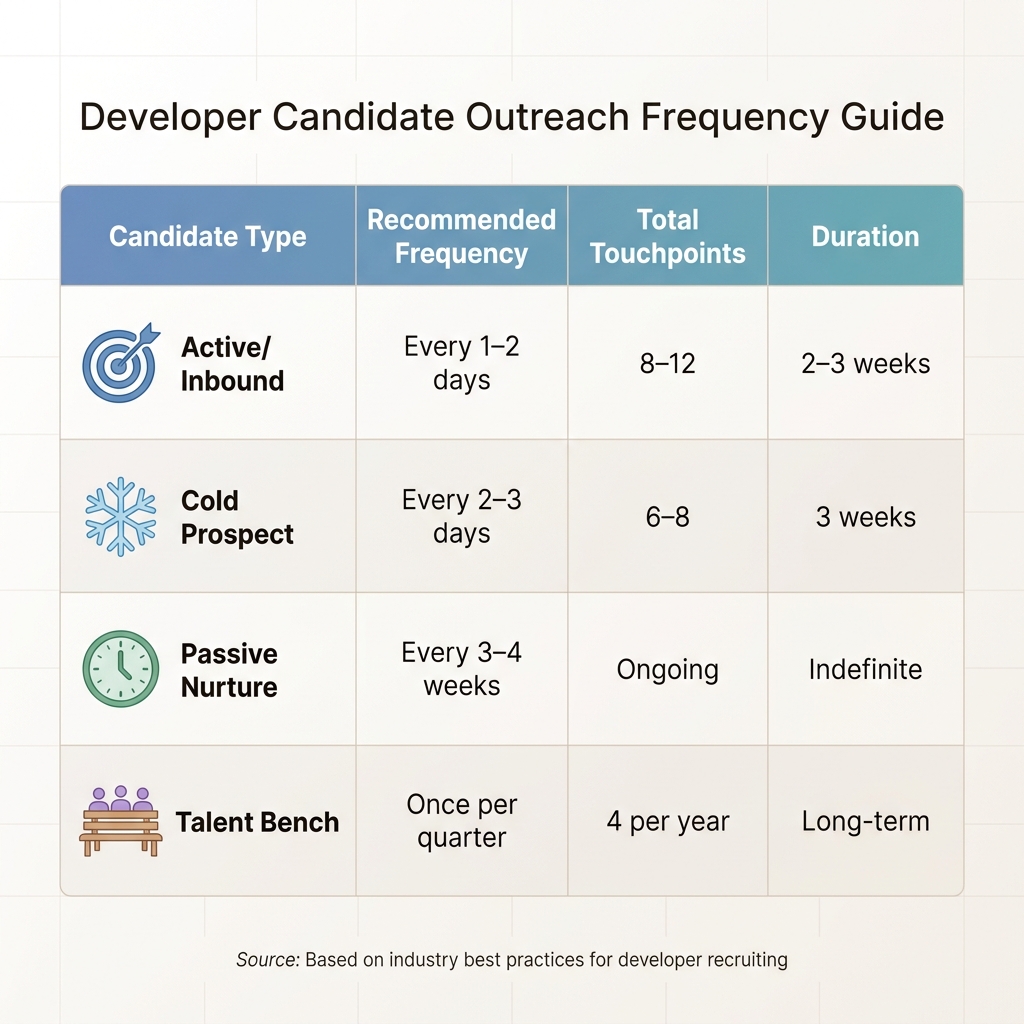 {Developer Candidate Outreach Frequency Guide by Candidate Type}
Finding the Right Contact Frequency
How often you reach out to developers depends largely on their position in your pipeline. For active candidates, aim for 8–12 touchpoints over 10–15 business days to keep the momentum going. This is especially important since top technical talent can accept offers in as little as 10 days , making a precise hiring timeline essential .
For cold outreach, stick to 6–8 touchpoints spread across two to three weeks. This keeps you on their radar without overwhelming them . When dealing with passive developers, monthly outreach is enough to stay visible without becoming intrusive . For long-term talent pools - such as silver-medalists or previous applicants - quarterly outreach is sufficient to maintain a connection .
"You may want to reach out to a candidate in the final stages of your interview process every single day, but you may only reach out to previous applicants that you want to stay engaged with once a quarter."
- Tyler Fisher, PHR, Eddy
Here’s a quick guide to structuring your outreach cadence:
| Candidate Type | Recommended Frequency | Total Touchpoints | Duration |
|---|---|---|---|
| Active/Inbound | Every 1–2 days | 8–12 | 2–3 weeks |
| Cold Prospect | Every 2–3 days | 6–8 | 3 weeks |
| Passive Nurture | Every 3–4 weeks | Ongoing | Indefinite |
| Talent Bench | Once per quarter | 4 per year | Long-term |
If there’s no response after a 30-day sequence, wrap up with a short "break-up" email and move them to quarterly outreach . Once you’ve got your cadence down, the next step is to vary your communication methods to keep engagement high.
Using Different Communication Channels
Switching up your outreach methods helps avoid inbox fatigue and keeps your messages fresh. Start with email for the initial introduction, then follow up with a LinkedIn connection request - without jumping straight into a pitch. By day 10, engage with their social media posts. A thoughtful comment on something they’ve shared can go further than another recruiting message .
The choice of communication channels can make your outreach even more effective. For example, a 30-day sequence might look like this: send an email on day 1, follow up on day 3, send a LinkedIn connection request on day 5, share technical content on day 7, comment on their LinkedIn post on day 10, send detailed role information on day 14, check in via phone or SMS on day 22, and close with an exit message on day 30 .
In 2025, Ten West Recruiting revamped their prospecting workflow, cutting daily prospecting time from four hours to just 1.5 hours. By structuring their cadence and mixing communication channels, they managed 40–50 touches per day and improved reply rates by 30–35% . A key part of their success was using behavior-based triggers - for instance, prioritizing follow-ups when a developer clicked a link or opened an email .
"A recruiting cadence is the high-level strategy that dictates how, when, and through which channels... you will consistently reach out to candidates."
- Yuri Kostun, Ten West Recruiting
Every interaction should provide value - whether it’s technical insights, updates on open-source projects, or event invitations. Offering useful resources sets you apart as a helpful partner rather than just another recruiter asking if they’re ready to interview .
CRM and Automation Tools for Developer Nurturing
What to Look for in Nurturing Tools
A great CRM should provide a complete view of each developer before you even hit send on a message. Look for tools that log every interaction - emails, calls, meetings - so your follow-ups are informed and relevant [28,30]. Having a 360-degree profile that includes details like career paths, preferred tech stacks, and personal aspirations ensures developers feel understood rather than just added to a list .
Flexibility in workflows is more valuable than flashy add-ons. Your CRM should adapt to your recruitment style, not force you into rigid processes. Customizable fields are key - they let you track what’s most important, whether it’s their favorite programming languages, open-source contributions, or interest in remote roles [28,29]. Modern CRMs often include AI-driven automation to qualify leads and craft personalized messages. But remember, the tech should enhance your strategy, not dictate it .
Technology is only the way you have to support not only processes but strategies as well.
- Flowlu Team
Integration across your communication tools is another must-have. Your CRM should sync effortlessly with platforms like Slack, Microsoft Teams, and Outlook, ensuring data flows smoothly across systems [28,30]. Analytical dashboards can also help you track engagement trends and identify which developers might be ready for a deeper conversation by optimizing your recruitment funnel . Before committing to a CRM, evaluate your current process and choose features that address real gaps rather than adding unnecessary complexity. As emphasized in our segmentation and content strategy, targeted engagement is the priority. A strong CRM sets the stage, but meaningful interaction still requires a human touch.
Keeping Automation Human
Once you have a solid CRM, automation can help - but it needs to feel personal. Behavioral triggers are a great way to automate messages. For example, instead of sending emails on a fixed schedule, you can set them to go out when a developer downloads a whitepaper or visits your engineering blog [31,32]. This makes your outreach feel responsive instead of mechanical.
Take OpenPhone’s example: in 2025, they reduced their speed-to-lead time by 67% using automation for scheduling and routing, while keeping key interactions manual . It’s all about balance. AI can handle the initial outreach - like referencing a developer’s recent project or a company milestone - but leave tasks like post-interview feedback or extending offers to your team [32,35]. Automated emails should come from a real recruiter’s address with a friendly, conversational tone, not a generic "no-reply" alias .
The best lead nurturing feels like a helpful conversation, not a sales pitch.
Smart segmentation is another way to keep automation personal. Tailor content to match developers’ interests and seniority levels [31,33]. AI can also summarize past interactions, making follow-ups feel natural and connected to previous conversations . Pay attention to the tone of developer responses - if someone seems frustrated, adjust your approach immediately . The goal is to stay helpful and visible without being overbearing. Platforms like daily.dev Recruiter excel at this by using opt-in discovery and engagement signals to align with a developer-first mindset.
Turning Nurtured Developers into Active Candidates
Once you've built a strong connection with developers through your content and communication strategies, the next step is to turn those relationships into active interest in open roles.
How to Make the Transition
Making this shift requires a personal touch. Reference specific details from your earlier conversations to show genuine interest. For example, if a developer once shared how they improved their team’s efficiency with a past project or expressed enthusiasm for building consumer-focused products, bring those points up when introducing a potential role. This shows you’ve been listening, not just collecting contacts.
Tie the role directly to their career goals. If someone mentioned a passion for distributed systems in the past, highlight how the new position involves tackling those challenges. For senior-level candidates, prioritize personal outreach - like a phone call - over email to make the interaction more meaningful. Don’t worry about finding an exact match; if the developer meets about 70% of the requirements and has the right mindset, they might be the perfect fit for the opportunity .
The key is timing. Recognize the signals that indicate when a developer is ready to move from being nurtured to actively exploring opportunities.
When to Start Recruiting
Use insights from your engagement efforts to identify when developers are open to new roles. Look for digital behaviors that suggest increased interest. For instance, if a developer starts browsing job postings, subscribes to your engineering newsletter, or frequently interacts with content like "day in the life" videos, it’s a sign they’re warming up to the idea of a change .
Pay attention to how their questions evolve. When casual tech discussions shift to inquiries about career growth, company culture, or long-term opportunities, it’s likely they’re considering their next move . Timing is critical here - someone who wasn’t interested six months ago may now be available as their current project wraps up . Asking direct questions like, “Has anything changed in your job search recently?” can help you gauge their readiness.
Tools like daily.dev Recruiter can simplify this process by surfacing engagement signals and facilitating warm, double opt-in introductions when the time is right . Recognizing and acting on these cues quickly can make all the difference in securing top talent.
How to Measure Your Nurturing Results
To truly understand the effectiveness of your nurturing efforts, you need to look beyond surface-level activity. Focus on metrics that show the real impact on hiring outcomes. These numbers will help you refine your strategy and smoothly transition candidates into active recruitment.
What Metrics to Track
A successful nurturing campaign should hit key benchmarks like 45% open rates, 10% reply rates, and 15% conversion of contacts into active candidates. Additionally, keep an eye on time-to-conversion and aim for a 12-month retention rate of at least 90% .
The most critical measure of success is impact - specifically, the quality of hires and their retention. Pay attention to unexpected departures, especially when high-performing hires leave because the role didn’t match the expectations set during the nurturing phase . For instance, Booking.com combined system data with developer satisfaction surveys and found a 16% boost in productivity, showing how blending data with feedback can reveal a fuller picture .
"The act of measurement changes how developers work, as they try to 'game' the system." – Gergely Orosz and Kent Beck
Avoid vanity metrics like "emails sent" or "total contacts", which only measure effort, not results. Instead, consider using a Candidate Net Promoter Score (cNPS) to understand how well nurtured candidates perceive your brand .
Using Data to Improve Your Approach
Once your metrics are in place, use them to fine-tune your strategy. Tie specific metrics to actionable changes. For example, if your open rates dip below 45%, test new subject lines or adjust the timing of your emails. If reply rates are lagging, it might indicate your content is too generic. This could be a sign to segment your audience more effectively - perhaps by their tech expertise or career stage to better align with passive developer needs .
Evaluate the ROI of sourcing channels to see which platforms or communities generate the most engagement, then shift resources to those that perform best . Use activity-based triggers in your CRM to make automation feel personal. For instance, if a developer interacts with three technical articles, you could automatically invite them to a technical roundtable . This keeps your outreach relevant and timely.
Poor communication can alienate candidates, so use your data to identify and resolve any friction points before they lead to missed opportunities . Adyen, for example, improved metrics across 50% of its teams in just three months by focusing on speed, quality, and impact rather than just activity counts . Follow their example by monitoring the overall health of your nurturing system instead of singling out recruiter performance, which could shift the focus away from relationship-building .
Finally, tools like daily.dev Recruiter can help by automatically surfacing engagement signals, making it easier to spot when candidates are ready to move forward - without the need for constant manual tracking.
Conclusion
Shifting from reactive hiring to a more proactive talent strategy is transforming how organizations connect with developer candidates. By focusing on developers who may not be actively job hunting but are open to the right opportunity, companies can tap into a large pool of highly skilled technical talent - often the best in the field .
The numbers back this up: companies that maintain warm talent pipelines see a 30% faster time-to-hire and achieve 90% retention rates within 12 months . Instead of trying to compete with Big Tech purely on compensation, you can stand out by building genuine relationships and delivering consistent value.
"You can't out-spend Big Tech, but you can out-nurture them." – Index.dev
Success in this approach depends on smart segmentation, delivering relevant content, and using CRM tools effectively. By tracking engagement signals through your CRM, you can identify when developers are ready for career conversations. The key is maintaining a steady, respectful communication rhythm that offers value at every interaction.
Tools like daily.dev Recruiter make scaling this strategy easier by automatically highlighting engagement signals and ensuring that every outreach is double opt-in. This means developers choose when they’re ready to engage, creating connections that are meaningful and mutually beneficial. This consent-based, relationship-focused approach is redefining tech recruiting, setting a standard that prioritizes respect and trust.
FAQs
How do I find passive developers who are open to the right role?
To reach passive developers effectively, prioritize creating meaningful, long-term connections through personalized strategies. Start by segmenting your audience based on factors like their interests, level of experience, preferred tech stack, and how ready they might be for a new role. Once segmented, share content that resonates with them - think articles, tech talks, or insightful engineering blog posts.
It's also important to stay consistent in your outreach while being mindful of their boundaries. Use tools that allow for personalized communication, and keep an eye on how they engage with your content. These engagement signals can help you spot developers who might be open to new opportunities, even if they’re not actively job hunting.
What should I send developers so it feels helpful, not spammy?
When reaching out, aim to offer real value with a friendly, personal touch. Share things like insightful articles, engaging tech talks, updates on open-source projects, or thought-provoking engineering blog posts. Tailor each message to match the recipient's interests or career aspirations - this keeps your communication meaningful and relevant.
Avoid being pushy or overly salesy. Instead, take an opt-in approach to ensure your outreach feels respectful and considerate. This way, you can build genuine connections without risking the impression of spammy or intrusive messaging. It's all about fostering trust and creating a positive, professional relationship.
How do I know when a nurtured developer is ready to talk jobs?
When trying to figure out if a developer is ready to talk about job opportunities, pay close attention to their engagement patterns. If they consistently interact with relevant content - like reading articles or attending tech talks - it’s a good sign they’re interested. Another key indicator is increased responsiveness, such as replying positively to your outreach. When they show genuine curiosity or enthusiasm, it often means they’re open to having a conversation about potential roles.


