

Meet developers where they work: compare contextual, privacy-first, and community channels to build a 2026 developer marketing mix.
Developer marketing in 2026 requires meeting developers where they spend their time - inside IDEs, reading documentation, and engaging with technical content. Traditional ads aren’t enough anymore. Platforms now focus on contextual targeting (not behavioral tracking) and privacy-conscious approaches to reach this audience effectively. Here’s a breakdown of the top platforms for developer marketing:
- daily.dev Ads: Targets 1M+ developers with native in-feed ads, achieving CTRs of 0.8–1.5%. Ideal for mid-funnel campaigns.
- Dev.to: Community-driven with tag-based discovery. Great for organic interaction and bottom-up adoption.
- Hashnode: Focuses on personalized blogging with high engagement rates (3%+). Sponsored posts range from $800–$3,000.
- Medium: Long-form content for top-of-funnel awareness. Focus on storytelling, not traditional ads.
- Carbon Ads: Privacy-friendly, single native ad per page. CTRs up to 6.4× higher than display ads, but requires $5,000–$10,000/month.
- BuySellAds: Connects with premium developer sites. Cost-per-click pricing with a $5,000 minimum.
- ReadMe: Embeds ads in technical documentation, reaching developers in problem-solving mode.
- Reddit: High traffic from subreddits like r/programming. CPMs start at $0.50, but authentic engagement is key.
- Discord: Builds long-term community relationships. Costs $5,000–$15,000/year to manage effectively.
- Hacker News: Organic "Show HN" posts and native sponsorships drive high-quality traffic. Conversion rates: 3–8%.
- Stack Overflow: Targets developers solving technical issues. Requires $10,000–$15,000/month.
- Google Ads: Captures high-intent traffic. CPCs for developer keywords range from $8–$30.
Quick Comparison
| Platform | Audience Reach | Ad Format | Pricing Model | Best Use Case |
|---|---|---|---|---|
| daily.dev Ads | 1M+ developers | Native in-feed ads | $2,000–$10,000/month | Mid-funnel signups |
| Dev.to | Community-driven | Native ads, sponsored posts | $35–$60 CPM | Organic engagement |
| Hashnode | 1.5M+ monthly readers | Sponsored posts, newsletters | $800–$3,000/post | High engagement content |
| Medium | Diverse audience | Long-form storytelling | Free (time investment) | Top-of-funnel awareness |
| Carbon Ads | Developer sites | Native text-and-image ads | $5,000–$10,000/month | Privacy-friendly visibility |
| BuySellAds | Premium sites | Native ads | $5,000+/month | Top-of-funnel awareness |
| ReadMe | Documentation sites | Contextual ads | Varies | In-workflow engagement |
| Developer subreddits | Promoted posts, CPC ads | $0.50–$3.50 CPM | Broad traffic, niche targeting | |
| Discord | Focused communities | Community building | $5,000–$15,000/year | Long-term relationships |
| Hacker News | 60–70% decision-makers | "Show HN", native sponsorships | Free/$35–$60 CPM | High-quality conversions |
| Stack Overflow | 50M developers | Tag-targeted ads | $10,000–$15,000/month | Mid-funnel targeting |
| Google Ads | Global reach | Responsive search ads | $8–$30 CPC | Bottom-of-funnel conversions |
Each platform serves a specific role in the marketing funnel. Small budgets ($5,000/month) should focus on high-intent channels like daily.dev Ads or Google Ads. Larger budgets ($25,000+) can diversify into community-driven platforms and technical content. For $100,000/month, combine advertising, Developer Relations, and events for full-funnel impact.
::: @figure 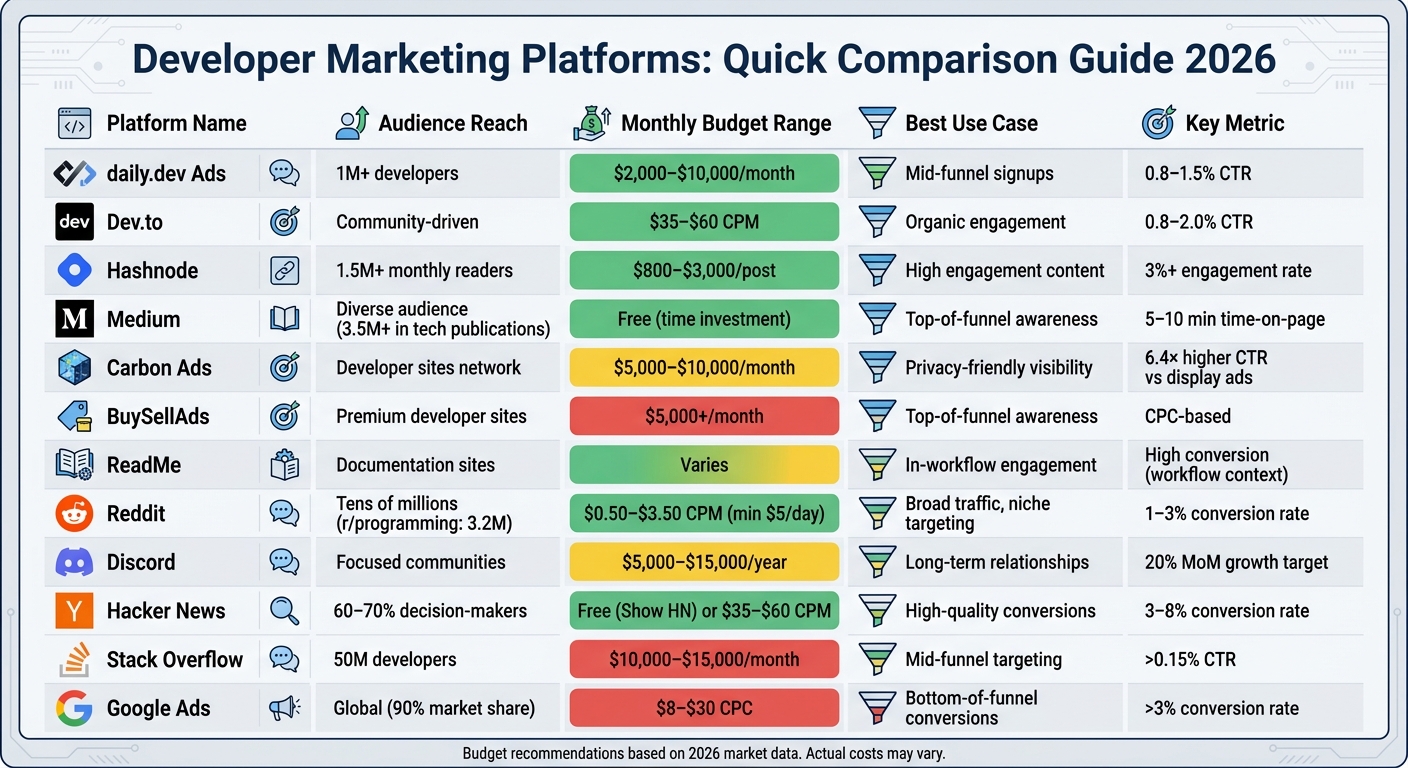 {Developer Marketing Platforms Comparison 2026: Budget, Reach, and Use Cases}
1. daily.dev Ads
daily.dev is a content aggregator that curates personalized technical feeds for over 1 million active developers. This means your message reaches developers right where they’re already consuming articles, tutorials, and industry updates.
Audience Reach
With access to 1 million+ active developers , daily.dev connects with an audience that relies on the platform as their go-to source for technical content. These users aren’t just browsing - they’re actively exploring tools, frameworks, and solutions. This makes daily.dev an ideal mid-funnel channel for driving signups and trial conversions .
Targeting Options
daily.dev leverages AI-driven contextual targeting to align your ads with what developers are actually reading and engaging with on the platform . By analyzing user preferences and behavior, the system ensures your ads reach the right audience segments. Plus, real-time AI optimization reallocates your budget to focus on the segments generating the highest conversions . This adaptability ensures campaigns continuously improve, delivering your message to the developers most likely to engage with your offer.
Ad Formats
Ads on daily.dev appear as native in-feed cards that blend seamlessly with organic content . This approach is key since over 50% of developers use ad-blockers and tend to ignore traditional banner ads. By integrating your ads into the feed where developers are already seeking technical insights, the platform creates a "trust transfer" effect from the surrounding content . This format positions daily.dev as an always-on marketing channel, naturally embedding your message into a developer’s daily routine.
Engagement Metrics
daily.dev focuses on cost per signup and trial conversions, rather than just impressions . Native ads on the platform achieve click-through rates between 0.8% and 1.5%, far exceeding the 0.25%–0.35% averages for traditional display ads . For businesses with monthly marketing budgets ranging from $2,000 to $10,000, daily.dev serves as a vital mid-funnel channel , especially when targeting early adopters exploring new solutions . These metrics highlight the platform’s strong performance, setting the stage for a closer examination of its advantages and limitations.
sbb-itb-e54ba74
2. Dev.to
Dev.to is a vibrant community for developers, offering a platform where they share tutorials, launch notes, and technical insights. It’s built entirely on user-generated content, making it a go-to space for developers to connect and learn from each other .
Audience Reach
Dev.to has a strong presence among software engineers, providing an excellent opportunity to engage with this specific audience . Unlike traditional advertising platforms, Dev.to thrives on peer-to-peer interaction. Developers use the platform to explore new tools, exchange feedback, and share knowledge. This organic interaction makes it a great fit for bottom-up adoption - where individual developers test and recommend tools before they are adopted on a larger scale by their companies . The platform’s tag-based discovery system ensures that content is seen by the right audience, reinforcing its community-driven approach.
Targeting Options
Content discovery on Dev.to revolves around community-defined tags rather than conventional ad targeting . Tags like #javascript, #webdev, and #devops help posts reach specific developer niches without relying on paid promotions . This system allows you to focus on engaging with developers directly. The platform’s light moderation further encourages quick feedback, making it ideal for sharing technical guides or gathering input on early-stage ideas . To connect effectively, use content formats developers appreciate, such as code snippets, terminal screenshots, and real-world problem-solving examples - steering clear of overly promotional language .
Ad Formats
Dev.to emphasizes native advertising and sponsored content that blends seamlessly with organic posts . Native ads on the platform typically achieve click-through rates between 0.8% and 1.5%, with standout campaigns hitting 2.0% . Engagement times average 45 to 90 seconds, while brand recall ranges from 25% to 35% . To maximize SEO benefits when syndicating content, use the canonical_url field in your post settings, ensuring your website remains the primary source. Keep in mind that outbound links on Dev.to are marked as rel=ugc or rel=nofollow . These ad formats deliver solid engagement and are well-suited for cost-effective campaigns.
Pricing Models
Native advertising on Dev.to and similar platforms generally follows a CPM model, with rates ranging from $35 to $60 . Campaigns often yield a return of $50 to $150 per qualified lead . To achieve meaningful results, expect to allocate a monthly budget of $5,000 to $10,000 .
3. Hashnode
Hashnode is a community-first blogging platform designed for developers who want full control over their content. By publishing on custom domains, developers retain SEO ownership, meaning all backlinks and search rankings benefit their site directly. Unlike platforms where content is tied to someone else's domain, Hashnode ensures your work stays under your control, while still being part of a centralized discovery feed .
Audience Reach
Hashnode draws in 1.5 million+ monthly readers as of 2026 . While the platform has a more specialized audience, it appeals strongly to developers who prioritize technical depth and detailed tutorials . It's become a haven for those looking to move away from restrictive platforms and build their personal brand . Top-performing posts on Hashnode often see engagement rates above 3%, including comments and shares, which highlights the platform's focus on fostering meaningful interactions .
Ad Formats
For brands, sponsored posts work best when they provide real value to readers - like technical guides or solutions to common challenges - rather than coming across as overly promotional . Developers on Hashnode value authenticity, so transparency about sponsorships is essential to maintain trust . Additionally, Hashnode's newsletter sponsorships allow brands to reach highly engaged subscribers, combining ad reach with monetization opportunities .
Pricing Models
The cost of sponsored posts on Hashnode ranges between $800 and $3,000, depending on the target niche and audience size . Newsletter sponsorships typically cost around $600 per month for established subscriber lists . For blogs with 100,000 monthly views, sponsorships and affiliate deals can generate between $1,300 and $2,500 . For example, in early 2026, a DevOps expert with an email list of 8,000 subscribers earned nearly $2,700 per month through a mix of sponsored posts, newsletter sponsorships, and affiliate marketing .
4. Medium
Medium takes a different approach compared to other developer content platforms by focusing on long-form content. It prioritizes well-crafted, in-depth writing and promotes it through its algorithm and established publications - all without relying on traditional ads.
Audience Reach
Medium attracts a diverse group of readers, including developers, product managers, founders, and technical decision-makers. For instance, specialized publications like JavaScript In Plain English can generate around 3.5 million monthly views across their tech-focused network .
Ad Formats
Instead of traditional advertisement campaigns for developers like banner ads or sponsored posts, Medium encourages brands to use long-form storytelling. This includes thought leadership pieces, technical guides, and engineering-focused narratives. To expand visibility, consider publishing within established Medium publications, such as Stackademic, which already have an engaged audience.
Pricing Models
Publishing on Medium is free, but the real cost comes in the time and resources needed to produce high-quality content. Some Medium publications offer sponsorship opportunities at negotiated rates . However, it’s important to note that all external links on Medium are marked as "nofollow", which can impact SEO. To address this, use Medium's Import tool to include canonical tags that point back to your original content .
Engagement Metrics
Medium evaluates success based on metrics like time-on-page, saves, and comments, which reflect the depth of reader engagement. This makes it an ideal platform for top-of-funnel brand awareness rather than direct-response campaigns. Its focus on meaningful interactions aligns with the goal of fostering deeper connections with readers at the awareness stage of the funnel.
5. Carbon Ads
Carbon Ads follows a straightforward approach: one ad per page. This ensures your message gets undivided attention. As part of BuySellAds, the platform places native text-and-image ads on well-known developer-focused sites like Bootstrap, Laravel, Font Awesome, and Dribbble.
Audience Reach
Carbon Ads connects with a variety of developer-focused sites, targeting front-end and full-stack developers, as well as designers. A standout feature is its privacy-friendly approach - no behavioral tracking or cookies. This makes the ads more likely to bypass ad blockers, which is critical since over 50% of developers use ad-blocking tools.
Targeting Options
Targeting on Carbon Ads is contextual, focusing on publisher categories like front-end, back-end, DevOps, or design. Instead of zeroing in on specific job titles or companies, the platform places ads where developers are already engaged in relevant content. Ads are desktop-only and designed to reach developers during work hours. This precise focus makes it a useful addition to your overall marketing strategy.
Ad Formats
The ads are native text-and-image units seamlessly integrated into each publisher's site design. This reduces the "banner blindness" common with traditional display ads. These native formats often perform better, reporting click-through rates (CTR) up to 6.4 times higher than the display ad industry average, typically ranging between 0.08% and 0.15%. This focus on engagement also shapes the platform's pricing model.
Pricing Models
Carbon Ads operates on a cost-per-click (CPC) basis, with a recommended starting budget of $5,000–$10,000 per month over 60–90 days. While more affordable than platforms requiring $10,000–$15,000 monthly minimums, it’s still pricier than entry-level options starting at $5 per day. The platform is best suited for building brand awareness at the top of the funnel, offering consistent visibility rather than driving immediate conversions. To keep campaigns effective, it’s advised to refresh your creative every 3–4 weeks, as the niche developer audience can quickly tire of repetitive ads.
Next, we’ll explore how BuySellAds expands on these strategies.
6. BuySellAds
BuySellAds, the operator behind the well-regarded Carbon Ads network, connects you to premium developer and design platforms like Bootstrap, Laravel, Font Awesome, and Dribbble. Carbon Ads stands out by offering a single, unobtrusive native ad format designed to grab the full attention of a technical audience without being disruptive.
Audience Reach
This platform caters to front-end developers, full-stack engineers, and designers by placing ads contextually on popular technical websites. What makes it even more appealing is its privacy-first approach. It avoids behavioral tracking and cookies, which helps it sidestep common ad blockers. This privacy-conscious strategy ensures your message reaches its audience while respecting their online preferences.
Ad Formats and Pricing
BuySellAds offers native text-and-image ads that align perfectly with the design of each publisher's site. These desktop-optimized ads blend into the surrounding content, minimizing banner blindness and encouraging interaction within its high-quality network.
The pricing operates on a cost-per-click basis, with a suggested starting budget of $5,000–$10,000 per month for a 60–90 day testing phase. While this approach is more expensive than self-serve platforms that start at just $5 per day, it delivers consistent visibility and works well for top-of-funnel brand awareness. For marketers targeting technical decision-makers, BuySellAds can be a dependable addition to your advertising mix.
Explore our detailed guide on allocating your developer advertising budget.
Next, we’ll dive into how ReadMe can further elevate your developer advertising strategy.
7. ReadMe
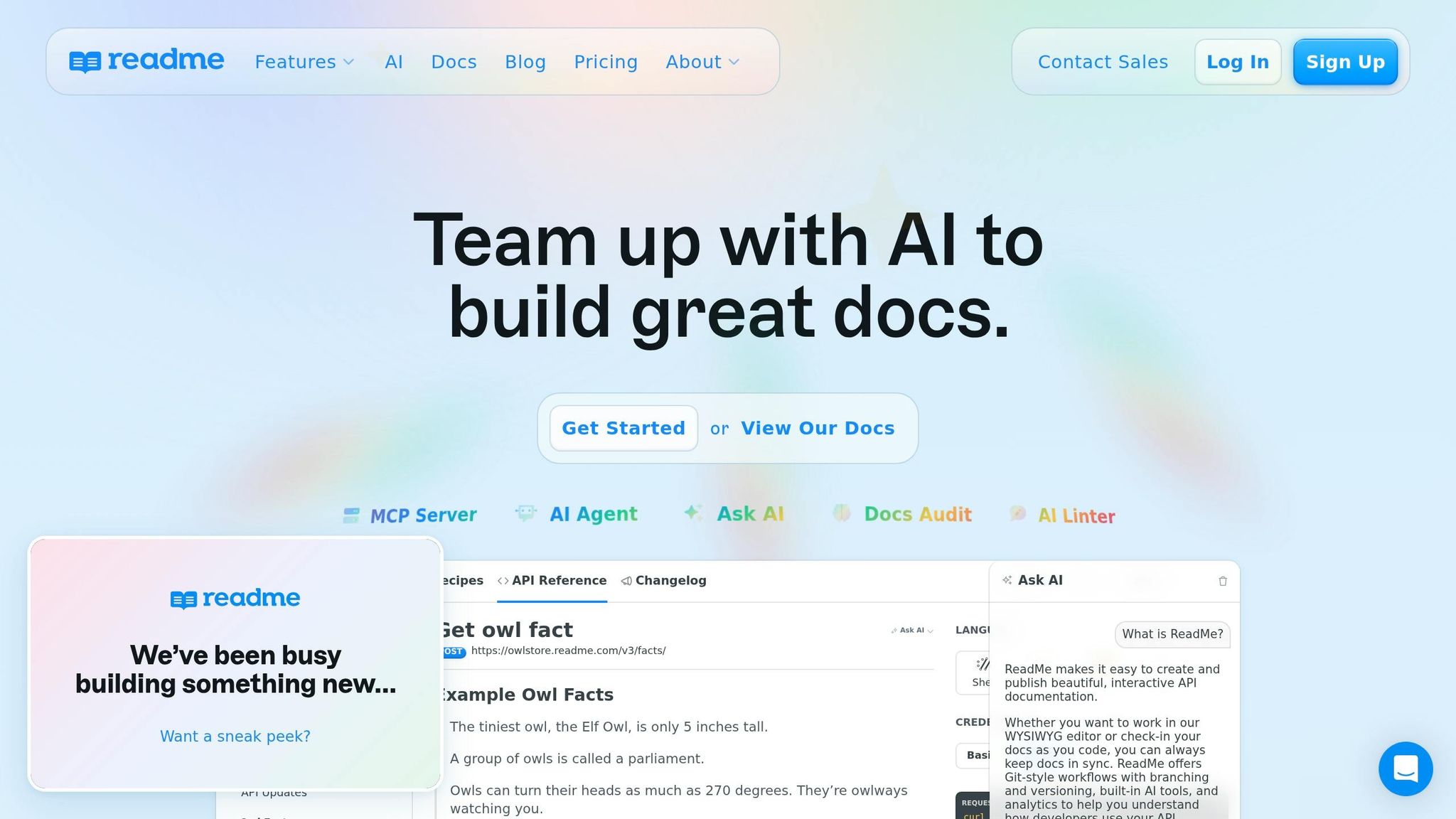
ReadMe integrates ads directly into technical documentation, targeting developers actively engaged in problem-solving.
Audience Reach
ReadMe allows you to connect with developers while they're troubleshooting or working with APIs . Developers visiting documentation sites are often in the middle of evaluating tools, integrating APIs, or resolving specific issues. This makes documentation an incredibly effective marketing tool for developer-focused products, often outperforming traditional ads by generating more signups .
What sets ReadMe apart is its ability to reach developers right within their workflow, alongside other high-impact environments like IDEs or package managers . This ensures your message reaches developers at the exact moment they're making technical decisions. By seamlessly integrating into their workflow, ReadMe provides a natural and unobtrusive way to deliver your message.
Ad Formats and Privacy-Focused Placements
ReadMe takes a privacy-conscious approach by focusing on contextual ad placements within documentation environments. Instead of relying on intrusive banner ads, the platform promotes content that drives developers to resources like sandboxes, documentation pages, or free tiers . This ensures the ads align with what developers are already working on, providing immediate and relevant value.
Networks like EthicalAds, which are designed to support documentation sites such as Read the Docs, emphasize contextual targeting rather than behavioral tracking . This approach appeals to developers who prioritize security and privacy, while still maintaining ad relevance and effectiveness.
8. Reddit
Reddit attracts tens of millions of monthly visitors across thousands of developer-focused subreddits like r/programming (3.2M members), r/javascript (2.8M), r/webdev (1.5M), and r/python (1.4M) . A well-placed post on a major subreddit’s front page can generate between 10,000 and 100,000 visits, making Reddit a powerful platform for developer-focused campaigns .
Audience Reach
Reddit's developer audience skews younger and is primarily mobile, with 70% of traffic coming from mobile devices. However, only 15–20% of users hold senior purchasing authority . This makes the platform more suitable for promoting consumer-facing developer tools or open-source projects rather than enterprise-level B2B infrastructure. While sessions average 2–4 minutes with a bounce rate of 60–80%, the platform delivers high traffic volumes, though conversion rates tend to hover around 1–3% .
Targeting Options
Reddit allows for precise targeting through specific subreddits, interest clusters, keywords, and geographic filters . Smaller, niche communities like r/rust, r/kubernetes, or r/devops often deliver better engagement and conversions compared to broader subreddits like r/programming. These smaller subreddits, typically ranging from 10,000 to 100,000 members, are less crowded and more receptive to authentic engagement . However, Reddit’s audience is outspoken and quick to downvote or criticize overly polished or insincere content .
Ad Formats and Pricing Models
Reddit offers several ad formats, including promoted posts (text, image, video, carousel) and conversation ads, which appear natively in users' feeds . Native ads are particularly effective at bypassing ad-blockers . Pricing operates on CPM ($0.50–$3.50) and CPC ($0.20–$1.50) models, with a minimum daily budget of $5 . Successful campaigns typically achieve an engagement rate above 1%, measured by upvotes and comments . Posting during US business hours (8–10 AM ET) on weekdays can maximize visibility , and refreshing creative every 3–4 weeks helps combat ad fatigue in smaller subreddits .
Engagement Metrics
Reddit thrives on authenticity. Follow the "9:1 rule": for every promotional post, contribute nine helpful comments to build credibility. Aim to accumulate 500+ karma in target subreddits before launching a product . Developers respond best to posts framed as "I built this", accompanied by technical details, code snippets, or terminal screenshots, rather than polished marketing copy . Provide direct links to live demos, sandboxes, or technical blog posts instead of gated landing pages . To sustain momentum, respond to comments within two hours .
Next, we’ll look at how Discord refines advertising strategies for developers.
9. Discord
Discord is a platform where companies can build genuine connections with their audience through direct interaction rather than relying on ads . Unlike platforms with a unified feed, Discord's reach is spread across smaller, focused communities - servers dedicated to specific frameworks like LangChain or programming languages like Rust .
Audience Reach
Discord isn't designed for instant, large-scale reach like traditional advertising platforms. Instead, it requires a long-term commitment, typically 12–24 months, to see a return on investment through the growth of community advocates . Building a thriving Discord community takes effort and resources, much like other high-engagement channels. For a true measure of community health, focus on tracking active members (not just total members) and aim for 20% month-over-month growth. Post-signup surveys can help identify where new members are coming from and provide valuable attribution data .
Engagement Metrics
Success on Discord revolves around building relationships rather than relying on metrics like click-through rates. Key goals include achieving a CSAT score of at least 4.5 and generating 5 or more pieces of community-created content per quarter . In a well-rounded marketing strategy, signups attributed to DevRel efforts should make up 15% of total signups . Since Discord operates as a "dark funnel" where traditional tracking tools fall short, post-signup surveys asking "How did you hear about us?" are essential for accurate attribution .
"A 2 AM debugging session by a developer advocate creates trust unmatched by any ad." - Idlen
To engage effectively, start by sharing valuable resources like data and code before promoting anything . Discord is also a great space to offer pair-programming sessions or provide debugging support for complex integrations . Keep in mind that managing a community on Discord typically costs between $5,000 and $15,000 annually for tools and platform management .
This sets the foundation for exploring other community-driven platforms, such as Hacker News.
10. Hacker News
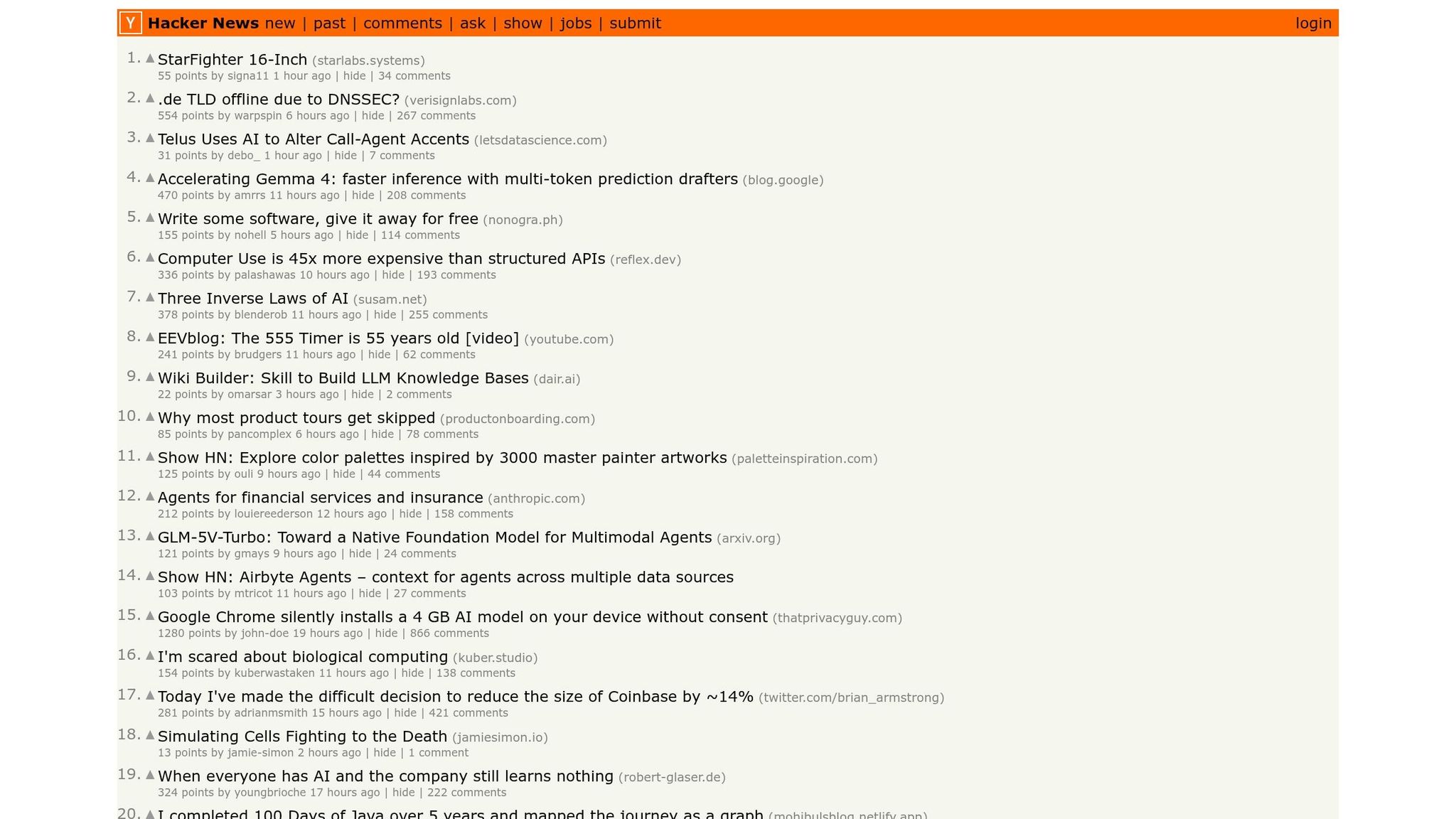
Hacker News stands out as a community-driven platform where technical depth takes precedence over flashy marketing. Instead of relying on traditional ads, it focuses on organic "Show HN" posts and native sponsorships seamlessly integrated into developer-focused content .
Audience Reach
A front-page "Show HN" post can bring in anywhere from 5,000 to 30,000 visits. Impressively, 60–70% of the audience consists of CTOs, engineering leaders, or founders with decision-making power. Additionally, only 40% of the traffic comes from mobile users, reflecting its desktop-heavy audience .
Ad Formats
Hacker News offers two main advertising methods: (similar to how you can advertise with daily.dev to reach technical audiences)
- Organic "Show HN" Posts: These are free but require authentic, technical content. The ideal title format is "Show HN: [Product Name] – [3-5 word description]" without unnecessary flair.
- Native Sponsorships: These text-based ads blend naturally into developer publications, focusing on depth rather than hype .
For example, in March 2026, PlanetScale's launch on Hacker News led to 14,000 visits, 420 signups, and 47 enterprise trials (each valued at $2,000+/month). In comparison, their Reddit campaign generated 31,000 visits but only 8 enterprise trials - showing a 5.9× higher conversion rate on Hacker News. Similarly, Cloudflare's technical breakdown of their 1.1.1.1 DNS resolver (a 3,400-word post) held the top spot for 12 hours, earning 380 points, 180 comments, and 67,000 visits .
Pricing Models
Hacker News delivers high-quality engagement, but the costs vary:
- "Show HN" Posts: These are free but require significant effort to produce in-depth technical content. Posts exceeding 2,000 words often outperform shorter ones by a factor of 10 .
- Native Sponsorships: These typically follow a CPM model, ranging from $35 to $60, with most placements averaging around $45. The cost per qualified lead generally falls between $50 and $150 .
Engagement Metrics
Hacker News traffic boasts a conversion rate of 3–8%, which is 2–3 times higher than Reddit’s 1–3%. Native sponsorships on the platform achieve an average click-through rate of 0.8–1.5%, with top-performing campaigns reaching up to 2.0%. Readers spend an average of 5–10 minutes per session, and bounce rates range from 40–60%, highlighting strong engagement .
"Reddit drives volume. Hacker News drives quality... Reddit gives you 3-5x more traffic, HN gives you 2-3x better conversion rates." – Rade Joksimovic, Founder, Teract
Timing is key. Posting between 9:00 AM and 11:00 AM ET on weekdays captures both U.S. morning and European afternoon audiences. Actively participating in discussions after posting can double or triple upvotes, keeping your post visible on the front page longer .
11. Stack Overflow
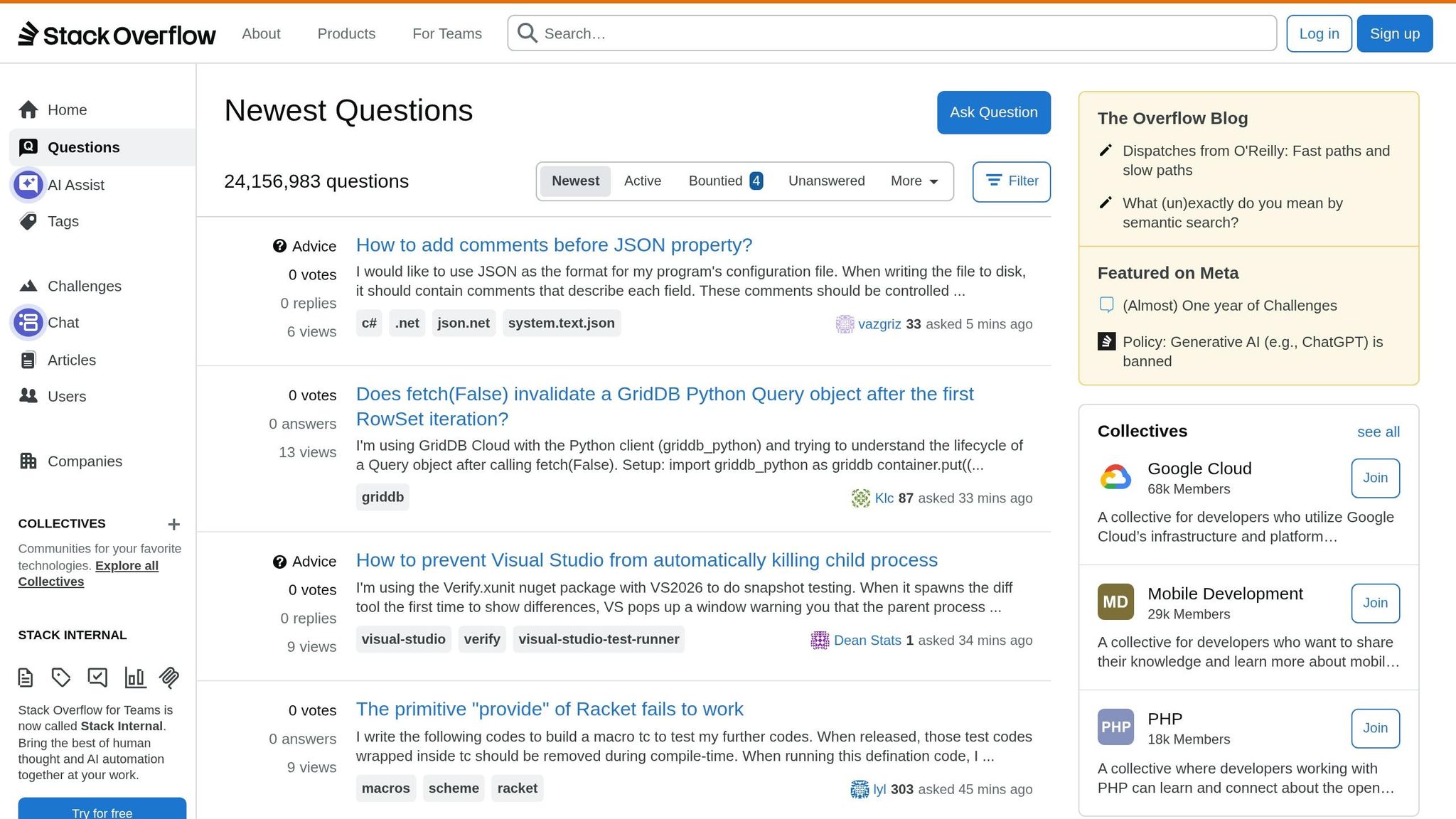
Stack Overflow connects with over 50 million developers and technologists every month, making it one of the largest technical communities globally . It excels as a mid-funnel channel for businesses aiming to engage developers who are already working with specific programming languages and frameworks. Unlike broader awareness platforms, Stack Overflow attracts developers in a problem-solving mindset, leading to higher-quality traffic .
Audience Reach
With a reach of 50 million monthly users, Stack Overflow surpasses LinkedIn's 30 million software engineering members . The standout factor here is the technical intent driving each visit - developers come to the platform with a clear purpose: to find solutions to coding challenges. This makes it a highly targeted space, often accessed through direct buys or Private Marketplace (PMP) deals for tag-targeted ad placements .
Targeting Options
Stack Overflow allows advertisers to use technology tag targeting, aligning ads with developers' immediate technical needs. Ads can be targeted by tags like Python, Kubernetes, or React, as well as by location and developer seniority . The platform’s strength lies in connecting with developers at the exact moment they’re addressing challenges related to your product. For example, headlines like "Debug your Python memory leaks" significantly outperform generic messaging . This precision helps position Stack Overflow as an ideal mid-funnel channel for reaching developers during key decision-making moments.
Ad Formats
The platform offers multiple ad formats, including display ads, tag-sponsored placements, newsletter sponsorships, and custom content . Among these, tag-sponsored placements tend to perform the best since they appear directly alongside relevant technical questions. This variety ensures you can engage developers in a way that aligns with their immediate needs and problem-solving activities.
Pricing Models
Stack Overflow uses a CPM pricing model, with a minimum spend of $15,000 per month, or $10,000 per month with a three-month commitment . This places it in the mid-to-high budget range, requiring a much larger investment than platforms like Reddit (minimum $5/day) or Google Ads (minimum $10/day) . The platform aims for a click-through rate (CTR) of >0.15%, with "time on site" serving as a secondary KPI to measure audience engagement quality . The pricing reflects the platform’s focus on delivering high-quality, technically engaged users.
Engagement Metrics
Key metrics to track include CTR, qualified site visits, and time on site . Stack Overflow’s audience tends to show stronger engagement compared to broader platforms, which justifies its premium pricing. Visitors who spend significant time on your site are a strong indicator of technically interested and relevant users .
12. Google Ads
Google Ads stands out as a key channel for bottom-of-funnel marketing, perfectly complementing other developer-focused strategies by capturing demand during the search phase. With a staggering 90% global market share , Google is where developers go when searching for terms like "best CI/CD tool" or "Terraform alternative." This makes it an ideal platform for targeting high-intent, conversion-ready traffic.
Audience Reach
Google's reach spans its Search Network and Display Network, covering over 35 million websites and apps and reaching 90% of internet users worldwide . For developer marketing, the Search Network is where the magic happens. Here, Google connects with developers actively researching tools, not just passively browsing. This intent-driven traffic often leads to conversions within 1–2 weeks , making it one of the fastest ways to generate measurable results. Thanks to this precision, Google Ads offers unmatched targeting opportunities.
Targeting Options
What sets Google apart is its ability to match ads to user intent. Developers searching for solutions are met with ads tailored to their needs. The most effective targeting strategies include:
- Keyword Intent: Bid on branded terms, competitor alternatives, and high-intent category keywords .
- Custom Segments: Target users based on competitor URLs, relevant developer keywords, and app interests .
- Contextual Targeting: Place ads on professional sites like G2, Capterra, or TechCrunch to catch developers in research mode .
For remarketing, Google supports lists with at least 100 active users and allows CRM uploads for Customer Match with a minimum of 1,000 active users . Since most trial registrations occur on desktop devices in professional settings, it’s smart to reduce mobile bids by 30–50% .
Ad Formats
For 2026, Responsive Search Ads (RSA) and Performance Max campaigns are the go-to formats . When crafting ads, use precise, technical language that resonates with developers. For example, a headline like "Debug your Python memory leaks" is far more effective than a generic message. Ads should link to ungated documentation, sandboxes, or free tiers to minimize friction for developers . Automated bidding strategies, like the 2025 Smart Bidding Exploration feature, have shown an average 19% lift in conversions, making them increasingly effective for technical products .
Pricing Models
Google Ads operates on a Cost-Per-Click (CPC) basis, and developer-focused keywords can be pricey. Here’s a breakdown:
- "API platform" keywords: $12–$25 per click
- "Developer tools" keywords: $15–$30 per click
- "Tool alternative" keywords: $8–$15 per click
On average, the cost per trial signup ranges from $100 to $300 . A $1,000 ad spend typically generates around 400 clicks, resulting in 15–25 trials and 2–4 paid conversions . To maintain steady lead flow, a starting budget of $1,000–$2,000 per month is recommended . A helpful rule of thumb: allocate at least 10 times your average cost per conversion as your initial monthly budget .
Engagement Metrics
The success of Google Ads is best measured through direct response metrics, like cost per signup and cost per trial. Aim for a conversion rate above 3% . Unlike awareness-focused channels, Google Search delivers immediate results and scalability - simply increase your budget or expand your keyword and geographic targets to grow your reach .
For bottom-of-funnel campaigns, it's critical to disable Optimized Targeting to avoid wasting your budget on cold audiences . Allocate about 50% of your paid media budget to Google Search to capture existing demand before branching out to awareness campaigns . Up next, we’ll dive into how the strengths and limitations of different platforms can refine your overall channel strategy.
Platform Strengths and Weaknesses
Each developer marketing platform has its own perks and challenges. Knowing where each one shines - and where it doesn’t - can help you make smarter decisions about where to invest your time and money. Instead of spreading your resources thin, you can focus on the platforms that best fit your goals.
In-workflow platforms, like Idlen, are great for high engagement. They connect with developers right inside tools like VS Code or JetBrains during natural pauses, delivering click-through rates (CTRs) of 2.1–3.5%. That’s about 10 times higher than traditional display ads. The downside? Limited historical data makes it harder to set benchmarks. Similarly, daily.dev Ads reach developers during their regular content discovery routines. It’s a strong choice for always-on campaigns that tap into developers’ technical interests.
Privacy-first networks, such as Carbon Ads and EthicalAds, tackle the challenge of high ad-blocker usage (67%) by using contextual targeting instead of behavioral tracking. Carbon Ads, for example, places a single native ad per page, achieving CTRs up to 6.4 times higher than display ad averages. But these platforms come with higher financial barriers: Carbon Ads requires a minimum monthly budget of around $5,000–$10,000, while EthicalAds starts at $1,000. For smaller teams, these costs can be a hurdle.
Community platforms offer mixed outcomes. Stack Overflow, with over 50 million developers visiting monthly, uses technology-tag targeting to align ads with developers’ real-time problem-solving. However, this platform requires a hefty monthly commitment of $10,000–$15,000. On the flip side, Reddit offers a lower-cost entry point and drives higher traffic volumes. That said, Reddit’s conversion rates tend to be lower, and its audience is quick to reject overt marketing. Ads here need to blend naturally with the platform’s organic, conversational style.
Finally, search and professional networks cater to bottom-of-funnel intent. Google Ads targets developers actively searching for solutions, but the cost of developer-related keywords ranges from $2 to $30 per click. LinkedIn, on the other hand, allows for precise targeting based on job titles and seniority, making it ideal for reaching decision-makers like CTOs and engineering managers. However, this precision comes at a price, with CPMs ranging from $33 to $120. For teams with tighter budgets, these channels can quickly drain resources unless campaigns are sharply focused on high-intent keywords or specific decision-maker groups.
Conclusion
Picking the right developer marketing platform means crafting a channel mix that fits your budget and aligns with your growth stage. Each platform plays a specific role in the funnel, from capturing high-intent traffic on Google Search to building lasting awareness through newsletters and community-driven platforms.
If your monthly budget is $5,000, focus on high-intent channels. Allocate 50% to options like daily.dev Ads or technical in-IDE placements to drive trial signups. Use 30% for niche newsletter sponsorships to maintain visibility and the remaining 20% for retargeting campaigns that re-engage users who have shown interest.
For a $25,000 monthly budget, aim for a more diverse strategy. Spend 40% on daily.dev Ads or in-IDE placements to drive mid-funnel engagement. Dedicate 25% to native content and newsletters, 20% to Google Search for intent-driven traffic, and 15% to retargeting and social platforms. This approach balances top-of-funnel discovery with mid-funnel engagement, creating a steady pipeline of leads.
With a $100,000 monthly budget, you can adopt a full-funnel strategy. Allocate 30% to multi-channel advertising (including daily.dev Ads, Reddit, and in-IDE placements), 35% to a robust Developer Relations program, 20% to technical content and SEO, and 15% to brand-building efforts like major events and conferences. At this level, advertising amplifies your Developer Relations efforts, creating a compounding effect that drives long-term growth and market presence.
daily.dev Ads serve as the cornerstone of an effective always-on strategy. These ads reach developers as they consume technical content, with AI-driven optimization that redirects budgets to the most effective segments in real time. Whether you're working with $5,000 or scaling up to $100,000, daily.dev Ads provide a dependable mid-funnel solution for product-led growth and sustained demand generation.
Tap into the daily intent of developers with daily.dev Ads to fuel growth across your entire funnel. For a deeper dive into optimizing your developer marketing strategy, check out our detailed allocation guide.
FAQs
How do I choose my 2026 developer channel mix?
When planning your 2026 developer channel strategy, aim for a multi-channel approach that fits both your budget and the audience you're trying to reach. Start by focusing on platforms that show clear signs of developer interest - places where technical content naturally draws them in.
Pair this with community-driven platforms that encourage organic interaction and discussions. To amplify your reach, consider ad networks for precise targeting and explore options like search engine ads or newsletter sponsorships, which offer trackable results.
Make sure to allocate your budget wisely. Base your decisions on how well each channel performs, the quality of the audience it attracts, and how those results align with your campaign goals.
What budget do I need to start getting results?
To make the most of developer marketing platforms in 2026, consider starting with a budget of $5,000 per month if your focus is on brand awareness or testing strategies. If you're aiming for a wider reach or generating leads, you'll need a larger budget - somewhere between $25,000 and $100,000 per month - to leverage a mix of channels effectively. Platforms like daily.dev excel at delivering results even with smaller budgets, thanks to their precise targeting and the ability to tap into developer intent signals. To see measurable outcomes, it's best to allocate at least $5,000 per month.
How do I track conversions with privacy-first targeting?
To measure conversions while respecting privacy, leverage real-time analytics and automated attribution tools that don't rely on invasive cookies or personal data. Instead, shift your attention to aggregated, anonymized signals and contextual data to assess campaign performance. This method helps you stay aligned with privacy regulations while still delivering precise insights into your results.


