

Pre-boarding, Day 1 setup and a 30‑60‑90 roadmap to shorten ramp-up, boost retention and get developers productive faster.
Onboarding developers effectively can save companies significant time and money. Poor onboarding costs over $75,000 in lost productivity per developer and increases turnover, with replacement costs ranging from 100% to 150% of a developer's annual salary. Yet, only 12% of employees feel their onboarding experience is well-handled.
Here’s how to fix it:
- Pre-boarding: Prepare all documentation, technical tools, and access before Day 1 using a technical onboarding checklist. Send hardware early and provide a clear Day 1 plan.
- Day 1: Focus on introductions, technical setup, and quick wins to build confidence.
- First 90 Days: Break onboarding into three phases:
- Days 1–30: Learn the environment and complete small tasks.
- Days 31–60: Take ownership of independent tasks and participate in reviews.
- Days 61–90: Lead features and achieve full productivity.
- Tailored Onboarding: Adjust onboarding for junior and senior developers. Juniors need structured guidance, while seniors thrive with autonomy and context.
Key Metrics to Track:
- Time to first commit: ≤ 3 days
- Time to first meaningful PR: 3–10 days
- 90-day retention: 95%+
With a structured approach, companies can reduce time-to-productivity to 10 days, improve retention rates, and ensure developers contribute quickly and effectively.
::: @figure 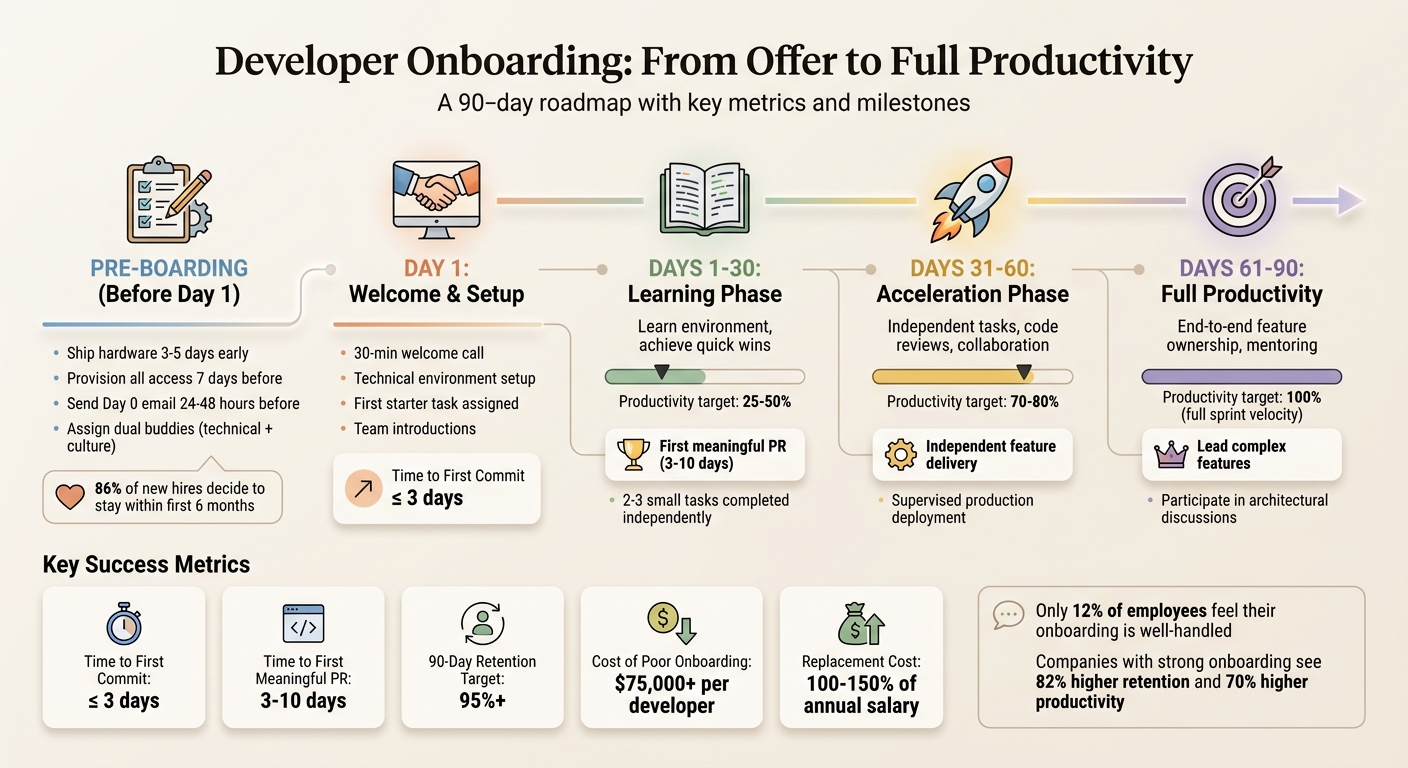 {Developer Onboarding Timeline: 90-Day Roadmap to Full Productivity}
Pre-Boarding: Getting Ready Before Day 1
The time between accepting an offer and starting a new job is more important than many realize. Research shows that 86% of new hires decide within their first six months whether to stay with a company . Pre-boarding turns this waiting period into a strategic opportunity to prepare new developers for success from the start.
Preparing Documentation and Role Expectations
Before Day 1, it’s crucial to have four key types of documentation ready:
- Technical: Architecture diagrams, API references, coding standards, and key repository READMEs.
- Operational: Onboarding playbook, team structure, communication guidelines, and FAQs.
- Administrative: Contracts, NDAs, tax forms, and other required paperwork.
- Role-Specific: Job responsibilities, KPIs, and a 30-60-90 day plan.
Since 81% of new hires feel overwhelmed by too much information , consolidate these materials into a single, searchable repository. Also, make sure to send a detailed Day 1 itinerary, work schedules, and a roadmap for the first week at least 48 hours before the start date. Companies like Google have shown that well-structured onboarding can help new hires become effective 25% faster .
Once the materials are in place, the next step is ensuring technical access is ready to go.
Setting Up Access and Technical Tools
Delays in access to tools and systems on Day 1 can hinder productivity. To avoid this, create a centralized checklist (using tools like Notion or Google Sheets) to track the setup of each tool, its owner, and its status. Begin this process at least seven days before the start date .
Ship essential hardware - laptops, monitors, and peripherals - so it arrives 3–5 days in advance, leaving time to address any issues. Provision access to all necessary accounts, such as GitHub or GitLab, Slack, Jira, cloud services, VPNs, and password managers. Use multi-factor authentication for added security and share credentials securely through tools like 1Password or Vault rather than plaintext.
To ensure everything is ready, schedule a quick 15-minute validation call the evening before Day 1. This step is especially critical for remote developers to catch any last-minute issues.
Creating a Personalized Welcome Plan
Tailor onboarding to each hire’s seniority, technical focus, and experience. A dual-buddy system works well: pair the new hire with a technical mentor for codebase questions and a culture buddy to help them navigate team dynamics. Studies show that new hires with buddies are 23% more satisfied after one week and 36% more satisfied after 90 days .
Send a "Day 0" email 24–48 hours before their start date. Include a warm welcome, login credentials, and a clear agenda for the first week. For remote employees, consider adding a personalized touch with a welcome pack containing company swag and a handwritten note. Prepopulate their calendar with introductory one-on-one meetings and a team lunch (virtual or in-person) for Day 1.
Assign a low-risk starter task, like updating documentation or fixing a README. A quick win on Day 1 builds confidence and shows immediate contribution. With a strong pre-boarding process, organizations can improve new hire retention by 82% .
sbb-itb-d1e6221
Day 1: Welcome and Initial Setup
Day 1 is all about setting the stage. With 20% of employee turnover happening within the first 45 days , it’s crucial to make a strong first impression. The goal? Help the new hire feel included, ensure everything works seamlessly, and avoid overwhelming them. Keep things simple and welcoming.
Team Introductions and Culture Orientation
Start with a 30-minute welcome call led by the manager. This is not the time to dive into technicalities - it’s all about creating a positive connection and making the new developer feel at ease. Afterward, introduce the new hire to the team with a Slack announcement, including their photo, a brief background, and a fun fact to spark engagement .
Building relationships early is key. Microsoft’s research shows that 97% of new hires who met their assigned buddy more than eight times in their first 90 days felt more productive . To emulate this, schedule informal 15–30 minute "coffee chats" with team members throughout the week. For remote teams, a casual virtual meet-and-greet works well - keep it light, with cameras on but no formal presentations.
Buffer’s approach provides a great example: since 2012, they’ve paired new hires with two buddies - a technical mentor for code-related guidance and a culture buddy to help them navigate company norms . Once personal connections are established, it’s time to shift focus to the technical setup.
Technical Environment Configuration
Even with pre-boarding efforts, 43% of new hires still face delays of over a week for basic technical setup . To avoid this, dedicate at least two hours on Day 1 to confirm that all tools are functional. Walk through key systems like the IDE, VPN, GitHub, Slack, cloud services, and password managers to ensure everything works as expected.
Here’s a quick comparison of setup methods:
| Setup Method | Estimated Setup Time | Best For |
|---|---|---|
| Manual README | 4 to 8 hours | First hire only |
| Scripted (Makefiles) | 1 to 2 hours | Teams of 2 to 5 |
| Docker Compose | 30 to 60 minutes | Teams of 5 to 15 |
| Dev Containers | 15 to 30 minutes | Teams of 10 to 30 |
| Cloud IDE (Codespaces) | Under 5 minutes | Any size, remote-first |
"Encountering GitHub access issues at 9 AM wastes critical onboarding time." - FirstHR
Assign a starter task, like updating documentation, to test the entire workflow - from creating a branch to merging it. This small, achievable task helps confirm the setup is complete and gives the new hire an early sense of accomplishment. In fact, 49% of employees with strong onboarding contribute to their team within the first week .
To wrap up the day, schedule a midday check-in to address any blockers and an end-of-day session to gather feedback and answer questions. This ensures the new hire feels supported and ready to dive deeper into their role.
First 90 Days: Building Confidence and Momentum
The first 90 days are crucial for shaping a developer's journey, from onboarding to making meaningful contributions. Interestingly, 22% of developers leave within this timeframe . To ensure success, this period can be divided into three distinct phases, each with specific goals and measurable milestones.
Days 1‑30: Learning the Environment and Achieving Quick Wins
The first month is all about getting oriented and making early contributions. Developers focus on understanding the codebase, workflows, and standards while aiming for quick wins. A significant milestone during this period is completing their first meaningful pull request (PR) - such as a bug fix, documentation update, or minor feature enhancement - within 3 to 10 working days .
Take Selleo, for example. In 2024, they reduced their time-to-first-meaningful-PR from 15 days to just 9 by introducing tools like a "first-PR playbook" and a "quick wins library." They also optimized local environment setup, cutting the time from 180 minutes to just 60 minutes with a single-command setup system .
"Expectations in the beginning need to be low because new hires are in the learning phase. This should be communicated so new developers don't feel pressured."
- Ruben Grill, Lead Backend Developer, TeleClinic
By the end of the first 30 days, developers should have completed 2 to 3 small tasks independently, demonstrating their ability to navigate the workflow. Pair programming sessions during this phase also help reinforce coding standards and the request lifecycle . With this foundational knowledge and early wins in place, the focus can shift to deeper collaboration and ownership of tasks.
Days 31‑60: Encouraging Collaboration and Code Ownership
In the second month, the emphasis moves from learning to active engagement. Developers begin taking on tickets independently and shift from primarily receiving feedback to providing thoughtful code reviews for their teammates . Assigning independent feature tasks that require minimal guidance helps build confidence . This is also the time for developers to observe the on-call rotation, giving them insight into operational workflows and allowing them to perform a supervised production deployment .
Organizations with strong onboarding processes report 82% higher new hire retention and 70% higher productivity . By day 60, developers should be operating at 70–80% productivity, contributing at a pace closer to the team average .
Days 61‑90: Cross‑Functional Collaboration and Full Productivity
The final month focuses on autonomy and ownership. Developers should take on end-to-end responsibility for a feature, from gathering requirements to deploying in production . They are encouraged to participate in architectural discussions, lead small initiatives, or tackle long-standing issues that may have been overlooked . These opportunities mark the transition from being a "new hire" to becoming an impactful contributor.
By day 90, the goal is for developers to reach full sprint velocity, matching the team average, and to achieve stable lead time trends . A formal 90-day review helps transition them from onboarding into regular performance management . Given the high cost of replacing a developer - ranging from 50% to 200% of their annual salary - getting this phase right is essential.
| Phase | Focus | Productivity Target | Key Milestone |
|---|---|---|---|
| Days 1‑30 | Learning & Integration | 25–50% | First meaningful PR merged |
| Days 31‑60 | Acceleration | 70–80% | Independent task delivery |
| Days 61‑90 | Autonomy | 100% | Complex feature leadership; mentoring others |
This structured approach ensures new hires move seamlessly from learning to contributing. Collecting feedback at key points - days 7, 30, 60, and 90 - helps identify and address any technical or team-related challenges . This ongoing feedback loop allows for continuous refinement, creating smoother onboarding for future hires.
Personalizing the Onboarding Process
A well-planned onboarding process can make a huge difference, especially when tailored to the experience levels of your team members. Junior developers need structure and guidance, while senior developers thrive with context and autonomy. Aligning onboarding tasks with these needs helps everyone integrate faster and more effectively.
Junior developers, with around 0–1.5 years of experience, benefit from clear instructions, coding standards, and close supervision during their first projects . On the other hand, senior developers, typically with 5–8+ years of experience, are more interested in understanding the reasoning behind architectural decisions and how their work impacts the company’s goals . They prefer autonomy over micromanagement.
"Senior developers bring more than just coding skills... They understand how to structure systems for long-term stability, how to scale efficiently, and how to deal with unexpected complications."
- Yannick De Pauw, People & Marketing Manager, MadeWithLove
The tasks assigned to each group should reflect these differences. Juniors excel when given defined, low-risk assignments like fixing bugs or tweaking UI elements. These tasks help them build confidence without feeling overwhelmed . Seniors, however, should tackle complex challenges, like system design or solving long-standing technical issues, to fully leverage their expertise .
Onboarding Junior Developers
Junior developers need a structured and supportive environment. Since they're learning how professional development works, it’s crucial to provide a clear framework and frequent check-ins. Assigning them a mentor - preferably a mid-level or senior developer - can make a big difference. Mentors can answer questions, review code, and guide juniors through their early days . Research shows that pairing new hires with mentors significantly boosts job satisfaction .
Instead of vague tasks, offer juniors a well-defined "first-PR playbook" with step-by-step instructions to help them master the basics. For instance, in 2024, Selleo created a library of small, achievable tasks that allowed junior developers to complete their first meaningful pull request in just 9 days, compared to the usual 15 . These early wins are crucial for building momentum and confidence during the first month.
Focus on teaching essential skills like coding standards, workflow processes, and navigating the codebase. Provide "how-to" guides and tutorials rather than overwhelming them with high-level architectural details . Pair programming is particularly effective, as it allows juniors to learn directly from more experienced teammates.
"Junior developers can move quickly, tackling well-defined tasks like coding features or making UI changes. With a senior developer providing oversight - much like a foreman - they can ensure everything is on track."
- MadeWithLove
It's important to set realistic expectations. Juniors need time to adapt to their new environment, and clear communication about this adjustment period can help reduce unnecessary stress.
Onboarding Senior Developers
Senior developers, on the other hand, require less guidance and more context. They want to understand the architectural choices behind your systems and the business domain they’ll be supporting . To meet this need, provide them with Architecture Decision Records (ADRs) that explain the rationale behind key tech stack decisions . This approach allows them to get up to speed without relying on repetitive questions.
From day one, grant seniors the autonomy to explore the codebase, form their own opinions, and even challenge existing requirements if they see potential issues . Assign them tasks that match their expertise, such as complex problem-solving or architectural reviews, rather than entry-level "good first issues" .
Seniors are also expected to step into leadership roles quickly. By mentoring junior and mid-level staff, conducting code reviews, and guiding the team, they contribute to overall team growth . By day 60, they should be leading small projects or addressing long-standing technical debt .
"Mid-level engineers build features. Senior engineers design systems."
- Isaac Rowaiye, Child Poverty Action Lab
The ramp-up timeline for seniors is shorter. While juniors might require the full 90 days to reach full productivity, seniors are typically operating at 70–80% by day 60 and should be handling end-to-end feature development by day 90 .
| Feature | Junior Developers | Senior Developers |
|---|---|---|
| Primary Focus | Tools, coding standards, workflows | Architecture, leadership alignment, business goals |
| Guidance Level | High (shadowing, frequent 1:1s, detailed requirements) | Low (autonomy, independent exploration) |
| Initial Tasks | Small bug fixes, documentation updates, UI tweaks | Complex problem-solving, architectural review, system design |
| Documentation Needs | "How-to" guides and step-by-step tutorials | ADRs and system architecture maps |
| Mentorship Role | Receives mentoring from assigned buddy | Provides mentoring to junior and mid-level staff |
| Productivity Target (Day 60) | Still ramping up (full productivity may take up to 90 days) | 70–80% |
Tools to Streamline Onboarding
Starting strong with the right tools can make onboarding efficient from Day 1. Companies with effective onboarding processes see a massive boost - new hire retention jumps by 82%, and productivity improves by over 70% . The key is cutting down the administrative delays that often hinder early progress.
Look for tools that automate repetitive tasks, grant access ahead of time, and track onboarding progress effortlessly. Begin with essentials like code repositories (e.g., GitHub at $4/user/month), communication platforms (Slack at $8.75/user/month), and documentation hubs (Notion at $10/user/month) . These tools lay the groundwork for a seamless onboarding experience.
"The maturity of your environment setup directly predicts how quickly a remote developer becomes productive."
- FirstHR
When it comes to environment setup, Cloud IDEs like GitHub Codespaces or Gitpod are game-changers. They slash configuration time from hours to just minutes, helping new developers bypass the frustration of local setup issues right from the start .
Using daily.dev Recruiter for Smooth Hiring Transitions
Bridging the gap between offer acceptance and Day 1 readiness can be tricky, but platforms like daily.dev Recruiter simplify the process. This tool connects companies with pre-qualified developers who are already familiar with modern development practices and tools. These developers come from an active professional network, bringing current skills and realistic expectations to the role.
With its warm, double opt-in approach, daily.dev Recruiter ensures that candidates are genuinely interested in the opportunity. This often translates to higher engagement with pre-boarding materials and quicker productivity - many new hires make their first pull request within three to five days . By focusing on technical readiness, the platform helps new team members achieve early wins instead of getting bogged down in administrative hurdles.
Project Management and Communication Tools
Once technical tools are in place, the next step is streamlining processes with project management and communication software. These tools help keep onboarding organized without micromanaging. Popular options like Linear (at $8/user/month) and Jira are great for creating structured 30/60/90-day roadmaps and tagging beginner-friendly tasks like "good-first-issue" tickets . Tackling these smaller tasks early gives new hires a sense of accomplishment while they familiarize themselves with the codebase.
Clearly defining the purpose of each tool is critical. For example:
- Slack: For quick questions and resolving blockers (responses expected within four hours).
- Project management tools: For task updates (same-day updates).
- Video calls: For complex discussions or pair programming (scheduled sessions).
This structured approach helps alleviate the confusion that 81% of new hires experience when they’re unsure where to direct their questions .
For asynchronous collaboration, Loom (at $12.50/user/month for Business) is invaluable. Record architectural walkthroughs once and let new hires watch them at their own pace. Tools like VS Code Live Share further enhance collaboration by enabling real-time pair programming, which helps developers navigate the codebase more effectively.
"The most impactful investment for onboarding remote developers is not software. It is documentation."
- FirstHR
Documentation platforms such as Notion play a crucial role in onboarding by centralizing knowledge. Structured documentation reduces repetitive questions and allows developers to become productive 40% faster . By creating a self-service knowledge base covering topics like coding standards, deployment workflows, and architectural decisions, senior developers can focus on mentoring rather than fielding routine queries.
Measuring Onboarding Success
Tracking the right metrics is the secret to transforming onboarding from a drawn-out process into a streamlined, efficient system. While most engineering teams take 7–9 months to get new developers fully productive, top-performing teams are hitting this milestone in just 1 month .
Key Metrics to Track Progress
One of the first indicators of progress is Time to First Commit - how quickly a new developer navigates your technical setup. The best teams aim for this on the first day, while a common benchmark is within three days .
Another critical metric is Time to First Meaningful PR, which measures when a new hire begins contributing real value. The goal should be between 3–10 days to ensure the onboarding process is effective. For example, Selleo introduced a "first-PR playbook" and a "quick wins library" in 2024 based on feedback from new hires, cutting their average time-to-first-meaningful-PR from 15 days to 9 days .
Retention is another key factor. Monitoring retention rates at 90 days and 6 months can help you identify onboarding issues early. A 90-day retention rate of 95% or higher is ideal . And don’t forget the cost of replacing a developer - it’s estimated to range from 100% to 150% of their annual salary. For a $120,000 role, that’s over $180,000 in recruiting, interviewing, and lost productivity .
"A weak onboarding process creates a roadmap tax that shows up as senior interruptions and blocked pull requests."
- Selleo
To steer clear of vanity metrics like lines of code or commit counts, use the SPACE Framework. This model evaluates Satisfaction, Performance, Activity, Communication, and Efficiency to measure genuine progress . Interestingly, teams that incorporate AI into onboarding report that 43% of their new hires are fully onboarded in under a month, compared to just 20% for teams without AI .
| Metric | Target Milestone | Purpose |
|---|---|---|
| Time to First Local Run | ≤ 60 Minutes | Evaluates setup efficiency |
| Time to First PR | Day 3–5 | Tracks initial workflow integration |
| First Ticket Completed | Day 10–14 | Validates team process understanding |
| Independent Feature Delivery | Day 30+ | Demonstrates familiarity with the codebase and architecture |
| Full Sprint Velocity | Day 60–90 | Confirms full autonomy and productivity |
| 90-Day Retention | 95%+ | Reflects onboarding success and team fit |
These metrics provide a clear roadmap for continuous improvement, helping teams cut down ramp-up time and enhance productivity.
Gathering Feedback from New Hires
While metrics give you the numbers, qualitative feedback gives you the "why." Gathering input from new hires at key intervals - Day 7, 30, 60, and 90 - helps you understand their evolving experience . At Google, 77% of new hires rated their onboarding experience positively, allowing them to become fully effective 25% faster .
Ask focused, actionable questions, such as:
- "What took longer than expected this week?"
- "Which documentation was missing or outdated?"
Structure feedback collection around milestones. For instance:
- Day 7: Focus on setup challenges and access issues.
- Day 30: Review the quality of their initial contributions and mentor support.
- Day 60: Assess their understanding of system architecture.
- Day 90: Evaluate their ability to deliver independent work .
"To receive feedback that you can act on, ask short, specific questions and require a concrete example. Convert each response into one change to documentation, tooling, or the onboarding kit."
- Selleo
Act on feedback immediately. For example, if multiple hires report delays in accessing AWS, automate or pre-provision permissions for future developers . Selleo tackled a recurring issue with their "time-to-local-run", reducing it from 180 minutes to just 60 minutes by introducing a one-command setup process based on direct feedback from new hires . By addressing pain points systematically, you can ensure each new hire’s experience is smoother than the last.
Conclusion
Developer onboarding can be a game-changer for companies. Consider this: 86% of new hires decide how long they'll stay within their first six months, and 80% would stick around longer if their onboarding experience improved . When you factor in that replacing a developer could cost between 100% and 150% of their annual salary - up to $180,000 for a $120,000 role - the stakes couldn’t be higher .
This is why a well-structured, intentional onboarding process isn’t just helpful; it’s essential. From detailed pre-boarding materials to achieving full sprint velocity in 90 days, every step plays a role in long-term success. Companies that automate environment setup, assign dual buddies for technical and cultural support, and set clear 30-60-90 day milestones are seeing faster results and better retention.
"Onboarding is a journey and not a destination, and... to be perfect is to change often."
Start small but smart: ship equipment early, run a "Day 0" validation call, and aim for a quick win on Day 1. Use feedback from new hires to refine the process. For instance, asking new team members to improve five documentation pages during their first 90 days can help close knowledge gaps for future hires . Tracking metrics like time-to-first-commit and 90-day retention can also highlight areas for improvement. This is especially critical when only 12% of employees strongly agree their company handles onboarding well .
Think of onboarding as a product. Keep iterating, refining, and improving it to boost both productivity and retention. Every new hire is a chance to make the process better.
FAQs
What should I automate first to speed up onboarding?
To make onboarding smoother, focus on automating the environment setup. With this in place, new developers can clone the repository and get started with just one command. Automating steps like installing dependencies, configuring tools, and preparing the environment minimizes delays, boosts productivity, and enables new team members to start contributing quickly.
How do I onboard remote developers without setup delays?
To make onboarding remote developers seamless, it's crucial to have all the technical infrastructure ready before their first day. This means ensuring they have access to essential tools, repositories, and security credentials.
Take care of pre-boarding tasks like shipping hardware and setting up accounts in advance. Assigning a technical onboarding buddy can also make a big difference by offering guidance and answering questions. Use detailed checklists to keep track of tasks and establish KPIs to monitor progress. This approach helps identify and resolve issues early, allowing developers to integrate more easily and start contributing faster.
Which onboarding metrics actually predict productivity?
Key indicators for assessing developer productivity during onboarding include:
- Time to first commit: Ideally, this should occur within 3 days.
- Time to first pull request merged: Aiming for under 1 week is a good benchmark.
- Time to first solo feature shipped: This milestone should be reached within 4 weeks.
Other important metrics to monitor are retention rates, which should stay above 95%, and onboarding NPS (Net Promoter Scores), which should exceed 8 out of 10. These numbers provide a clear picture of how well new developers are integrating into the team.


