

Up-to-date benchmarks and clear total-compensation guidance to set competitive developer offers in 2026.
Hiring developers in 2026? You need accurate salary benchmarks to stay competitive. Here’s what you should know:
- Compensation is the #1 reason developers accept or reject offers. Offering below-market pay can triple your hiring time and hurt your reputation.
- Median total compensation for U.S. software engineers is $190,417. Specialized roles like AI/ML engineers command a 15–50% premium.
- Pay transparency laws are in effect in several states, making accurate salary data legally essential.
- Key salary ranges by experience:
- Junior (0–2 years): $95K–$145K
- Mid-Level (3–5 years): $145K–$220K
- Senior (6+ years): $200K–$310K
- Staff/Lead (8+ years): $270K–$450K+
- Remote roles pay 10–15% less than onsite positions in top-tier cities but are increasingly aligned with national medians for top talent.
- Developers value total compensation that aligns with their goals, including base salary, bonuses, equity, and perks like signing bonuses or learning budgets.
Pro Tip: Use platforms like Levels.fyi, Radford, and Carta for real-time salary data. Combine this with transparent, itemized offers to build trust and close deals faster.
Developer Compensation in 2026: Current Market Overview
::: @figure 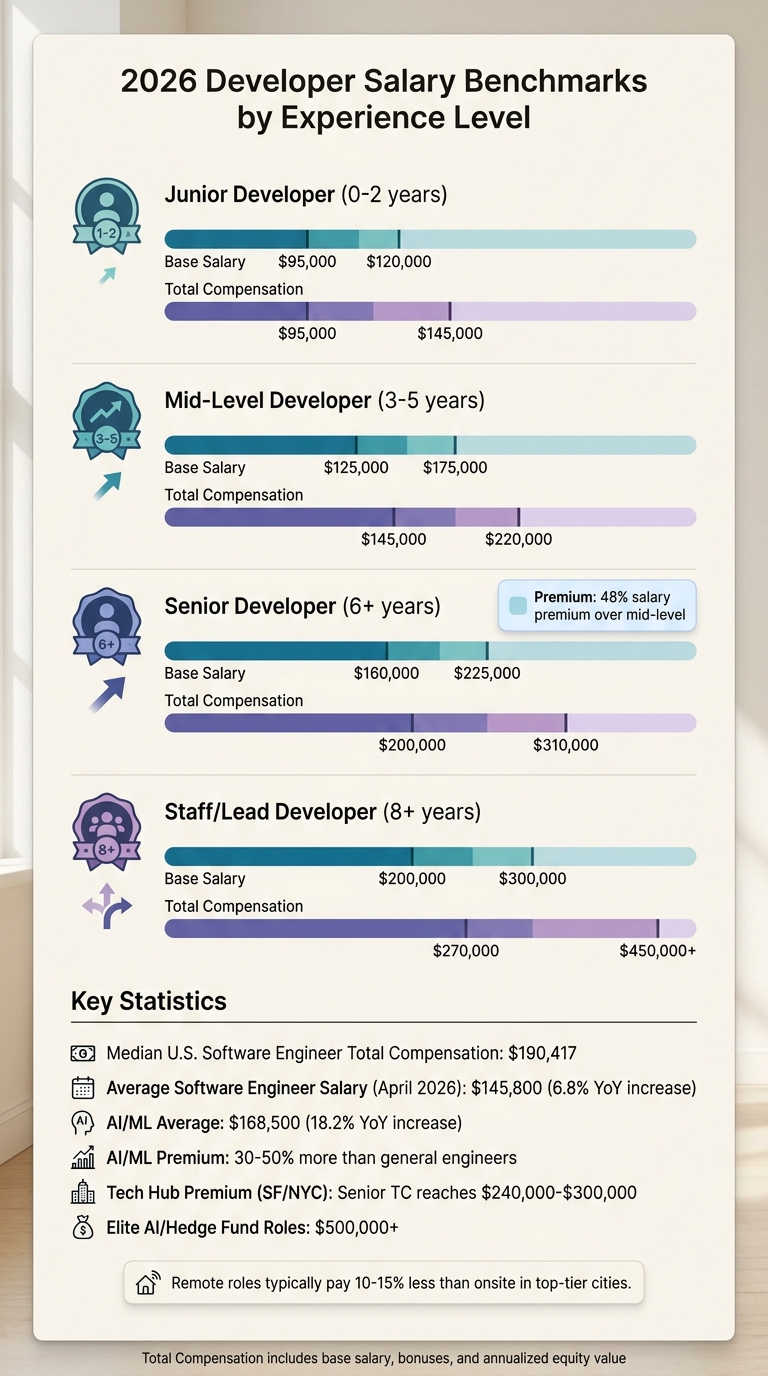 {2026 Developer Salary Ranges by Experience Level and Total Compensation}
Companies are increasingly prioritizing architectures that ensure safe AI coding . This shift has led to specialized skills in AI/ML, platform engineering, and emerging tech stacks commanding higher salaries, while more generalist roles are experiencing slower wage growth.
As of April 2026, the average software engineer salary reached $145,800, reflecting a 6.8% year-over-year increase . AI/ML roles saw even greater growth, climbing 18.2% to an average of $168,500. Additionally, 87% of tech leaders have increased pay for candidates with expertise in cybersecurity and cloud architecture . The market is now favoring roles that leverage technical skills to maximize efficiency, with AI tools and automation enabling smaller teams to deliver the same output as larger ones .
2026 Salary Ranges by Experience Level
Here’s a breakdown of developer compensation by experience level:
| Experience Level | National Base Salary | Total Compensation (TC) |
|---|---|---|
| Junior (0–2 years) | $95,000 – $120,000 | $95,000 – $145,000 |
| Mid-Level (3–5 years) | $125,000 – $175,000 | $145,000 – $220,000 |
| Senior (6+ years) | $160,000 – $225,000 | $200,000 – $310,000 |
| Staff/Lead (8+ years) | $200,000 – $300,000 | $270,000 – $450,000+ |
In tech hubs like San Francisco and New York, these figures climb higher. Senior developers in these cities often see total compensation packages of $240,000–$300,000, with elite roles in AI labs or hedge funds surpassing $500,000 . Notably, senior engineers earn a 48% salary premium over mid-level engineers, reflecting the heightened demand for seasoned technical leaders .
Specialized skills also significantly boost earning potential. AI/ML engineers typically earn 30–50% more than general software engineers at the same level of experience . For instance, senior platform engineers earn between $197,000 and $251,000 , while senior full-stack developers earn $155,000–$200,000 . Developers skilled in AI coding tools like Cursor or Claude Code can expect 10–20% higher pay compared to peers without these proficiencies .
How Remote Work Affects Developer Pay
Remote work continues to influence compensation trends. While remote roles have stabilized after initial fluctuations, they still tend to pay 10–15% less than equivalent onsite positions in top-tier tech cities like San Francisco or New York . For example, a senior developer earning $240,000 onsite in San Francisco might receive an offer in the $200,000–$215,000 range for a fully remote position.
Companies typically adopt one of three remote pay models:
- Location-agnostic: Uniform pay regardless of where employees live.
- Location-tiered: Pay adjusted based on geographic cost-of-living zones.
- Local-market benchmarked: Compensation tied to the median salary of the employee’s specific city .
Many firms now factor in a "flexibility discount" during negotiations, treating remote work as a benefit that justifies slightly lower base pay . However, for top-tier remote talent, compensation is increasingly aligned with national medians - around $206,600 for senior roles - regardless of local living costs .
With these trends in mind, the next step is identifying reliable sources for salary data to fine-tune job offers effectively.
sbb-itb-d1e6221
Where to Find Accurate Salary Data
Accurate salary data is the backbone of competitive hiring strategies. Without it, you risk either overpaying or losing top candidates to better-informed competitors. To get a clear picture of the market, it’s crucial to combine data from multiple platforms - no single source provides the full story. Below, we’ll explore five platforms that deliver reliable salary data for tech roles.
5 Salary Data Platforms Recruiters Should Use
Levels.fyi is a go-to resource for tech-specific compensation insights. It offers verified data on total compensation (including base salary, stock options, and bonuses) and uses a standardized leveling framework for easy comparison across companies. For instance, a "Senior Software Engineer" at Google often aligns with a "Software Engineer III" at Meta. The platform has also introduced "Radford compatibility", enabling recruiters to align real-time market data with formal corporate benchmarks . By 2025, median total compensation for U.S.-based software engineers rose by 3.49%, with senior roles averaging $312,600 .
Glassdoor is a well-known platform that aggregates salary ranges based on user-submitted data. While it may not be as precise for tech roles as specialized platforms, it’s helpful for understanding general market trends and how candidates perceive pay at specific companies .
Radford remains a trusted standard for enterprise-level benchmarking. It provides structured, formal data that HR leaders use to define internal pay bands and ensure compliance with compensation policies . Platforms like Levels.fyi now integrate with Radford frameworks, bridging the gap between traditional benchmarks and real-time market trends .
Pave and Carta are indispensable for startups, especially when equity compensation is part of the equation. These platforms offer payroll and equity data segmented by funding stages (e.g., Seed through Series C), including details on equity percentages and vesting schedules . This is particularly valuable when competing with startups that can offer significant equity upside.
| Source | Primary Use Case | Key Strength |
|---|---|---|
| Levels.fyi | Tech-specific leveling | Real-time total compensation and "Radford compatibility" |
| Radford | Enterprise benchmarking | Structured corporate data trusted by HR leaders |
| Carta / Pave | Startups & equity | Detailed payroll and equity data segmented by funding stage |
| Glassdoor | Broad market data | Aggregated salary ranges and insights into company-wide compensation sentiment |
By leveraging these platforms, recruiters can fine-tune salary offers and build credibility with candidates - a must in today’s competitive hiring environment.
Using daily.dev Recruiter Data for Salary Calibration
In addition to aggregate platforms, tools that provide candidate-specific insights can further refine your salary benchmarks. daily.dev Recruiter offers an extra layer of intelligence by analyzing code-verified skills, GitHub contributions, and engagement patterns. This allows recruiters to assess a candidate’s seniority beyond what’s listed on their resume . For instance, a Mid-Level Engineer at a startup may possess the skills and impact of a Senior Engineer at a larger organization.
Take candidates with advanced AI/ML expertise or those demonstrating LLM integration skills - they could command a 15–30% premium by 2026 . These insights enable recruiters to craft competitive offers that reflect a candidate’s true value, rather than relying solely on self-reported experience.
The platform’s warm, double opt-in model ensures that candidates are genuinely engaged, reducing the risk of mismatched salary expectations. By providing a clear view of a candidate’s skills and engagement, recruiters can confidently calibrate offers - avoiding both underwhelming offers that damage trust and overpayments that strain budgets. When combined with traditional data sources, these insights offer a more complete picture of compensation trends.
Base Salary vs Total Compensation: What Developers Actually Care About
Understanding how developers evaluate compensation in 2026 is crucial for crafting competitive offers. These days, developers focus on total compensation - a package that includes base salary, bonuses, and annualized equity - rather than just the base salary. For instance, imagine an offer with a base salary of $180,000. If another offer adds $50,000 in annual RSUs and a performance bonus of 15% of the base salary (about $27,000), the total compensation jumps to approximately $257,000. This comprehensive view helps employers stand out in a competitive hiring market.
Here’s the breakdown: base salary is the fixed annual cash amount, while total cash compensation includes bonuses or commissions. Total compensation goes further, factoring in the annualized value of equity (such as RSUs or stock options) over the vesting period. Developers often find equity and vesting schedules - commonly four years with a one-year cliff - challenging to evaluate. For example, in February 2026, Airbnb offered senior engineers base salaries between $200,000 and $280,000, but equity pushed total compensation into the $300,000–$400,000+ range. If you fail to provide a clear breakdown, your offer may lose its competitive edge.
How Developers Evaluate Job Offers
Developers assess every part of a job offer, not just the headline salary number. For senior full-stack engineers, total compensation typically falls between $300,000 and $380,000, combining base salary, equity, and bonuses. Bonuses alone often add 10–20% for mid-level roles and 15–25% for senior positions. Engineers with AI/ML expertise can command an additional 15–30% premium compared to peers without similar skills.
Equity is another major consideration, especially in startups and established tech companies. Remote work flexibility also plays a big role, with developers valuing it at around $10,000–$20,000 annually due to savings on commuting and potential tax advantages. This highlights the importance of presenting offers in a way that accounts for every component.
Presenting Offers with Full Transparency
To build trust and make your offer more appealing, transparency is key. Developers value detailed, itemized offers that clearly outline every part of the compensation package. This includes base salary, signing bonuses, annual bonus potential, and the projected value of equity over its vesting period. Non-cash benefits, like learning budgets, hardware stipends (typically $2,000–$5,000), and home office allowances, should also be assigned a dollar value to show the full scope of the offer.
"Compensation is the #1 reason developers accept or reject offers." - Zumo Guides
When presenting equity, explain the current 409A valuation and provide details on potential exit scenarios. For remote roles, emphasize the financial perks, such as tax and cost-of-living benefits. For instance, developers living in no-income-tax states like Texas or Florida can save $15,000–$40,000 annually compared to high-tax states. Additionally, strategically using signing bonuses of $10,000–$30,000 can help close the gap when base salaries are less negotiable. A clear, detailed offer not only builds trust but also helps developers make faster, informed decisions.
Location-Based vs Role-Based Pay: Choosing Your Approach
How you decide to compensate employees - whether through location-based or role-based pay - has a direct impact on your budget, hiring strategy, and how candidates perceive your company. Location-based pay aligns salaries with local costs of living or labor, making it a practical choice for startups aiming to control expenses by hiring in lower-cost areas. On the other hand, role-based pay (also called location-agnostic pay) focuses on compensating employees based on the value they bring, regardless of their address. This approach simplifies payroll management and can attract top talent from anywhere.
Many Series A+ companies are now blending these approaches. They often set base pay at national market averages but add premiums for high-cost cities like San Francisco or New York City. For specialized positions - such as AI/ML engineers, Rust developers, or DevOps experts - geography tends to matter less, making role-based pay the preferred method.
Let’s break down how these models work with some examples.
Adjusting Salaries for Cost of Living
Location-based pay relies on geographic multipliers to align salaries with local market conditions. For instance, jobs in San Francisco typically carry a 20–35% premium over the national median, using a multiplier of 1.4–1.6x. In comparison, roles in New York City often come with a 15–30% premium. To illustrate, a senior engineer in San Francisco might earn $210,000, while the same role in Austin pays closer to $168,000.
However, raw salary figures don’t tell the full story. You also need to consider purchasing power. A $210,000 salary in San Francisco (Cost of Living Index: 145) equates to just $144,828 in purchasing power in a median-cost city. Meanwhile, a $168,000 salary in Austin (COLI: 89) translates to $188,764 in real-world value.
When offering location-based salaries, apply multipliers to a baseline. For example:
- San Francisco: 1.4–1.6x
- New York City/Seattle: 1.2–1.3x
- Austin/Denver: 1.0–1.1x
This data allows you to show candidates how a $155,000 offer in Raleigh-Durham might provide more disposable income than a higher salary in a coastal city. Transparency like this builds trust and helps candidates evaluate offers based on what truly matters to them financially.
Once technical expertise becomes the driving factor, it may be time to shift to a location-agnostic pay model.
Premium Pay for Specialized Roles
While location-based pay works for general positions, specialized roles often require a different strategy.
For niche positions, geographic location becomes far less important. For example, senior AI/ML engineers typically earn between $185,000 and $260,000, with a 12–15% premium over generalist senior developers. Similarly, DevOps and platform engineers earn $165,000 to $215,000, while Rust developers command salaries ranging from $170,000 to $225,000. These premiums reflect the scarcity of such skills and their direct impact on business outcomes.
Many companies also account for what’s known as the "AI Tax" - a premium paid to engineers managing the added complexity of AI-related technical debt.
"In 2026, the 'AI Tax' on companies is real, and it's being paid directly to the senior engineers who can implement it." - Bytexel Editorial
For roles like these, a role-based pay model is essential, regardless of where the employee lives. A senior machine learning engineer in Tampa delivers the same value as one in Seattle. Offering below-market rates for these skills is a surefire way to lose candidates. Increasingly, top-tier remote talent benchmarks their compensation against a "Zone 3" average of approximately $206,600 for senior roles, irrespective of cost of living.
When setting salaries for specialized positions, focus on the technical impact and value these professionals bring to your business, rather than their geographic location.
Setting Salaries for Niche and Emerging Roles
Hiring for specialized positions like blockchain developers or AI ethics officers can be tricky because established benchmarks often don’t exist. Instead of guessing, refine your research methods. Just like with more traditional roles, pulling data from several sources is essential to crafting competitive offers.
Start by combining insights from various platforms. Use real-time tools like Pave or Carta, traditional surveys like Radford, and public job postings from states with pay transparency laws. This layered approach helps you identify outliers and pinpoint realistic salary ranges.
"When benchmarking a niche or emerging role, relying on a single data source is like buying blind. Cross-checking multiple sources helps you spot outliers, understand the range, and make a more confident decision."
– Alistair Fraser, Founder of Justly
Another strategy is using proxy roles. For instance, you might treat an AI Ethics Officer like a Compliance Manager and apply a market-driven premium. If your data shows AI Engineers earn 10% more than Software Engineers, apply that same 10% adjustment to your salary bands .
Combining Multiple Data Sources for Sparse Markets
For roles like security engineers or blockchain developers, blending multiple data sources is crucial. Start with Glassdoor to get a broad sense of market trends, then add Radford’s survey data for industry-specific insights. Daily.dev Recruiter engagement data can also be helpful - it tracks what developers with niche skills are reading and interacting with, offering real-time insights into their expertise.
Look for consistent patterns across datasets. For example, if Kubernetes specialists consistently earn 15% more than general DevOps engineers, that’s a reliable modifier you can use.
| Niche Skill/Role | Premium Modifier | Applied To |
|---|---|---|
| Blockchain/Crypto | +30-50% | Rust/Systems roles |
| AI/ML Engineering | +15-30% | Python Backend baseline |
| visionOS | +20% | Swift/iOS roles |
| Kubernetes/Cloud-Native | +10-15% | Go or Java roles |
Adjust your salary bands with these market-driven premiums to stay competitive while maintaining equity within your organization . Keep in mind that emerging tech markets evolve quickly - what works in January might be outdated by April. Regularly reviewing and updating these premiums ensures your offers remain relevant and attractive.
Benchmarking New Tech Stacks
When hiring for cutting-edge technologies - like LLM integration specialists or visionOS developers - traditional experience metrics often fall short. This is where expertise signals become invaluable.
Daily.dev Recruiter data can help you assess how developers interact with content related to these new technologies. Are they diving into advanced architecture discussions or sticking to beginner tutorials? Their GitHub activity can also reveal their skill level. Developers with proven expertise in areas like machine learning, LLM integration, and MLOps typically earn 15-30% more than peers without these skills .
For AI/ML Python developers, salaries may run 30-50% higher than those of web backend developers at the same seniority level . Similarly, Rust developers in blockchain or crypto fields command significant premiums due to the limited talent pool . These figures reflect the high demand and scarcity in these areas.
"Over-relying on only a few isolated data points or anecdotal evidence from peers is a big risk for an emerging role with limited market data. It can result in overpaying for trending skills, or underpaying and struggling to attract and retain critical talent."
– Jörn Diekmann, Independent Total Rewards Consultant
If your budget can’t stretch to meet the cash demands for these roles, consider alternative incentives. Options like front-loaded equity vesting (3 years instead of 4), signing bonuses ranging from $10,000 to $30,000, or annual professional development budgets of $3,000 to $10,000 can help close the gap without permanently inflating salary bands . But remember, for highly specialized talent, lowballing total compensation is a surefire way to lose candidates. Tailored strategies like these strengthen your overall compensation approach and help you secure top-tier talent. By refining benchmarks and applying targeted premiums, you can meet developer expectations and succeed in negotiations.
Salary Negotiation: What Developers Expect and Where Recruiters Lose Them
Salary negotiations often become the breaking point where recruiters lose strong candidates. The issue isn't that developers demand excessive pay - it’s that some recruiters approach these discussions with outdated information, a confrontational tone, or an overly narrow focus on base salary. With tech unemployment hovering at just 2.8% , developers have plenty of alternatives. If your offer doesn’t align with their expectations, they’ll simply move on.
Meeting Developer Salary Expectations
When developers switch jobs, they generally expect a 10–20% increase in base salary . This isn’t an arbitrary demand - it reflects current market norms. If your offer falls short without a convincing explanation, you risk losing out. To stay competitive, rely on up-to-date benchmarks from platforms like Levels.fyi or Glassdoor to justify your numbers. And when candidates push back, don’t treat it as a conflict. Instead, shift the conversation to total compensation - base salary, equity, bonuses, and perks like 401(k) matches or learning budgets.
If your base salary has limits, consider alternatives to make your offer stand out. Options include:
- A $10,000–$30,000 signing bonus
- Accelerated performance reviews
- Remote work flexibility, which candidates often value at $10,000–$20,000
- Front-loaded equity vesting (e.g., over three years instead of four)
Explain these elements clearly, using data to show why your offer is competitive.
"Negotiating a senior developer salary in 2026 is no longer about winning a battle of wills; it is about proving a mathematical necessity."
– Bytexel
For candidates juggling multiple offers, closing offers tend to be 12–18% higher . If your initial offer doesn’t reflect market rates, competitors are likely to swoop in. Don’t wait for a counteroffer to adjust your numbers - start strong. A proactive approach not only improves your chances of closing the deal but also builds trust with the candidate.
Why Lowball Offers Kill Your Pipeline
Lowball offers don’t just cost you a single hire - they can disrupt your entire recruitment process. Offers that fall below market standards can double or triple your time-to-hire . For example, companies that fail to meet the $200,000 base salary floor for senior developers in 2026 face an average time-to-fill of 114 days . That’s nearly four months of lost productivity and mounting recruitment expenses.
But the damage goes beyond delays. Lowball offers can erode trust. When candidates receive offers that are far below market benchmarks, they may question whether you understand the value of their skills - or worse, assume you’re undervaluing them intentionally. And rescinding an offer after a candidate negotiates professionally? That’s a surefire way to earn a reputation as a toxic workplace.
"A company that rescinds an offer over polite, professional negotiation is not a healthy place to work."
– OpenJobList
Even if you manage to hire someone at below-market rates, it’s a short-term win at best. Developers who realize they’re underpaid are likely to leave within 12 months , creating a costly cycle of recruitment, onboarding, and training.
The solution? Use data-backed benchmarks, emphasize total compensation, and treat negotiations as a collaborative process. Developers aren’t trying to squeeze you dry - they just want fair pay for their expertise. Show them you’re willing to meet them halfway, and you’ll close more deals, faster.
Building a Compensation Strategy That Retains Talent
Offering competitive salaries might attract developers, but it’s a well-thought-out compensation strategy that keeps them around. Companies with formalized compensation plans experience 23% lower voluntary turnover compared to those that operate without one . The key difference lies in having a clear, transparent system that aligns pay with market trends and individual career paths. This approach avoids the reactive "counteroffer scramble" when an employee threatens to leave. A transparent, data-backed strategy not only builds trust but also helps prevent the missteps of lowball offers. It ensures compensation grows alongside career development.
Getting this wrong can be costly. Replacing specialized roles can cost anywhere between 50% and 200% of an annual salary . For instance, losing a senior machine learning engineer earning $250,000 could result in up to $500,000 in expenses, factoring in recruiting, onboarding, lost productivity, and knowledge transfer. Simply put, retention planning begins the moment you make an offer.
Matching Offers to Developer Career Goals
Developers care about more than just their current paycheck - they want a clear vision of their future. Publishing salary bands and career progression paths demonstrates transparency and provides a roadmap. This helps developers understand what skills, responsibilities, and performance milestones are needed to advance. Such clarity fosters trust and reduces the likelihood of employees testing the waters elsewhere.
Equity plays a big role, especially for senior developers. While the standard 4-year vesting schedules with a 1-year cliff help with retention, they aren’t enough on their own . After the initial equity grants vest, compensation can stagnate, which is why equity refresh programs are vital. These annual refreshes often range from 0.01% to 0.15% of equity, depending on the role and performance . Without them, long-tenured developers may feel their total compensation lags behind market rates, even if their base salary remains competitive.
Another important factor is offering dual career tracks. This means creating equal pay scales for Individual Contributors (ICs) and management roles . For example, a Staff or Principal Engineer should earn as much as an Engineering Manager at the same level. If your pay structure forces ICs into management roles just to earn more, you risk losing talented developers who prefer to stay hands-on.
Additional perks also matter. Many companies allocate $2,000 to $10,000 annually for professional development budgets for senior developers. Similarly, remote engineers often receive $1,000 to $3,000 annually in home office stipends . These benefits, paired with regular compensation reviews, are crucial for keeping developers engaged and satisfied.
"A P75 philosophy with a P40 budget creates more problems than having no philosophy at all."
– Dr. Bruce Brown, Founder, CompRatio LLC
Using daily.dev Recruiter to Refine Your Compensation Strategy
Compensation benchmarking isn’t a one-and-done task. By 2026, AI/ML salaries have been climbing 15–20% annually . To stay competitive, it’s essential to review compensation ratios quarterly . This means comparing current pay rates to your target percentile (e.g., 50th or 75th) and addressing any discrepancies - especially for high-demand roles. Real-time market data is essential to fine-tune your strategy.
daily.dev Recruiter provides real-time insights to help you adjust offers and spot retention risks. By analyzing developer activity and market trends, you can better understand seniority and market positioning than relying on outdated annual reports. This tool complements your broader strategy, ensuring you’re always ahead of the curve. For example, if a senior developer is actively engaging with AI/ML salary trends or exploring new opportunities, it’s a clear sign to reassess their compensation before they start interviewing elsewhere.
Address pay gaps proactively. If a developer earning $130,000 discovers the market rate is closer to $170,000, it won’t be long before they start looking for opportunities elsewhere .
Conclusion
Accurate salary benchmarking is the backbone of successful hiring and employee retention strategies. Compensation consistently ranks as the top reason developers accept or decline job offers . If you rely on outdated benchmarks, you risk losing candidates, damaging your reputation within developer communities , and offering packages that miss the mark - like targeting senior talent with mid-level pay . Worse, it can create internal pay gaps that erode team morale .
It’s not just about the numbers - it’s about transparency and the full package. Developers assess offers based on Total Compensation (TC), which includes base salary, bonuses, and equity, not just the base pay . When you present the complete picture and clearly outline career growth opportunities, you establish trust from the start. This approach minimizes the chances of developers leaving within their first year due to inadequate compensation and helps you sidestep the high costs of turnover.
"IT leaders who combine market insights with data-driven decision-making will be best positioned to build teams - and careers - that are ready for what's next."
– James Vallone, President, Motion Recruitment
Tools like daily.dev Recruiter make this process easier by offering real-time insights into developer activity and market trends. Instead of relying on outdated annual reports, you can proactively spot retention risks and adjust offers to align with current conditions. This is especially critical in fast-evolving fields like AI/ML, where salaries are rising 15–20% annually . These insights not only refine your hiring strategies but also support long-term retention efforts seamlessly.
FAQs
How do I set salary bands for my engineering team in 2026?
When determining salary bands in 2026, it's crucial to rely on current market data and account for factors like experience level, location, and job specialization. For instance, software engineers in the U.S. have a median total compensation of $190,417. Entry-level salaries generally range between $85,000 and $115,000, while senior engineers can earn upwards of $280,000.
To stay competitive - especially for niche roles - use platforms like Levels.fyi or Glassdoor to gather accurate compensation benchmarks. Offering salaries that align with market expectations helps attract top talent and avoids the pitfalls of low offers, which can damage trust and deter skilled professionals.
What should I include in total compensation to make offers competitive?
To remain competitive in 2026, offering a well-rounded total compensation package is crucial. This package should include not just a base salary but also bonuses, profit-sharing opportunities, and equity options such as stock options or RSUs. For highly specialized roles like AI engineers, total compensation can often surpass $400,000, highlighting the intense demand in the market. Being transparent about compensation and aligning it with candidate expectations is key to attracting top talent. On the flip side, lowball offers can erode trust and may even result in candidates disappearing from the hiring process entirely.
How should I benchmark pay for niche roles with limited market data?
To determine competitive pay for niche roles with scarce data, focus on a few key strategies:
- Use specialized salary benchmarks: Rely on trusted sources that provide data for unique or emerging roles.
- Factor in geographic differences: Pay can vary widely based on location, so consider regional adjustments.
- Account for premiums in high-demand fields: Roles in areas like AI or machine learning often command higher salaries due to their specialized nature.
Additionally, explore insights from secondary markets and track trends specific to the role you're assessing. Taken together, these steps can help you craft compensation packages that are both appealing and in line with market standards.


