

Relying on LinkedIn narrows your talent pool—use GitHub, Stack Overflow, Discord, events, content, and referrals to reach top developers.
Relying only on LinkedIn for technical recruiting is limiting your reach. Here’s why: 75% of developers aren’t actively using LinkedIn to find jobs, and senior engineers receive so many recruiter messages that most go ignored. LinkedIn’s InMail response rate is just 18-21%, while other channels like Slack and Discord communities see response rates as high as 35-48%.
To connect with top talent, you need to expand beyond LinkedIn. Here’s a quick summary of how to diversify your recruiting strategy:
- Audit Current Channels: Track where your hires come from and measure time-to-fill, cost-per-hire, and response rates for each channel.
- Engage Developer Communities: Platforms like GitHub, Stack Overflow, and niche Discord/Slack groups offer better engagement with skilled developers.
- Leverage Events: Hackathons, meetups, and conferences let you build relationships face-to-face, with follow-up response rates of 60-75%.
- Content-Driven Recruiting: Use engineering blogs, tutorials, and open source contributions to attract passive candidates.
- Referral Networks: Structured employee referral programs and alumni networks can generate high-quality hires with long-term retention.
- Paid Channels: Platforms like Stack Overflow Talent, GitHub Sponsors, and niche job boards allow for targeted outreach.
::: @figure 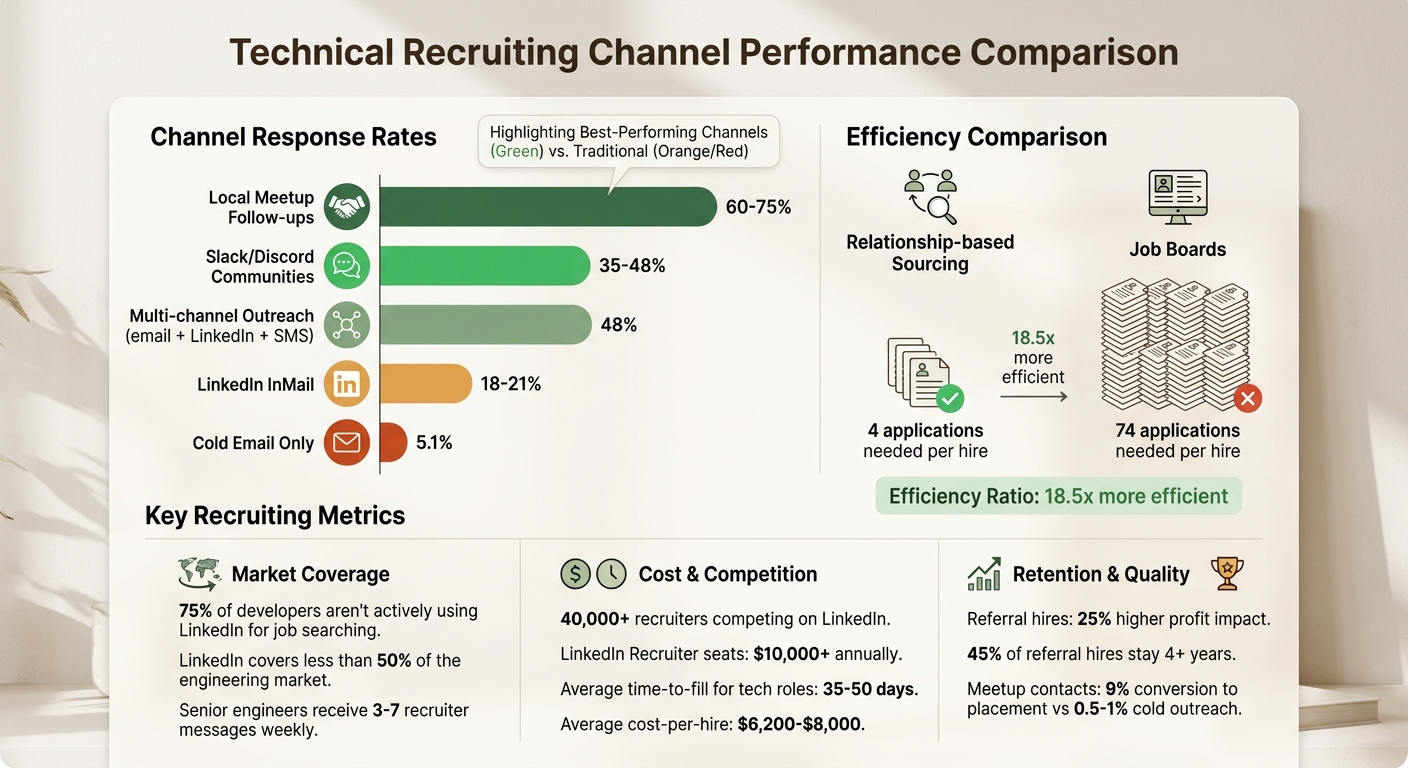 {Technical Recruiting Channel Performance Comparison: Response Rates and Efficiency Metrics}
The Risks of Relying on One Recruiting Channel
Why LinkedIn Dependency Creates Problems
Leaning entirely on LinkedIn for recruiting presents three major challenges: limited reach, intense competition, and incomplete candidate data. For starters, LinkedIn only covers less than 50% of the engineering market . A significant number of skilled developers either don’t maintain active profiles or rarely update them. Even when they do, crucial technical details - like specific programming languages, frameworks, or open-source contributions - are often missing .
The competition on LinkedIn is another hurdle. With over 40,000 recruiters vying for attention , candidates, especially senior engineers, are inundated with 3 to 7 messages weekly . This constant barrage leads to inbox fatigue, where many developers simply ignore or mute incoming InMails. It’s easy for your outreach to get lost in this overwhelming noise.
Moreover, LinkedIn doesn’t cater to all professions equally. Unlike sales and marketing professionals who meticulously update their profiles, many developers prefer platforms like GitHub, Stack Overflow, or even Discord, where their work directly reflects their skills. For example, a skilled Rust developer might not even mention Rust on their LinkedIn profile . By relying solely on LinkedIn, you risk overlooking highly qualified candidates who don’t showcase their expertise there. These gaps can lead to operational inefficiencies and financial strain, as demonstrated by real-world examples.
Real Examples of Single-Channel Problems
Beyond operational inefficiencies, depending on a single platform like LinkedIn increases costs and introduces algorithmic challenges. For instance, LinkedIn Recruiter seats now cost over $10,000 annually , with single-seat licenses priced around $170 per month . These expenses add up, especially when incomplete candidate data limits your ability to find the right talent.
Algorithm changes on LinkedIn further complicate matters. The platform’s new AI-driven "360Brew" reasoning engine prioritizes relevance over recency . This means candidates are pre-ranked based on what LinkedIn deems "relevant", often sidelining profiles that don’t include exact title matches, key skills, or seniority levels . As a result, highly qualified candidates may never even appear in your search results.
The "Open to Work" feature also highlights another issue. While it boosts visibility, it inadvertently makes candidates more vulnerable to scams. Between May and July 2025, job-related scams surged by 1,000% , with reported losses reaching $501 million in 2024 - five times higher than in 2020 . LinkedIn itself removed 80.6 million fake accounts in the latter half of 2024 alone . This environment not only makes candidates more cautious but also reduces engagement rates, creating additional hurdles for recruiters trying to connect with top talent.
sbb-itb-d1e6221
How to Audit Your Current Recruiting Channels
Step-by-Step Channel Audit Process
Before diving into new recruiting channels, it’s important to evaluate how your current ones are performing. Start by tracking the true source of every hire - not just where the initial contact happened. A simple spreadsheet can help: include columns for referrals, inbound applications, LinkedIn outreach, niche job boards, and community platforms. Once you have data from several hires, patterns will start to emerge, giving you a clear picture of which channels are working best .
Check if your hires are evenly distributed across sourced, inbound, and referral channels. The "Rule of Happy Thirds" suggests aiming for one-third of hires from each category . If more than 50% of your hires come from a single channel, like LinkedIn, you could be at risk. Changes to algorithms, pricing, or platform saturation could quickly disrupt your pipeline .
"The metric you're looking to optimize is number of high quality hires - not number of candidates."
- Greg Brockman, Chairman and CTO at OpenAI
Also, calculate the true cost per hire for each channel, including hidden costs. For example, a $500 job posting might seem affordable but becomes expensive if it generates a flood of unqualified applications that require significant screening time . Compare that to channels like talent relationships, where only four applications might be needed to make a hire . This kind of efficiency allows your team to focus on building stronger connections with top talent.
Which Metrics to Track
To make informed decisions, track these five key metrics: time-to-fill, cost-per-hire, response rate, pipeline-to-hire ratio, and 12-month retention. For technical roles, the average time-to-fill is between 35 and 50 days, while cost-per-hire typically ranges from $6,200 to $8,000 . If a channel consistently exceeds these benchmarks, it may not be worth the investment.
One particularly insightful metric is the pipeline-to-hire ratio. If you’re reviewing more than 20 candidates to secure one hire, your targeting might be too broad . Meanwhile, retention data helps differentiate channels that deliver quick hires from those that contribute to long-term success. For instance, referral hires tend to have a 25% higher profit impact, and 45% of them stay with the company for at least four years .
To stay on top of these metrics, create a source scorecard and update it weekly. This approach lets you spot issues early, saving time and money by avoiding ineffective channels .
| Metric | What It Measures | Target Benchmark |
|---|---|---|
| Time-to-Fill | Speed of hiring cycle | 35–50 days for tech roles |
| Cost-per-Hire | Financial efficiency | $6,200–$8,000 for tech roles |
| Response Rate | Engagement effectiveness | 18–25% (InMail); 48% (Multi-channel) |
| Pipeline-to-Hire | Targeting precision | 5:1 to 20:1 ratio |
| 12-Month Retention | Long-term hire quality | 45% stay 4+ years (Referrals) |
These metrics act as a compass, helping you fine-tune your recruiting efforts while exploring new channels like community platforms and events. By keeping an eye on these numbers, you’ll avoid over-reliance on any one channel and ensure a more balanced, effective recruiting strategy.
Community-First Channels for Developer Recruiting
Once you've reviewed your current recruiting channels, it’s time to focus on community-first spaces - places where developers naturally gather to connect, learn, and share. Unlike traditional platforms that push job postings to a wide audience, these spaces allow for genuine engagement. The results speak for themselves: sourcing through platforms like Slack and Discord achieves response rates of 35–48%, compared to just 18–21% for LinkedIn InMail .
Why the better results? It boils down to trust. Developers in these communities aren’t actively job hunting - they’re there to discuss their interests and passions. As Erin Mathew, Sr. Tech Talent Sourcer at PayPal, explains:
"There really is a community for everything... It's a place where developers really tend to thrive... People aren't there to get followers, they're there to discuss what they're passionate about" .
To succeed in these spaces, recruiters need to build trust by contributing value first. Instead of jumping straight to job offers, focus on engaging authentically. Your audit may reveal that these communities are a hidden goldmine for meaningful interactions, leading to more effective and trusted recruiting practices.
daily.dev Recruiter: Connecting with Developers Through Trust
daily.dev Recruiter is designed to align with this trust-first strategy. It facilitates warm, double opt-in introductions, connecting you with developers in spaces where they’re already active - whether they’re reading technical news, honing new skills, or collaborating with peers. This approach ensures that developers are open to hearing from you, eliminating the intrusiveness of cold outreach.
What sets daily.dev Recruiter apart is the ability to use real-time insights to personalize your outreach. Instead of relying on outdated profiles, you can see what developers are currently learning or building. This makes your communication relevant and engaging, especially since 70% of tech talent is passive - not actively job hunting but open to the right opportunity . By meeting developers on their terms, this approach minimizes friction and maximizes connection.
Developer Communities and Platforms
To build trust, start by exploring the best communities for sourcing developers where they naturally share and collaborate. Here are some key spaces to consider:
- Dev.to and Hashnode: Developers use these blogging platforms to publish tutorials, share insights, and dive into technical topics. They’re great for spotting thought leaders and active contributors.
- GitHub: With over 180 million developer accounts , GitHub is the go-to for assessing code quality and collaboration. Look beyond "stars" and focus on consistent contribution patterns (those "green squares" over 12+ months) to identify dedicated developers .
- Stack Overflow: Perfect for finding senior experts. Developers with high reputation scores in specific technical tags (like Rust or Kubernetes) have been peer-validated for their expertise .
- Discord and Slack: These real-time platforms host niche groups centered on technologies like React, Golang, or AI/ML. Hugging Face, for example, has become a hub for AI professionals, with over 800,000 open-source models hosted .
Building trust in these communities requires patience. Follow the "2-Week Rule" - spend time participating, sharing, and adding value before approaching anyone about a role . Always respect community norms, such as using designated #jobs channels for postings, and practice radical transparency. Include details like salary ranges, specific tech stacks, and even potential challenges of the role. Developers value honesty over corporate polish. As Erin Mathew advises:
"The best advice I can give [for recruiting] in closed-off communities, is to give more than you take" .
Event-Based Recruiting Channels
Event-based recruiting is a powerful complement to community-focused and content-driven strategies, creating a more well-rounded approach that reduces reliance on LinkedIn. While online communities help establish remote connections, in-person events allow you to meet developers face-to-face and gain insights into their skills and personalities. The numbers speak for themselves: follow-ups from local meetups boast response rates of 60–75%, compared to just 18–21% for LinkedIn InMail. Even better, meetup contacts convert to placements at a rate of 9%, significantly outperforming the 0.5–1% seen with cold digital outreach .
These events offer something a resume simply can’t: context. You get to see how developers approach challenges, work with others, and communicate complex ideas. Plus, you’re meeting them in environments where they’re engaged and enthusiastic about their work - not just browsing job listings out of necessity.
The key to success here? Consistent participation. Attend 2–3 events per month for at least two months before expecting measurable results . And remember, the real recruiting happens after the event - during the follow-up. While at the event, focus on building genuine connections. From there, you can explore specific formats like hackathons or tech talks to maximize engagement.
Hackathons and Meetups
Hackathons offer a front-row seat to a candidate’s technical abilities and teamwork. You can observe their problem-solving skills and how they collaborate in real-time. It’s no surprise that 40% of companies now incorporate hackathons into their recruitment strategies, as they’re excellent for connecting with passive candidates without spamming them even if they don't have an updated LinkedIn profile .
Interestingly, 82% of hackathon participants attend primarily to network and meet new people . This makes them especially open to conversations. To make the most of these events, don’t just observe - get involved. Participate as a mentor or technical advisor to build trust. As Justin Ng, Director of Ecosystem Development at AngelHack, explains:
"A well-run hackathon is a business program. It generates working prototypes, developer adoption, talent pipeline, and community momentum."
Local meetups, on the other hand, allow for more targeted engagement. Seek out gatherings focused on specific technologies or programming languages, like React meetups, Python user groups, or Kubernetes forums. Platforms like Meetup.com and Luma can help you find events tailored to your tech stack . One recruiter even suggests spending $500 on drinks for 20 attendees you meet at free events - because personal connections often outweigh broad brand exposure .
While hackathons and meetups excel at fostering direct interaction, tech talks and conferences help build deeper relationships with industry leaders.
Tech Talks and Conferences
High-profile conferences like KubeCon (focused on infrastructure), PyCon (for Python developers), or RustConf (for Rust enthusiasts) draw senior-level experts and thought leaders . These events provide a space for developers to dive into complex technical topics, making them ideal for connecting with specialists in particular fields. By establishing your presence in these spaces, you can further reduce reliance on LinkedIn’s overcrowded recruiting environment.
When attending these events, skip the generic hiring pitches. Instead, focus on discussing the specific engineering challenges your team is tackling . Developers are far more interested in the work itself than a simple list of open positions. After workshops, engage with speakers and active participants - they’re often some of the most motivated and skilled individuals in the room .
Since 2020, hybrid and virtual events have expanded the reach of these opportunities. You can now connect with attendees and speakers from around the world without incurring travel expenses . That said, in-person events remain unmatched for building stronger relationships. Whether virtual or in-person, consistency is key. Joining professional groups like IEEE or SANS can also grant access to member directories and help you connect with influential community figures .
To measure your success, track metrics like attendance versus registration rates, the number of interviews conducted post-event, interview-to-offer ratios, and time-to-hire compared to other recruiting methods .
Always follow up within 48 hours to maintain momentum while the event is still fresh in everyone’s mind . Reference specific details from your conversation - such as a side project they mentioned or a challenge they discussed - to show you were genuinely engaged. This personal touch can make all the difference.
Content-Driven Inbound Recruiting
Events can create valuable face-to-face connections, but content-driven recruiting allows you to draw in developers before you ever reach out to them. Here's the reality: 70% of tech talent isn't actively job hunting, yet they're constantly engaging with technical content . By producing high-quality engineering blogs, tutorials, or contributing to open source projects, you position your company as a hub for meaningful technical work.
This approach flips traditional recruiting on its head. Instead of relying on cold messages - which now have a dismal 5.1% response rate - you attract talent by showcasing your team's expertise. Developers get a firsthand look at your code quality, the architectural decisions you make, and the challenges your team tackles. This "proof-of-work" method allows candidates to evaluate your company before you even have a conversation .
The secret? Focus on creating content that’s genuinely useful, not thinly disguised job ads. Tutorials that solve real-world problems or meaningful open source contributions build credibility and trust. When done right, these efforts make recruiting feel more like a natural connection than a sales pitch.
Engineering Blogs and Tutorials
Your engineering blog can act as a living portfolio of your team’s technical journey. Developers are drawn to transparency, so don’t shy away from sharing the messy details: your refactoring decisions, scaling challenges, production failures, and the lessons learned along the way. Avoid generic corporate buzzwords like "innovation" - instead, focus on real stories. For example, write about how your team migrated from a monolith to microservices or solved a complex race condition in production .
This kind of content resonates with senior developers who care deeply about the work itself. A blog post about your Kubernetes migration strategy, for instance, could instantly appeal to someone whose expertise aligns with your challenges. Platforms like daily.dev make it easier for this content to reach developers who are actively learning and sharpening their skills .
Your posts don’t need to be earth-shattering - they just need to be authentic. Document your adoption of new technologies, share optimization techniques, or publish outage post-mortems. These stories reveal your technical depth in a way that no job description ever could.
Open Source Contributions
Open source contributions offer an entirely different way to discover and evaluate talent. Instead of relying on interviews or resumes, you can observe developers in action - reviewing their code, watching how they handle feedback, and seeing how they collaborate with others . As recruiting expert Augtal puts it:
"A developer with 200+ contributions to a Kubernetes-related repo is infinitely more verifiable than someone claiming 'Kubernetes expert' on LinkedIn" .
The numbers back this up. By 2025, GitHub had reached 180 million developer accounts, with 36.2 million new users joining that year alone. In the same period, open source repositories saw 1.4 billion contributions . This ecosystem gives you unparalleled insight into how developers actually work - not just what they list on their resumes.
Companies like Novu and Winglang have already turned their open source communities into hiring pipelines. For instance, Shai Ber, Co-Founder of Monada (the company behind Winglang), has confirmed that his team has successfully hired contributors from their open source community and plans to continue doing so .
To make this strategy work, you need to actively participate in open source - not just observe. Encourage your team to contribute to external projects during work hours; it’s a perk that stands out in today’s competitive market . Using corporate email addresses for commits signals your company’s support for the ecosystem, and allowing developers to retain authorship credit builds both their professional brand and morale .
Start by identifying open source projects that align with your tech stack. Look at contributor lists to find developers with expertise in the tools you use . Then, get involved: answer questions, review pull requests, and sponsor projects. After a couple of weeks of genuine participation, you’ll have earned the credibility to start conversations about open roles . The developers you connect with this way aren’t just skilled - they’re already familiar with your technical approach and values.
Building and Using Referral Networks
Referral networks tap into one of your most reliable talent sources: your current team and former employees. By leveraging these trusted internal connections alongside community and event strategies, you can create a balanced recruiting mix. The numbers back this up - referral hires tend to stay 25% longer than those from other channels and contribute a 25% higher profit impact . Even more impressive, referred candidates respond to outreach at rates of 50% to 70%, far surpassing typical digital efforts . Despite these advantages, many companies fail to fully embrace referrals as a key part of their talent acquisition strategy.
What separates an average referral program from a great one? The answer lies in structure. High-performing programs go beyond offering bonuses - they empower employees to actively scout and recruit talent . This requires treating referrals as a strategic initiative, not just a transactional process. Let’s explore how structured programs and alumni engagement can elevate your referral success.
Employee Referral Programs
Strong referral programs provide employees with the tools they need to recruit effectively, rather than simply asking for names. Take Stripe, for example. Between 2025 and 2026, they implemented a structured referral program focused on speed and efficiency. By tracking referral-to-hire cycle times, they cut their time-to-hire by 35% and achieved 55% of their engineering hires through referrals . The key wasn’t just cash bonuses - it was their "Referral Kit", which included email templates, job descriptions, culture guides, and even interview questions employees could share with candidates .
Similarly, Ramp approached referrals differently during their rapid growth from Series B to C in 2024-2025. They combined modest cash bonuses ($500–$2,000) with career development incentives, resulting in over 60% of their hires coming through referrals. In just 18 months, they added more than 100 employees . Ramp prioritized cultural alignment, ensuring employees referred candidates who fit the team’s ethos.
For senior or hard-to-fill roles, larger bonuses - ranging from $10,000 to $15,000 - can be far more cost-effective than agency fees . Adding incentives like "speed kickers" (e.g., a 10% bonus for hires within 30 days or 20% for hires within 20 days) underscores the value placed on employee networks .
Cash isn’t the only motivator. Companies like HubSpot have diversified rewards by offering professional development budgets, equity grants, extra vacation days, or public acknowledgment during all-hands meetings . HubSpot also focused on education, providing employees with resources like interview guides and market insights. This approach improved referral quality by 40% .
Alumni and Boomerang Hires
In addition to active employee referrals, alumni and boomerang hires represent an often-overlooked but valuable talent pool. Former employees bring a unique advantage - they’re already familiar with your systems, culture, and technical challenges. As a result, they ramp up quickly and come with a proven track record . Tracking your "Rehire Rate" can offer a clear view of how well you’re maintaining relationships with past employees and the strength of your employer brand .
But alumni networks extend beyond just rehiring former staff. They can include candidates who previously interviewed well but weren’t hired, contractors who collaborated on projects, or even university alumni. Using AI-driven candidate rediscovery tools can help you identify talent that might have been overlooked in the past. For instance, someone who wasn’t ready for a junior role three years ago might now be a perfect fit for a senior position . Referrals from this group are especially reliable - employees are unlikely to recommend someone who could damage their professional reputation.
To keep alumni networks active, it’s essential to maintain relationships after employees leave. Consider creating a formal alumni program with a dedicated Slack channel or LinkedIn group. Share company news, invite former employees to events, and make it clear they’re welcome back when the right opportunity arises. This approach provides access to a pool of vetted, passive talent with less competition than traditional job boards, offering stability in an unpredictable hiring market .
Paid Channels Beyond LinkedIn
Once you've tapped into community and event channels, it’s time to consider paid options that provide immediate access to candidates. While LinkedIn is often the go-to, it can be expensive and doesn’t always deliver the reach you need. In fact, LinkedIn covers less than half of the engineering market, with 45.6% of developers are passive talent not actively job hunting and 28.8% only being "somewhat open" to new opportunities . Forward-thinking recruiters are reallocating their budgets to platforms that offer stronger candidate signals and better engagement rates.
Here are some paid channels worth adding to your recruiting strategy:
Stack Overflow Talent and GitHub Sponsors
Although Stack Overflow shut down its standalone Jobs board in 2022, its Talent product still offers a goldmine for finding developers open to recruiter outreach . Developers’ reputation scores and tag specializations act as peer-verified indicators of expertise. For example, a developer with 10,000+ reputation points in "machine-learning" or "Kubernetes" has proven their skills through hundreds of answered questions - something a resume alone can’t show .
GitHub, on the other hand, serves as a real-time portfolio for over 100 million developers . Instead of relying on self-reported skills, recruiters can analyze actual code contributions, collaboration patterns in pull requests, and consistency through contribution graphs . This approach provides a clearer picture of a candidate’s abilities and reduces the risk of making a bad hire. As Nick Poloni, President of Cascadia Search Group, explains:
"The sourcing data is incredible, scanning 850M+ profiles with recruiter-level precision to uncover perfect-fit candidates I'd never find otherwise" .
Both platforms provide a data-rich environment where recruiters can confidently identify top talent. Beyond these, niche job boards offer another way to target specific developer segments.
Niche Developer Job Boards
Unlike general job boards, niche platforms cater to specific developer communities, often attracting candidates with higher intent. Platforms like Hired and Underdog.io, which include salary transparency and allow companies to apply to pre-vetted candidates, tend to yield better response rates since candidates already know compensation details upfront . Toptal, for example, connects companies with the "top 3%" of global engineering talent, making it a great choice for businesses looking for elite freelance or contract developers .
Other platforms cater to specific needs or preferences. For instance:
- Wellfound (formerly AngelList Talent): Ideal for startup-focused engineers.
- Dice: Tailored for enterprise technology roles.
- We Work Remotely: Attracts developers seeking remote-first opportunities .
These platforms allow recruiters to target candidates based on their preferred work environment, company size, or technical expertise.
Programmatic Job Advertising
For those managing multiple job postings, programmatic platforms like Joveo and Pin can streamline the process. These tools distribute job ads across hundreds of niche publishers and social channels while optimizing budget allocation based on performance . By automating this process, recruiters save time and ensure their ads reach the right audience. Pin, for example, starts at just $100 per month, making it a cost-effective option for smaller teams .
Programmatic advertising also provides centralized analytics, tracking every click, application, and hire across channels. This data-driven approach helps recruiters identify which sources deliver the best candidates, ensuring budgets are spent wisely. It’s especially useful for high-volume roles, allowing recruiters to focus their manual efforts on harder-to-fill positions.
How to Measure Channel Effectiveness
Once you’ve diversified your recruiting channels, it’s time to focus on metrics. Without clear data, it’s impossible to know which channels are delivering real results and which ones aren’t worth the investment.
Key Metrics to Track
It’s important to distinguish between the number of applicants a channel generates and the actual hires it produces. For example, while some channels may require 74 applications to make one hire, relationship-based sourcing often needs just 4. That makes it 18.5 times more efficient .
To keep your strategy on track, monitor these four metrics weekly: time-to-fill, source-of-hire, response rate by channel, and pipeline-to-hire ratio . Use benchmarks for comparison. For instance, if your LinkedIn InMail response rate falls below 18%, it might be time to shift your budget to job boards vs. developer networks .
The pipeline-to-hire ratio is a key indicator of how well you’re targeting candidates. Ratios above 20:1 suggest you’re reaching too many unqualified candidates, while a ratio below 5:1 might mean your search is too narrow . If you’re sourcing 100 candidates just to make one hire, it’s a sign that your channels aren’t delivering the right matches. Multi-channel outreach - using email, LinkedIn, and SMS together - can significantly improve response rates, reaching 48%, compared to just 5.1% for cold emails alone .
Don’t forget to track candidate satisfaction scores as well. These scores reflect how well your channels treat candidates and play a big role in maintaining your employer brand . Together, these metrics provide the insights you need to adjust your budget effectively.
How to Allocate Your Budget
When it’s time to reallocate your budget, think strategically. Use a portfolio approach tailored to your hiring volume. For teams making 1–10 hires annually, aim to distribute funds as follows: 40% to referrals, 30% to direct sourcing, 20% to your career site, and 10% to specialized agencies . For teams hiring 50 or more annually, adjust the mix: 25% to job boards, 20% to your career site, 20% to direct sourcing, 15% to referrals, 10% to campus recruiting, and 10% to surge agencies .
Be sure to calculate the true cost of each channel. For instance, a $300 job board posting might seem inexpensive. But when you factor in the 40–60 hours spent screening unqualified candidates, the actual cost can balloon to $4,000–$8,000 per hire . To stay on top of costs, create a monthly scorecard for each channel that tracks applicants, qualification rates, interviews, hires, cost per hire, and 12-month retention rates .
If a channel’s performance starts to slip, act fast. For example, if your LinkedIn response rate drops below 18%, consider reallocating funds to community platforms where developers are more active . Use tools like UTM parameters to measure recruitment marketing ROI and identify which placements are driving the best results .
Conclusion
Relying solely on LinkedIn puts you in a tough spot - competing with thousands of recruiters for the same, overcrowded pool of candidates. Meanwhile, a staggering 75% of developers aren’t even in LinkedIn's active pool. Many aren’t looking for jobs, are only “somewhat open,” or simply don’t bother updating their profiles .
The way forward? Diversify your sourcing strategy. Focus on platforms where developers actually spend their time - places like GitHub, Stack Overflow, Discord, hackathons, and daily.dev. A multi-channel outreach strategy (using email, LinkedIn, SMS, etc.) can boost response rates to 48%, compared to LinkedIn’s 18–21% . Plus, talent relationship channels require just 4 applications per hire, while job boards need a whopping 74 .
"LinkedIn isn't broken, it's just oversaturated. When everyone uses the same channel, the best candidates become unreachable." - Augtal Guide
To make this shift work, start by auditing your current recruitment channels. Reallocate your budget to coding-focused candidate sourcing tools that let you assess real coding skills and community involvement. Use the 2-week rule to test new communities and track cost per quality hire by source. It’s worth noting that top startups like Ramp and Perplexity source over 80% of their hires outside of LinkedIn . With software developer employment expected to grow 15% through 2034 - about 4x faster than most other jobs - you can’t afford to stick to just one platform .
The best developers aren’t sitting around waiting for an InMail. They’re already active in the communities you haven’t tapped into yet.
FAQs
What channels should I add first to reduce LinkedIn dependency?
To lessen reliance on LinkedIn, explore developer-focused platforms like GitHub, Stack Overflow, and community spaces such as Discord and Slack groups. These platforms allow you to connect with candidates by evaluating their technical contributions and engagement within the community.
Another option is to tap into curated talent marketplaces featuring pre-vetted candidates. These marketplaces can give you access to skilled professionals, streamlining your search for quality talent. Both approaches are excellent for broadening your sourcing strategy, particularly when hiring for technical roles.
How do I measure cost per quality hire by source?
To figure out the cost per quality hire by source, follow these steps:
- Add up total costs per source: This includes both internal costs (like recruiter hours and tools) and external expenses (such as job board fees or agency charges).
- Track hires per source: Keep a record of how many successful hires come from each channel over a defined period.
- Do the math: Divide the total costs by the number of quality hires. The formula is simple: Total Costs ÷ Quality Hires = Cost Per Quality Hire.
This calculation helps you assess ROI and adjust your sourcing methods for better results.
How can recruiters build trust in developer communities without spamming?
To earn trust within developer communities, prioritize authentic interaction and meaningful contributions. Rather than flooding the space with job postings, engage in conversations, provide useful advice, and back community-driven projects. Participating in open-source initiatives, sharing expertise on technical forums, or attending and supporting events signals sincerity and builds credibility. This consistent effort helps form genuine connections, encouraging developers to consider opportunities more openly.


