

Quality hires combine user-focused QA with SDET-built automation to prevent bugs and scale reliable delivery.
Hiring the right QA Engineers and SDETs is critical to delivering reliable software and preventing costly bugs. QA Engineers focus on manual testing to identify user-facing issues, while SDETs create automated frameworks to streamline testing in Agile and CI/CD environments. Both roles are essential for maintaining quality and efficiency in software development. Here's what you need to know:
- QA Engineers specialize in manual testing, usability checks, and identifying edge cases. They often use tools like Selenium, Postman, and Jira, with salaries ranging from $80,000 to $140,000 for mid-to-senior roles.
- SDETs focus on automation, writing code to build testing frameworks and integrating them into CI/CD pipelines. They require strong programming skills and earn $110,000 to $220,000 depending on experience and company size.
- Job descriptions should focus on problem-solving skills and highlight the impact candidates will have on software quality.
- Screening candidates involves assessing technical skills, communication, and their ability to align with team needs. Use practical tests like coding challenges or test case design tasks.
- Retention strategies include structured onboarding, career growth opportunities, and offering remote or hybrid work options with competitive benefits.
Quick Comparison:
| Role | Focus | Skills Needed | Tools Used | Salaries |
|---|---|---|---|---|
| QA Engineer | Manual testing, usability | Analytical thinking, basic scripting | Selenium, Postman, Jira | $80,000–$140,000 |
| SDET | Automation frameworks | Advanced coding, CI/CD | Selenium, Jenkins, Docker | $110,000–$220,000 |
To succeed, hire based on your team’s specific needs, focus on clear job descriptions, and invest in onboarding and retention.
QA Engineers vs. SDETs: Understanding the Differences
::: @figure 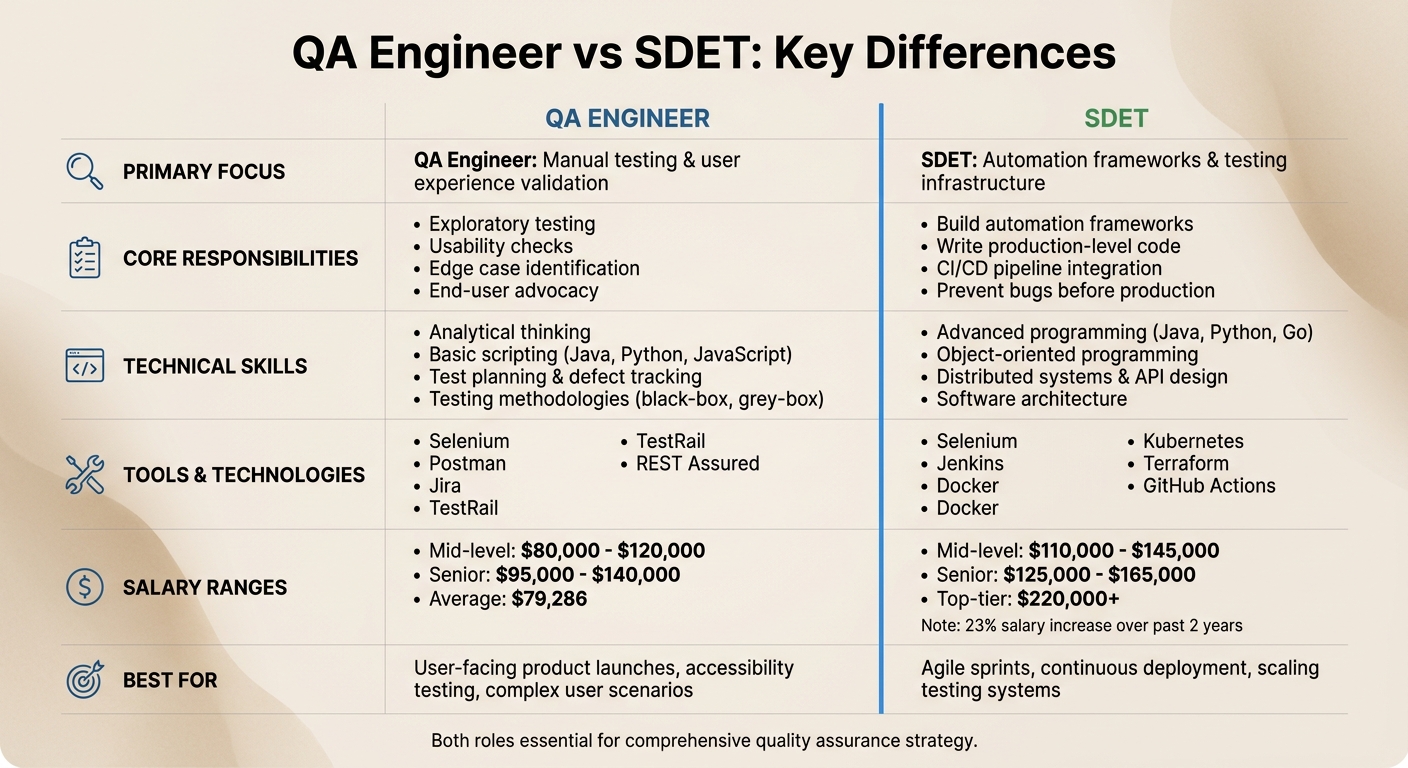 {QA Engineer vs SDET: Roles, Skills, Salaries and Tools Comparison}
Before bringing someone onto your team, it’s important to understand the specific roles of QA Engineers and SDETs. Despite the occasional overlap in job titles, these roles are distinct. They differ in what they create and how they fit into your testing strategy. Knowing these differences can help you craft better job descriptions and evaluate candidates more effectively.
What QA Engineers Do
QA Engineers are the "end-user advocates" of the software world. They manually test products, often stepping into the shoes of the user to uncover bugs and issues that automated tools might miss. Their work includes exploratory testing, usability checks, and identifying edge cases. While some QA Engineers dabble in automation with tools like Selenium, their primary focus is ensuring the product meets quality standards from a user's perspective.
Rather than building tools, QA Engineers typically rely on existing ones. They use test management software, bug tracking platforms like Jira, and automation tools such as Selenium or Postman. Their coding skills, if used, are aimed at running tests rather than creating testing frameworks. The role demands strong analytical abilities, attention to detail, and a solid grasp of testing methodologies (like black-box or grey-box testing). Ultimately, their value lies in their ability to spot issues that could disrupt or confuse users, such as inconsistent design elements or inaccessible features.
What SDETs Do
SDETs, on the other hand, are the architects of testing systems. They write production-level code to build automation frameworks, libraries, and tools that make testing faster and more reliable. While QA Engineers focus on finding bugs, SDETs work to prevent bugs from ever reaching production. Their role is especially critical in environments where speed and scalability are key, such as Agile workflows and DevOps pipelines.
The technical skill set for SDETs is more demanding. They are proficient in programming languages like Java, Python, or Go and are adept at creating scalable testing frameworks. SDETs also integrate testing into CI/CD pipelines using tools like Docker, Kubernetes, and Terraform. Beyond automation, they enhance production code with features like improved logging and testability hooks, build mock servers, and create reusable libraries.
Amy Reichert, a QA Lead, highlights the dual nature of their role:
Software Development Engineers in Test can also utilise these projects to enhance coding and evaluation skills and gain experience deploying into branches as well.
When hiring SDETs, look for candidates who can think about scaling testing systems and optimizing execution across environments - not just those who can write individual tests. Their expertise in distributed systems, API design, and software architecture makes them essential for building robust testing infrastructure.
Key Differences in Hiring
The salary gap between these roles reflects their distinct skill sets. QA Engineers typically earn between $42,000 and $62,000, while Senior SDETs can command salaries around $125,000, with top-level positions exceeding $220,000 at leading tech companies . This difference underscores the importance of aligning your hiring strategy with your project’s needs.
For fast-paced Agile sprints or continuous deployment, SDETs are indispensable to avoid testing bottlenecks. On the other hand, QA Engineers shine when launching user-facing products that require attention to design, accessibility, and complex user scenarios. Often, having both roles on a team creates a balanced approach - SDETs provide the automation backbone, while QA Engineers ensure no critical user issues slip through the cracks.
sbb-itb-d1e6221
Writing Job Descriptions That Attract Quality Candidates
Crafting an effective job description is crucial when hiring for QA Engineers and SDETs. It’s often the first impression your company makes on potential hires, and in a field where 87% of companies struggle to fill QA positions due to skill shortages , standing out is a must. The secret? Clarity and focus.
A great job description should immediately communicate the role's purpose. Instead of just listing tools, focus on the problems the candidate will solve. For example, instead of saying, "Automate tests using Selenium", you could say, "Build quality signals that block risky releases before they reach production" . This approach appeals to candidates who think strategically about their work. For SDETs, make it clear that their role involves embedding quality into the software delivery process, as Rework puts it: "SDETs now architect quality into the entire software delivery pipeline."
When listing required skills, keep it concise. Overloading the description with every possible tool or framework can deter qualified candidates. For QA Engineers, focus on essentials like test planning, defect tracking (e.g., JIRA), API testing (e.g., Postman or REST Assured), and basic automation tools like Selenium or Cypress . For SDETs, highlight skills such as full-stack test automation, framework architecture, CI/CD integration (e.g., Jenkins or GitLab CI), and performance testing tools like JMeter or K6 .
Skills to Include in Your Job Posting
Programming skills are a must for both roles, though the level of expertise differs. QA Engineers should have basic scripting abilities in languages like Java, Python, or JavaScript . SDETs, on the other hand, need advanced coding skills, including a strong grasp of object-oriented programming principles .
Experience requirements vary by role and company size. For mid-level positions, 3–5 years of experience is standard . Startups may seek candidates capable of building testing infrastructure from scratch, while enterprise roles often require familiarity with complex integrations and compliance standards like SOX or GDPR . Industry-specific knowledge can also be a game-changer: FinTech roles might demand understanding of PCI-DSS and high-frequency trading systems, while HealthTech roles could require expertise in HIPAA compliance and HL7/FHIR standards .
Certifications like ISTQB remain widely recognized for both QA Engineers and SDETs . For SDETs working in cloud environments, certifications from AWS, Azure, or GCP can add extra appeal . However, don’t overemphasize credentials - 86.7% of software engineers are self-taught in at least some of their skills . Practical assessments often reveal more about a candidate than a resume ever could.
Finally, highlight soft skills that set exceptional candidates apart. Analytical thinking, attention to detail, and the ability to explain technical concepts to non-technical stakeholders are key . Modern QA roles increasingly require professionals who can act as quality partners, helping developers improve their testing practices .
Salary Ranges and Work Arrangements
Transparency around compensation can save time and attract serious candidates. For QA Engineers, mid-level roles typically offer $80,000 to $120,000, with senior positions reaching $95,000 to $140,000 . The national average base salary is around $79,286 .
SDET salaries reflect their advanced technical requirements and have risen 23% over the past two years . By 2026, expect to pay $110,000 to $145,000 for agency or consultancy roles, $125,000 to $165,000 for in-house corporate positions, and $115,000 to $150,000 at startups . Top-tier positions at leading tech companies can exceed $220,000 . Startups often offer equity stakes (0.1%–0.25%) , while corporate roles may include annual bonuses of 15%–20% .
Work arrangements are just as important as salary. 78% of QA and SDET roles now offer remote or hybrid options . Mention perks like home office stipends ($1,000–$2,500), professional development budgets ($1,500–$4,000 annually), and wellness benefits . Policies like unlimited PTO with mandatory minimums or comprehensive parental leave programs can also set your company apart.
To grab attention, consider adding a "Quick Stats" section at the top of your job description. Highlight key details like remote flexibility, growth opportunities, and the tech stack . This helps candidates quickly determine if the role aligns with their goals.
Finding and Reaching QA and SDET Candidates
Before diving into recruitment, take a moment to assess your team's current needs. Do you require more manual regression testing? Broader test coverage? Or perhaps better integration with existing services? Pinpointing these gaps will determine how and where you search for candidates. As Joshua Bihun, Fractional QA Leader, explains:
The right QA hire is not the candidate who matches the most bullet points on a generic job description. It's the candidate whose strengths address the specific gaps your team has now.
This targeted mindset ensures your search efforts are laser-focused on finding the right match from the start.
However, traditional platforms like LinkedIn often fall short when it comes to engaging top-tier testing talent. 90% of engineers on daily.dev won’t respond to messages on LinkedIn or apply through job boards . Why? Because the best QA and SDET candidates are typically passive - they’re already employed and not actively job hunting. In fact, 85-90% of daily.dev users are currently employed, with 40% holding senior roles or technical leadership positions . This makes daily.dev a goldmine for uncovering skilled, experienced professionals.
How daily.dev Recruiter Helps You Find Testing Talent
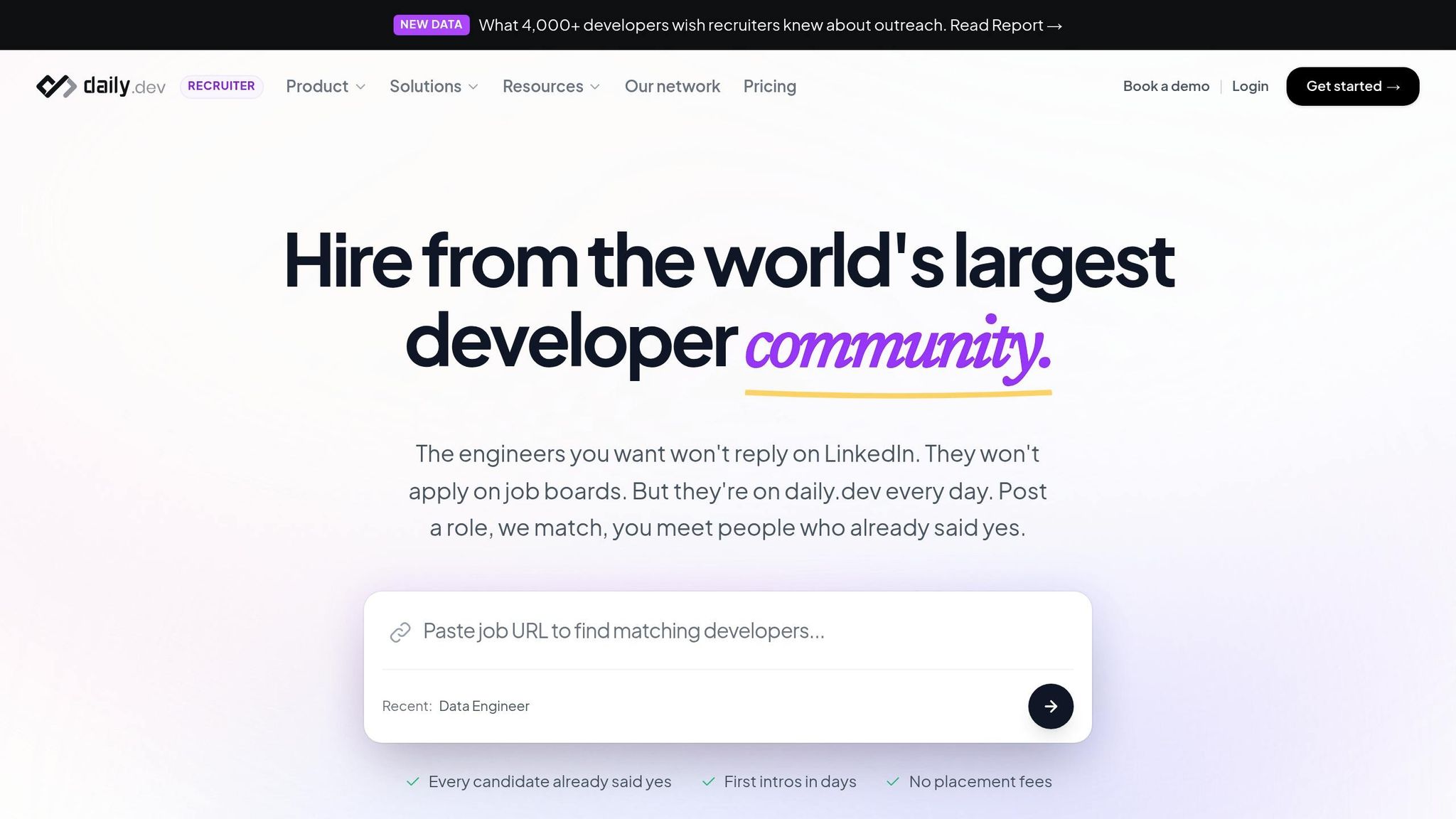
daily.dev Recruiter bridges the gap by connecting you with testing professionals where they naturally spend their time - engaging with technical content. Instead of relying on static resume keywords, it uses behavioral matching based on what developers are reading, building, and following within the community .
The platform's double opt-in system, nicknamed "TinDev", ensures that both you and the candidate express mutual interest before an introduction is made . This approach eliminates the frustration of cold outreach and ghosting. You can even set up to three custom screening questions to ensure candidates meet your technical requirements - like experience with tools such as Cypress or API testing frameworks - before they land in your inbox .
daily.dev Recruiter integrates seamlessly with major ATS platforms like Greenhouse, Lever, Ashby, and Workable, automatically syncing candidate profiles and updates . Advanced filtering options allow you to zero in on specific skills, whether you’re looking for SDETs with JavaScript framework expertise or QA Engineers skilled in CI/CD pipelines . And the pricing is refreshingly straightforward: $350 per role, per month, with unlimited seats and candidate introductions - no hidden fees or placement costs .
With these tools, finding the right testers becomes a streamlined and effective process.
Connecting with Passive Candidates
Engaging passive candidates requires a thoughtful, tailored approach. Generic recruitment messages won’t cut it. Instead, focus on the unique technical challenges of the role and the specific tech stack they’ll be working with . Highlight what they’ll be building and why your team stands out.
To make your outreach personal, reference their past work - whether it’s open-source contributions, technical articles, or patents . For SDET roles, mention tools like Playwright, Selenium, or GitHub Copilot to demonstrate your team’s commitment to staying ahead of the curve . Frame the opportunity as a step forward in their career, transitioning from traditional QA to roles like "Quality Engineering" or "Automation Architecture." Emphasize how they’ll have a strategic impact rather than just executing repetitive tasks .
Top-tier candidates want to see how the role addresses broader quality challenges, not just a checklist of technical requirements. Make it clear how they’ll contribute to solving systemic quality issues while advancing their career in meaningful ways.
How to Evaluate QA and SDET Candidates
Once you've identified potential candidates through targeted outreach, the next step is to thoroughly evaluate their skills and compatibility with your team. This involves structured assessments designed to measure both technical expertise and how well they align with your team's dynamics. QA Engineers typically excel in analytical thinking and testing strategies, while SDETs bring strong programming skills and the ability to create automation frameworks from the ground up . The following sections outline how to effectively assess these candidates.
Start with a brief phone interview. Include one simple and one challenging question to quickly gauge their foundational skills .
Initial Screening and Technical Tests
For QA Engineers, focus on their ability to plan tests and prioritize defects. A good way to do this is by asking them to design test cases for a new feature and explain how they would prioritize bugs when resources are limited .
For SDETs, consider live coding exercises where candidates automate a practical scenario, such as testing your company's homepage. Alternatively, assign a take-home task and follow up with a live review to discuss their decisions . During these assessments, the reasoning behind their solutions is just as important as the solutions themselves. Ask them to explain their choices, whether it's about selecting specific selectors, managing flaky tests, or scaling a test suite to handle over 500 tests.
Strong communication is key. Candidates should clearly articulate their thought processes. Often, skills-based testing provides more insight than formal credentials .
Evaluation Criteria: QA Engineers vs. SDETs
The evaluation process varies significantly between these two roles. Here's a quick breakdown of how to assess each:
| Role | Skills Assessed | Sample Questions | Tools Tested |
|---|---|---|---|
| QA Engineer | Analytical thinking, defect reporting, test case design | "How do you prioritize bugs when resources are limited?" | Jira, TestRail, SQL, Selenium |
| SDET | Programming, framework architecture, CI/CD integration | "How would you structure this test suite to support 500+ tests?" | Selenium, Jenkins, Appium, Cypress |
This framework helps differentiate the roles and ensures a focused evaluation during interviews.
For QA Engineers, pay attention to their detail orientation, ability to think like an end user, and communication skills - especially their ability to bridge gaps between developers and product managers . Test their familiarity with tools like Jira and TestRail, as well as their understanding of manual and basic automation testing .
For SDETs, go deeper into computer science fundamentals, including data structures, algorithms, and object-oriented programming . Beyond coding, top candidates should have a grasp of networking basics (e.g., TCP/IP and routing), database principles, and system startup processes . As Ingraham notes:
A strong SDET should always be able to defend the decisions they make today, with consideration of the impact of those decisions in the future .
Wrap up the evaluation process with a "work day" simulation lasting 3–4 hours. This hands-on exercise lets you confirm their technical abilities and see how well they fit within your team.
Onboarding and Keeping Your Testing Talent
Bringing new testers on board is just the beginning. The real challenge lies in helping them ramp up quickly and keeping them engaged over the long haul. A well-structured onboarding process can make all the difference, reducing the time it takes for new hires to become fully productive while setting them up for success . As ARDURA Consulting puts it:
The key metric is not speed but quality: a tester who is onboarded thoroughly catches more defects than one who is rushed into execution.
Setting Up a 30-60-90 Day Onboarding Plan
Preparation starts before Day 1. Make sure new hires have access to essential tools like TestRail, Jira, code repositories, and CI/CD platforms (e.g., Jenkins, GitHub Actions) to avoid unnecessary delays .
First 30 Days: Begin by laying a strong foundation.
- Week 1: Focus on orientation, product overviews, and setting up the local development environment. Aim for new hires to run their first meaningful test case within hours, not days .
- Week 2: Let them execute existing test cases independently under mentor supervision while learning your bug reporting standards.
- Week 3: Introduce automation frameworks by having them review and modify existing tests, rather than writing new ones.
- Week 4: Assign ownership of a portion of the sprint's testing scope, culminating in writing their first automated test from scratch .
Days 31 to 60: Shift the focus to autonomy. By this phase, new hires should consistently contribute to test automation, handle bug triage, and manage regression testing for specific features.
By Day 90: Expect full productivity. They should proactively identify gaps in test coverage, participate in test planning, and write advanced automation scripts without guidance . A mentor (not their manager) should check in daily during Week 1, transitioning to weekly 30-minute sessions by Week 4 .
Once onboarding is complete, the focus turns to career development and keeping your team motivated.
Retention Through Career Growth and Benefits
A strong start sets the stage for long-term success. Providing clear career progression paths - like moving from QA Engineer to roles such as SDET, Senior SDET, Test Architect, or even Engineering Manager - is crucial . With SDET job postings up 127% since 2022 and salaries climbing 23% in the last two years, staying competitive is essential . Offering annual learning budgets between $3,000 and $10,000 for certifications like ISTQB or AWS can be a game-changer .
Remote and hybrid work options are now the norm, with 78% of QA/SDET roles offering these arrangements . To support remote employees, consider home office stipends between $2,000 and $5,000 and wellness allowances of about $2,000 annually . Investing in SDET talent pays off: companies report 40% fewer production incidents and 60% faster release cycles .
Finally, protect your team’s time for strategic quality engineering and automation work. Avoid letting them become bogged down with repetitive manual regression tasks, often referred to as being a "ticket sponge" . Pairing a strong onboarding process with clear career paths and meaningful benefits can go a long way in retaining top talent.
Conclusion
Finding the right testing talent begins with recognizing the core differences between QA Engineers and SDETs. QA Engineers focus on manual testing with a user-first mindset , while SDETs build automated frameworks that integrate quality into CI/CD pipelines . Both roles are essential: QA Engineers ensure a seamless user experience, and SDETs bring the efficiency and scalability of automation . Together, they create a balanced and effective testing strategy.
To attract the right candidates, your hiring process should combine well-defined job roles with transparent compensation. Write clear job descriptions that highlight specific needs - whether it’s manual testing expertise or advanced coding skills for automation . Transparency in pay not only builds trust but also encourages stronger engagement from potential hires.
daily.dev Recruiter simplifies the hiring process by connecting you with motivated developers through warm, double opt-in introductions. This approach eliminates the inefficiencies of cold outreach and outdated resume databases, leading to better response rates and more meaningful conversations.
Once you’ve sourced candidates and conducted interviews, precise evaluation is key. Go beyond resumes by using developer assessment tools, like Selenium tests or coding challenges, to confirm technical expertise . For QA Engineers, prioritize communication skills , and ensure new hires hit the ground running with a well-structured onboarding plan.
Retention doesn’t stop at onboarding. Offering clear career progression and flexible work options is essential, especially as 58% of enterprises now upskill QA teams with AI tools . These efforts not only keep your team engaged but also prepare them for the future of testing.
FAQs
When should I hire a QA Engineer vs. an SDET?
When deciding between a QA Engineer and an SDET, it’s essential to consider your project needs:
Hire a QA Engineer if your focus is on manual testing, creating detailed test cases, and ensuring product quality through traditional approaches. QA Engineers specialize in usability testing and identifying bugs through hands-on methods.
Opt for an SDET when your priority is automation, designing test frameworks, and integrating testing into CI/CD pipelines to catch defects early in the development cycle. SDETs thrive in automation-driven, fast-moving environments.
In short, QA Engineers are perfect for process-driven testing, while SDETs bring value to automation-heavy workflows.
What interview tasks best predict QA/SDET performance?
To accurately assess candidates for QA or SDET roles, technical assessments are crucial. These evaluations focus on coding skills, critical thinking, and a solid understanding of testing principles.
Here are some effective methods to gauge performance:
- Coding Exercises: Test candidates' ability to write clean, efficient code.
- Test Framework Design: Evaluate their knowledge of building and maintaining testing frameworks.
- Problem-Solving Tasks: Measure analytical thinking and approach to real-world challenges.
In addition, skills assessments like API testing, SQL validation, and coding challenges are excellent for identifying practical expertise. These tasks also provide insight into a candidate's ability to communicate effectively - an essential skill for QA and SDET roles.
How do I reduce flaky tests in CI/CD automation?
Flaky tests can be a nightmare for CI/CD pipelines, but there are ways to tackle them effectively. The key is to focus on improving test reliability. Here’s how:
- Set up automatic test retries: This helps catch intermittent failures without derailing the entire pipeline.
- Adjust wait times: Ensure your tests allow enough time for elements to fully load, reducing false negatives.
- Check for memory leaks: Memory issues can cause inconsistent test behavior, so addressing them is essential.
- Use stable locators: Opt for reliable selectors like
data-testattributes instead of dynamic or fragile ones. - Maintain isolated environments: Tests should run in controlled, independent environments to avoid interference.
- Control external dependencies: Mock or stub external services to eliminate variability caused by third-party systems.
Additionally, automating the detection of flaky tests and analyzing patterns can provide valuable insights into root causes. By addressing these issues, you’ll build a more stable and reliable CI/CD pipeline.


