

Guide to hiring Product AI, MLOps, and research engineers—sourcing, assessment, and compensation for AI-native startups.
Building an AI-native startup is different from traditional tech companies. These startups rely on AI as the core of their business, not just as a feature. Every hiring decision is critical, as these companies often operate with smaller teams but higher revenue per employee. By 2026, the demand for AI engineers is expected to outpace supply by 3.2:1, leaving 1.6 million roles unfilled globally. This makes finding and hiring AI engineers a top priority.
Key takeaways:
- Core Roles: Focus on hiring Product AI Engineers, MLOps Engineers, Applied AI Scientists, and Founding AI Engineers.
- Skills Needed: Python, RAG techniques, cloud infrastructure, and orchestration tools like LangGraph and AutoGen.
- Sourcing Talent: Use developer-first networks like daily.dev Recruiter and niche communities like Hugging Face.
- Compensation: Offer competitive salaries, equity, and perks like GPU budgets and learning allowances.
- Assessment: Prioritize practical, AI-focused projects over traditional coding tests to evaluate candidates' judgment and problem-solving skills.
Speed and precision in hiring are essential. A streamlined process, clear job descriptions, and a compelling mission can help startups secure top AI talent in a competitive market.
Key AI Engineering Roles and Required Skills
::: @figure 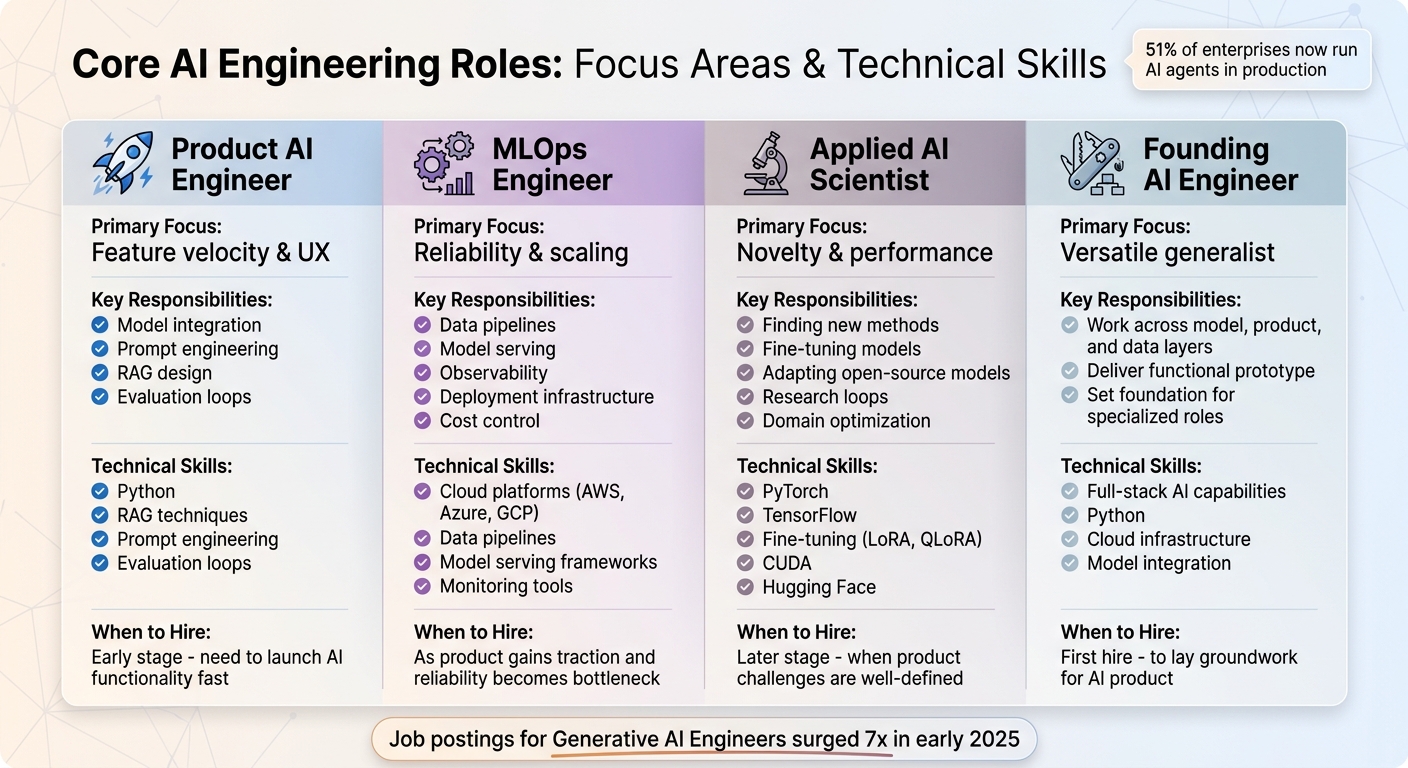 {AI Engineering Roles: Responsibilities and Required Skills Comparison}
To build a solid AI-driven product, it’s critical to identify your startup’s immediate challenges. If your demos are promising but production systems are shaky, you’ll need an engineer focused on reliability. On the other hand, if your infrastructure is stable but your AI features aren’t meeting expectations, you’ll want someone who can accelerate feature delivery. These distinctions are key to creating a resilient foundation for your AI product. Let’s dive into the essential roles for an AI-native team.
Core Roles for AI-Native Startups
Product AI Engineers are all about speed and usability. They focus on getting features up and running quickly, handling tasks like model integration, prompt engineering, retrieval-augmented generation (RAG) design, and evaluation loops. If your goal is to launch AI functionality fast, this is the role to prioritize .
MLOps or AI Infrastructure Engineers ensure your AI systems are reliable as they scale. They manage everything from data pipelines and model serving to observability and deployment infrastructure, all while keeping costs under control. This role becomes crucial as your product gains traction and reliability becomes a bottleneck .
Applied AI Scientists or Research Engineers specialize in finding new methods and fine-tuning models. They adapt open-source models, conduct research loops, and optimize performance for specific domains. However, startups often delay hiring for this role until product challenges are well-defined, as early-stage companies typically need engineers focused on shipping features rather than deep research .
Founding AI Engineers are the versatile generalists who lay the groundwork for your AI product. They work across the model, product, and data layers to deliver a functional prototype. These early hires set the stage for more specialized roles as your team grows .
Other emerging roles include AI Quality Engineers, who create frameworks to evaluate model accuracy and safety, and Forward Deployed AI Engineers, who implement AI solutions directly in customer environments. Interestingly, job postings for Generative AI Engineers have surged sevenfold as of early 2025, highlighting the rapid evolution of these roles .
Technical Skills AI Engineers Need
Python remains the go-to programming language for AI, supported by powerful libraries like TensorFlow, PyTorch, and Scikit-learn . But coding is just the beginning. Modern AI engineers must also master RAG techniques, including chunking strategies, embedding model selection, and hybrid retrieval, to effectively combine foundation models with proprietary data .
System orchestration and cloud infrastructure skills are equally important. Engineers need expertise in orchestration frameworks like LangGraph, CrewAI, and AutoGen to build multi-step, autonomous systems. With 51% of enterprises now running AI agents in production, this skill set is more in demand than ever .
For infrastructure-focused roles, proficiency in cloud platforms such as AWS, Azure, and GCP is essential. Familiarity with vector databases, model serving frameworks like vLLM or Ray, and MLOps tools for monitoring and deployment is also critical. Engineers working on specialized machine learning tasks should be adept in fine-tuning methods like LoRA and QLoRA, as well as inference optimization techniques such as quantization and distillation .
The field has split into two main tracks: AI Engineers, who integrate existing foundation models using APIs, and ML Engineers, who focus on building and training models from scratch. AI Engineers need sharp judgment for tasks like model selection and managing failure modes, while ML Engineers require a solid grounding in linear algebra, calculus, and statistics, along with expertise in distributed training and GPU optimization .
When hiring, prioritize candidates who demonstrate strong AI judgment over those who simply excel at coding. Look for engineers who can troubleshoot issues in a brittle retrieval chain or weigh the tradeoffs in cost versus performance when selecting a model.
| Role | Primary Focus | Key Technical Skills |
|---|---|---|
| Product AI Engineer | Feature velocity & UX | Python, RAG, prompt engineering, evaluation loops |
| MLOps Engineer | Reliability & scaling | Cloud platforms, data pipelines, model serving, monitoring |
| Applied AI Scientist | Novelty & performance | PyTorch, TensorFlow, fine-tuning (LoRA), CUDA, Hugging Face |
| AI Quality Engineer | Accuracy & safety | Evaluation frameworks, benchmarking, edge case testing |
How to Source AI Talent
For AI-focused startups, finding the right talent requires accuracy and a strong sense of trust. Traditional methods like job boards or cold LinkedIn outreach often fall short. Job boards tend to attract active job seekers rather than the highly skilled, passive candidates you’re looking for. And cold outreach? It’s largely ignored - 90% of engineers on specialized developer platforms won’t respond to recruiters on other channels. The underlying issue here is trust. Top-tier AI engineers, many of whom are already employed, are unlikely to engage with unsolicited messages.
The solution lies in developer-first networks. These platforms integrate job opportunities into spaces where engineers naturally spend their time. Instead of relying on keyword-heavy profiles, these networks identify potential candidates based on their engagement with technical content - like tutorials on PyTorch or contributions to LangChain repositories.
Using Developer Networks to Find Candidates
Platforms like daily.dev Recruiter are reshaping the way AI talent is sourced. By focusing on passive candidates, they connect companies with top developers through warm, double opt-in introductions. Engineers visit daily.dev around 200 times a month to engage with technical content. When you post a job, it’s shown privately to engineers whose current interests and projects align with your role - not just those whose resumes match a list of keywords.
Here’s why this approach works so well:
- Access to passive talent: Most users (85–90%) are already employed and not actively job hunting.
- Warm introductions: Developers who express interest in your role have already reviewed the job details and agreed to be contacted. This eliminates the usual frustrations of ghosting or spam.
- Custom screening: You can include up to three tailored screening questions during the initial phase, helping you quickly assess technical fit while avoiding irrelevant applications.
Additionally, daily.dev Recruiter integrates seamlessly with your ATS, filtering out duplicates and ensuring a smooth hiring process. Pricing is straightforward - $350 per role per month, with no placement fees or hidden costs. As Nimrod Kramer, CEO & Co-Founder of daily.dev, explains:
We built a place where engineers can turn off the noise. To enter this space, you don't need a hack. You need trust.
While developer-first networks are essential, combining them with targeted sourcing strategies can further expand your talent pool.
Targeted Sourcing Methods
To connect with specialized AI candidates, engaging with niche communities is key. For roles requiring expertise in areas like natural language processing or computer vision, explore GitHub contributions to repositories such as Hugging Face transformers or LangChain. Platforms like Hugging Face Spaces and Streamlit also showcase interactive demos, giving you insight into what candidates are actively building.
AI-powered sourcing tools like HireEZ and SeekOut can also streamline your search. These tools use natural language processing to scan vast databases of public profiles, identifying candidates with the precise skills you’re seeking. With natural language search, you can outline an ideal candidate profile, and some tools even boast databases of over 800 million profiles. Personalized messaging through these platforms yields response rates 30% to 40% higher than traditional cold outreach.
For startups needing a more flexible approach, fractional recruiters specializing in AI talent can be a game-changer. With just 10–20 hours a week, these recruiters maintain a warm pipeline by connecting with talent in spaces like private Discord servers, Hugging Face communities, or AI-focused subreddits. They understand where AI professionals gather and how to build meaningful relationships in those spaces.
Specialized recruiters can deliver their first batch of vetted profiles within 72 hours, significantly cutting down the time it takes to create a shortlist.
Writing Job Descriptions That Attract AI Engineers
Job descriptions act as your first filter. With 1.6 million AI job openings and only 518,000 qualified candidates available, generic postings just won’t cut it. Vague titles like "AI/ML Engineer" can obscure what the role actually entails. Be specific - do you need a Product AI Engineer to develop customer-facing features, an MLOps Engineer to build reliable pipelines, or an Applied AI Scientist to refine models? Precise definitions help candidates determine if they’re the right fit. Instead of listing every AI library, focus on the real challenges - like turning a messy LLM prototype into a reliable product feature.
Emphasizing AI-First Priorities
Highlight the tough problems your team is tackling - whether it’s improving model latency, lowering inference costs, reducing hallucinations, or designing seamless human-AI handoff systems. These kinds of challenges attract engineers who thrive on solving complex technical issues, not just integrating pre-built APIs.
For startups, framing roles as Founding Engineer positions can appeal to candidates who value direct access to leadership and the chance to shape the technical foundation from scratch. Mention the modern tools your team uses daily, as experienced engineers appreciate environments that enhance their productivity. If the role includes the freedom to choose the initial tech stack, make sure to highlight that.
Be specific about the work - tasks like fine-tuning open-source LLMs on financial datasets can help candidates quickly assess whether the role aligns with their skills and interests. Don’t shy away from discussing current limitations, such as messy data or fragile infrastructure. Position these as opportunities for problem-solving and innovation. Beyond technical details, be transparent about the compensation and career growth opportunities tied to building AI-focused solutions.
Including Equity and Career Growth
AI engineers command higher salaries compared to traditional roles. Be upfront about equity options, the vesting schedule, and the potential value of shares at key milestones. Having an honest, detailed conversation about equity can set your offer apart from high-cash roles at Big Tech companies.
Standard four-year vesting schedules (with a one-year cliff) and sign-on bonuses ranging from $15,000 to $50,000 can help offset any unvested equity a candidate might leave behind. For roles requiring heavy experimentation, include a monthly GPU/compute budget of $2,000 to $10,000.
Lay out a clear 30-60-90 day onboarding plan and define advancement opportunities. Whether it’s leading a team, owning a product vertical, or transitioning into research, candidates want to see their potential growth path. Offering an annual learning budget of $5,000 to $10,000 for conferences, courses, and research materials can also appeal to the curiosity-driven mindset of top AI talent.
Thoughtfully crafted job descriptions not only attract the best candidates but also set the tone for building a team capable of driving your AI-first startup’s vision forward.
How to Screen and Assess AI Engineers
Finding the right AI engineer means designing a hiring process that tests both technical ability and strategic thinking, especially for startups focused on AI. Traditional coding challenges - like solving algorithmic problems on LeetCode - aren't great predictors of success in AI-focused roles. The game has changed. AI engineers today need to make decisions under uncertainty, evaluate AI-generated outputs, and know when not to use AI. Engineers who effectively integrate AI tools can deliver features up to 5x faster . Your hiring process should reflect this shift.
Start by assigning AI-enabled take-home projects where candidates are encouraged to use AI tools. Focus on their reasoning, not just the final code. Follow up with a detailed interview where they explain their design choices, trade-offs, and any adjustments made to AI-generated code. A two-phase live interview works well: dedicate 40 minutes to problem-solving and architecture (without AI) to test their foundational skills, then spend 20 minutes observing how they use AI tools to implement solutions. This approach reveals their prompting strategies and iterative process.
AI-Specific Assessment Methods
To evaluate candidates effectively, use prompts that intentionally produce hallucinated responses. Observe how they identify and correct the issues using a structured, hypothesis-driven approach. Another useful test is asking candidates to break down a complex feature - like an authentication module - into tasks that are better suited for AI versus those requiring human judgment. This shows their ability to strategically approach problem-solving.
For specific roles, tailor the assessment:
- ML Engineers: Assign tasks like fine-tuning a small open-source model (e.g., Llama-3-8B) with raw data. This tests their attention to data quality and scientific rigor.
- AI API Integrators: Have them build a retrieval-augmented generation (RAG) prototype using provided documents. This reveals their skill in managing hallucinations and ensuring traceability.
- LLMOps Engineers: Present a slow or resource-heavy model script and ask them to optimize it. Look for their understanding of trade-offs, efficiency, and cost analysis.
Ask about past challenges they’ve faced, such as, "What’s an example of a misleading summary statistic you’ve encountered?" This can reveal their self-awareness and technical humility. Dive into their approach to estimating token costs or optimizing pipelines, as production AI often involves balancing cost and accuracy. Considering that hiring a specialized AI engineer typically takes 45 to 90 days , a streamlined process can save valuable time and resources.
Once technical skills are assessed, shift focus to behavioral traits and ethical judgment.
Behavioral and Ethical AI Interviews
Beyond technical expertise, it's crucial to evaluate how candidates approach problems. Do they start with, "What are we trying to achieve?" or dive straight into solutions? Strong candidates demonstrate a problem-first mindset. Look for "measured enthusiasm" - a balance of excitement about AI's potential and awareness of its limitations. For example, a candidate who suggests regex parsing instead of an LLM for structured data extraction shows sound judgment.
"A good AI engineer is 80% backend/data engineer and 20% AI specialist - because at the end of the day, AI is just another tool in the software stack." - CoderPad
Pose scenario-based questions like, "If the system returns unverified answers, how would you diagnose and fix the issue?" This tests their ability to distinguish between issues like hallucination versus retrieval failure and their understanding of common AI-specific challenges, such as prompt injection or context window limits.
Real-world case studies can also spark insightful discussions. For instance, in October 2018, Amazon discontinued an AI recruiting tool after discovering it penalized resumes with the word "women's" and downgraded graduates from all-women's colleges . Ask candidates how they would detect and address such algorithmic bias.
Encourage candidates to share stories of production failures they’ve encountered. Assess whether they take ownership of mistakes or deflect blame. Look for experience handling issues like hallucinations that damage user trust, bias in model outputs, or privacy concerns related to contextual data. Companies that prioritize ethically designed AI have seen 48% less hiring bias . This underscores the importance of hiring engineers who value ethical considerations alongside technical expertise.
Structuring Competitive Compensation Packages
Once you've nailed down your candidate screening and assessment processes, the next big step in securing top AI talent is offering compensation that stands out. AI roles typically come with a hefty price tag - salaries for these positions are significantly higher than traditional software roles. For instance, AI roles carry a 56–67% wage premium over standard software jobs , and in 2025, the average AI engineer salary hit $206,000 - a $50,000 leap from the previous year . With a global demand-to-supply ratio of 3.2:1 , competition for AI expertise is fierce, especially against well-funded companies. In this tight market, your compensation offer can be just as critical as a stellar technical assessment in landing the right hire. The challenge? Crafting packages that balance market expectations with your startup's financial limitations.
A common misstep is focusing solely on base salary. Candidates evaluate total compensation, which includes base pay, equity, and bonuses . With Big Tech offering total packages that can exceed $400,000 for senior ML engineers , your equity strategy becomes a key differentiator. Transparency about equity and overall compensation helps build trust and attract candidates who are genuinely aligned with your vision.
Speed also matters. Top AI candidates are often off the market within 10–14 days, while the average hiring cycle drags on for 142 days . To stay competitive, aim for a two-week hiring process - from first contact to signed offer . Delays often mean losing out to faster-moving rivals. As one Dover Recruiting Partner aptly put it:
"You don't beat bigger companies by outspending them. You win by giving candidates a story they want to write the next chapter of."
AI Engineer Salary Benchmarks
Understanding how the market values AI talent is crucial. Offering below-market salaries can hurt your credibility. For example, advertising a senior AI role with a $180,000 base salary is like listing a house at half its market price and wondering why no one bites . Location still influences pay - San Francisco typically commands a 20–35% premium, while NYC adds 10–20% . However, many startups now pay national market rates to streamline operations and maintain fairness .
Specialization also impacts compensation. Engineers specializing in LLMs or Generative AI often earn 10–15% more than general ML engineers . When you factor in equity, benefits, payroll taxes, and infrastructure, the total annual cost of a senior AI engineer can range from $444,000 to $480,000 .
Here’s a breakdown of salary ranges:
| Role | Mid-Level (3–5 yrs) | Senior/Staff (6+ yrs) | Big Tech TC |
|---|---|---|---|
| ML Engineer | $140,000–$210,000 | $180,000–$280,000 | $250,000–$400,000+ |
| LLM Engineer | $160,000–$240,000 | $200,000–$350,000 | $300,000–$500,000+ |
| MLOps Engineer | $145,000–$220,000 | $190,000–$280,000 | $240,000–$380,000+ |
Equity is another critical piece of the puzzle. Founding engineers at the seed stage often receive 0.5%–2.0% equity, while senior hires typically see 0.15%–0.5% . AI engineers generally command a 10–20% equity boost over non-AI roles . While equity percentages have dipped since their 2021 peak, startups are sweetening the deal with perks like longer exercise windows . Equity can help bridge a base salary gap of $30,000–$50,000, but be prepared to discuss your cap table, dilution, and liquidity plans.
Negotiating and Closing Offers
If matching Big Tech salaries isn’t an option, focus on what makes your opportunity stand out. A compelling mission or technically challenging project can often justify a $20,000–$30,000 salary gap for the right candidate . Highlight growth opportunities - like building your MLOps infrastructure from scratch - and emphasize the autonomy your startup offers compared to the rigidity of larger organizations .
Non-cash perks can also make a big difference. Offering a dedicated GPU or a $2,000–$10,000 monthly compute budget appeals to engineers eager to experiment . Similarly, allocating $3,000–$10,000 annually for conferences like NeurIPS or ICML supports professional development . Even small gestures, such as upgrading a title from "Senior Engineer" to "Founding Engineer" or "Principal", can add significant resume value at no extra cost . Front-loading equity with a shorter vesting period is another creative way to make your offer more appealing.
For startups with tight budgets, contract-to-hire models allow you to test a candidate’s fit before committing to a high-salary hire . Paid work trials, where candidates are compensated for a one-week scoped task, are another effective way to assess both performance and fit before extending a full-time offer .
Finally, keep your compensation data up-to-date. AI salary trends can shift quickly - reviewing and adjusting your ranges every six months is a smart move .
As BitTalent Insights aptly noted:
"Everyone has AI tools. Almost no one has AI talent. That is the gap that defines this market."
Conclusion
Creating an AI engineering team from scratch isn't just about filling roles - it’s about identifying specific goals and bringing on team members who can deliver results. Success or failure often comes down to an engineer's ability to transition from a demo to a fully functional, production-ready system . Globally, the demand for AI talent outpaces supply by about 3.2 to 1, with 68% of employers struggling to find qualified professionals . Startups that succeed are those that act quickly, tell a compelling story, and adopt targeted sourcing strategies even on a tight budget.
Speed is critical. The best candidates often juggle multiple offers within 3–5 business days, so tightening your hiring timeline to 2–3 weeks can make all the difference . Instead of relying on abstract coding challenges, focus on practical assessments that reflect real-world scenarios - like building a Retrieval-Augmented Generation (RAG) pipeline or containerizing a model API . And while competitive salaries are important, offering candidates autonomy, the chance to make a direct product impact, and a mission they connect with can set you apart.
To meet the need for speed, modern sourcing platforms can simplify your recruitment process. Tools like daily.dev Recruiter help you connect with pre-qualified developers who are already engaged in professional communities. Rather than wasting time on cold outreach or endless screening calls, these platforms provide warm, double opt-in introductions to candidates genuinely interested in relevant opportunities. This approach builds trust and connects you with engineers ready to deliver production-grade AI systems.
The stakes are high when building your team. A great hire not only avoids operational debt but also lays the foundation for scalable systems. On the flip side, a poor hire can drain resources, burn through runway, and leave behind fragile infrastructure that won’t hold up . Your ability to succeed hinges on finding engineers who combine technical skill with strategic insight, ensuring they can navigate the unique challenges of building AI products.
FAQs
Which AI role should I hire first for my startup?
When launching an AI-focused startup, your first hire should be an AI engineer with strong problem-solving skills and experience in rapid prototyping. This position is essential because they’ll oversee the entire machine learning lifecycle, tackle uncertainties, and create functional prototypes at speed. Once this key role is filled, you can bring in specialists, such as ML model fine-tuners or LLM integrators, as your product and needs grow.
How can I tell if a candidate has strong AI judgment?
Assessing strong AI judgment means looking beyond technical skills to evaluate how well a candidate makes decisions grounded in data, context, and ethics. Tools like skills tests and behavioral assessments can help gauge their problem-solving and decision-making abilities. The best candidates show they can navigate technical challenges while considering ethical implications and real-world limitations - an essential skill set for creating effective AI systems, especially in high-stakes scenarios.
What compensation perks help attract AI engineers?
Compensation packages designed to attract AI engineers often include bonuses, equity options, and comprehensive benefits. These additional perks can boost the total value of the offer by 15–25% beyond the base salary. Such incentives reflect the competitive nature of the field and help make roles more enticing in a market where demand for top talent is exceptionally high.


