

Target developers using real-time intent signals—GitHub, Stack Overflow, and profile activity—to boost reply rates, candidate quality, and reduce time-to-hire.
Intent-based recruiting focuses on identifying job candidates who actively show interest in new opportunities through their behavior, like contributing to open-source projects, engaging with specific technologies, or updating their profiles. Unlike traditional methods that rely on static resumes or cold outreach, this strategy prioritizes real-time signals to connect with developers who are likely open to career moves.
Key Takeaways:
- What it is: A proactive approach that uses behavioral data (e.g., GitHub activity, Stack Overflow contributions) to identify engaged candidates.
- Why it works: Response rates can jump from under 5% in traditional methods to as high as 85-90% by targeting candidates already signaling interest.
- How to implement: Look for intent signals like frequent contributions to developer communities, professional network updates, or specific learning activities.
- Benefits: Higher response rates, improved candidate quality, reducing time-to-hire, and better alignment between candidates and roles.
This method ensures you reach candidates at the right time, improving hiring outcomes and making the recruitment process more efficient.
How to Identify Intent Signals in Developers
Spotting intent signals involves observing where developers invest their time and identifying behaviors that suggest genuine interest. These signals generally fall into two main areas: activity in developer communities and engagement on professional networks. It's essential to distinguish between casual browsing and actions that indicate active career interest.
Intent Signals in Developer Communities
Platforms like GitHub offer a wealth of intent signals when examined closely. For example, the "hireable" flag on GitHub can be pinpointed using Boolean search (e.g., site:github.com "hireable" software AND (engineer OR developer)). Beyond this flag, other signs of active engagement include consistent contribution graphs, prominently pinned repositories, and detailed README files that showcase technical expertise.
Stack Overflow provides another layer of insight through community-validated expertise. Developers with high reputation scores have earned recognition for their knowledge. Additionally, badges awarded for consistent contributions or helpfulness, along with activity in specific technology tags like React or Python, signal both specialization and active participation in solving technical challenges.
In early 2025, Netflix's talent team utilized a targeted GitHub search (
org:netflix language:go followers:>100) to identify senior engineers based on their public contributions and influence. This approach resulted in 15 hires within two months, reducing time-to-hire by 33% and boosting offer acceptance rates by 27% compared to traditional methods.
Reading Intent Through Professional Networks
While developer communities highlight technical engagement, professional networks provide insights into real-time learning and career aspirations.
A platform like daily.dev can reveal what technologies developers are exploring. For instance, a developer frequently engaging with articles on GenAI, LLMs, or specific frameworks indicates their current professional focus. Reputation points earned through community activities - such as approved source suggestions (+200 points) or upvoted comments (+50 points) - show active involvement rather than passive browsing. Developers with 250+ reputation points are often trusted contributors who prioritize professional development.
Tracking tenure is another effective method. Developers approaching the two-year mark at a company often exhibit openness to new opportunities. This is especially true when paired with recent blog posts, conference appearances, or profile updates. The strongest signal, however, comes from double opt-in systems, where developers explicitly express interest before being contacted by recruiters.
sbb-itb-d1e6221
Benefits of Intent-Based Recruiting for Technical Roles
::: @figure 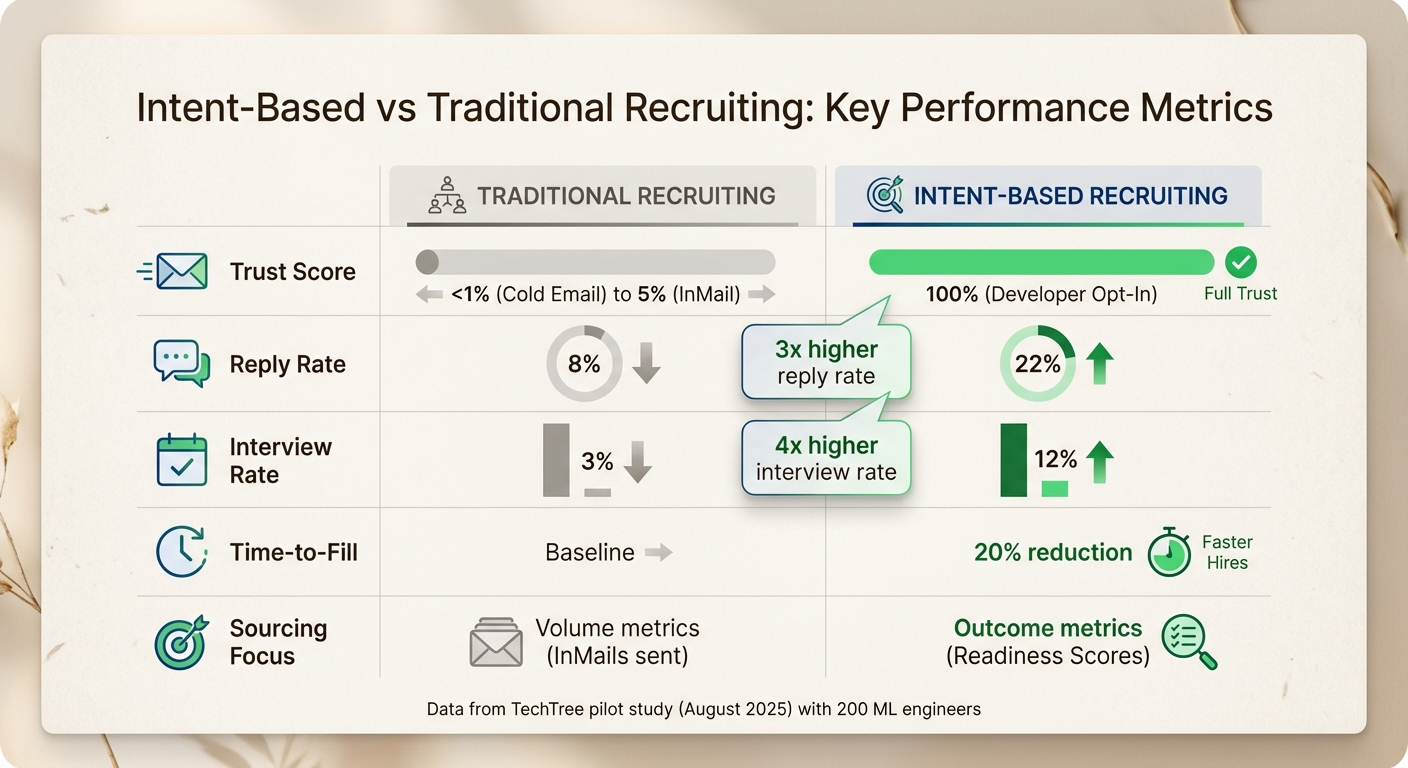 {Intent-Based vs Traditional Recruiting: Performance Metrics Comparison}
Intent-based recruiting zeroes in on developers already showing interest through their actions. This method connects you with candidates who are actively engaged in their field, leading to measurable improvements at every stage of the hiring process. These gains are reflected in key metrics, as outlined below.
Higher Candidate Quality and Response Rates
Targeting developers based on behavior rather than static profiles means reaching out to individuals who are actively involved in their craft. As a result, response rates soar. Developers contributing to open-source projects, earning reputation points, or exploring new technologies are far more likely to engage than those passively listed in a database.
In August 2025, TechTree ran a pilot study with 200 Machine Learning engineers to compare signal-based sourcing against traditional methods. Led by Laurence Sangarde-Brown, the study used behavioral cues and funding triggers to assess candidate readiness. Signal-based outreach achieved a 22% reply rate and a 12% interview rate, compared to the control group's 8% reply and 3% interview rates. This approach also cut time-to-fill by 20% and boosted first-year retention .
Intent signals don’t just improve response rates - they also help pinpoint candidates whose skills and interests align with your needs. For example, developers without recent promotions are 18% more likely to be open to new opportunities , making them ideal targets for well-timed outreach. This precision ensures that candidates' skills match the role requirements. Additionally, skills-based assessments in intent-driven recruiting prioritize practical expertise over formal credentials, creating a more adaptable and capable workforce .
Intent-Based vs. Traditional Recruiting Methods
This approach doesn’t just enhance candidate quality - it delivers quantifiable performance benefits. The table below highlights how intent-based recruiting stacks up against traditional methods:
| Metric | Traditional Recruiting | Intent-Based Recruiting |
|---|---|---|
| Trust Score | <1% (Cold Email) to 5% (InMail) | 100% (Developer Opt-In) |
| Reply Rate | 8% | 22% |
| Interview Rate | 3% | 12% |
| Time-to-Fill | Baseline | 20% reduction |
| Sourcing Focus | Volume metrics (InMails sent) | Outcome metrics (Readiness Scores) |
Intent-based recruiting also taps into the 70% of the global workforce that is passive . These are professionals who aren’t actively job hunting but are open to the right opportunity. By monitoring growth signals like project involvement and skill development, you can connect with top talent before competitors even know they’re available. This strategy strengthens your hiring pipeline and ensures you’re engaging high-quality candidates at the right time.
How to Build an Intent-Based Recruiting Strategy
It's time to move beyond simply sifting through resumes. Instead, focus on actively observing developer behavior - where they spend their time, the projects they take on, and how they engage in their communities. The idea is to reach out to candidates when they're most open to new opportunities, not just when you urgently need to fill a role. Here's how to put this into action.
Steps to Find and Use Intent Signals
Start by pinpointing the platforms where your target developers are most active. Look at indicators like GitHub contributions, Stack Overflow reputation points, and LinkedIn updates. For instance, a single GitHub commit might not reveal much, but months of consistent activity can indicate skill growth and openness to new roles . Historical hiring data can also uncover patterns, such as when certain developers tend to update their profiles or show signs of being ready for a change.
When reaching out, make it personal. Instead of sending generic messages, refer to specific signals you’ve noticed - like a project or tool they’ve worked on. Mentioning these details turns a cold message into a meaningful conversation that acknowledges their work . Once you’ve made contact, focus interviews on how they solve problems rather than just verifying credentials. This approach aligns better with the intent signals you’ve already observed .
By identifying clear intent signals, you can craft outreach messages that truly connect with a developer's interests and goals.
Best Practices for Developer Outreach
Once you've identified intent signals, the next step is to use them to create personalized outreach. Reference specific work or contributions to show genuine interest. For example, if a developer has worked on an accessibility project, highlight that effort to demonstrate you’ve noticed their expertise in solving practical challenges .
When reaching out, focus on more than just salary. Developers who respond to intent-based messages are often weighing whether a role aligns with their technical passions and long-term career goals . Explain how the position can help them grow the skills they’re already working on. Keep your message brief - two to three short paragraphs - and end with a clear, low-pressure next step, like inviting them to chat about their interests. This makes your outreach feel approachable and respectful of their time.
Using daily.dev Recruiter for Intent-Based Hiring
daily.dev Recruiter taps into an active network of developers who are continuously learning and engaging with the community. Instead of relying on outdated profiles or impersonal cold emails, it connects you with developers based on their current interests. By tracking real-time activity - like reading habits, upvotes, and participation in discussions - the platform identifies developers who are genuinely interested in specific technologies or career opportunities . These insights shape every step of your recruitment process.
Features That Support Intent-Based Recruiting
One standout feature is the double opt-in system, TinDev, which ensures both parties agree before connecting. This eliminates the frustration of cold outreach and reduces the chances of being ignored . When you post a job, it’s listed as a "Verified Opportunity", complete with essential details like team size, the interview process, and specific responsibilities. This transparency helps developers decide if the role aligns with their goals .
daily.dev Recruiter also allows you to filter candidates based on behavioral patterns rather than traditional job titles. For instance, if you're looking for a React developer, you can target individuals actively engaging with React-related content instead of relying solely on their resume . This shift from cold outreach to engaging with candidates already showing interest in relevant technologies reinforces the platform’s intent-based approach. Additionally, you can streamline the process further by adding up to three custom screening questions to automatically filter candidates before initiating conversations .
The platform integrates seamlessly with popular Applicant Tracking Systems (ATS), automatically creating profiles and syncing updates when candidates opt in. It also offers clear metrics to show where candidates drop off in the process, helping you measure the effectiveness of your intent-based strategy .
How daily.dev Recruiter Improves Hiring Outcomes
These features translate directly into better hiring results. With daily.dev Recruiter, response rates are three times higher than traditional cold outreach methods . In fact, 90% of developers on the platform won’t respond to recruitment messages sent through other channels . Engineering managers have reported saving an average of 37 hours per hire by using real-time intent signals instead of sorting through irrelevant applications . Because every introduction is warm and mutually agreed upon, you’re only speaking with developers who are genuinely interested.
"We built a place where engineers can turn off the noise. To enter this space, you don't need a hack. You need trust."
- Nimrod Kramer, CEO & Co-Founder, daily.dev
The platform operates on a results-driven payment model. There are no placement fees, monthly subscriptions, or seat-based charges - you only pay when you successfully connect with qualified candidates .
Measuring Success in Intent-Based Technical Recruiting
What sets intent-based recruiting apart from traditional approaches? It’s the ability to measure success with precision. The standout metric here is the reply rate. Signal-based outreach boasts a 22% reply rate, compared to a mere 8% for generic, high-volume tactics . This nearly threefold difference reveals whether you’re connecting with developers who genuinely find your offer relevant. Beyond the initial response, keeping an eye on time-to-hire is just as critical. These metrics provide clear markers for refining your recruitment process.
Key Metrics to Track
To turn intent-based recruiting into tangible results, focus on these key metrics:
Conversion rates at each funnel stage: In 2026, only 0.5% of applicants result in a hire, with technical roles requiring an average of 35–36 interviews per position . If your numbers fall short of these benchmarks, it’s time to reassess your strategy. Pay special attention to sourced candidate performance, as sourced candidates are eight times more likely to be hired compared to those from general job boards .
Offer acceptance rates: This metric reflects how well your process aligns with candidate expectations and market trends.
Cost per qualified introduction: Forget about cost per applicant. With intent-based recruiting, the focus shifts to quality. Calculate how much you’re spending to connect with one developer who meets your criteria and responds meaningfully.
Intent signal accuracy: Correlate initial signals - like engagement with specific technologies or active job-search behavior - with actual job performance 6–12 months later. Recency plays a big role here. For example, every 30-day reduction in the time since a candidate last searched for a job boosts the likelihood of a switch by 45% .
Using Data to Improve Your Strategy
Once you’ve gathered the metrics, dissect your hiring funnel into stages - Engage, Source, Assess - to identify where candidates drop off and identify qualified technical candidates. If replies dry up after initial outreach, your messaging might need adjustment. If candidates struggle during technical assessments, the evaluation could be too difficult or misaligned with the role.
Segment your data by developer role, seniority, and technology stack, as different profiles often require tailored approaches. Also, A/B test elements like email subject lines, message length, and timing. Research shows reply rates are highest for emails sent between 12:00 PM and 6:00 PM local time.
Feedback from hiring managers can validate whether the tracked intent signals actually predict candidate success. New hire surveys at 30, 90, and 180 days can also reveal gaps between recruitment promises and the reality of the job. Using built-in metrics to track drop-off points makes it easier to adjust your strategy based on real-world behavior, ensuring you’re always improving.
Conclusion
Intent-based recruiting is reshaping how technical hiring works. Instead of casting a wide net, it focuses on developers who show real interest through their actions. This approach helps recruiters form stronger connections and engage with candidates in a way that actually matters.
Developers value transparency, respect, and relevance - and intent-based recruiting delivers on all three. By leveraging real-time behavioral data, recruiters can interact with candidates at the perfect moment, meeting them where they already spend their time.
Platforms like daily.dev Recruiter make this strategy both efficient and scalable. Thanks to its double opt-in system, you only connect with developers who have already reviewed your role and expressed interest. The platform's ability to track real-time reading habits and coding activity opens doors to a vast pool of passive talent - developers who aren’t actively job hunting but are open to the right opportunity. Features like automated screening, behavioral matching, and seamless ATS integration simplify the process . The numbers speak for themselves: 90% of developers on daily.dev won’t respond to recruiters elsewhere . With access to a community of over 1 million engineers, including 40% senior technical leaders across 13,000+ companies , you’re engaging with a highly qualified and active network.
The tools and insights are already here to transform your hiring process. Use intent signals to guide your recruiting efforts, track meaningful metrics, and refine your outreach with data-driven strategies. The future of technical hiring isn’t just about finding candidates - it’s about building trust, fostering transparency, and connecting at the right time.
FAQs
What intent signals matter most for my role?
Recruiting developers effectively often hinges on recognizing key intent signals. These signals include behavioral and engagement indicators like active public contributions on platforms such as GitHub, well-executed personal or collaborative projects, and applications that specifically reference relevant tech stacks.
Other valuable signs include activity patterns such as reading history on technical topics, frequent updates to professional profiles, or evidence of ongoing learning through courses or certifications. By analyzing these behaviors, recruiters can identify both active job seekers and passive candidates who might be open to opportunities. This insight streamlines targeting efforts and helps reduce the time it takes to fill roles.
How do I avoid false intent signals?
To minimize false intent signals in technical recruiting, focus on analyzing a range of behavioral indicators instead of relying on single actions like social media activity or profile updates. Pay attention to patterns, such as recent project involvement, endorsements, or noticeable spikes in activity. To confirm genuine interest, use direct conversations, personalized outreach, or assessments. This multi-faceted strategy helps pinpoint truly engaged candidates and reduces the risk of misinterpreting isolated behaviors.
How soon can I see better reply rates?
You can see improved reply rates relatively quickly after adopting targeted, personalized outreach strategies. Make sure to be upfront about important details such as salary, the tech stack, and work arrangements. Many recruiters have observed improvements in just a few weeks to a couple of months.


