

Practical playbook on legal compliance, fair pay models, async hiring, and onboarding to retain remote developers.
Hiring remote developers in 2026 requires a new mindset. Here's what you need to know:
- Remote Work is Here to Stay: 38% of developers work fully remote, with 42% in hybrid setups. Remote-first hiring now accounts for over 50% of tech placements.
- Candidate Preferences: 50% of remote workers would quit if forced back to the office, and remote job postings attract 35% of applications despite being only 8% of listings.
- Key Challenges: Legal compliance, compensation fairness, and building a strong team dynamic are critical for success.
- Legal Complexities: U.S. multi-state hiring triggers tax, labor law, and workers' comp requirements. International hiring often requires an Employer of Record (EOR) or setting up a local entity. Misclassifying workers can lead to steep fines.
- Pay Models: Choose between location-based, role-based, or hybrid pay structures. Transparency and fairness are essential to retain talent.
- Hiring Strategies: Asynchronous tools, clear time zone overlap, and structured onboarding improve efficiency and reduce turnover.
Remote hiring isn't just about flexibility - it's about creating a legally sound, fair, and engaging environment for developers.
How Remote Hiring Differs from In-Person Hiring
Remote hiring isn't just about moving traditional processes online. It requires a different approach to evaluate candidates effectively, especially when assessing their ability to work independently without constant supervision.
For example, traditional whiteboard interviews often fall short because they focus on academic knowledge rather than practical skills. In a remote setting, methods like asynchronous code reviews and short, paid take-home projects (limited to 2–4 hours) are far better at showcasing a candidate's actual work capabilities . These tools are essential for building successful distributed engineering teams that can operate across multiple locations.
Speed is another critical factor. Remote candidates often have multiple offers on the table, especially when dealing with different time zones. Companies that can extend offers within 48 hours of the final interview gain a competitive edge. To streamline the process, limit the interview loop to four steps: recruiter screening, an asynchronous exercise, a live technical interview, and a final discussion with the hiring manager .
Async Interviews and Time Zone Coordination
A simple, 20-minute asynchronous writing exercise can be surprisingly effective. It not only evaluates technical knowledge but also tests how well candidates can communicate their decisions in writing . This is crucial because clear communication is a cornerstone of remote work.
"A remote engineer who can't write a coherent Slack message will cost you a week of confusion every sprint." – Tom Kenaley, Senior Partner, KORE1
When hiring across time zones, core overlap hours should be clearly defined from the start. The required overlap depends on the type of work:
- Production on-call duties: Typically need 6+ hours of overlap, which often restricts hiring to North America and nearby regions.
- Active development: Works well with 4–6 hours of overlap, enabling hiring from LATAM or Western Europe.
- Asynchronous tasks: May only require 1–2 hours of overlap, allowing for broader geographic flexibility.
However, forcing extreme time zone pairings - like a U.S.–Asia collaboration for real-time tasks - often leads to issues, such as someone being stuck with 3 AM meetings. For distributed teams spanning locations like San Francisco and Warsaw, rotating meeting times can help share the inconvenience .
These practices create a smoother hiring process and set the stage for a seamless onboarding experience.
Virtual Onboarding for Remote Developers
The first week of onboarding is crucial - it directly impacts long-term retention rates, which can reach 67% . Unlike in-person settings where casual interactions help new hires settle in, remote teams need structured onboarding and detailed documentation.
Start by shipping hardware a week before the hire date. Delays in equipment or access to credentials can derail the onboarding process. Providing a self-serve onboarding checklist on platforms like Notion or GitHub helps new hires hit the ground running, even if their manager is in another time zone .
Pairing new hires with a peer mentor for the first 90 days is another effective strategy. Assigning a small, manageable task early on helps them adapt quickly and ensures your development workflow is efficient .
| Onboarding Phase | Focus Area | Key Activities |
|---|---|---|
| Week 1 | Environment & Basics | Hardware setup, account access, buddy assignment, first small PR |
| Weeks 2–3 | First Real Task | Scoped feature/bug fix, daily check-ins, detailed code reviews |
| Week 4 | Ramping to Autonomy | Larger tasks, reduced hand-holding, weekly one-on-ones |
| Days 30–90 | Integration | 30/60/90-day milestones, architectural contributions, full autonomy |
Async video walkthroughs using tools like Loom are an excellent way to introduce the codebase and explain architecture. These videos allow new hires to learn at their own pace and revisit sections as needed . Short, one-on-one video calls with key team members are also more effective than lengthy group meetings where people mostly listen.
"If a process isn't written down, it doesn't exist for a distributed team." – Pin
This structured onboarding process not only helps new hires integrate more quickly but also reduces risks, especially when navigating compliance and legal requirements.
sbb-itb-d1e6221
Legal and Compliance Requirements
Hiring remote employees comes with legal obligations tied to the worker's location, not your company's headquarters. For example, if your company is based in Delaware and you hire a developer in Texas, you’re now responsible for meeting Texas-specific requirements like tax nexus, workers' compensation, and labor law compliance .
Misclassifying workers is a common and costly mistake. Around 30% of U.S. companies have misclassified at least one worker . The IRS estimates that 38% of contractors are misclassified , and penalties can reach $2,074 per misclassified worker, not including back taxes . These errors often stem from overlooking compliance regulations, leading to significant financial consequences.
When hiring internationally, the complexity increases. A full-time developer in Brazil contributing to your core product isn't automatically a contractor just because their contract says so. If they’re part of your team’s daily operations, regulators will likely classify them as an employee regardless of the contract’s wording .
"The law depends on where the employee is, rather than where the company is located." – Ihor Shcherbinin, VP of Recruiting, DistantJob
Understanding these rules is crucial to avoid audits and financial liabilities.
US Multi-State Hiring: Nexus, Tax Withholding, and Workers' Compensation
Hiring a remote worker in a new state immediately triggers compliance requirements. As soon as you onboard a W-2 employee in a state where you don’t already operate, you establish a "payroll nexus" . This requires you to register with that state’s tax authority, set up unemployment insurance, and comply with local labor laws, which may include sick leave, paid family leave, and disability insurance.
Tax withholding becomes more complicated. Federal withholding follows IRS Publication 15, but each state has unique income tax rules. Some states, like California, New Jersey, and Illinois, apply the "ABC Test" for worker classification. This test assumes workers are employees unless you can prove they’re independent, operate outside your business’s core functions, and manage their own trade .
Workers' compensation insurance is another mandatory expense in nearly every state. Rates vary widely - covering a developer in California might cost 2–3% of their salary, while the same coverage in Florida could be about half that. Payroll taxes, benefits, and other overhead can add 25–35% to a worker’s base salary .
The federal Department of Labor uses an "economic reality" test to determine whether someone is an employee or contractor. This framework considers factors like control, profit opportunities, and whether the work is integral to your business. Misclassification can lead to years of back taxes and penalties.
"The moment you hire a W-2 employee in a state where you don't already have a payroll nexus, you have to register with that state's tax authority." – Tom Kenaley, President at KORE1
Steps to stay compliant:
- Register for state taxes before issuing any paychecks.
- Use tools like geo-fencing or travel trackers to monitor where employees are working. For example, if a New York-based developer works remotely from Florida for several months, this could trigger Florida-specific obligations .
- Consider using an Employer of Record (EOR) for multi-state operations to simplify payroll, tax withholdings, and benefits management .
While navigating U.S. compliance is challenging, international hiring introduces even more layers of complexity.
International Hiring: EOR vs. Setting Up Your Own Entity
When hiring internationally, you have two main options: work with an Employer of Record (EOR) or establish your own local legal entity. The best choice depends on your company’s scale, goals, and risk tolerance.
Employer of Record (EOR) services act as the legal employer in the worker’s country. They handle payroll, tax compliance, statutory benefits, and labor law requirements. This approach offers speed and reduced risk, as the EOR assumes compliance liability and helps you avoid creating a "Permanent Establishment" (PE), which might expose your company to corporate taxes in that country .
"The Client and Worker often have no direct legal contract, which is how the Client avoids 'Permanent Establishment' risk." – DistantJob
Setting up your own entity is better suited for hiring 50 or more employees in a single country or when planning a long-term presence. While it requires 3–9 months to establish and comes with higher upfront costs, it offers more control over benefits, equity, and employment terms. Over time, the per-employee cost decreases at scale .
| Factor | Employer of Record (EOR) | Local Entity Setup |
|---|---|---|
| Setup Time | 5–15 days | 3–9 months |
| Monthly Cost | $299–$599 per person | High fixed costs, lower per person |
| Compliance Risk | Low (EOR assumes liability) | Low (direct control) |
| Best For | Testing new markets, small teams | 50+ employees, long-term presence |
| Permanent Establishment | Minimal (triangular structure) | Eliminated (you are the local entity) |
Intellectual property (IP) protection also varies by country. In civil law jurisdictions like France, Brazil, and Germany, creators retain "Moral Rights" that cannot be transferred . Contracts should use "Present Assignment" language - stating that the developer "hereby assigns" all rights immediately - and include "Further Assurances" clauses to secure IP ownership if additional documentation is needed .
Social security costs differ significantly worldwide. For example, French employers face charges exceeding 45% of salary, while Spanish employers pay around 32% . These costs can heavily influence salary comparisons across regions.
Understanding these international frameworks is essential to avoid misclassification risks, which are explored next.
Contractor Misclassification Risks by Region
Worker classification depends on the actual working relationship, not the labels in a contract. Regional differences make this issue even more complex, as each jurisdiction has its own approach to determining worker status.
The financial risks are high. Beyond back taxes and social security contributions, companies may owe mandatory benefits like 13th-month salaries (common in Latin America), severance pay, and interest on unpaid amounts. In some cases, misclassification can even jeopardize intellectual property rights if ownership defaults to the creator under "contracts for service" .
"If a developer behaves like an employee, regulators expect employee treatment." – Ken O'Friel, CEO of Toku
In the U.S., states like California, New Jersey, and Illinois use the "ABC Test", which presumes employee status unless specific conditions are met . The federal standard is slightly more flexible, using a seven-factor "economic reality" test, but both focus on the substance of the relationship over contractual terms.
In the European Union, regulators assess "subordination" and "integration." If a worker follows your orders, adheres to your processes, and is integrated into your hierarchy, they are likely considered an employee . For instance, Germany scrutinizes "false self-employment", while French regulators focus on the degree of control over work methods.
Latin America presents unique challenges. In Brazil, authorities closely monitor "Pejotização", where companies use shell entities to disguise employment relationships . If a developer works exclusively for your company, follows your schedule, and doesn’t serve other clients, they will likely be classified as an employee. Misclassification in Brazil can be especially costly due to mandatory 13th-month pay and high social charges, often 30–40% of salary .
In India, the distinction between contractors and employees follows...
Compensation Models for Distributed Teams
::: @figure 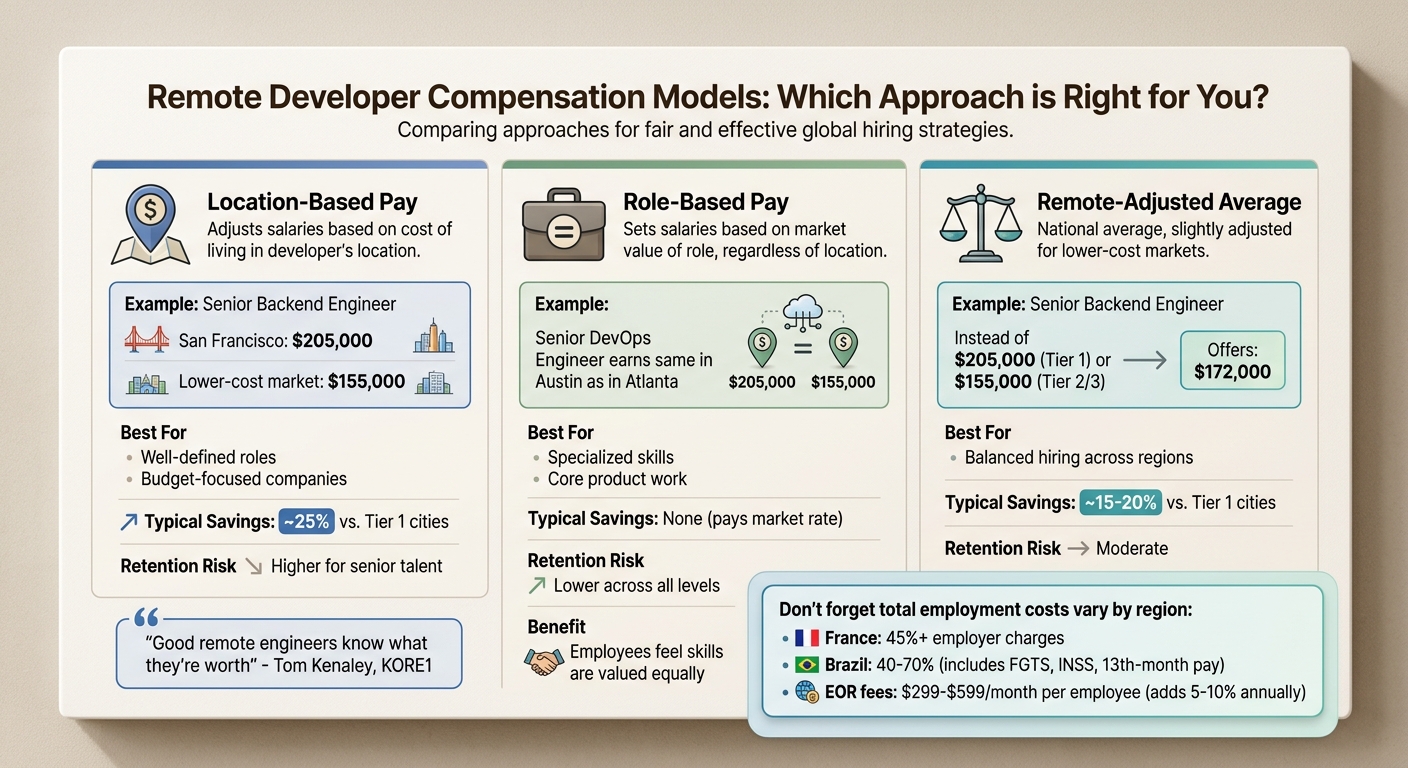 {Remote Developer Hiring: Compensation Models Comparison - Location-Based vs Role-Based vs Remote-Adjusted Pay}
Getting compensation right is one of the most important steps for attracting and keeping top remote talent. When it comes to remote developers, compensation isn't just about the numbers - it's about choosing an approach that balances budgets, employee satisfaction, and staying competitive.
While many developers are willing to accept slightly lower pay in exchange for remote flexibility, they tend to reject pay structures that feel unfair or arbitrary. Take this example: a senior engineer in Pittsburgh finds out they're earning 25% less than a colleague in San Francisco for the same role. Even if their pay is competitive locally, they might start exploring other options.
Location-Based vs Role-Based Pay: The Tradeoffs
Location-based pay adjusts salaries based on the cost of living in the developer's location. For instance, a senior backend engineer in San Francisco might earn $205,000, while the same role in a lower-cost market could pay around $155,000 . This approach allows companies to save significantly by hiring in less expensive areas, often cutting costs by about 25%.
However, this model has its downsides. Engineers with specialized skills, such as expertise in distributed systems or security, often receive multiple offers from companies worldwide. If your pay is tied solely to location while competitors offer role-based compensation that reflects the market value of the job, you risk losing these candidates.
"The math people walk in with, that 'I'll pay 60% of the SF rate because they're working from home' math, does not survive contact with the candidate market for more than about a week... Good remote engineers know what they're worth." – Tom Kenaley, Senior Partner and President, KORE1
Role-based pay, on the other hand, sets salaries based on the market value of the role, regardless of where the employee lives. For example, a senior DevOps engineer would earn the same in Austin as in Atlanta. While this eliminates the savings tied to geographic arbitrage, it often leads to better retention since employees feel their skills are valued equally.
A middle-ground approach uses a national average, adjusted slightly for lower-cost markets. For a senior backend engineer, this could mean offering $172,000 instead of $205,000 (Tier 1 cities) or $155,000 (Tier 2/3 cities). This saves around 15–20% compared to Tier 1 rates while staying competitive .
| Approach | Best For | Typical Savings | Retention Risk |
|---|---|---|---|
| Location-Based | Well-defined roles, budget-focused | ~25% vs. Tier 1 cities | Higher for senior talent |
| Role-Based | Specialized skills, core product work | None (pays market rate) | Lower across all levels |
| Remote-Adjusted Average | Balanced hiring across regions | ~15–20% vs. Tier 1 cities | Moderate |
Location-based pay works well for roles tied to local cost considerations. Role-based pay is better for critical engineering positions where losing top talent could derail key projects.
Once you've chosen a pay model, the next step is structuring salary bands that account for total employment costs.
Creating Salary Bands for Remote Teams
Salary bands should reflect all employment costs, which vary significantly by region. In France, for example, employer-side charges can exceed 45% of the base salary. In Brazil, mandatory contributions like FGTS, INSS, and 13th-month pay can add 40–70% to gross pay. A developer earning $50,000 might actually cost the company $85,000 once these obligations are included.
Start by defining role levels and expectations. Recent data from Q1 2026 shows mid-level backend engineers in the U.S. earning between $118,000 (Tier 2/3 cities) and $155,000 (Tier 1 cities), with a remote-adjusted average of around $132,000 .
Next, account for region-specific benefits. For example:
- In Brazil, budget for the 13th-month salary, which is often split into two payments.
- In Mexico, include the Christmas bonus (Aguinaldo, equivalent to 15 days' pay) and profit-sharing obligations.
If you're hiring internationally, don't forget to factor in Employer of Record (EOR) fees. These services, which help manage payroll and compliance, typically charge $299–$599 per employee per month , adding 5–10% to annual costs.
Avoid setting pay strictly based on local market rates without considering global competition. For example, offering an Argentine developer $85,000 might seem fair locally, but a U.S. company could swoop in with a $135,000 offer for the same role . Short-term savings can lead to long-term challenges like high turnover.
In countries with high inflation, such as Argentina or Turkey, developers increasingly expect flexible pay options. This might include partial payouts in stablecoins like USDC or USDT to protect against currency devaluation . Incorporating such options can make your compensation package more appealing.
Finally, consider transparency. Publishing salary bands internally or clearly explaining how they're structured builds trust. In a remote work environment, where informal pay discussions are common, clarity around compensation goes a long way.
"Pay properly for the location, not punitively for the lack of an office." – Tom Kenaley, Senior Partner and President, KORE1
Tools for Remote Recruiting
Remote job postings make up just 8% of all listings but manage to draw in 35% of applications . This means hiring teams need tools that can handle a surge of interest while still identifying the best candidates. The key is to use tools that align with how developers actually work, rather than forcing them into outdated or artificial interview setups. These tools should also complement the asynchronous and distributed nature of remote work, seamlessly fitting into a remote hiring strategy.
Video Interview Platforms: Asynchronous and Live Options
For live interviews, Zoom and Google Meet are still go-to options . These platforms are great for behavioral interviews, where direct interaction helps assess communication style and team compatibility. However, live video isn’t always practical for teams spread across multiple time zones.
That’s where Loom comes in. It’s become a favorite for asynchronous video communication [3,9]. For example, you can ask candidates to create a 5-minute Loom video explaining a complex pull request or an architecture decision.
"A 5-minute Loom video explaining a feature or architecture decision can be watched by teammates in three timezones without scheduling a single meeting." – Steven Lu, Pin
When it comes to technical assessments, platforms like CoderPad, CodeSignal, HackerRank, and Codility provide shared IDEs. These tools allow you to observe how candidates approach coding challenges in real time, offering insights into their problem-solving and architectural thinking [1,9].
Remote Coding Tests and Virtual Whiteboarding Tools
Technical assessments for remote roles need to reflect actual work scenarios. Traditional whiteboarding doesn’t cut it - it’s not how developers typically work. Instead, focus on tools that mimic real-world coding tasks.
GitHub and GitLab are increasingly popular for interviews . One approach is to share a pull request with intentional issues and ask candidates to provide written feedback. This method tests their ability to identify problems, communicate clearly, and work asynchronously. For live sessions, tools like CoderPad can be used for 60-minute pair programming exercises. These sessions help evaluate how candidates navigate ambiguity and explain their thought process .
If you’re assigning take-home projects that take more than two hours, consider compensating candidates - around $100 per hour is a fair rate [1,9]. This not only respects their time but also encourages high-quality submissions.
"Whiteboarding does not predict remote performance. Asynchronous code with documentation does." – Tom Kenaley, Senior Partner and President, KORE1
With AI now generating up to 90% of boilerplate code , assessments should prioritize skills like auditing and refining AI-generated code. Include tasks where candidates review this code to uncover security vulnerabilities or architectural flaws - skills they’ll use daily in real-world roles.
Building Remote Engineering Culture That Retains Talent
Hiring remote technical talent is just the beginning; keeping them engaged and committed requires deliberate effort to build a strong team culture. While meeting legal and compensation standards is essential, the real challenge lies in creating an environment where remote workers feel connected and valued. With 58% of developers now working fully remote , successful teams rely on clear communication, effective timezone coordination, and meaningful team-building efforts to retain top talent.
Async-First Communication and Documentation Practices
Top-performing remote teams prioritize asynchronous communication and only turn to synchronous methods when absolutely necessary . For instance, instead of daily standups, developers can share written updates in platforms like Slack, allowing them to contribute at their convenience. Tools like Loom are great for creating quick 2-minute video walkthroughs of complex pull requests, eliminating the need for scheduling meetings across time zones .
Documentation is the glue that holds remote teams together. If processes or decisions aren’t documented, they might as well not exist . Architecture Decision Records (ADRs) can replace brainstorming calls, enabling team members to provide feedback asynchronously. Platforms like Notion or Confluence can serve as the central repository for all team knowledge, ensuring everyone stays informed . These practices not only improve efficiency but also build trust, which is crucial for any remote team.
Additionally, focus on outcome-based metrics like Cycle Time, PR Throughput, and Code Quality rather than monitoring online activity . Tracking active hours undermines trust and shifts focus away from meaningful results, which are the true indicators of productivity.
Managing Timezone Overlap and Virtual Team Building
To maintain effective collaboration, aim for a daily overlap of at least 3–4 hours (e.g., 9:00 AM–1:00 PM EST), though five hours is ideal for smoother communication . Without this overlap, team members may end up working late hours, increasing the risk of burnout and attrition within just six months .
When it comes to virtual team-building, skip the mandatory team activities. Instead, foster organic connections by creating dedicated channels for casual, non-work topics and offering optional virtual coffee chats to replicate informal office interactions . Pairing new hires with a peer mentor during onboarding can also make a huge difference, improving long-term retention rates by 67% .
How daily.dev Recruiter Connects You with Remote Developers
daily.dev Recruiter offers a fresh way to connect with remote developers by meeting them where they already are - engaging with technical content on a developer-first platform. Instead of relying on outdated methods like cold LinkedIn messages, the platform positions you in the same space where developers are actively learning, reading, and interacting. This approach ensures you're reaching developers in an environment they trust and frequent.
One of the standout features is its double opt-in introductions, which replace impersonal mass outreach. Developers who engage with the platform signal genuine interest through their participation in the community, rather than relying on static, outdated profiles. This method is particularly important in 2026, when developers are more selective about the opportunities they consider.
The platform prioritizes essential traits for remote work, such as asynchronous communication skills, written clarity, and self-direction . Instead of solely focusing on resumes, daily.dev Recruiter helps identify these qualities through developers’ contributions and interactions. This allows you to screen for critical skills like architectural thinking and the ability to work independently across time zones - key factors for successful remote hiring.
Another advantage is access to passive talent - developers who aren’t actively job hunting but are open to opportunities that align with their goals. This leads to higher response rates and quicker hires, as you're connecting with individuals genuinely interested in what you offer. Say goodbye to cold outreach and endless screening calls; daily.dev Recruiter focuses on targeted, meaningful introductions.
The platform also integrates smoothly with your current ATS and sourcing tools. You can customize screening criteria, target specific frameworks or experience levels, and ensure timezone compatibility before reaching out. By streamlining the remote hiring process, daily.dev Recruiter saves time for both you and the developers, fostering a recruiting experience built on trust and efficiency.
Conclusion
Hiring remote developers in 2026 isn't about picking between flexibility and structure - it’s about blending both seamlessly from the start. Companies that thrive in this space make remote hiring a key part of their strategy, ensuring compliant legal frameworks, transparent compensation, and an async-first culture that prioritizes results over hours worked .
Legal missteps can be expensive. Misclassifying just one worker could lead to hefty fines and ongoing Employer of Record (EOR) fees . For international hires, using an EOR - already utilized by 41% of teams - helps avoid issues like Permanent Establishment tax risks or breaching local labor laws . Speed also matters. Slow hiring processes often mean losing top remote candidates to competitors offering faster, more efficient experiences.
But legal compliance is only part of the equation. Building the right company culture is just as important. With 58% of developers now working fully remote , they can easily tell the difference between a truly remote-first company and one that just dabbles in remote work with the occasional “work-from-home Friday.” Trust is key. Practices like async-first communication, managing by outcomes, and scheduling 3–4 hours of daily overlap for real-time collaboration help retain top talent. In fact, hybrid setups have been shown to cut turnover by 33% .
Platforms like daily.dev Recruiter simplify the process by connecting you with developers who are already prepared for remote work, based on their proven engagement and communication . This eliminates the need for cold outreach, allowing you to reach candidates in an environment they trust. It’s a streamlined way to strengthen your engineering talent acquisition framework.
The real challenge lies in finding the right balance between structure and flexibility. Nail down your legal, compensation, and cultural foundations, and remote hiring becomes a powerful edge. After all, while remote roles make up just 8% of job listings, they attract a whopping 35% of applications . That’s an opportunity you can’t afford to miss.
FAQs
When should I use an EOR vs. set up a local entity?
Choosing between an Employer of Record (EOR) and creating a local entity comes down to your hiring strategy and business needs.
- An EOR is perfect for fast, compliant hiring without the hassle of setting up a legal entity. This option works well for short-term projects or when you're exploring new markets.
- A local entity, on the other hand, makes sense for long-term hiring plans, especially when you need complete control over employment terms and want to establish a stronger presence in the local market.
Each approach has its place, depending on your goals.
How can I avoid contractor misclassification in remote hiring?
To steer clear of contractor misclassification when hiring remotely, it's crucial to follow the specific rules set by various jurisdictions, including IRS guidelines and state laws. Start by examining worker classification carefully. Key factors to consider include how much control you have over the worker, their level of independence, and the type of work they perform. Consulting with legal experts is a must to confirm whether a worker should be classified as an employee or an independent contractor.
Which remote pay model is fairest: location-based or role-based?
The discussion around location-based pay versus role-based pay remains a hot topic in 2026. Many businesses are gravitating toward role-based pay, which ties compensation to the responsibilities and skills required for the position. This approach aligns pay with the value of the work itself, regardless of where it's performed. On the other hand, location-based pay factors in the cost of living in a specific area. While this might seem practical, it can feel unfair to remote workers living in high-cost regions or those who prioritize flexibility over location. For distributed engineering teams, role-based pay is often viewed as a fairer solution.


