Learn how senior engineers think: own outcomes, apply systems thinking, communicate clearly, influence without authority, and prioritize impact.
Being a senior engineer is less about writing perfect code and more about making sound decisions. The key lies in judgment - knowing what to build, when to challenge ideas, and how to handle ambiguity. Senior engineers focus on outcomes, not just output, and their mindset revolves around three core principles:
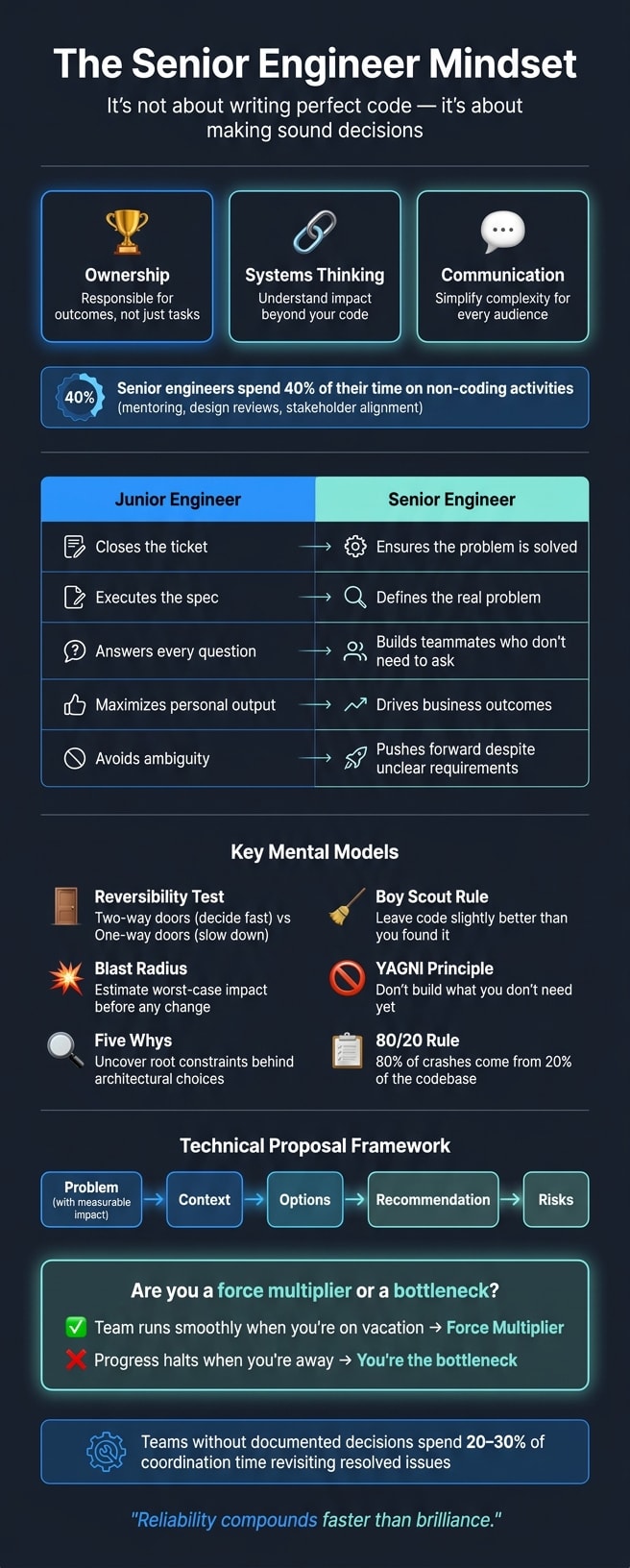
- Ownership: Take responsibility for results, not just tasks. Ensure problems are fully resolved, even in the face of unclear requirements.
- Systems Thinking: Understand how changes impact the broader system and the organization. Evaluate trade-offs and consider long-term effects.
- Communication: Simplify complex ideas for different audiences, provide clear updates, and build trust through structured, precise language.
Senior engineers spend 40% of their time on non-coding activities like mentoring, design reviews, and aligning with stakeholders. They lead through influence, empower their teams, and prioritize work based on impact and risk. This mindset ensures they drive meaningful results while maintaining system health and fostering team growth.
Actionable Tip: Start a decision journal. Document one major decision daily, your reasoning, and expected outcomes. Review it after 30 days to refine your judgment.
How GREAT Senior Software Engineers Think! (Steal these 9 TIPS!) Kent C. Dodds
Core Traits of a Senior Engineer's Mindset
The introduction highlighted three key shifts: ownership, systems thinking, and communication. However, understanding these ideas is one thing; putting them into practice is where many developers face challenges.
Ownership and Accountability
Being a senior engineer isn’t about working endless hours or answering Slack messages immediately - it’s about owning outcomes, not just tasks. While a junior engineer might consider their job done once a ticket is closed, a senior engineer ensures the problem is fully resolved.
"My responsibility ends only when the problem is solved." - Adler Hsieh, Tokyo Tech Lead
This mindset shows up in actions like monitoring system performance, creating runbooks to share insights, and addressing technical debt before it snowballs. A useful mental exercise is the "Absent Owner" test: Would your systems operate smoothly if you weren’t around?
Senior engineers also embrace ambiguity. Instead of waiting for perfect requirements, they push projects forward by asking thoughtful questions, outlining possible approaches, and making informed decisions even when details are unclear. This approach naturally leads to assessing whether a task truly addresses the root problem before diving into execution.
Shaping Solutions, Not Just Executing Tasks
Senior engineers don’t jump straight into coding - they pause to evaluate whether a feature or task is even necessary. They focus on understanding the why behind a request, ensuring it aligns with user needs or exploring if the goal can be achieved in a simpler way.
"A senior engineer is assigned a goal and figures out the right problems to solve, in what order, with what trade-offs." - Truongpx396, Senior Software Engineer
Instead of blindly following a spec, senior engineers define the real problems, prioritize solutions, and weigh potential trade-offs. They also think about second-order effects. For instance, while adding a cache might improve performance quickly, it could lead to tricky invalidation bugs later. In this mindset, complexity is seen as a risk, not a badge of honor.
By carefully defining problems, senior engineers set the stage for clear and focused communication.
Communicating with Clarity and Purpose
Strong communication is essential for senior engineers to amplify their impact. Even the most skilled technical expert won’t achieve much without the ability to convey ideas effectively. As one engineering community wisely noted:
"A 10x engineer with 0.1x communication is a 1x engineer." - Dev Weekends
Senior engineers adapt their communication to match their audience. With product managers or executives, they emphasize business outcomes rather than technical details. Among peers, discussions focus on trade-offs instead of personal preferences. A practical framework for technical proposals might look like this: Problem (with measurable impact) → Context → Options → Recommendation → Risks.
Another hallmark of strong communication is providing timely updates. Proactively sharing progress and flagging potential risks builds trust. Clear pull request descriptions and realistic time estimates also contribute to a reputation for dependability and precision.
Systems-Level Thinking
Clear communication is important, but it's only part of the equation. Senior engineers go beyond individual tasks, constantly considering how their work fits into the bigger picture.
Framing Problems in Context
Architect Eliel Saarinen summed up this mindset perfectly:
"Always design a thing by considering it in its next larger context - a chair in a room, a room in a house, a house in an environment, an environment in a city plan."
This principle applies just as well to software. Senior engineers don’t dive into coding without first evaluating how a service aligns with broader business objectives. One method they often use is the Five Whys technique. By repeatedly asking "why?" about an architectural choice, they uncover the deeper constraints driving the decision. For instance, if someone suggests using Redis, a senior engineer will probe further: Is it latency concerns? High read volumes? Session storage? This approach ensures solutions address the root problem, not just surface symptoms. It also naturally leads to better documentation of decisions.
Using Lightweight Architectural Tools
Effective documentation is a hallmark of senior engineers. Research indicates that teams without documented architectural decisions spend 20% to 30% of their coordination time revisiting resolved issues . To avoid this, senior engineers use tools like RFCs (Request for Comments) to explore options and ADRs (Architectural Decision Records) to log final decisions and their rationale. These concise records preserve the reasoning behind choices, even when it’s not evident in the code itself.
Balancing Tradeoffs
With documented decisions in hand, senior engineers excel at evaluating tradeoffs. They embrace the phrase "it depends" but back it up with specific considerations like scale, team size, deadlines, budget, and regulatory constraints. A helpful mental model for this is the reversibility test. Decisions can be categorized as:
- Two-way doors: Easily reversible, such as switching a logging library or toggling a feature flag.
- One-way doors: Harder to undo, like altering a core database schema, which requires thorough analysis.
"Every technical decision is a trade-off. Master the frameworks. Own the thinking." - Sarim Nadeem, Engineer
Before implementing a major change, senior engineers assess its potential impact, or "blast radius." For example, tweaking CSS poses less risk than migrating a critical database. By classifying changes as Small, Medium, Large, or Critical, they determine appropriate safeguards - whether that’s feature flags, staged rollouts, or manual approvals . This structured approach minimizes risk while maintaining forward momentum.
Leading Through Influence, Not Authority
Senior engineers often don’t have direct reports, yet their impact on how teams build software is undeniable. Their influence doesn’t come from titles but from trust. As Sandor, author of The Dev Ladder, explains:
"Senior engineers don't lead by authority. They lead by making it easier for others to do the right thing - and then stepping back when the team does."
This trust is earned through consistency, honesty about what you don’t know, and following through on commitments. Think of influence like a bank account: you make deposits by being helpful and reliable before you can spend it on guiding big decisions.
Mentoring and Empowering Others
The best senior engineers aren’t the ones who can type the fastest. They act as force multipliers, enabling their teams to achieve far more than they could alone. In fact, their guidance can make a small team just as effective as a much larger one . The goal isn’t to solve every problem yourself - it’s to empower your teammates to solve problems without relying on you.
That means holding back the urge to jump in with answers. Instead, ask questions like: "What steps have you tried so far?" or "What do you think is causing this?" This approach, often called the Socratic method, helps teammates develop problem-solving instincts that last. Joel Dickson, Director of Engineering at Agoda, puts it this way:
"Helping isn't answering every question. Helping is building people who don't need to ask."
Here’s a simple way to measure your mentorship: what happens when you’re on vacation? If the team operates smoothly, you’ve done your job well. If progress grinds to a halt, you’ve become a bottleneck instead of a multiplier . Even in routine tasks like code reviews, you can empower others by using clear labels - must (blocker), should (strong suggestion), nit (minor issue) - to make feedback actionable and reduce confusion .
Strong mentorship naturally lays the groundwork for influencing the team’s technical direction.
Influencing Technical Direction
Beyond mentoring, senior engineers play a critical role in shaping technical decisions. Without managerial authority, their primary tool for steering the team is structured and clear communication. RFCs (Request for Comments) are particularly effective - they allow you to propose solutions, outline tradeoffs, and gather feedback before any code is written. This process sharpens your own thinking while giving teammates a chance to refine or challenge the idea.
When making technical arguments, focus on shared goals like reliability, speed, or customer outcomes - avoid framing it as personal preference. For example, instead of saying, "I think this is cleaner," you might write: "We chose [Option A] over [Option B] because [Reason]. The trade-off is [Cost]. We’d reconsider if [Condition changed]." This shows you’ve carefully thought through the options and their implications.
For decisions with high stakes, ensure you gather input but avoid letting consensus delays stall progress. Influence comes from making sound, well-documented choices - not from “winning” debates. Your goal is to make the right decision clear, actionable, and easy for the team to align with.
Prioritizing Work Under Constraints
Every engineer encounters times when the workload feels overwhelming, and the hours in the day simply aren't enough. What sets senior engineers apart isn't their speed - it's their ability to decide what deserves their attention. They don't just aim to maximize their personal output; they focus on driving business outcomes.
Assessing Impact and Risk
Senior engineers start by asking: "What happens if this fails?" This approach is known as the blast radius mental model. Before making changes, they estimate the worst-case scenario. For instance, tweaking CSS has a small blast radius - it’s easy to fix if something goes wrong. On the other hand, tasks like a database migration or modifying core authentication systems come with a much larger blast radius. These require extra precautions like canary deploys, rollback plans, and manual checks .
In addition to assessing blast radius, they evaluate decisions based on reversibility. Decisions are categorized as "one-way" (irreversible) or "two-way" (reversible) . Reversible decisions - like switching a logging library or adjusting a feature flag - are made quickly to maintain momentum. Irreversible ones - such as selecting a primary database or designing a public API contract - demand more deliberate planning. These often involve writing design documents, conducting premortems, and taking time to reflect.
"The first thing I do is figure out if this is a one-way door or a two-way door. If it's reversible, I decide in minutes. If it's irreversible, I slow down." - Staff Engineer, Fintech Company
Premortems are a powerful tool in this process. By imagining a project has failed six months down the line, engineers can uncover hidden risks early . Combining this with the 80/20 rule - where 80% of crashes tend to come from just 20% of the codebase - helps focus attention on the areas that matter most. These evaluations guide the balance between delivering quickly and maintaining long-term system stability.
Balancing Short-Term Delivery and Long-Term System Health
Speed and system health don’t have to be at odds, but they do require thoughtful tradeoffs. Senior engineers avoid overengineering solutions for problems that don’t yet exist. This is where the YAGNI principle (You Aren’t Gonna Need It) comes into play. For example, there’s no need to build an elaborate plugin system for an internal tool that only three people use . Instead, they reserve major investments for critical areas like security, data integrity, core business logic, and API contracts.
At the same time, they don’t neglect the codebase while pushing for fast delivery. The Boy Scout Rule offers a balanced approach: leave the code a bit better than you found it. This might mean renaming a confusing variable, adding a missing test, or cleaning up an outdated comment. However, they avoid overhauling 500 lines of code just to fix a one-line bug . These small, incremental improvements add up over time without slowing down progress. As Truongpx396, Senior Software Engineer, aptly puts it:
"Reliability compounds faster than brilliance."
Continuous Growth with a Senior Mindset
Achieving senior status in your career isn't the endgame - it's a stepping stone. A senior mindset thrives on consistent effort toward both personal and team growth. Engineers who continue to excel treat their careers like a product, actively investing in acquiring new skills, building relationships, and increasing their visibility, rather than expecting growth to happen by default .
Targeted Skill Development
For growth at the senior level, developing T-shaped skills is one of the most effective approaches. This means having deep expertise in one area while maintaining a broad understanding across others. For instance, a backend engineer might focus deeply on database internals while also staying familiar with observability, distributed systems, and API design. This breadth is what makes you valuable in architectural discussions and cross-team collaborations - not just within your specialty .
A simple habit that can create lasting improvement is the 15-minute daily practice. Dedicate a few minutes each day to challenge a technical assumption, read a public postmortem from companies like Cloudflare or AWS, or sketch a system diagram for something you're working on. Over time, this builds a mental toolkit of failure patterns and architectural insights .
Senior engineers who embrace AI as a partner - not just a tool for completing tasks - can work 1.5 to 2 times faster than those who use it superficially . The trick is leveraging AI for repetitive or mechanical tasks, like generating test scaffolding or navigating unfamiliar codebases, so you can focus your energy on higher-level decisions and system design.
This kind of personal growth sets the stage for making a broader impact through shared knowledge.
Building Leverage Through Knowledge Sharing
Personal growth is just one piece of the puzzle. To truly amplify your impact, you need to scale your influence across the team. Individual output has its limits, but leverage - especially through written knowledge - can extend your reach.
Writing Architecture Decision Records (ADRs) or RFCs might feel like extra work, but a single well-documented ADR can save your team from revisiting bad decisions for years. As Mooh, a Senior Engineer, explains:
"The most scalable output is knowledge - writing clear explanations of system decisions prevents repeated mistakes."
A good test of your knowledge-sharing effectiveness is whether your team can function independently when you're unavailable. If everything grinds to a halt in your absence, it means you're a bottleneck, not a force multiplier .
Using daily.dev for Growth
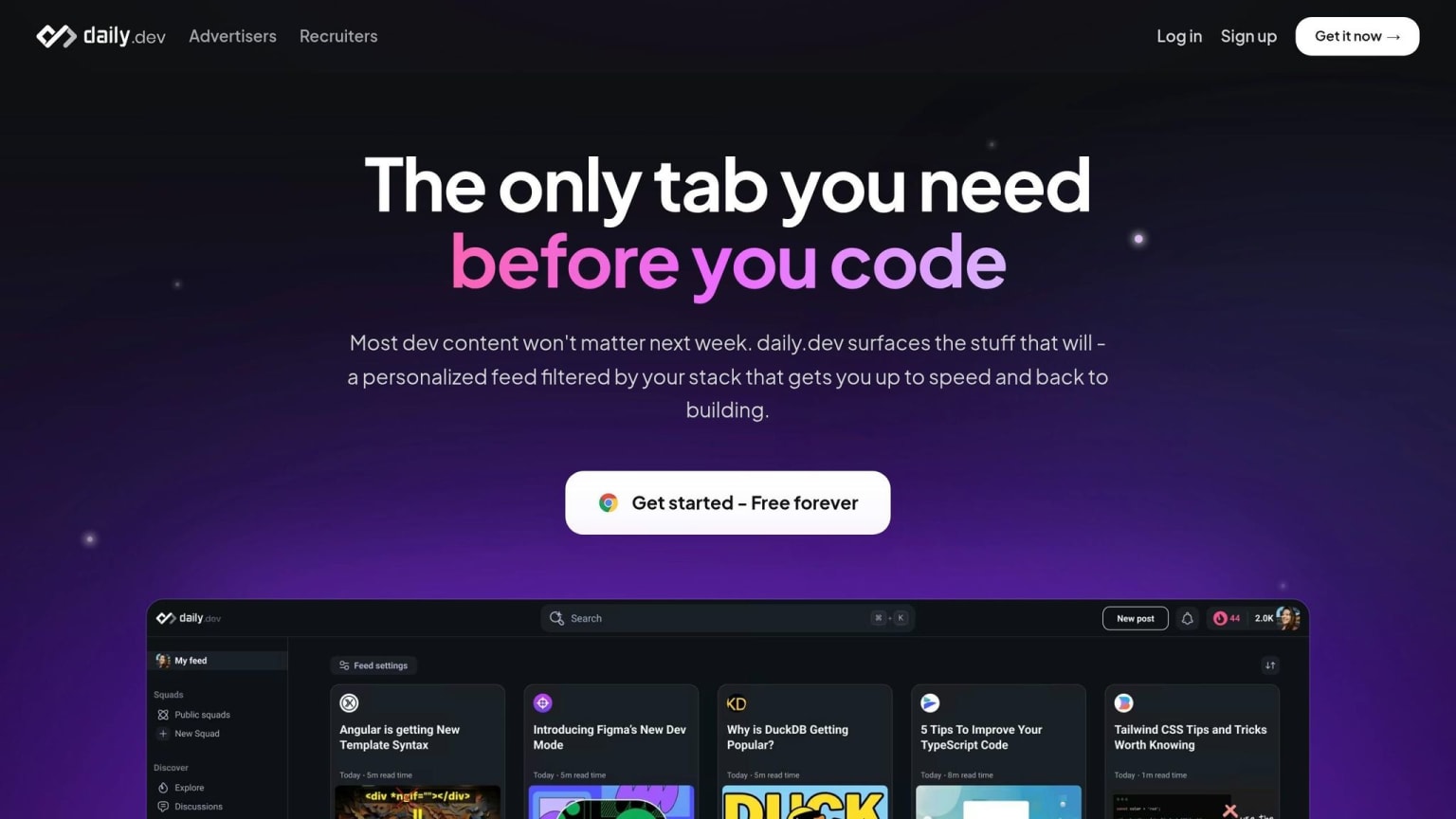
Staying informed in a fast-moving industry requires discipline. The challenge isn't finding content - it’s filtering it effectively. The aim is to maximize insight per unit of attention, not to consume every piece of information out there .
daily.dev is designed to help with this. Its personalized feed curates relevant technical content - like tutorials, incident reports, and in-depth analyses - tailored to your interests. If you're honing your T-shaped skills, you can follow specific areas like distributed systems or observability to sharpen your expertise. The Squads feature enables you to engage with developer communities, turning passive reading into active learning. This keeps you connected to industry trends without overwhelming your schedule.
Conclusion: Putting the Senior Engineer Mindset into Practice
Seniority in engineering isn't about how much code you write or how many tools you master - it's about the impact you create and the decisions you make. Gareth Clubb sums it up perfectly:
"Seniority is not about what you know... it is about how they think, how they make decisions, and how they multiply the effectiveness of everyone around them."
Throughout this guide, we've explored key principles like ownership, systems thinking, communication, influencing without authority, and deliberate growth. All of these boil down to one essential idea: focus on outcomes, not just output. Closing a ticket or completing a task means little if it doesn’t contribute to the product's progress or improve the team's effectiveness.
If you're wondering how to start applying these ideas, try this: keep a decision journal. For the next week, write down one major technical decision you make, your reasoning behind it, and what you expect to happen. Then, revisit it in 30 days. This simple habit, when practiced regularly, can help you develop the kind of judgment that sets growing engineers apart from those who stagnate .
This emphasis on thoughtful decision-making and measurable results is at the heart of the senior engineer mindset. William Wang, Founder of GEOScore AI, puts it this way:
"The gap is closed by treating decision-making as a skill - one that can be studied, practiced, measured, and improved. Most engineers never do this."
Ultimately, developing this mindset comes down to the actions you take daily - questioning priorities, designing systems that can handle failure, and making small yet meaningful improvements over time.
FAQs
How do I practice “ownership” without burning out?
To practice ownership in a balanced way, start with a manageable project or specific area. This helps you build confidence while staying focused. Organize your tasks around times when your energy levels are at their highest, take real breaks to recharge, and establish clear boundaries to prevent overworking. Keep communication open by sharing updates and potential risks early - this can ease stress. It's important to remember that ownership is about ensuring results and maintaining a healthy workflow, not taking on everything yourself. This way, you can make meaningful contributions without burning out.
How can I tell if a decision is a one-way door or a two-way door?
When deciding whether something is a one-way door or a two-way door, focus on its reversibility and impact. A one-way door represents a choice that's tough or expensive to undo - like setting up a database schema. On the other hand, a two-way door involves decisions that can be reversed with little effort, such as picking a logging library. With one-way doors, take the time to evaluate thoroughly. For two-way doors, act swiftly and keep moving.
What should I write in an ADR or RFC to influence a decision?
To guide decision-making effectively, an ADR (Architectural Decision Record) or RFC (Request for Comments) should present the context, available options, trade-offs, and reasoning in a clear and structured way. Be sure to outline the problem, provide background information, list alternatives, and detail the consequences of each choice. Then, include the final decision, highlighting its advantages and potential drawbacks.
Keep it brief - aim for about one page - and use templates to maintain uniformity. Adding metrics or success criteria can make your argument more compelling and help others understand the decision in the future.