

How take-home and live coding tests differ, when to use each, and why a hybrid approach best predicts developer success.
When hiring developers, choosing the right assessment method is crucial. The two main options are take-home coding assignments and live coding assessments. Each has strengths and works best in different scenarios:
- Take-Home Assignments: Candidates complete tasks over 2–7 days in their own environment. Great for evaluating code quality, architecture, and testing skills. Best for senior roles and tasks requiring independent problem-solving.
- Live Coding Assessments: Real-time coding sessions with an interviewer. Ideal for assessing problem-solving, communication, and collaboration under pressure. Works well for junior roles and positions requiring teamwork.
Key Insights:
- Take-home tests correlate better with long-term performance (0.62) than live coding (0.57).
- Live coding is quicker (60–90 minutes) but can cause anxiety (62% of candidates report stress), making it vital to optimize the candidate experience.
- A hybrid approach combining both methods gives the most balanced evaluation, with a 0.71 correlation to peer reviews.
Quick Comparison:
| Feature | Take-Home Assessment | Live Coding Assessment |
|---|---|---|
| Focus | Code quality, architecture | Real-time problem solving |
| Candidate Stress | Low | High |
| Time for Candidate | 3–8 hours over days | 60–90 minutes |
| Best For | Senior roles | Junior roles, collaborative tasks |
Combining both methods ensures a thorough evaluation of technical and interpersonal skills, improving hiring outcomes. For a step-by-step guide to the full process, use our developer hiring checklist.
::: @figure 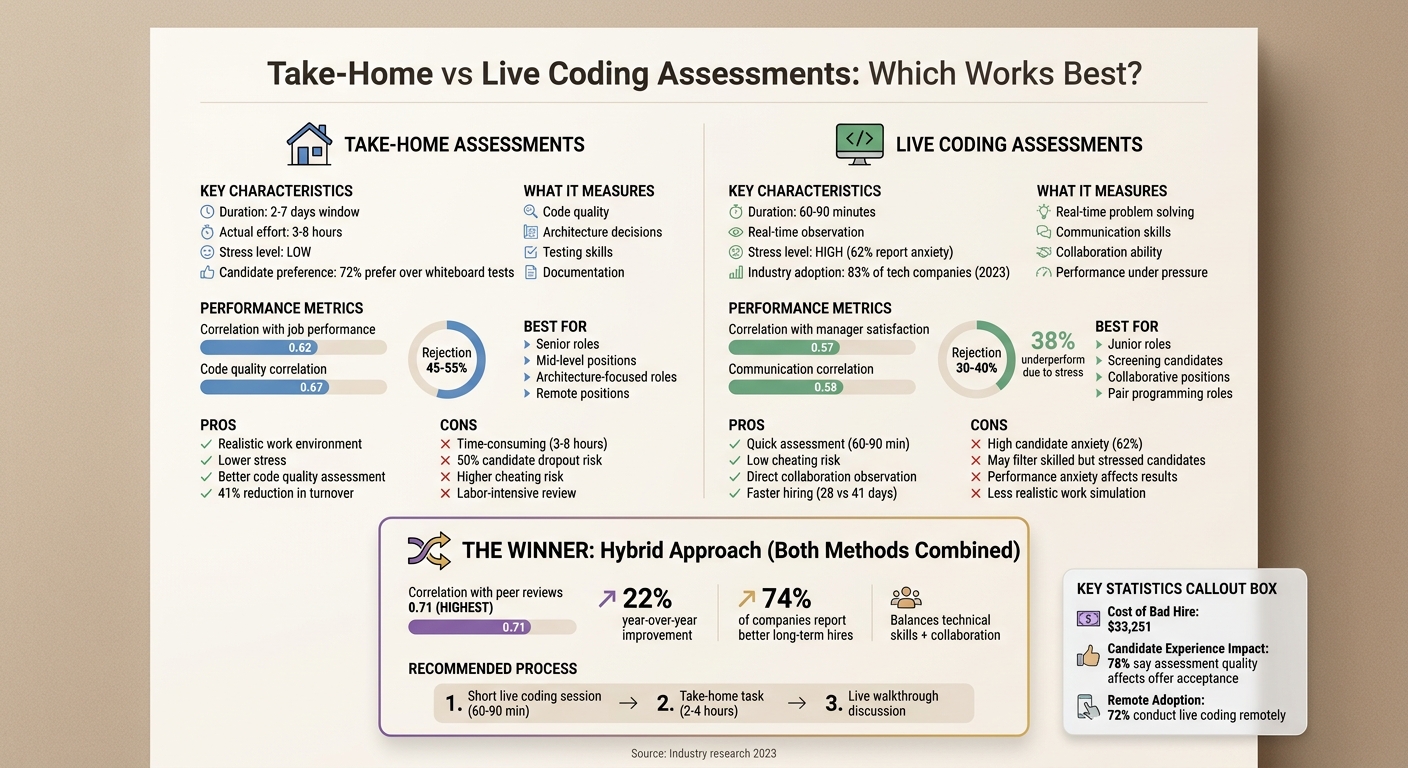 {Take-Home vs Live Coding Assessments: Complete Comparison for Developer Hiring}
What Are Take-Home Coding Assessments?
Definition and Purpose
Take-home coding assessments are unmonitored assignments that candidates complete independently over a span of 2–7 days . Unlike live coding interviews, these tests allow candidates to work at their own pace, using their preferred tools and development environments.
The idea is to mimic real-world development scenarios, where developers often rely on documentation and online resources. Typically, recruiters provide a project brief (sometimes including a Git repository link), and candidates submit their completed work for evaluation. While the overall window for completion is several days, the actual effort usually takes between 3–8 hours .
These assessments focus on evaluating the quality of code, architectural decision-making, and documentation skills. Specifically, they look at aspects like maintainability, testing strategies, folder organization, and handling edge cases. Ihor Shcherbinin, VP of Recruiting at DistantJob, highlights the value of this approach:
"The take-home exam provides an assessment of what the developer can accomplish in their home environment, which is not as stressful and more realistic."
Now, let’s look at the best developer assessment tools and where these assessments are most effective.
Common Use Cases
Take-home assessments are often used for mid-to-senior-level roles where architectural thinking and code craftsmanship are critical. They’re particularly useful for tasks that closely resemble actual job duties, such as building small applications, integrating APIs, or improving legacy code.
Interestingly, 72% of developers prefer this format over traditional whiteboard interviews . However, these assessments tend to have a higher rejection rate - 45–55% compared to live coding’s 30–40% - as they often reveal gaps in discipline or code structure that shorter interviews might miss .
sbb-itb-d1e6221
What Are Live Coding Assessments?
Definition and Purpose
Live coding assessments are real-time interviews where candidates are asked to code, debug, or refactor while being observed. These sessions usually last between 45 and 90 minutes and take place on collaborative coding platforms like CodeSignal or CoderPad. These platforms often include features like built-in IDEs, terminals, and live previews to facilitate the process.
What sets live coding apart from take-home tests is the need for candidates to explain their thought process as they work. This approach allows interviewers to evaluate not just the final output but also the candidate’s reasoning and problem-solving approach. As Mary Teolis, Talent Acquisition Manager at UKG, puts it:
"The objective here is not to assess perfect syntax, but rather to observe their ability to think critically, articulate their thought process, pose insightful questions, and collaboratively work towards a solution with our interviewer."
By simulating a collaborative environment, live coding tests how candidates handle pressure and work in real-time. This format is harder to fake, offering a more accurate picture of a candidate’s abilities. In fact, as of 2023, 83% of tech companies have integrated live coding into their hiring process .
Now, let’s explore when live coding is most effective.
Common Use Cases
Live coding works best for roles that require quick thinking and effective communication. During these assessments, candidates might be asked to:
- Debug code snippets
- Implement small features in existing codebases
- Integrate REST APIs
- Refactor poorly written code to follow principles like SOLID
This format is particularly useful for junior developer roles, where foundational skills need to be verified, and the ability to accept feedback is essential. It’s also valuable for positions involving pair programming or client-facing technical tasks, where explaining complex ideas clearly is critical. Notably, 92% of hiring managers believe that strong communication skills are just as important as technical expertise .
That said, live coding does come with challenges. For example, 62% of candidates report experiencing significant anxiety during live technical interviews, and 38% of developers feel they often underperform in high-pressure scenarios . However, with 72% of companies now conducting these sessions remotely using specialized platforms, the shift away from traditional whiteboard interviews may help reduce some of this stress.
Comparing Take-Home and Live Coding: Strengths and Weaknesses
Take-Home Coding Assessments: Strengths and Weaknesses
Take-home assignments allow candidates to work in a comfortable environment, which often reduces stress and highlights their ability to produce well-structured, maintainable code. This format is excellent for evaluating a candidate's approach to documentation, testing, and overall code quality - areas that can be harder to assess in a short live session.
On the downside, these assignments can be time-consuming, often requiring 3–8 hours to complete. This can discourage candidates, especially those balancing full-time jobs or personal commitments. In fact, up to 50% of pre-qualified candidates may opt out when faced with a take-home challenge, particularly if they’re already employed . Additionally, the unmonitored nature of these tests raises concerns about fairness, as candidates could use external help, including AI tools. For hiring teams, reviewing these submissions can also be labor-intensive, potentially slowing down the overall hiring process.
Live Coding Assessments: Strengths and Weaknesses
Live coding assessments offer a real-time look at a candidate's skills, making it difficult to hide gaps in knowledge. They’re particularly effective at testing technical and soft skills like problem-solving, communication, and performance under pressure - qualities that are crucial for roles involving teamwork or client-facing tasks. As Matthew Johnson, CTO of a SaaS platform, explains:
"We've found take-home coding tests predict long-term success while live coding predicts short-term onboarding speed. Our ideal process uses both sequentially to get a complete picture."
These assessments are easier to schedule and take less time - usually 60–90 minutes - making them more manageable for candidates compared to longer take-home assignments. They also provide immediate insights into collaboration and responsiveness. However, the high-pressure environment can lead to performance anxiety. Research from NC State University likens technical interviews to the Trier Social Stress Test, which is designed to induce stress . The impact is clear: 62% of candidates report significant anxiety during live coding interviews , 38% of developers say they perform well below their actual ability in these settings , and one study found that women who failed a public coding interview passed the same problem in a private setting . This suggests live coding might unintentionally filter out skilled candidates who struggle with stress rather than coding itself. In some cases, hiring teams may even choose to assess technical skills without coding tests to avoid these biases.
Side-by-Side Comparison
Here’s a quick breakdown of how the two methods differ:
| Feature | Take-Home Assessment | Live Coding Assessment |
|---|---|---|
| What It Measures | Code quality, architecture, testing, documentation | Real-time problem solving, communication, collaboration |
| Candidate Stress Level | Low (private, familiar environment) | High (62% report significant anxiety) |
| Time Required (Candidate) | 3–8 hours over several days | 60–90 minutes |
| Time Required (Interviewer) | 30–60 minutes (asynchronous review) | 60–90 minutes (synchronous) |
| Risk of Cheating | Higher (unproctored; AI assistance possible) | Low (proctored; interactive) |
| Collaboration Signal | Limited (assessed through code walk-through) | Strong (observed directly) |
| Best For | Senior roles, architecture skills, specialized expertise | Junior roles, screening, collaborative positions |
| Performance Correlation | 0.62 with first-year reviews | 0.57 with first-year reviews |
| Candidate Preference | 72% of developers prefer over whiteboard tests | Lower preference due to stress factors |
What Research Shows About Assessment Effectiveness
Research highlights a strong connection between assessment methods and job performance. For instance, take-home tests show a 0.62 correlation with first-year job performance, while live coding sessions score 0.57 with manager satisfaction . Although the difference may seem small, it plays a meaningful role in shaping long-term team success.
Each method brings unique strengths to the table, reflecting broader insights for recruiters on what developers value in the hiring process. Take-home assignments, for example, provide code quality metrics that correlate at 0.67 with a developer's ability to write maintainable production code . On the other hand, live coding sessions showcase communication skills, which correlate at 0.58 with effective team collaboration . These approaches measure different but equally critical aspects of a developer’s capabilities.
The benefits of structured assessments also extend to retention rates. Companies using structured take-home tests report a 41% reduction in early employee turnover . This is a big deal when you consider the average cost of a bad technical hire - $33,251 . Lower attrition means fewer resources spent on hiring, onboarding, and replacing employees, making the hiring process more efficient and cost-effective.
Interestingly, combining both methods - take-home tests and live coding - delivers even better results. This hybrid approach has a 0.71 correlation with peer evaluations, outperforming either method alone . Companies adopting this combined strategy have experienced a 22% year-over-year improvement , showing that a more comprehensive evaluation approach leads to better hiring outcomes.
Experts also back up these findings. Dr. James Rodriguez, a recruitment specialist in the tech industry, emphasizes:
"The best predictor remains a candidate's ability to explain their previous work in detail with technical precision. Assessment results confirm rather than replace this insight" .
Ultimately, assessments are most effective when paired with other evaluation tools like work history discussions and collaborative problem-solving exercises. Together, they provide a fuller picture of a candidate’s potential.
When to Use Each Assessment Method
Choosing the right assessment method depends on the specific needs of the role, how quickly you need to hire, and the technical expertise required.
Best Situations for Take-Home Assessments
Take-home assignments are a great fit for mid-to-senior level roles that involve tasks like designing complex systems, writing clean, maintainable code, or working independently with minimal guidance. These assessments shine when evaluating backend developers tasked with creating performance-critical systems, senior architects making crucial trade-offs, or DevOps engineers tackling specialized challenges.
Take-home tests are also ideal for remote positions or roles requiring high autonomy. They mimic the candidate's actual working conditions, offering a more realistic gauge of their capabilities. In early 2023, a fintech startup saw its successful hire rate jump from 60% to 81% after swapping generic tests for structured 3–4 hour take-home assignments. These assessments included a clear evaluation rubric and follow-up discussions on architectural decisions .
Timing is a key factor, though. To respect candidates' time, keep the scope manageable - 3–4 hours maximum. For example, Dropbox found that when assignments exceeded this time limit, 20% of candidates dropped out of the process, with highly sought-after candidates being the most likely to disengage .
On the other hand, if the role emphasizes immediate problem-solving or dynamic collaboration, live coding assessments might be a better choice.
Best Situations for Live Coding Assessments
Live coding sessions are particularly effective for entry-level positions, where the focus is on evaluating basic problem-solving skills and the ability to learn quickly. This is a critical step to identify qualified technical candidates early in the funnel. These candidates often lack extensive portfolios, so observing how they approach a problem in real-time provides valuable insights into their thought processes, responsiveness to feedback, and ability to articulate technical ideas.
Another advantage of live coding is its speed. A 2023 case study from a healthcare technology company showed that structured live coding sessions, with evaluation criteria shared 24 hours ahead of time, reduced their hiring timeline from 41 to 28 days .
This method also excels in roles that require frequent collaboration and real-time communication, such as pair programming or client-facing positions. For example, frontend developers who need to work closely with designers or professionals who must explain technical decisions to non-technical stakeholders benefit greatly from this interactive format.
Using Both Methods Together for Better Results
Hybrid assessments, which combine take-home assignments with live coding tests, offer a well-rounded way to evaluate a candidate's skills . Each method uncovers distinct strengths, creating a fuller picture of a candidate's abilities. Take-home tasks demonstrate how developers approach problems independently, focusing on code quality, architectural decisions, and documentation. On the other hand, live coding sessions reveal how candidates handle pressure, articulate technical ideas, and respond to feedback. Together, these approaches create a balanced evaluation that aligns with an effective hiring strategy.
A typical hybrid approach might start with a short live coding session, followed by a 2–4 hour take-home task. The process concludes with a live walkthrough, where interviewers dive into the candidate's architectural choices . This final discussion allows for targeted questions, helping interviewers assess how well candidates can justify their solutions and adapt in real time. As InCruiter explains:
"A hybrid approach feels less like a spotlight and more like a conversation. Candidates get to work in their comfort zone first, then walk through their solution and make adjustments live" .
This method has tangible benefits for businesses. For instance, Google's research highlights that a candidate's ability to adapt to feedback during live sessions is a stronger predictor of successful team integration than technical correctness alone . Moreover, 74% of companies report that hiring strategies evaluating both technical skills and teamwork result in better long-term hires .
To make the most of hybrid assessments, companies should adopt a structured evaluation process. Use a standardized rubric that balances code quality and communication equally. Keep take-home tasks manageable to avoid discouraging candidates, while still ensuring they’re deep enough to reveal meaningful insights. The goal isn’t to find perfection but to identify developers who combine technical expertise with strong collaboration skills.
Improving Your Assessment Process with daily.dev Recruiter
Engaging candidates effectively is just as important as selecting the right assessment format. One of the toughest hurdles in hiring isn’t necessarily the type of assessment you choose - it's getting the right candidates into your pipeline in the first place. Without this, you risk losing top talent before they even reach the evaluation stage.
This is where daily.dev Recruiter steps in, helping you connect with pre-qualified developers through verified, warm introductions. Instead of casting a wide net and hoping that a small percentage of applicants pass a take-home test , you start with candidates who are already vetted and motivated. This not only saves time but also allows you to shift focus to meaningful, high-value evaluations that better showcase a candidate's abilities.
Another key benefit of daily.dev Recruiter is its ability to address live coding performance anxiety. Studies show that 62% of candidates experience significant stress during live coding interviews, and research from NC State University highlights how being observed can cut performance in half . Warm introductions help break down these barriers by fostering rapport early on. This creates a more collaborative and less intimidating environment, enabling candidates to perform at their best.
The platform’s pre-qualification process also supports streamlined, candidate-friendly evaluations. By combining this with hybrid assessment strategies, you can move quickly from initial screening to high-impact tasks. With access to high-intent developers, you can confidently limit take-home assignments to 60–90 minutes, ensuring you gather key insights without overburdening candidates. This is crucial, as 78% of developers say the quality of the assessment experience heavily influences their decision to accept an offer. Additionally, optimized hiring processes can reduce time-to-hire by 37% and improve retention by 25% .
Conclusion
Deciding between take-home assignments and live coding sessions isn't about picking a "better" option - it’s about aligning the method with your hiring objectives. Take-home tasks shine when evaluating code quality, architectural decisions, and independent problem-solving, making them a strong fit for senior roles where expertise and precision are key. On the other hand, live coding sessions highlight real-time communication, teamwork, and how candidates perform under pressure, which is especially useful for junior roles or teams that emphasize pair programming.
Interestingly, data suggests that combining both methods yields the best results. A hybrid approach shows a 0.71 correlation with peer evaluations, outperforming either method used on its own . This blend helps mitigate the limitations of each individual approach while offering a more complete view of a candidate's abilities.
Beyond technical evaluations, the candidate experience plays a pivotal role in hiring success. With 78% of developers stating that their assessment experience significantly impacts their decision to accept an offer , it's clear that every detail counts. For take-home assignments, keep them under two hours, focus on realistic problems that reflect your team's actual work, and always provide constructive feedback. For live coding, aim to create a collaborative and supportive environment rather than a high-stress interrogation.
Effective assessments start well before candidates even see your coding challenge. daily.dev Recruiter simplifies this by connecting you with pre-qualified, motivated developers through warm introductions. By integrating hybrid assessment strategies with this platform, you can skip unnecessary screening and focus on building connections with candidates who are already engaged and ready to excel.
FAQs
How do I choose between take-home and live coding for this role?
When deciding how to assess candidates, focus on the skills you need to evaluate. Take-home assignments are ideal for gauging code quality, independent problem-solving, and adaptability. On the other hand, live coding shines when you want to test real-time problem-solving, teamwork, and how well someone performs under pressure. Combining both methods can provide a well-rounded understanding of a candidate’s strengths. Make sure your approach aligns with the role’s needs, your hiring objectives, and the time you have for assessments.
How can I reduce cheating risk in take-home assignments?
To reduce cheating in take-home assignments, design practical, task-oriented problems that are difficult to replicate or automate. Incorporate randomized question sets to ensure each test feels unique, making it harder for answers to be shared. Additionally, take advantage of tools like proctoring software, behavioral pattern analysis, and code tracking to spot unusual activities. A blend of clever test creation and smart technology can help maintain fairness and integrity in assessments.
What’s the best way to run a hybrid assessment without dragging out hiring?
To make hybrid assessments work smoothly, prioritize clear communication, keep candidates engaged, and ensure virtual assessments run without hiccups. A good strategy is to mix formats, such as starting with virtual interviews and following up with focused take-home assignments. This method helps evaluate technical skills thoroughly while cutting down on lengthy, multi-round interviews and avoiding unnecessary delays. The trick lies in balancing speed with an in-depth evaluation to keep the hiring process running efficiently.


