

Roadmap from sourcer to Head of Talent: roles, salaries, skills, tools and certifications for advancing in technical recruiting.
Becoming a technical recruiter offers a clear path to growth, from entry-level sourcing roles to executive positions like Head of Talent. This career demands a blend of technical knowledge, relationship-building skills, and leadership abilities. Here's what you need to know:
- Roles evolve over time: Start as a Sourcer or Coordinator, move to Technical Recruiter, then Senior Recruiter, Talent Acquisition Manager, and finally Head of Talent.
- Salary growth: Entry-level roles start at $48,846, while top executives earn $200,000+ annually.
- Key skills: Technical understanding (e.g., programming concepts), strong communication, and management expertise are essential at every stage.
- Tools and certifications: Platforms like LinkedIn Recruiter, GitHub, and certifications like AIRS Certified Technical Recruiter ($795) are critical for success.
- Challenges: From learning technical jargon early on to managing large teams and budgets later, the career demands continuous learning and adaptability.
Whether you're new to the field or aiming for leadership, this career path offers structured growth and opportunities to specialize or pivot into related fields like HR, operations, or consulting.
Career Progression Stages in Technical Recruiting
::: @figure 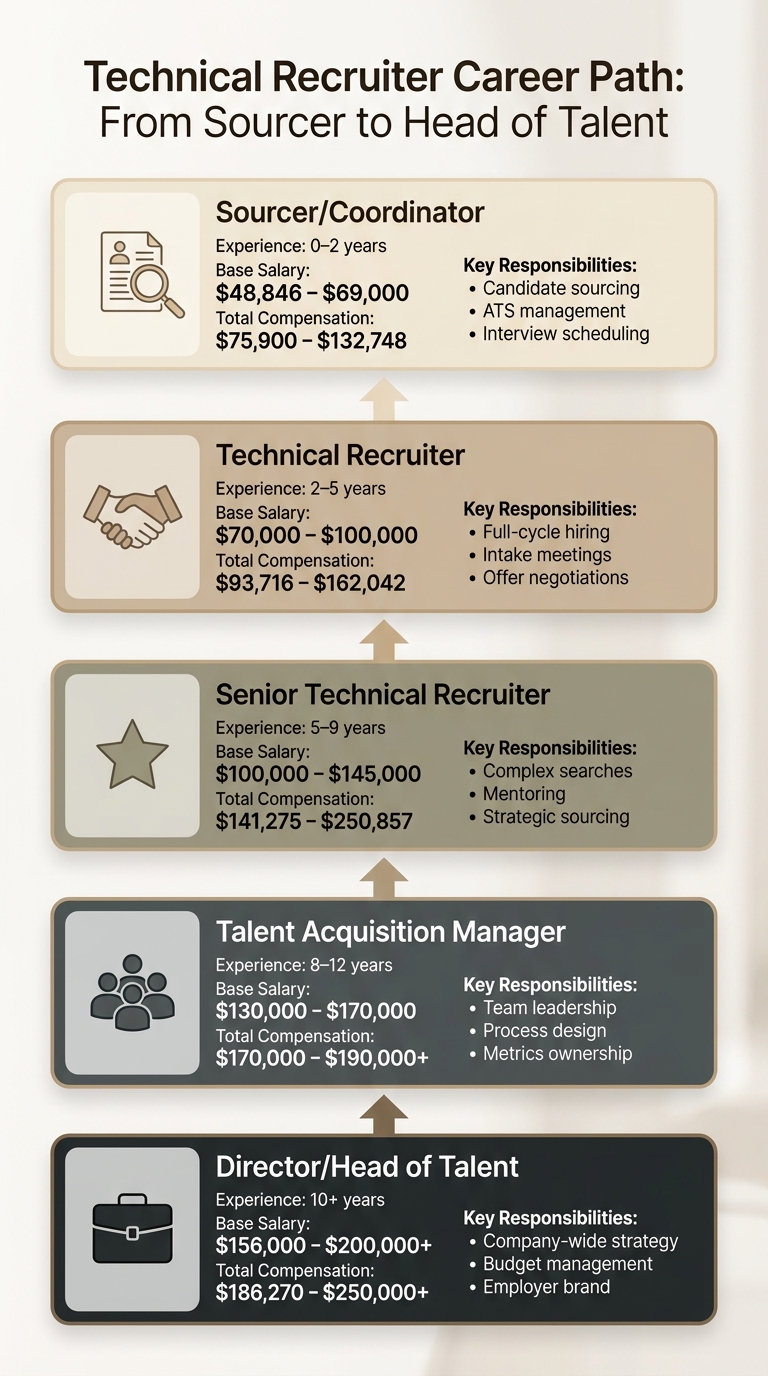 {Technical Recruiter Career Path: Stages, Salaries, and Responsibilities}
A career in technical recruiting typically unfolds across five stages, each bringing greater responsibilities and earning potential. Moving from sourcer to head of talent requires not just experience but also a growing mastery of AI-driven tools and specialized skills. This journey reflects a steady climb in technical, managerial, and strategic expertise - key ingredients for success in tech recruitment.
Entry-Level: Sourcer and Recruiting Coordinator
Starting out, your focus is on mastering the basics: sourcing candidates, managing applicant tracking systems (ATS), and coordinating interview schedules. This is where you get familiar with technical jargon - like understanding the difference between DevOps and Site Reliability Engineers or why some companies lean toward React instead of Angular.
In these early years, developing a disciplined approach to processes and building technical knowledge is critical. Tracking metrics like screen-to-interview ratios can highlight your progress and set the stage for the next step in your career.
Mid-Level: Technical Recruiter
With 2–5 years of experience, you take on full-cycle recruiting. This includes everything from conducting intake meetings with engineering managers to technical screenings and offer negotiations. At this stage, you're not just filling roles - you’re evaluating candidates for their fit and guiding them through the entire hiring process.
The financial jump from mid-level (around $73,000) to senior-level (around $112,000) can be substantial, often requiring 2–4 years of consistently strong performance to achieve .
Advanced: Senior Technical Recruiter
As a senior recruiter, you handle searches for high-level roles like Principal Engineers, VP positions, and emerging fields such as AI and machine learning. Alongside managing these complex searches, you mentor junior recruiters, craft new sourcing strategies, and provide guidance to engineering leadership.
This stage demands ongoing learning to stay ahead in niche areas and adapt to shifting business needs. The skills acquired here often pave the way for a transition into management roles.
Leadership: Talent Acquisition Manager
After 8–12 years, you may step into a management role, leveraging your technical and strategic insights to lead a team. Your focus shifts from individual hires to overseeing team performance, setting hiring goals, and streamlining processes. Metrics like time-to-fill and offer acceptance rates become central to your success.
Although your primary role is leadership, many managers still handle a few critical searches. Success here is measured by how well you optimize team productivity and improve department-wide outcomes.
Executive: Director/Head of Talent
With over a decade of experience, you take on the responsibility of shaping the company’s overall talent strategy. This executive role involves managing budgets, enhancing the employer brand, aligning with senior leadership, and planning workforce strategies for the long term. Your focus expands from individual hires to building the systems and processes that attract and retain top talent organization-wide.
Key responsibilities include presenting hiring strategies to the board, negotiating vendor contracts, and making high-stakes decisions. Some professionals in this stage explore alternative paths, such as Recruiting Operations or Talent Intelligence, or even independent consulting, where top earners can make $1 million or more annually .
Here’s a quick breakdown of the career stages:
| Career Stage | Experience | Base Salary Range | Total Compensation | Primary Responsibilities |
|---|---|---|---|---|
| Sourcer/Coordinator | 0–2 years | $48,846 – $69,000 | $75,900 – $132,748 | Candidate sourcing, ATS management, interview scheduling |
| Technical Recruiter | 2–5 years | $70,000 – $100,000 | $93,716 – $162,042 | Full-cycle hiring, intake meetings, offer negotiations |
| Senior Technical Recruiter | 5–9 years | $100,000 – $145,000 | $141,275 – $250,857 | Complex searches, mentoring, strategic sourcing |
| TA Manager | 8–12 years | $130,000 – $170,000 | $170,000 – $190,000+ | Team leadership, process design, metrics ownership |
| Director/Head of Talent | 10+ years | $156,000 – $200,000+ | $186,270 – $250,000+ | Company-wide strategy, budget, employer brand |
Skills Needed for Career Growth
Advancing in technical recruiting requires developing skills that add value at every stage of the hiring process. These skills are key to transitioning from hands-on recruiting roles to positions of strategic leadership.
Technical Knowledge and Industry Understanding
Having a solid grasp of how technology works can transform a recruiter from being competent to becoming a trusted advisor. While you don't need to write code, understanding concepts like backends, databases, and tools such as Kubernetes goes a long way. This is about moving beyond surface-level knowledge and buzzwords.
Why does this matter? Miscommunication between recruiters and hiring managers can drag out the hiring process. When you can differentiate between roles like DevOps engineers and Site Reliability Engineers or explain why a team might use SQL over NoSQL, you earn credibility with both candidates and hiring teams.
"The shift from good recruiter to trusted technical partner often comes down to how you frame your questions. Asking 'Do you have experience with microservices?' gets you a yes-or-no answer. Asking 'What problems did microservices solve for you... and what challenges did they create?' gets you a real answer." - Andrew Stetsenko, HR-tech entrepreneur
Practical steps to deepen your technical understanding include:
- Building a small project, like a basic website with React or a Python script, to learn concepts like APIs and deployment.
- Observing technical interviews to see how engineers evaluate candidates.
- Setting up a GitHub account to understand version control.
- Using tools like GlossaryTech to clarify technical jargon in real time .
With 81% of employers shifting toward skills-based hiring in 2024 , it's becoming increasingly important to evaluate candidates on their actual work. Reviewing GitHub pull requests, Stack Overflow contributions, and conference talks can help verify skills. Debriefing with hiring managers can also highlight the traits of top candidates .
A strong technical foundation not only improves your credibility but also strengthens relationships with both candidates and hiring managers.
Building Relationships and Trust
Strong relationships are often the key to converting passive candidates who might otherwise ignore your messages. Technical professionals are frequently overwhelmed with recruiter outreach, so showing genuine curiosity and following through consistently can set you apart . The benefits of building these connections are clear: hiring candidates whose values align with company culture has been shown to increase productivity by 23% and reduce attrition by 51% .
Career growth often hinges on moving from being an "order taker" to becoming a consultative partner . This involves influencing hiring managers, understanding candidates' motivations through deeper conversations, and navigating complex situations like counteroffers .
Here are some ways to strengthen relationships:
- Personalize outreach by referencing candidates' open-source contributions or career transitions.
- Maintain a talent pipeline for future roles instead of only reaching out when a position opens .
- Shadow technical teams during intake calls to learn their language and challenges.
- Seek mentorship from experienced technical recruiting leaders for insights into the strategic aspects of the role .
These strategies not only enhance your relationship-building skills but also prepare you for the management and planning responsibilities that come with leadership roles.
Management and Planning Skills
As you step into leadership, your focus shifts from execution to strategy. Instead of simply filling roles, you'll design interview processes, create sourcing frameworks, and use AI tools to streamline workflows. Leadership also involves managing team productivity, coaching junior recruiters, and driving internal training initiatives.
The numbers highlight why these skills are critical. For example, interview hours per hire and applications per hire have risen by approximately 182% . Tackling these challenges requires data-driven decision-making - everything from analyzing recruitment success metrics to managing recruiting budgets effectively.
To build these skills, consider:
- Volunteering for leadership roles within recruitment initiatives to gain managerial experience.
- Shadowing engineering leaders during intake calls to understand their priorities.
- Learning recruitment analytics to evaluate sourcing effectiveness and presenting insights to stakeholders .
- Pursuing certifications like the AIRS Certified Technical Recruiter (CTR), which costs $795 and formalizes expertise in IT role taxonomy and advanced sourcing .
With 51% of organizations now using AI in recruiting and recruiters saving about one workday per week with generative AI tools, mastering these technologies is becoming essential. Managing high-volume requisitions - often 26 or more at a time - while setting realistic hiring targets is what separates effective leaders from those who feel overwhelmed .
Tools and Resources for Career Development
Having the right certifications, platforms, and learning tools can fast-track your journey from entry-level sourcing to leadership positions. These resources not only validate your skills but also deepen your technical knowledge and improve how you connect with top developers.
Certifications and Training Programs
If you're looking to specialize in technical recruiting, the AIRS Certified Technical Recruiter (CTR) is a well-regarded certification . Did you know that technical recruiters who can "speak engineer" typically earn 30% more than their generalist peers ? Alongside the CTR, certifications like the AIRS Certified AI and Sourcing Recruiter (CASR) and AIRS Certified Internet Recruiter (CIR) focus on IT role frameworks, AI-driven processes, and advanced sourcing techniques. These certifications range from $795 to $895 .
For those stepping into broader HR or leadership roles, the SHRM-CP certification offers industry-wide recognition and comes in at $495–$595 . If you're just starting out, platforms like LinkedIn Learning and Coursera provide foundational courses, such as the ADP AIRS Entry-Level Recruiter Certificate, which can prepare you for more advanced credentials .
Beyond certifications, leveraging the right recruiting tools is key to staying efficient and effective.
Recruiting Platforms and Software
When it comes to recruiting platforms, LinkedIn Recruiter is a staple for many professionals. For tech-specific sourcing, platforms like GitHub and Stack Overflow are invaluable. These tools allow you to evaluate developers based on their code contributions and community involvement, revealing their skills in action - something a resume can't always show .
Data-driven platforms that aggregate profiles from sources like GitHub, Stack Overflow, and patent databases can help you identify candidates with unmatched precision. AI-powered tools are also transforming the hiring process, with some teams reporting up to an 82% improvement in time-to-hire .
For a more personal touch, daily.dev Recruiter facilitates warm, opt-in introductions to pre-qualified developers, ensuring that every connection is meaningful. On the pipeline management side, tools like Greenhouse offer advanced analytics, Lever provides CRM-style relationship management, and iCIMS is ideal for handling large-scale recruitment . Meanwhile, tools like Calendly and Zoom make scheduling easier, and ChatGPT can even help generate complex Boolean search strings, potentially saving recruiters an entire workday each week .
These platforms are most effective when paired with ongoing learning and community engagement.
Learning Resources and Communities
Once you've streamlined your sourcing methods, it's time to sharpen your industry knowledge. Platforms like freeCodeCamp and Codecademy can help you understand developer workflows and common challenges . Staying up-to-date on industry trends is also crucial - reading engineering blogs from companies like Stripe and Uber or following tech news on Hacker News and TechCrunch can keep you informed .
Engaging with Slack and Discord communities focused on specific tech stacks can deepen your understanding of how engineers communicate and what they value in employers . Additionally, the Association of Talent Acquisition Professionals (ATAP) is a great network for expanding your professional connections .
For more structured learning, consider Michal Juhas's Tech Recruitment Academy, which offers over 80 sourcing webinar replays and IT-focused training for €197 (one month) or €249 (two months) . As Michal Juhas, the Lead Tech Recruiter and Founder of the academy, puts it:
"When I was the CTO and hired software engineers, I realized very few headhunters and recruiters actually know anything about IT and IT roles. They couldn't help me hire the right IT candidates."
You can also explore platforms like Coursera, LinkedIn Learning, and Udemy for courses on recruitment strategies and emerging technologies. Interestingly, LinkedIn Learning has seen a 2.3× growth in talent acquisition professionals developing AI skills over the past year .
Common Challenges and Career Options
Solving Common Problems
As you move through your career in technical recruiting - from entry-level roles to leadership positions - the challenges you face will shift and grow. At the entry level, sourcers and coordinators often struggle with what's known as the "vocabulary gap." This includes understanding the differences between technologies like React and Angular or clearly defining roles such as Principal Engineer . Instead of pretending to know everything, it's better to ask clarifying questions to ensure accuracy in communication. To build credibility and improve your technical knowledge, try observing technical interviews or reading blogs from companies like Stripe or Uber . Starting with simpler roles, like QA or IT support, can help you gain confidence and knowledge before tackling more complex areas like Software Engineering or Cybersecurity .
For mid-level technical recruiters, the challenges often revolve around balancing supply and demand while sourcing candidates for technical roles under a heavy workload. You might find yourself handling 20–25 or more open roles at a time, especially in a tight talent market . On average, it takes 52 days to fill technical positions, compared to 41 days for non-technical roles . Using AI-powered tools to scan profiles and personalize outreach can significantly improve response rates - from a typical 5% to as high as 48% .
Senior recruiters and leaders face a different set of issues, such as meeting individual hiring goals while mentoring junior team members and filling niche positions like VP of Engineering . Leadership roles also come with broader responsibilities, including managing team productivity, overseeing budgets, and coordinating across global time zones . The key to success at this level is treating technical literacy as an ongoing process, not a one-time task .
Tackling these challenges not only sharpens your recruiting skills but also sets the stage for exploring a variety of career paths.
Alternative Career Directions
A career in technical recruiting can lead to a range of opportunities both within and beyond the talent acquisition field. If you want to stay in recruiting, you could specialize in areas like Technical Sourcing, Employer Branding, Recruiting Operations, or Talent Intelligence. If you're looking to branch out, roles in HR, People Operations, Sales, Account Management, or Project Management are natural next steps . Many recruiters transition into Sales or Account Management because the skills overlap - both require strong negotiation and relationship-building abilities .
Another growing trend is moving into independent consulting. Experienced recruiters, especially top performers at tech-focused firms, can earn over $200,000 annually through commissions in this space .
The skills you develop as a recruiter - like negotiation, data analysis, technical knowledge, and building relationships - are highly transferable . To make a smooth transition into a new role, consider shadowing colleagues in other departments, learning basic programming, or earning certifications like the AIRS Certified Technical Recruiter (CTR) for $795 or the SHRM-CP, which costs $495–$595 . These steps can help formalize your expertise and open new doors.
Conclusion
Advancing from a sourcer to a Head of Talent is a journey that thrives on continuous growth and adaptability. Building a career in technical recruiting means embracing lifelong learning, cultivating meaningful relationships, and staying ahead of the curve with the latest tools and strategies. Skills like technical fluency, AI tool expertise, and strategic thinking aren't just milestones - they're ongoing commitments.
Tools like daily.dev Recruiter can be game-changers, helping you connect with pre-qualified developers more effectively. By improving response rates and fostering genuine relationships, these tools can significantly boost your progress toward becoming a leader in tech recruitment.
No matter where you are in your career - whether just starting out or aiming for a senior role - focus on the skills that matter most at each stage. Earning certifications such as the AIRS Certified Talent Recruiter (CTR) for $795 or the SHRM-CP for $495–$595 can validate your expertise and set you apart . Actively engage in developer communities, observe technical interviews, and treat every position as a stepping stone for growth. These practical steps align with the strategies discussed earlier, providing a clear roadmap for success. While the path from sourcer to Head of Talent may be demanding, deliberate effort and the right resources can make it attainable.
FAQs
How technical do I need to be to recruit engineers?
To excel as a technical recruiter, you don’t need to be a coding expert, but having a good grasp of technical concepts and staying updated on industry trends is crucial. Understanding roles like software engineering or data science allows you to connect better with both candidates and hiring managers. By learning the basics of key skills, technologies, and industry jargon, you can streamline your sourcing and screening process while positioning yourself for growth in this field.
What should I do to move from recruiter to TA manager?
To move from a recruiter role to a Talent Acquisition (TA) manager position, you'll need to focus on developing leadership abilities, expanding your knowledge of recruitment strategies, and mastering the art of strategic talent acquisition. This transition involves taking on responsibilities like managing recruitment teams, creating employer branding initiatives, and overseeing the overall hiring process.
Building strong relationships with hiring managers is crucial, as is showcasing your ability to lead teams and create effective hiring plans. To succeed, prioritize leadership development and gain a thorough understanding of every stage in the recruitment lifecycle. These skills and experiences will position you for growth into a TA manager role.
Which certification is most worth it for tech recruiting?
The "Strategic Talent Acquisition" certification offers a strong advantage for tech recruiters. It emphasizes hiring practices that align closely with business goals while also helping professionals advance their careers. Certifications from organizations like AIHR can further boost your skills and enhance your reputation in HR and recruiting. These credentials are particularly useful for gaining specialized knowledge in tech recruitment.


