

90-day ramp for new tech sourcers: learn developer stacks, master sourcing tools, personalize outreach, and own hiring metrics.
Hiring a technical sourcer can be expensive, and early turnover makes it worse. A structured 90-day onboarding plan helps reduce ramp time, improve retention, and boost productivity. Here’s a breakdown of the plan:
Days 1-30: Learn and integrate
- Understand the developer ecosystem (tech stacks, tools, and roles).
- Learn company-specific products, hiring needs, and tools like ATS and GitHub.
- Build relationships with hiring managers and peers.
Days 31-60: Execute and contribute
- Start sourcing actively using diverse developer sourcing channels (GitHub, Stack Overflow, Kaggle).
- Personalize outreach messages and manage candidate pipelines.
- Use feedback from hiring managers to refine processes.
Days 61-90: Take ownership
- Independently manage roles and regions.
- Build long-term candidate relationships and improve sourcing workflows.
- Share knowledge with the team and measure performance against benchmarks.
Why it matters: Companies with structured onboarding see 82% higher retention and 70% greater productivity. This phased approach ensures new sourcers succeed quickly and effectively.
::: @figure 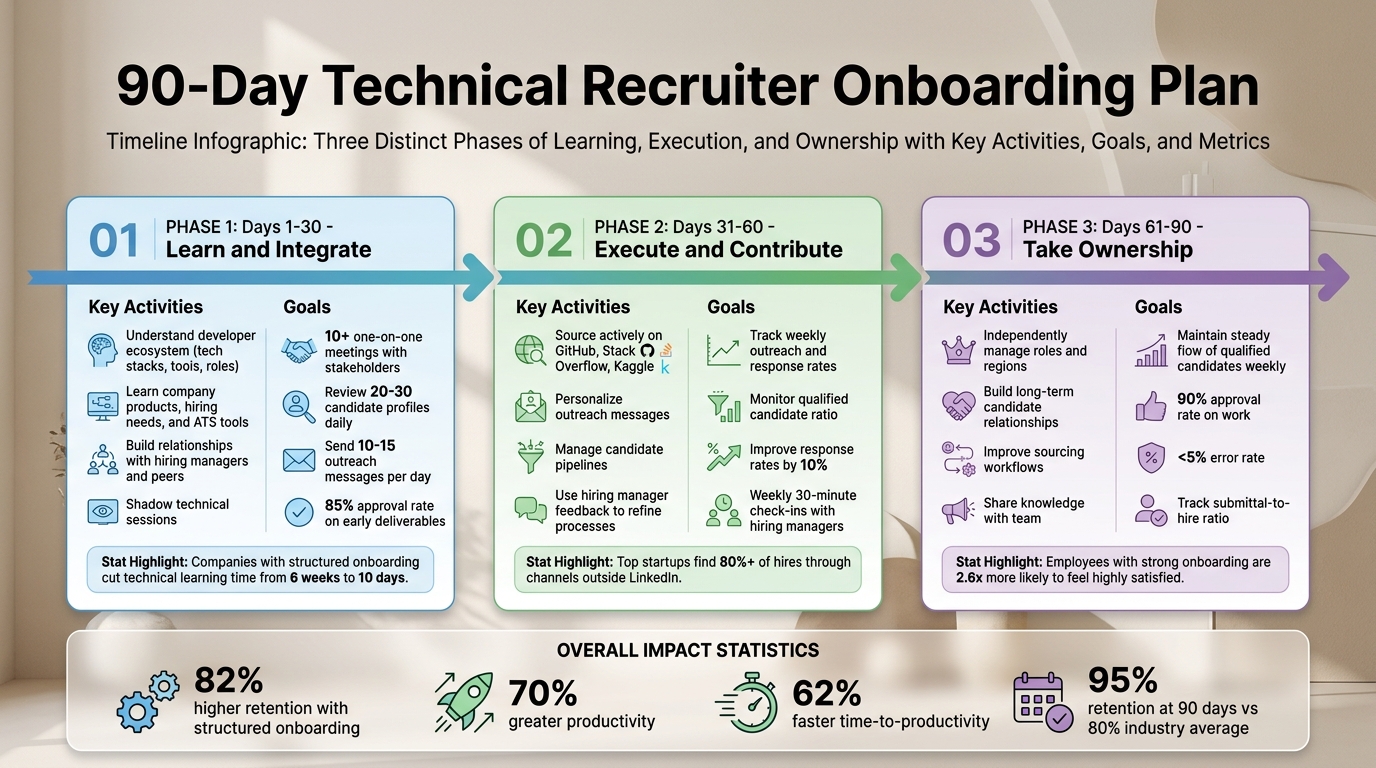 {90-Day Technical Recruiter Onboarding Timeline with Key Milestones and Metrics}
Days 1-30: Learning the Basics
The first month is all about laying the groundwork. Skipping this phase can lead to months of playing catch-up, so it’s crucial to focus on understanding the fundamentals. This initial effort will set you up for success in sourcing.
Learning the Developer Ecosystem
To succeed in technical recruiting, you need to understand how developers operate. Start by familiarizing yourself with the tech stack - the programming languages, frameworks, databases, and tools your company uses. Review architecture diagrams and system overviews to see how everything fits together. Dig into team glossaries to grasp terms like "microservices", "CI/CD pipelines", and "pull requests."
Shadowing technical sessions is a game-changer. Watch developers walk through code or discuss system architecture to understand what’s important when reviewing candidate profiles. Companies with structured onboarding programs often cut technical learning time from six weeks to just 10 days .
"New developers must understand component interactions before writing code. This foundation prevents architectural mistakes that create technical debt later." - Full Scale
Make sure you can differentiate between frontend, backend, and DevOps roles. Each requires a distinct skill set, and knowing these differences ensures you don’t send mismatched candidates. By the middle of the month, aim to identify the core libraries your company’s primary product relies on.
Once you have a handle on the broader developer landscape, it’s time to dive into the specifics of your company.
Learning Company-Specific Information
Understanding your company’s product, market position, and hiring needs is essential. Spend time with product managers to learn what the engineering team builds and why it’s important. Review past job descriptions and analyze successful hires to spot patterns in skills, experience, and team compatibility.
Manager involvement can make a big difference. New hires are 3.4 times more likely to report a great onboarding experience when their manager is actively engaged . Schedule weekly check-ins with your manager to address challenges and align on priorities.
Pairing up with a peer "buddy" is another effective strategy. Research shows that 56% of new employees feel they become productive faster when they have an onboarding buddy . This relationship offers a judgment-free zone to ask questions and learn undocumented tips.
Armed with industry insights and company knowledge, you’re ready to tackle auditing your tech hiring stack.
Getting Started with Sourcing Tools and Platforms
Mastering sourcing tools can save time and eliminate inefficiencies. Start with your company’s Applicant Tracking System (ATS) - whether it’s Greenhouse, Lever, or Workday. Learn how to log candidates, track their progress, and generate reports. This is non-negotiable for staying organized.
Next, dive into developer-specific platforms. GitHub is invaluable for assessing real-world coding activity through commits, pull requests, and repository maintenance. Stack Overflow can reveal a candidate’s problem-solving skills based on their Q&A history.
For outreach, explore daily.dev Recruiter. Unlike cold emails, this platform uses a double opt-in process, meaning developers have already expressed interest in connecting. This boosts response rates and minimizes wasted effort on uninterested candidates.
Integrate these tools with your ATS early on to automate tracking. Manual data entry slows you down and increases the risk of losing promising candidates.
Connecting with Hiring Managers
Your relationship with hiring managers directly impacts your sourcing success. Schedule intake meetings for every open role to go beyond the job description. Ask about team dynamics, project challenges, and qualities that made past hires successful. These insights help you find candidates who thrive, not just meet the basics.
Sitting in on interviews during your first month is another great way to learn. Observe how hiring managers evaluate candidates and note the questions they ask and the traits they value.
"Start by understanding your people, processes, and pain points. Shadow recruiters, review processes, sit in on intake meetings." - Alyssa Terrizzano, CEO, Pierpoint
Build trust early by asking clarifying questions rather than sending unsuitable candidates. Hiring managers appreciate sourcers who take the time to understand their needs.
Setting First-Month Goals and Metrics
In your first month, focus on learning metrics instead of performance metrics. Track how many candidate profiles you review daily (aim for 20-30), how many outreach messages you send (start with 10-15 per day), and your initial response rates (expect 5-10%).
Set SMART goals: specific, measurable, achievable, relevant, and time-bound. For example: "Identify all core libraries used in the primary product by day 15" or "Complete three intake meetings with hiring managers by day 20" . These goals give you clear markers of progress.
Document everything you learn in a personal knowledge base. Include common tech stack combinations, effective outreach templates, and hiring manager preferences. This resource will be invaluable as you move into active sourcing in the second month.
Identify and address small bottlenecks in processes or workflows to build momentum. These quick wins show your value while you’re still getting up to speed. By the end of the month, you should feel confident navigating internal systems and discussing role requirements with candidates.
Days 31-60: Starting Active Sourcing
The second month marks your shift from observing to actively executing. This phase is all about building strong pipelines, fine-tuning your messaging strategies, and using real-time feedback to improve your results.
Choosing Sourcing Channels and Strategies
If you're relying solely on LinkedIn, you're competing with countless recruiters reaching out to the same talent pool. In fact, top startups find over 80% of hires through channels outside of LinkedIn . This month, focus on diversifying your sourcing efforts to find talent without overspending.
Start with GitHub, which boasts over 100 million developer profiles . Narrow your search by programming languages (like Python, Go, or Rust) and review contribution graphs to gauge activity. Another excellent option is Stack Overflow, home to 20 million profiles where reputation scores highlight problem-solving skills .
For specialized roles, explore niche platforms. Kaggle is perfect for data science positions, offering competition rankings as proof of expertise. AngelList (Wellfound) attracts professionals interested in startups, equity, and fast-paced environments . Professional groups like IEEE can also connect you with seasoned engineers who may not frequent mainstream platforms.
Employee referrals are another goldmine, delivering candidates with a 25% higher profit impact . Tap into your team's network by asking engineers about colleagues they know or have met at industry events. These warm introductions often lead to better engagement and retention.
When using high-volume platforms like Indeed, filter for candidates marked as "Recently Active" (within the last 72 hours) to boost response rates. Additionally, tools like daily.dev Recruiter offer a double opt-in system, ensuring you’re reaching developers who have already expressed interest in recruiter outreach.
Writing Better Outreach Messages
Once you've diversified your channels, it's time to focus on crafting effective outreach messages. Generic emails won’t cut through the noise developers face daily. Personalization is key.
Reference specific contributions, such as a GitHub repository, pull request, or a well-regarded Stack Overflow answer. Showing that you've taken the time to research their work makes your message stand out.
"Part of being effective engineering recruiting is building the brand around your engineering efforts that make folks excited to join."
- Will Larson, CTO and Author
Leverage your company's engineering content as a conversation starter. Mention technical blogs, conference talks, or open-source projects that align with the candidate's expertise.
Shadowing senior recruiters during closing calls can also offer valuable insights. Pay attention to how they communicate your company’s mission and technical challenges. Use these learnings to refine your messaging and highlight the aspects that resonate most with candidates.
Your messages should be concise - three to four sentences are enough. Explain why you’re reaching out, emphasize a key role or benefit, and end with a clear call to action. If your LinkedIn InMail response rates fall below the typical 20%-40% range , experiment with subject lines, opening sentences, and calls to action. A/B testing can help you identify what works best.
Managing Pipelines and Qualifying Candidates
Without structure, even promising leads can get lost. Use your ATS to document every interaction and establish defined stages, from Identified to Qualified. If candidates are stalling at the "Contacted" stage, revisit your messaging to identify potential issues.
Qualifying candidates goes beyond matching their resumes to job descriptions. Ask questions to uncover their motivations and preferences: What do they want to learn? What challenges are they facing? What type of team environment helps them thrive? These insights help you assess both their fit for the role and their potential for long-term success.
"You want recruits who not only have the requisite experience but also exhibit the behaviors necessary to excel consistently."
- Jay Forte, Career Coach
Prioritize quality over quantity. Instead of submitting a high volume of average candidates, focus on presenting a select few who meet both technical and team requirements. This sets the foundation for meaningful feedback from hiring managers.
Using Feedback from Hiring Managers
The best sourcers actively seek feedback. Don’t wait for formal reviews - schedule weekly 30-minute check-ins with hiring managers to discuss pipeline health and candidate quality .
Ask direct questions: Did the candidate’s experience align with expectations? What stood out during the screening process? Use this feedback to refine your sourcing criteria and address any workflow bottlenecks. For example, if candidates are dropping out due to delays, work with your manager to speed up processes.
Treat your 30-60-90 day plan as a dynamic document. Adjust your approach based on feedback - whether that’s targeting candidates at a different seniority level or emphasizing particular technical skills. Organizations that embrace continuous feedback loops see 14.9% lower turnover rates .
Increasing Performance Targets
With refined outreach and better candidate management, focus on scaling your efforts while maintaining quality. Track response rates and aim to improve them by 10% over the next 30 days through more personalized messaging.
Set SMART goals - Specific, Measurable, Achievable, Relevant, and Time-bound - to guide your progress. For instance, you could aim to submit five qualified backend engineers for the payments team by day 60.
Document your progress, noting which sourcing channels and outreach strategies yield the best results. Incorporate hiring manager feedback to create a knowledge base that supports your long-term success.
Days 61-90: Working Independently
By day 61, it's time to take full ownership of your roles or regions. This phase is all about managing hiring needs independently, stepping up without constant oversight, and making meaningful contributions to the team's long-term goals.
Taking Ownership of Roles and Regions
Taking charge means you're now managing key hiring responsibilities with minimal guidance. You should be capable of handling an entire role - starting from sourcing all the way to candidate submission - without needing frequent approvals. For example, you might oversee all backend engineering searches for the payments team or manage sourcing efforts for the East Coast region.
Break each role into manageable tasks, set realistic timelines, and communicate any roadblocks immediately. For instance, if a hiring manager changes their requirements mid-search, flag it right away and adjust your approach. Keeping a "wins" document can be a game-changer, helping you track achievements like the number of candidates moved to interviews or successful hires in your area .
This level of autonomy also allows you to build stronger, more meaningful connections with candidates.
Building Deeper Candidate Relationships
Not every great candidate is ready to make a move right away. Some may be tied up with ongoing projects or waiting to see how the company evolves. Taking the time to nurture these relationships can create a talent network that benefits you long after your first 90 days.
Stay connected with high-potential candidates who aren't ready to interview yet. Share relevant blog posts, invite them to virtual events, or touch base periodically to discuss their career goals. Use your ATS to document these interactions - include notes about their interests, timelines, and follow-up plans. This ensures continuity, whether you or another recruiter picks up the relationship later.
As you strengthen your talent network, it's also a great time to fine-tune your sourcing methods.
Improving Sourcing Processes
With a fresh set of eyes, take a closer look at your sourcing results and compare them to team KPIs. Identify areas where the funnel slows and cut time-to-fill by addressing low response rates or weak screen-to-submittal ratios .
Pinpoint repetitive tasks that could be automated. Are you constantly reusing the same outreach templates? Is your pipeline tracking still stuck in spreadsheets? Introducing scripts or workflow tools can speed things up and improve accuracy .
Update any outdated sourcing documentation with your learnings. For instance, if you've found a new sourcing string for Rust developers or an outreach strategy that increased response rates by 10%, make sure the team has access to it .
"Intellectual curiosity is a key attribute of any good employee - it fuels self-directed learning, innovation, and process improvement."
- Carol Anderson
Sharing Knowledge with the Team
As you near full productivity, start giving back to the team. Host a "brown-bag" session on a niche platform you've mastered, like Kaggle for data science roles. Record a step-by-step guide for your most effective sourcing strategy, or help newer team members refine their outreach messages by sharing feedback from hiring managers .
This kind of collaboration strengthens the team as a whole. Companies that prioritize knowledge sharing see lower turnover rates - 14.9% lower, to be exact - thanks to continuous feedback loops .
While sharing insights, keep assessing your own progress to ensure you're meeting expectations.
Measuring Performance Against Benchmarks
At the 90-day mark, it's crucial to measure your performance against established benchmarks. Compare your activity metrics (like outreach volume and response rates) and quality metrics (such as submittal-to-hire ratios and hiring manager satisfaction) to team standards.
Schedule a formal review that includes both self-assessment and feedback from hiring managers and peers. This 360-degree feedback approach helps align your work with team expectations . Use the insights from this review to set goals for the next quarter, such as mastering a specific technical system or mentoring a new hire .
Research shows that employees who experience strong onboarding are 2.6 times more likely to feel extremely satisfied with their workplace . By meeting your 90-day benchmarks, you're not just proving your abilities - you’re laying the groundwork for long-term success as a technical recruiter. These benchmarks act as both a measure of your progress and a roadmap for continued growth.
Performance Metrics for the 90-Day Plan
This 90-day plan comes with a set of metrics designed to keep your progress on track and measurable. By aligning these metrics with each phase of your ramp-up, you can ensure steady progress toward full productivity. Keeping an eye on these markers helps spot potential gaps early, giving you the chance to adjust and refine your approach.
Activity Metrics
Activity metrics focus on your efforts and outreach. In the first 30 days, prioritize building relationships with key stakeholders. Your goal? At least 10 one-on-one meetings with hiring managers and cross-functional partners. Moving into the 31–60 day range, shift your attention to outreach metrics: track the number of candidates you contact weekly and monitor response rates.
By the final stage (days 61–90), aim to maintain a steady flow of qualified candidates each week. For technical roles, structured onboarding has been shown to speed up time-to-productivity by 62%, helping companies improve sourcing efficiency .
Quality Metrics
Quality metrics ensure you're not just increasing the quantity of candidates but identifying the right ones. During the first 30 days, focus on achieving an 85% approval rate on your early deliverables, such as candidate profiles or outreach messages . As you move into the 31–60 day period, start tracking the percentage of candidates who advance to interviews (your qualified candidate ratio) and gather feedback from hiring managers.
By the 61–90 day phase, aim for a 90% approval rate on your work, while keeping errors below 5%. Additionally, monitor your submittal-to-hire ratio and any improvements in time-to-hire .
Engagement and Retention Metrics
Engagement metrics reflect the strength of your candidate relationships and the health of your talent pipeline. Keep an eye on how many candidates stay engaged through multiple interactions, and track your offer acceptance rates to see if you're setting the right expectations during outreach.
It's also important to monitor your own engagement. Research shows employees with strong onboarding experiences are 2.6 times more likely to feel highly satisfied with their workplace . Companies with structured onboarding report retention rates of 95% at 90 days and 87% at one year, compared to industry averages of 80% and 65%, respectively . If you find yourself feeling disconnected or unclear about expectations at the 30- or 60-day mark, speak up immediately to address potential issues . By staying proactive and using these metrics as a guide, you'll be well-prepared to handle independent sourcing challenges.
Tools and Resources for Technical Sourcers
The right tools don't just make your sourcing process faster - they also enhance the quality of your outreach and connections. By combining effective platforms, systems, and frameworks, you can save hours weekly while building stronger relationships with candidates.
Developer-First Platforms
One standout tool is daily.dev Recruiter, which connects you with developers already engaged on the platform. These are warm, double opt-in introductions, meaning the developers have already shown interest in opportunities that align with their preferences. This approach eliminates the need for cold outreach and achieves response rates that traditional methods can't match.
What makes this platform so effective is its ability to meet developers where they naturally spend their time. Instead of bombarding inboxes with generic messages, you're offering opportunities in a trusted environment. This builds trust and helps you see what developers want and what meaningful candidate engagement looks like. To maximize efficiency, integrate advanced CRM tools to ensure a smooth pipeline from the very beginning.
ATS, CRM, and Pipeline Management Tools
Your CRM should be your go-to hub for managing passive talent and fostering long-term relationships. Only transfer candidates to your ATS once they’re actively moving through the interview process. This keeps your pipeline clean and avoids duplicate outreach across your team. By enabling bi-directional synchronization, updates in one system will automatically reflect in the other, saving time and avoiding confusion.
Recruiters who automate data entry between sourcing platforms and their CRM can save up to six hours per week . Browser extensions allow you to quickly import profiles from platforms like GitHub, Stack Overflow, and LinkedIn directly into your pipeline. Another time-saver: set up automated follow-up emails for candidates who made it far in the hiring process but weren’t selected - these "silver medalists" often turn into excellent hires for future roles. Automating these steps ensures an efficient and organized workflow.
Research and Outreach Frameworks
Having the right tools is only half the equation; a solid framework ensures consistency and effectiveness in your outreach. Start by creating a "What Success Looks Like" framework before diving into your search. Define the technical skills, experience, and behavioral traits that align with the role. This framework helps you craft consistent candidate profiles and tailor your outreach to individuals.
Personalization matters. Reference a candidate’s specific contributions - like their GitHub repositories or Stack Overflow answers - to demonstrate that you’ve done your homework. This level of detail significantly improves response rates.
To find developers on less conventional platforms, use advanced Boolean search techniques, such as "site:" or "filetype:". Additionally, implement technical scorecards with clearly defined skills and behavioral criteria to reduce bias during the qualification process. These frameworks not only keep your efforts consistent but also make scaling your sourcing strategy much easier as you progress into later stages.
Conclusion
A well-organized onboarding process isn’t just about ticking boxes - it’s a key driver of long-term success in technical sourcing. By breaking the process into three clear phases - foundation, contribution, and autonomy - you create a roadmap that sets new hires up for success from the very beginning.
The numbers speak for themselves: companies with structured onboarding see a 62% faster time-to-productivity and improve employee retention by over 60%. Employees who go through a standout onboarding experience are 2.6 times more likely to feel highly satisfied with their workplace. And with turnover rates reaching up to 20% in the first 45 days, having a clear and phased plan is not just helpful - it’s essential.
This phased approach thrives because it prioritizes developer-focused strategies at every step. From mastering the nuances of the developer ecosystem early on to building meaningful relationships with candidates later, each stage builds the skills and confidence needed to source top tech talent in a competitive landscape.
Don’t forget the importance of continuous feedback. Regular check-ins, setting SMART goals, and addressing challenges quickly are vital. Organizations that embrace ongoing feedback see turnover rates drop by 14.9%, proving that support beyond the initial onboarding phase is just as critical as the structure itself.
FAQs
What should I learn first to understand my company’s tech stack fast?
To get a clear picture of your company’s tech stack, start by digging into system documentation, version control history, and any in-IDE walkthroughs available. Pay attention to how different components work together and review repository-versioned decisions to understand the reasoning behind past changes. Additionally, identifying your first meaningful pull request and keeping an eye on lead times for changes can give you valuable insights into the codebase and help you gauge progress effectively.
How do I choose the best sourcing channels for each technical role?
To find the best sourcing channels, concentrate on platforms where your ideal candidates are most active. Customize your approach based on the specific skills you're looking for. Leverage specialized tools designed for sourcing developers and expand your reach by incorporating multiple channels, including those powered by AI. Focus on building a well-rounded, multi-channel strategy that matches the technical expertise, industry focus, and engagement habits of your target talent.
What metrics prove I’m on track by day 90?
By the 90-day mark, your focus should be on hitting key metrics like sourcing highly qualified candidates, refining your outreach strategies, and showing increased confidence and autonomy in your role. To measure progress, keep an eye on metrics such as time-to-fill, candidate quality, and outreach response rates. These indicators will help you gauge your performance, ensure you're reaching important milestones, and lay the groundwork for ongoing success.


