.png)


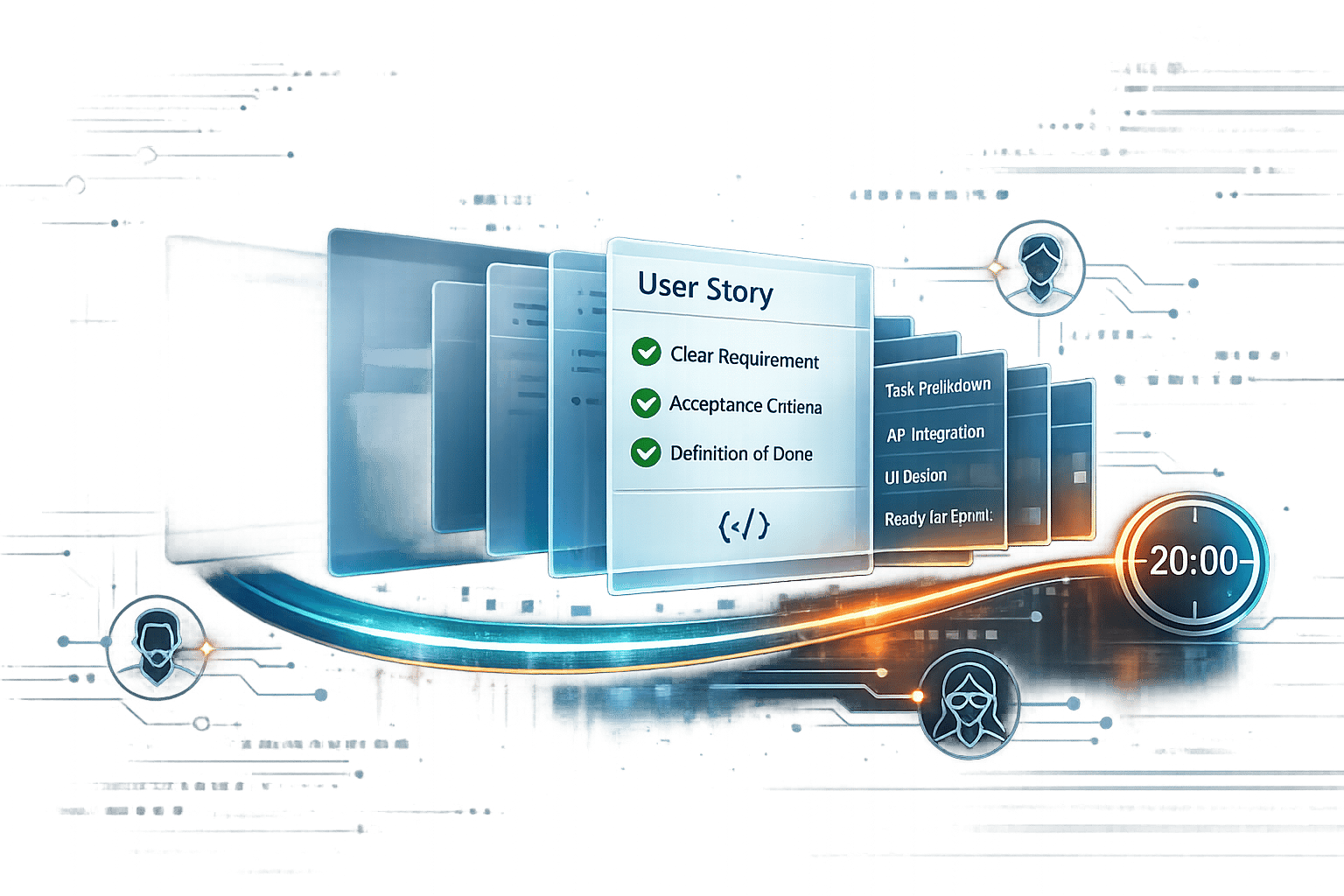



A well-run backlog refinement turns vague ideas into sprint-ready work: timebox sessions, involve the whole team, break stories, and use clear acceptance criteria.
Backlog refinement transforms raw ideas into actionable tasks, ensuring your team is ready for sprint planning. Effective refinement is one of the best sprint planning tips for maintaining velocity. It’s not an official Scrum event, but it’s essential for maintaining a clean, prioritized backlog. Here's what you need to know:
- What It Is: A recurring, timeboxed activity where teams review, clarify, and prioritize backlog items.
- Why It Matters: Speeds up sprint planning (up to 3x faster), reduces defects by 40%, and aligns teams with the product vision.
- Best Practices:
- Timebox sessions (60–90 minutes) and limit discussions to ~10 minutes per item.
- Prepare ahead - clean up the backlog and share agendas 24 hours in advance.
- Involve the whole team for diverse input and alignment.
- Use techniques like breaking down large stories (INVEST criteria) and estimating with story points vs. ideal days.
- Common Mistakes: Avoid over-refining, low team participation, and unclear backlog items.
A well-refined backlog means fewer mid-sprint surprises and smoother development cycles. Focus on collaboration and clarity to keep your backlog actionable.

Backlog Refinement Impact: Key Statistics and Best Practices
Best Practices of Product Backlog Refinement
sbb-itb-bfaad5b
Best Practices for Backlog Refinement
Running productive backlog refinement sessions demands a balance of structure and focus. These sessions help streamline sprint planning and keep the backlog actionable for the team.
Set Time Limits and Schedule Regular Sessions
Structure is key to keeping refinement sessions on track. Setting clear time limits ensures discussions stay focused and productive. Most teams hold these sessions once or twice per sprint, usually mid-sprint to avoid scheduling conflicts. According to the Scrum Guide, no more than 10% of the Development Team's capacity should be spent on refinement activities. Sessions are typically timeboxed to 60–90 minutes. If discussions stretch beyond 90 minutes, it’s often a sign of inefficiency.
"If your sprint planning sessions regularly run over two hours, that's usually a sign your refinement process is broken".
To avoid unnecessary deep dives, limit discussions on each backlog item to 10–15 minutes. Any topic exceeding this timeframe can be added to a "parking lot" for follow-up outside the session.
Prepare Before Each Session
Preparation is the backbone of effective refinement. The Product Owner should dedicate about an hour during the sprint to review and clean up the backlog. This includes removing outdated items, merging duplicates, and discarding anything that no longer fits the product vision. Aligning backlog items with the product roadmap ensures the team focuses on relevant work.
Sharing the agenda and the list of items to be refined at least 24 hours before the session allows team members to review the material in advance.
"Backlog refinement is a continuous process".
For particularly complex stories, consider using the "Three Amigos" approach before the session. This involves the Product Owner, a Developer, and a QA representative conducting a deep dive to clarify technical feasibility and quality requirements. Focus on items likely to be tackled in the next 2–3 sprints, avoiding over-detailing work that isn’t immediately upcoming. A well-prepared agenda helps the entire team contribute meaningfully.
Include the Whole Team
Once the session is planned, engaging the entire team ensures alignment across all roles. Cross-functional participation is critical for creating backlog items that are fully "ready." The Product Owner, Developers, and QA/Testers should collaborate to confirm that items are viable, technically achievable, and meet quality standards. This collective input reduces the risk of mid-sprint surprises.
Encourage open discussion where all team members feel comfortable questioning priorities or raising technical concerns, regardless of their role or seniority. Rotating facilitators for each session can boost team ownership and keep the process fresh.
You can also start sessions with a few minutes of silent brainstorming or 10 minutes of silent reading (sometimes called the "Amazon Technique") to gather unbiased input before diving into discussions. Incorporating estimation methods like Planning Poker or T-shirt sizing ensures every team member provides input on complexity, helping the team achieve a shared "Definition of Ready" for backlog items.
Techniques for Refining Backlog Items
Transforming ideas into clear, actionable backlog items is key to smooth implementation. Building on solid session planning, the following techniques ensure backlog items are well-defined and ready to go.
Add Details Gradually
Take a tiered approach to detailing backlog items, depending on when they’ll be addressed:
- Tier 1 items (next sprint): Include full acceptance criteria, UI/UX mockups, technical details, and resolve any dependencies.
- Tier 2 items (next 2–3 sprints): Provide moderate detail, such as basic acceptance criteria and an initial technical assessment.
- Tier 3 items (longer-term): Capture just enough detail to outline the scope and purpose.
For Tier 1 items, use Gherkin syntax (Given-When-Then) to create testable acceptance criteria. If technical uncertainties arise, consider spike solutions - time-limited research tasks to reduce unknowns before estimating effort. Also, regularly clean up your backlog by archiving or removing items untouched for 3–6 months to avoid unnecessary clutter.
Break Down Large User Stories
If a user story is too big to fit into a single sprint, break it down using the INVEST criteria: Independent, Negotiable, Valuable, Estimable, Small, and Testable. Instead of splitting tasks by technical layers, use vertical slicing to create thin, functional slices that deliver end-to-end value. For related tasks, group them into a single story to maintain that end-to-end functionality.
A Definition of Ready (DoR) checklist can help ensure stories meet minimum standards - like clear acceptance criteria, approved UI/UX mockups, and resolved dependencies - before they’re added to a sprint.
Estimate Effort with Story Points
Story points are a useful way to estimate effort based on complexity and uncertainty, rather than hours. With well-defined backlog items, these estimates become more reliable. Comparing new items to reference stories can further refine accuracy. The Fibonacci sequence (1, 2, 3, 5, 8, 13, 21) is a common choice for story points because its non-linear scale reflects the growing uncertainty of larger tasks.
Keep a library of completed stories with established point values to help calibrate future estimates. Adding confidence ratings (High/Medium/Low) alongside estimates can highlight items that might need to be revisited as more details emerge. Collaborative estimation methods like Planning Poker can boost accuracy, with studies showing up to 40% improvement. Additionally, 73% of Agile practitioners report re-estimating tasks as new information becomes available.
"Product Backlog refinement is the act of adding detail, estimates, and order to items in the Product Backlog. This is an ongoing process in which the Product Owner and the Developers collaborate." - Scrum Guide
Common Mistakes to Avoid
Even well-meaning teams can hit roadblocks during backlog refinement. Being aware of these common missteps can save time and reduce frustration.
Over-Refinement
A frequent issue is over-refining - aiming for absolute certainty when a basic understanding is enough. Mike Cohn, Founder of Mountain Goat Software, explains it well:
"The goal in any refinement session is to reach a point where the team feels confident they can probably complete the item within the iteration. Teams aren't aiming to eliminate all uncertainty".
Focus on refining items for the next 2–3 sprints rather than tasks already in progress. To stay efficient, limit discussion on each item to 10–15 minutes. If unresolved, move the item to a "parking lot" or assign a spike for further research. These practices, combined with proper preparation, help keep the session on track.
Low Team Participation
Balanced input from the entire team is crucial for effective backlog refinement. Problems arise when discussions are dominated by the Product Owner or senior developers. As Jim Schiel from Artisan Agility puts it:
"If the PO delivers an extended monologue that stifles team discussion, that's not refinement - it's a lecture".
Interestingly, research shows a 16-point gap in perception between senior leaders and individual contributors on whether teams share ownership effectively. To encourage collaboration, rotate facilitators and start sessions with a silent brainstorming activity to gather diverse input. Invite quieter team members to speak up, and share backlog items at least 24 hours before the session so everyone can prepare questions and ideas.
Dealing with Unclear Items
Unclear backlog items can derail a sprint. A Definition of Ready (DoR) helps ensure that backlog items meet minimum standards - like having clear acceptance criteria, resolved dependencies, and team-approved estimates - before entering a sprint. The "Three Amigos" approach, which brings together business, technical, and quality perspectives, is another way to catch issues early.
When discrepancies arise during Planning Poker - such as one developer estimating 3 points and another estimating 13 - use these differences to uncover potential complexities. Teams with strong refinement practices report up to a 70% drop in mid-sprint clarification requests. Tackling ambiguities during refinement ensures the backlog is ready for sprint planning.
Conclusion
Backlog refinement isn’t just a one-and-done activity - it’s an ongoing process that transforms rough ideas into clear, actionable tasks. When handled effectively, it can speed up sprint planning by up to three times and cut down on mid-sprint disruptions. The secret lies in making it a team effort, where developers, testers, and the Product Owner collaborate to balance technical feasibility with business goals.
Data supports this approach: it’s recommended that teams have 1.5 to 2 times the amount of work "ready" compared to what they can complete in a single sprint. This buffer helps maintain a steady workflow. As Stefan Wolpers, a Professional Scrum Trainer, explains:
"The end-stage of refinement is a shared understanding of the why, what, how, and probably who, paired with confidence on the Developers' side that they can create the Product Backlog item in question within a single Sprint".
The strategies we’ve covered - from time-boxing sessions to fostering team involvement - all lead to a healthy product backlog. A clear backlog ensures everyone is aligned on what needs to be built and why, helping teams focus on delivering results instead of clarifying tasks mid-sprint.
FAQs
How do we know a backlog item is “ready” for sprint planning?
A backlog item is considered "ready" for sprint planning when it satisfies the SUPER criteria. This means it’s:
- Small enough to be completed within a sprint.
- Understood clearly from both business and technical viewpoints.
- Prioritized according to its importance.
- Estimated with a defined effort or time requirement.
- Includes clear, Refined Acceptance Criteria to define when it’s done.
These factors help the team plan and execute the item with confidence during the sprint.
What should we do when a story is still unclear after refinement?
If a story is still unclear even after refinement, it might be time to take extra steps. You can try breaking it into smaller, more manageable tasks or even consider removing it from the backlog entirely. The goal is to keep the backlog clear, actionable, and ready for development. Prioritize items that are well-defined to maintain efficiency and ensure smooth progress.
How much refinement is too much for our team?
Backlog refinement should use up no more than 10% of the development team's capacity. Spending too much time on it can cause fatigue, overload from constant meetings, or even burnout. The goal is to maintain a steady, manageable pace that improves clarity and prioritization without feeling redundant. Striking this balance keeps the backlog actionable, aligned with sprint objectives, and helps preserve the team's morale and focus.