

Compare contractors and full-time developers by cost, duration, IP, and compliance to choose the right hiring model.
Hiring developers? Here's the crux: contractors excel in short-term, specialized tasks, while full-time employees are better for long-term, core product development. Your decision hinges on factors like project scope, cost, legal compliance, and team needs.
Key takeaways:
- Contractors: Ideal for projects under 6 months, defined scopes (e.g., migrations, audits), and flexible timelines. Rates range from $100–$250/hour, with no benefits or long-term commitment.
- Full-Time Developers: Best for ongoing work, sensitive IP, and institutional knowledge. A $150K salary costs $210K–$225K annually after taxes and benefits.
Quick Comparison:
| Factor | Contractors | Full-Time Developers |
|---|---|---|
| Duration | Short-term (<6 months) | Long-term (>12 months) |
| Cost | $100–$250/hour | $210K–$225K/year (loaded) |
| IP Ownership | Requires explicit agreements | Automatically employer-owned |
| Flexibility | High | Low |
| Knowledge Depth | Limited to deliverables | Deep, ongoing understanding |
Tip: For legal compliance, classify workers correctly (1099 vs. W-2) to avoid costly fines. Contractors fit project-based work, while full-time roles suit ongoing responsibilities. Choose based on your project's duration, scope, and IP needs. Once you decide on a model, you'll need to choose a developer hiring platform that aligns with your specific requirements.
::: @figure 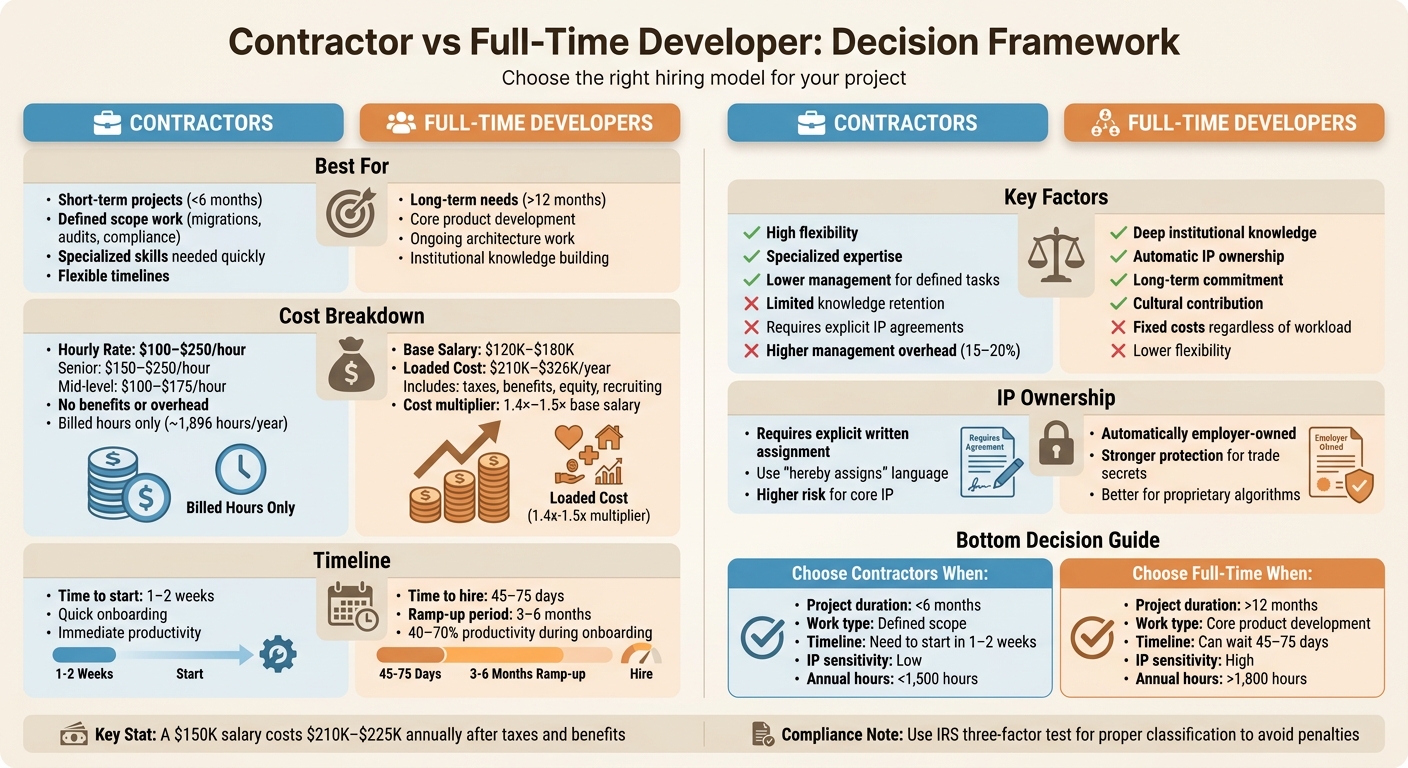 {Contractor vs Full-Time Developer: Complete Comparison Guide}
When to Hire Contractors vs Full-Time Developers
When deciding between contractors and full-time developers, it's essential to weigh factors like project duration, work scope, intellectual property (IP) concerns, and team capacity.
If your project is short-term - lasting less than six months - contractors are often the better choice financially. They can start quickly, typically within 1–2 weeks, compared to the 45–75 days it takes to onboard a full-time hire. This faster start can save $30,000–$60,000 in engineering output . However, for engagements exceeding 12 months, full-time employees generally become more cost-effective when annualized.
The nature of the work is another key consideration. Contractors shine in projects with well-defined scopes, such as database migrations, security audits, SOC 2 compliance, or testing out new technologies like Rust or GraphQL. On the other hand, full-time developers are better suited for core product development, where understanding data models, architectural decisions, and business logic is critical. As one analysis explains:
"Contractors are, by definition, temporary. They are less likely to push back on bad architectural decisions because they will not be around to live with the consequences" .
For projects involving sensitive IP - think trade secrets, proprietary algorithms, or foundational architecture - full-time employees offer stronger protections. By default, IP created by employees belongs to the employer, while contractor-created IP requires explicit assignment through precise legal language. Prasanna Krishna, Founder & CEO of StackMint, highlights the risks:
"For tech startups, the independent contractor model introduces a significant 'cloud on title' regarding intellectual property" .
The availability and cost of contractors also play a role. In 2026, contractors range from ex-staff engineers at Stripe to former tech leads from Figma and senior systems engineers who prefer project-based work for better pay and flexibility . Rates for senior contractors fall between $150–$250 per hour, while mid-level contractors charge $100–$175 per hour . By comparison, a full-time senior developer with a $180,000 salary can cost $273,000–$326,000 in their first year when you account for benefits, equity, and recruiting fees .
Here’s a framework to help guide your decision:
| Factor | Hire a Contractor When... | Hire Full-Time When... |
|---|---|---|
| Duration | Project is under 6 months | Need extends beyond 12 months |
| Work Type | Defined scope (e.g., migration, audit) | Core product development, ongoing architecture |
| Timeline | Need to start in 1–2 weeks | Can wait 45–75 days for the right fit |
| IP Sensitivity | Low; no core algorithms or trade secrets | High; involves proprietary technology |
| Knowledge Transfer | Context can be documented and handed off | Deep institutional knowledge is critical |
| Team Capacity | Team can provide code reviews and guidance | Need mentorship and cultural contributions |
This framework helps clarify when to choose contractors versus full-time developers, setting the stage for technical hiring best practices and a deeper dive into costs and legal considerations in the following sections.
True Cost Comparison: Contractor Rates vs Full-Time Salaries
Let’s dive deeper into the financial realities of hiring full-time developers versus contractors. It’s easy to misjudge the costs involved - many underestimate the full cost of salaried employees while overestimating contractor expenses.
Take a $150,000 annual salary, for example. Once you add payroll taxes (like Social Security, Medicare, and unemployment insurance), health insurance, 401(k) matching, paid time off, and a typical 5% bonus, the total cost balloons to nearly $159,000. In fact, employers often face a 1.4× to 1.5× multiplier on the base salary to cover these extras.
Now let’s look at contractors. At first glance, their rates might seem steep - a contractor charging $85 per hour may appear more expensive than a salaried developer. But contractors only bill for productive hours. Instead of working the standard 2,080 hours per year, contractors typically bill for about 1,896 hours annually, factoring in roughly 23 unpaid days off. At $85 per hour, that totals $161,160 annually before overtime. Adding an average of 3.5 hours of overtime per week brings the total contractor cost to approximately $178,110 per year.
Nick Nordin from BridgeView IT puts it succinctly:
"While full-time employees might often work over 50 hours a week without extra compensation, contractors get paid for every hour worked."
Beyond direct compensation, other factors shape the cost equation. For ongoing work exceeding 30 hours per week, hiring full-time often becomes more cost-effective. However, each model comes with hidden costs. Full-time developers usually take 3–6 months to reach full productivity, operating at only 40–70% capacity during that time. Contractors, on the other hand, can require additional management oversight - about 15–20% of your team’s time goes toward project management, code reviews, and communication. If rework exceeds 15% of contractor deliverables, any savings from hiring contractors can quickly evaporate.
Here’s a side-by-side comparison of a $120,000 salaried developer versus a $50-per-hour contractor over one year:
| Cost Category | Full-Time ($120K Base) | Contractor ($50/hr) |
|---|---|---|
| Direct Compensation | $120,000 | $104,000 |
| Taxes & Benefits | $24,000 | $0 |
| Equipment and Office Costs | $7,000 | $2,000 |
| Recruiting & Onboarding | $11,700 | $5,000 |
| Management Overhead | $9,000 | $12,000–$18,000 |
| Rework & QA | Included | $18,400–$35,800 |
| Total Annual Cost | $171,700 | $141,400–$164,800 |
As the table shows, contractors can be more cost-effective for short-term projects. However, for longer engagements, the additional costs of rework and management overhead can tip the scales in favor of full-time employees. Ultimately, the best choice depends on your project’s duration and complexity.
Legal Requirements: 1099 vs W-2 Classification
When deciding between hiring a contractor or an employee, it's not just about cost or efficiency - legal classification is a critical factor. The distinction between a 1099 contractor and a W-2 employee isn't just about job titles; it hinges on the actual working relationship. The IRS uses a three-factor test to determine classification, which looks at:
- Behavioral control: Does the company dictate how the work is performed?
- Financial control: Who provides tools and manages expenses?
- Nature of the relationship: Does the arrangement include benefits, and is the work ongoing or project-based?
On top of federal guidelines, some states impose stricter rules, such as the ABC test used in California, Massachusetts, and New Jersey. This test assumes workers are employees unless all three conditions are met:
- The worker operates free from the company's control.
- The work is outside the company's usual business.
- The worker has an independently established trade.
For tech companies, Factor B often poses challenges. For instance, hiring a developer to create software for a software company rarely satisfies this criterion .
Misclassifying a worker as a 1099 contractor can lead to hefty penalties. Under IRS Section 3509, fines can range from 1.5% to 3% of wages for income tax withholding issues and 20% to 40% of unpaid FICA taxes. For example, if a developer earning $60,000 annually is misclassified for three years, the IRS could impose penalties of $30,000 to $50,000 - excluding state penalties and legal fees .
Here’s a quick breakdown of the practical differences between W-2 employees and 1099 contractors:
| Factor | W-2 Employee | 1099 Independent Contractor |
|---|---|---|
| Control of Methods | Employer dictates when, where, and how work is done | Contractor decides their process; employer specifies the outcome |
| Tax Withholding | Employer withholds income tax and pays 7.65% FICA | Contractor pays the full 15.3% self-employment tax |
| Benefits & Protections | Eligible for unemployment, workers' compensation, health insurance, and PTO | Responsible for their own insurance; no access to employee benefits |
| Equipment | Provided by the employer | Supplied by the contractor |
| Relationship Length | Typically indefinite and ongoing | Usually project-based or limited in duration |
When unsure, it's safer to classify workers as W-2 employees. The IRS offers a Voluntary Classification Settlement Program (VCSP) to help reduce back taxes and minimize audit risks if corrections are needed .
Managing Contractors and Full-Time Developers Together
Effective management of mixed teams - contractors and full-time developers - requires tailored approaches to ensure smooth collaboration and sustained productivity. Full-time employees thrive with ongoing context and opportunities for career growth, while contractors perform best with clearly defined project scopes and necessary technical access .
To respect legal and functional boundaries, provide contractors with scoped access - such as project-specific repositories and deployment pipelines - while reserving full internal access for full-time developers. This setup allows employees to handle architectural guidance and code reviews while maintaining compliance with legal requirements .
According to TalentHR, contractors often excel in asynchronous work, and frequent meetings can disrupt their workflow . To support their independence, assign contractors specific deliverables with clear milestones. Supplement this with shared wikis and knowledge bases that provide essential technical context, reducing the need for constant check-ins .
Streamlined onboarding is key for contractors. Focus on the technical essentials - like deployment conventions, testing patterns, and pull request protocols - while skipping culture presentations or benefits-related details. A paid trial lasting one to two weeks on a well-defined project can be an effective way to assess their communication and code quality before committing to a longer-term arrangement .
Payment clarity is equally important. Ambiguity in project scopes or payment terms can deter highly skilled contractors. Use detailed Statements of Work (SOWs) with measurable milestones, set up bi-weekly payments or milestone-based structures, and require documentation of architectural decisions to minimize knowledge gaps after the engagement ends .
Pros and Cons
When deciding between contractors and full-time developers, it’s all about weighing practical tradeoffs. There’s no one-size-fits-all answer here - it depends on your project’s timeline, budget, and how crucial institutional knowledge is to your product’s future.
Contractors are perfect for quick, specialized tasks. Let’s say you need a Web3 feature developed or a security audit completed before launch. In these cases, paying $60–$100 per hour for a contractor makes more sense than spending months recruiting and onboarding a full-time hire. Plus, contractors don’t come with the added overhead of full-time benefits. For short-term projects (under 1,500 hours annually), contractors are often more cost-effective than the $160,000–$170,000 fully-loaded cost of a U.S.-based developer . While contractors offer speed and savings for specific tasks, full-time developers bring long-term value to the table.
Full-time developers, on the other hand, are a long-term investment. They build a deep understanding of your product, contribute to your engineering culture, and stay committed to your company’s vision. As Greg Vilines, SVP of Product at Terminal, explains:
"Having committed, long-term team members is the ONLY way to ensure you win" .
This level of commitment is vital for maintaining core systems or working in industries where intellectual property (IP) security and accountability are critical.
Beyond cost, the choice often boils down to flexibility versus stability. Contractors allow you to scale your team up or down for a product launch without worrying about severance or complex legalities. In contrast, full-time hires come with fixed payroll costs, regardless of workload . However, full-time employees retain critical contextual knowledge and ensure the ongoing stability of your systems and retain top engineering talent.
IP ownership is another key factor. With full-time roles, IP ownership is straightforward - it automatically belongs to the employer. Contractors, however, require explicit written agreements to ensure rights are assigned properly. Here’s a quick breakdown of the differences:
| Category | Contractors | Full-Time Developers |
|---|---|---|
| Cost Structure | Variable; $60–$100/hour with no benefits | Fixed; $127,000 median + 25–30% overhead |
| Flexibility | High; easy to scale by project volume | Low; hiring and offboarding take weeks/months |
| Commitment | Limited to contract terms; may split time across clients | High; invested in company vision and culture |
| Knowledge Retention | Targeted but limited to deliverables | Deep institutional knowledge of tech stack and processes |
| IP Ownership | Requires explicit written assignment | Defaults to employer ownership |
| Management Overhead | Higher; requires clear SOWs and milestone tracking | Lower; integrated into daily workflows and reviews |
Ultimately, the best choice depends on your project’s size, duration, and how critical IP security is to your business. Each option has its strengths and tradeoffs, so it’s all about aligning the decision with your specific needs.
Conclusion
When deciding between contractors and full-time developers, it's essential to weigh your specific work needs and cost considerations. There's no one-size-fits-all solution. Instead, the right choice depends on how well the hiring model aligns with your unique situation. For roles requiring over 1,500–1,800 hours annually, a full-time employee often becomes more cost-effective, even when factoring in the 33–55% overhead for taxes and benefits . On the other hand, for specialized projects requiring fewer than 1,000 hours a year, contractors provide better flexibility and value.
Use the three-test audit to assess each role. Ask yourself: Do you need to control how the work is done, or just the final outcome? Is the work integral to your core business? Will the developer rely on your company financially? If you answer "yes" to any of these, you're likely dealing with an employee relationship - regardless of contractual terms . This audit also helps ensure compliance with worker classification laws.
Prioritize intellectual property (IP) protection from the start. For contractors, make sure agreements include "hereby assigns" rather than "agrees to assign" to secure immediate ownership of the code . For full-time employees, IP typically transfers automatically to the employer, reducing this risk.
If your focus is on building core product features, maintaining critical systems, or developing long-term institutional knowledge, full-time developers are the better option. For time-limited projects, specialized skills, or fluctuating workloads, contractors offer the flexibility you need without requiring a long-term commitment. If you are specifically looking for specialized talent, you might want to compare platforms for finding backend developers to see which fits your project needs.
By following this framework and using a developer hiring checklist, you can confidently shape your hiring strategy. And when you're ready to find long-term, dedicated developers who align with your vision, daily.dev Recruiter connects you with pre-qualified talent through warm, double opt-in introductions - no cold outreach, no outdated profiles, just developers genuinely open to the right opportunity.
Align your hiring model with your project's duration, integration needs, and strategic goals. Proper classification and IP agreements will help you avoid costly mistakes.
FAQs
How do I decide between a contractor and a full-time developer?
Choosing between a contractor and a full-time developer comes down to factors like the size of your project, deadlines, budget, and legal requirements.
Contractors work best for short-term or highly specialized tasks. They offer flexibility and can usually start quickly, making them a great fit for projects with tight timelines or niche technical needs.
Full-time developers, on the other hand, are ideal for long-term commitments. They integrate more seamlessly with your team, provide better intellectual property (IP) security, and ensure consistent collaboration over time.
When making this decision, don’t just compare hourly rates to annual salaries. Be sure to factor in the full picture: benefits, taxes, and any relevant IRS guidelines that distinguish contractors from employees. It’s not just about cost - it’s about what aligns with your project’s goals and structure.
When does a contractor become more expensive than a full-time hire?
When hiring a contractor, costs can quickly add up if their hourly rate multiplied by billable hours exceeds the total annual expense of employing a full-time developer. This expense includes not just salary but also benefits, taxes, and overhead. For example, if a full-time developer costs $150,000 per year, a contractor charging $100 per hour would become more expensive after working more than 1,500 billable hours in a year. It's important to weigh factors like project scope, timeline, and workload fluctuations when evaluating these costs.
What steps reduce 1099 vs W-2 misclassification risk?
To reduce the risk of misclassifying workers as 1099 contractors or W-2 employees, focus on adhering to the IRS's control and economic reality tests. These tests help determine the correct classification by evaluating factors like the level of control over the worker and the nature of their work relationship.
Make sure to use clear, well-drafted contracts that accurately outline the worker's status and responsibilities. This documentation should align with both IRS guidelines and any state-specific regulations. Properly defining the working relationship and keeping thorough records can help you avoid costly legal and financial complications.


