

Showcase technical challenges, GitHub, engineering blogs, and community trust to attract senior engineers.
Senior engineers don’t care about office perks or flashy recruitment videos. They care about technical challenges, team expertise, and real engineering culture. If your employer branding doesn’t reflect this, you’re losing top talent. Here’s what matters most:
- Transparency builds trust over polish: Share your technical challenges, failures, and problem-solving processes openly.
- Prove your technical depth: Use GitHub activity, engineering blogs, and open-source contributions to showcase your team’s expertise.
- Trust matters: Engineers rely on reviews, forums, and authentic content - not marketing fluff.
- Strong signals attract talent: Glassdoor reviews, your tech stack, and an organized interview process are key factors senior engineers evaluate.
Companies with engineering-focused branding see 53% lower hiring costs and 41% faster time-to-hire. To win over senior engineers, ditch the gimmicks and focus on what they value: solving hard problems with talented teams.
::: @figure 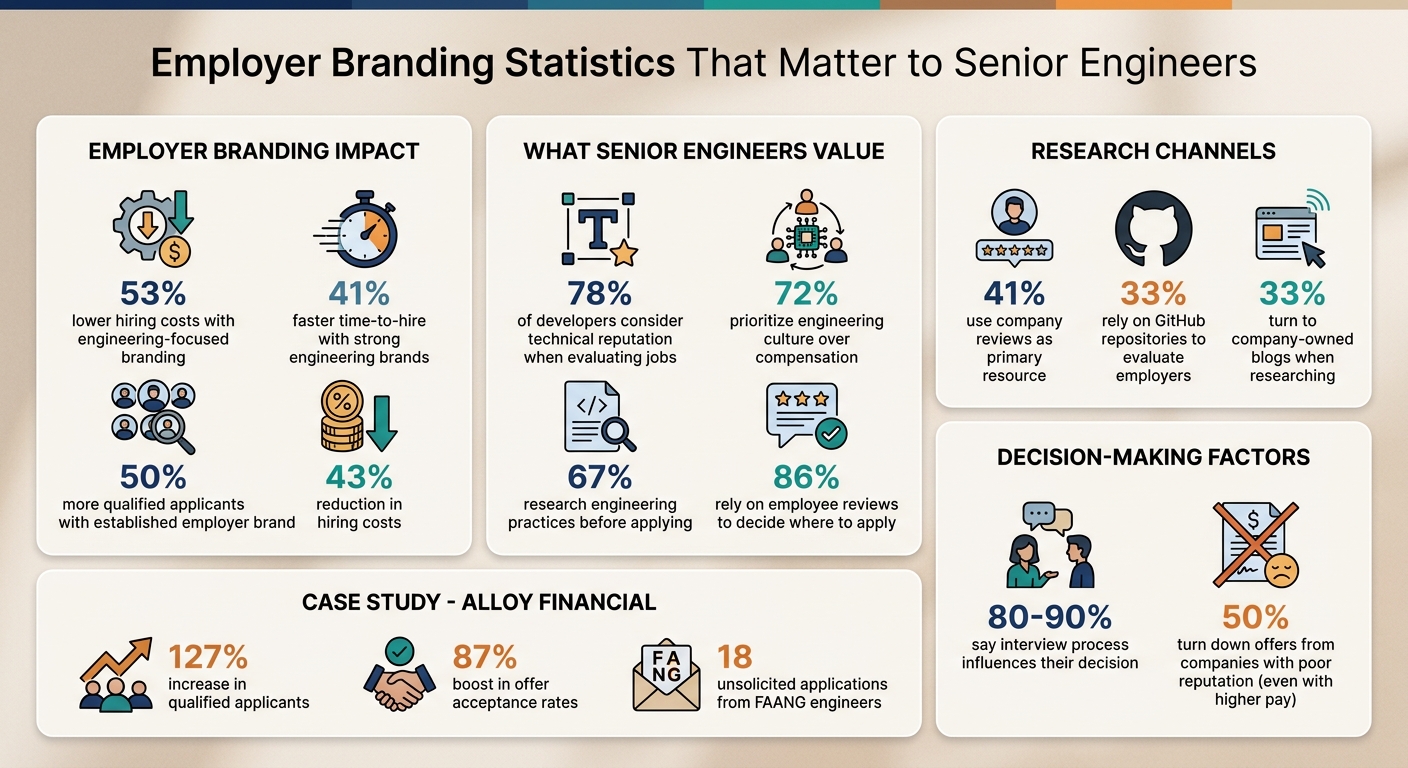 {Employer Branding Impact on Senior Engineer Recruitment: Key Statistics}
What Employer Branding Means to Senior Engineers
Senior engineers don’t evaluate companies the way HR departments often think they do. While your recruiting team might highlight culture videos or office perks, seasoned developers are looking for something entirely different: proof of technical expertise and problem-solving capabilities. They’re not swayed by ping-pong tables or free snacks - they want to know who they’ll work with and what tough challenges they’ll face.
Unlike traditional employer branding, which often emphasizes team events and workplace perks, an engineering brand needs to showcase technical depth. This means providing tangible evidence, like architecture decisions or examples of production issues your team has resolved. In fact, 78% of developers consider a company’s technical reputation when evaluating job opportunities . This focus on real-world actions over promises is key to understanding what truly matters to developers.
Developers Trust Actions, Not Marketing Claims
Experienced engineers have a sharp radar for marketing fluff. They’ve seen companies claim to be cutting-edge, only to discover outdated codebases and expectations of late-night deployments. The disconnect between what’s promised and what’s delivered is more obvious than ever.
What developers value is proof. They’ll look at your GitHub activity to see if your team contributes to open source, read your engineering blog to gauge how you approach complex challenges, and analyze your tech stack to see if you make smart architectural decisions instead of chasing trends.
Take Netflix’s Chaos Monkey as an example. By publishing a detailed technical deep dive about injecting failures into production systems, Netflix didn’t just document engineering work - they sent a clear message about their technical sophistication. This transparency attracted engineers who thrive on solving high-stakes problems .
Similarly, Cloudflare builds trust by sharing detailed post-mortems after incidents. These aren’t polished PR statements; they’re honest accounts of what went wrong, including specifics like BGP routing errors or Lua code that caused performance issues. This level of openness signals to senior engineers that the company values technical accuracy over spin and prioritizes psychological safety . These examples show how authenticity and transparency can resonate deeply with developers.
Why Trust Matters in Employer Branding
Beyond tangible proof, trust is the foundation of a strong engineering brand. Senior engineers often rely on insights from other developers - whether from Reddit threads or Glassdoor reviews - because they know these sources won’t sugarcoat the truth. By 2026, candidates may even use AI tools to cross-check corporate claims against unfiltered employee feedback on these platforms.
Building trust requires transparency. For example, Alloy Financial, a fintech company with 270 employees, shared an honest account of their transition from a monolith to microservices, including the challenges they faced. This openness led to a 127% increase in qualified applicants and drew 18 unsolicited applications from senior engineers with experience at FAANG companies .
"The best engineers don't want a job. They want a challenge. Show them the mountain you are climbing, and they will bring their own climbing gear." – Ninad Pathak, Founder, Pathak Ventures
To earn the trust of senior engineers, focus on showing rather than telling. Don’t just say you value innovation - share case studies of experiments that didn’t work and the lessons your team learned. Instead of claiming you have a strong technical culture, publish architecture decision records. And rather than promising interesting problems, detail how you optimized your database to handle a 10x increase in write load. These actions create the trust that turns passive interest into active applications.
sbb-itb-d1e6221
5 Signals Senior Engineers Check Before Applying
Senior engineers don’t just skim a careers page when considering a job - they dig deeper. They conduct their own research to uncover what it’s really like to work at a company. In fact, 86% of job seekers rely on employee reviews to decide where to apply . For senior engineers, it’s all about finding real evidence of a company’s engineering culture. Here are five signals they pay close attention to before hitting "Apply."
Glassdoor Reviews
Platforms like Glassdoor are a key resource for senior engineers. They’re not just looking for surface-level insights - they want to understand workplace culture, management quality, work-life balance, and psychological safety. Even the interview process is scrutinized, with 80–90% of engineers noting its influence on their decision .
The numbers back this up: 41% of developers use company reviews as their primary resource when researching employers . And here’s a telling stat - 50% of candidates turn down offers from companies with poor reputations, even if the pay is competitive . Positive reviews build trust, but senior engineers don’t stop there - they also explore your public technical footprint.
GitHub Activity
Your GitHub presence is like a portfolio for your engineering team. Senior engineers check it to see if your team contributes to open source projects, releases useful tools, or actively maintains repositories. Around 33% of developers rely on GitHub repositories and similar platforms to evaluate potential employers .
They’ll look at things like code quality, commit frequency, and how your team tackles complex challenges. A well-maintained GitHub signals that technical excellence is a priority, reinforcing the credibility of your engineering culture.
Engineering Blog
An engineering blog can be a powerful way to showcase your technical depth - if it’s done right. Senior engineers gravitate toward authentic content that dives into real challenges, like production issues or architectural trade-offs. They can easily spot marketing fluff, so a blog that shares genuine problem-solving stories stands out.
This kind of transparency helps candidates assess the skills and expertise of the team they might join. A blog that speaks directly to developers offers a glimpse into the day-to-day realities of your engineering culture.
Interview Process
For senior engineers, the interview process is more than just a hurdle - it’s a preview of your company’s values. They’ll notice if technical screens are well-organized, respectful, and relevant to the role. On the flip side, unprepared interviewers or poor communication can leave a bad impression.
A thoughtful interview process that focuses on meaningful problem-solving challenges shows respect for a candidate’s time and expertise. It’s a clear signal that your company takes hiring seriously and aligns with the values it promotes .
Tech Stack Choices
Your tech stack says a lot about your company. Senior engineers want to know if they’ll have opportunities to grow or if they risk stagnating. Transparency about your technology choices - what you use, why you chose it, and how you plan to evolve - helps candidates see if they’re a fit.
Being upfront about your tools and frameworks attracts engineers who are genuinely excited about the challenges you’re solving. It’s one more way to show that your engineering culture values innovation and growth.
Building an Engineering Blog That Attracts Candidates
An engineering blog can be one of your strongest tools for recruiting top talent. In fact, 33% of developers turn to company-owned blogs when researching potential employers . Developers can easily spot the difference between genuine technical content and marketing fluff. The secret? Let your engineers take the lead and focus on the real-world problems they solve. Here's how skipping the fluff and showcasing authentic challenges can make your blog stand out.
Skip the Marketing Fluff
Experienced engineers care about two things: who they'll work with and what challenges they'll face . Take Cloudflare, for example. When they publish post-mortems, they dive deep - down to the packet level - breaking down specific BGP routing errors and Lua code issues. This approach emphasizes technical rigor, not PR polish, and it’s exactly what draws principal engineers .
To build credibility, focus on the details. Share architecture decisions, performance metrics, and actual code samples. By doing so, you'll not only attract seasoned engineers but also establish your blog as a hub of technical expertise .
Share Real Engineering Challenges
Building developer trust is key when it comes to employer branding. The best engineering blogs don’t sugarcoat - they document real work, challenges, and lessons learned. Take Alloy Financial, for instance. In 2024, this 270-person fintech company completely reshaped its employer brand by publishing in-depth case studies on their transition from a monolith to microservices. The results? A 127% jump in qualified applicants, an 87% boost in offer acceptance rates, and 18 unsolicited applications from senior engineers at top tech companies .
Rotate authorship among teams - Infrastructure, Frontend, Backend - so readers get diverse perspectives . Encourage engineers to write about incidents, failed experiments, and the lessons they’ve learned. This level of honesty demonstrates psychological safety and resonates with senior talent who value truth over polished marketing . This approach is particularly effective when trying to build trust with passive candidates who aren't actively looking but are drawn to technical excellence. Etsy’s "Code as Craft" blog is a great example of how engineer-driven content can effectively connect with the developer community .
"Writing is not a distraction from the work. Writing is the documentation of the work."
– Ninad Pathak, Founder, Pathak Ventures
Using Open Source for Employer Branding
Leveraging open source is an effective way to strengthen your engineering brand while showcasing technical transparency. Senior engineers often prioritize technical rigor over workplace perks . By sponsoring projects, releasing internal tools, or presenting your work at conferences, you can build trust within the developer community - something traditional advertising can’t achieve .
Sponsor Open-Source Projects
Supporting or sponsoring open-source projects is a great way to build goodwill and establish credibility among developers. In fact, 78% of developers consider a company’s technical reputation when evaluating job opportunities . Start by contributing to projects that align with your tech stack or address challenges your team regularly encounters. This shows you’re not just using open source - you’re actively contributing to its growth and sustainability.
Begin with smaller contributions, like fixing documentation or submitting bug fixes, to establish a presence before moving on to more complex features . Consistency is key here. Sporadic contributions can hurt your credibility, while steady involvement demonstrates genuine commitment and reliability.
Release Internal Tools
Open-sourcing internal tools is another way to highlight your team’s innovation and dedication to the broader tech ecosystem. This approach often attracts senior engineers who value organizations that contribute to shared resources and technical advancement . Publicly releasing tools allows the community to assess your work’s quality and the transparency of your development processes .
To make an impact, focus on coding-focused candidate sourcing tools and internal utilities that solve common industry problems. Provide clear onboarding materials, comprehensive documentation, and commit to ongoing maintenance . Effective management of issues, pull requests, and version releases is crucial for maintaining credibility . On the flip side, neglecting these responsibilities can harm your reputation and signal a lack of follow-through . When releasing a tool, explain the reasoning behind your technology choices to demonstrate your team’s depth and thought process .
Beyond sharing tools, speaking publicly about your work can further enhance your technical reputation.
Give Conference Talks
Presenting at conferences is a powerful way to position your team as thought leaders. These talks showcase your expertise and transform your company from just another brand into one led by respected professionals . This visibility creates what some call the "Brand Bus Factor", where talented engineers are drawn to work alongside your team’s recognized experts .
"Serious engineers do not care about your bean bags. They do not care about your 'culture' as defined by perks. They care about one thing. Who else works there, and what problems are they solving?" - Ninad Pathak, Marketing Strategist
Focus your talks on the how. Instead of promotional pieces about feature launches, dive into the technical challenges your team solved - like handling specific loads or overcoming architectural constraints . Help your engineers succeed by supporting them with CFP (Call for Proposals) monitoring, proposal writing, and public speaking training . To extend the reach of these efforts, repurpose conference talks into blog posts, white papers, or social media content .
Engaging with Developer Communities
engaging with developer communities takes your engineering culture from being just transparent to being truly connected. It’s about shifting from a company that recruits to one that’s seen as a trusted technical peer. Senior engineers often spend their time in forums, meetups, and open-source projects. By meeting them in these spaces and offering practical, problem-solving insights, you build a reputation that naturally draws in top talent. This kind of engagement works hand-in-hand with your open-source contributions and technical blogs, reinforcing your position as a peer rather than just an employer.
The key is to stop thinking like a "talent hunter" and start thinking like a "talent magnet." Instead of focusing on immediate hiring goals, prioritize contributing to the community. When developers see your engineers solving real problems on Stack Overflow, leaving thoughtful code reviews on GitHub, or sharing lessons learned at meetups, they start forming opinions about your technical culture long before they encounter your job postings.
Host Meetups and Hackathons
Hosting meetups and hackathons is a great way to connect with developers while showcasing your team’s technical expertise. These events allow you to share your knowledge and build trust within the community. Focus on workshops, lightning talks, or panels that highlight specific challenges your team has tackled, like scaling systems, improving performance, or evolving software architecture.
To make an impact, host events regularly - aim for at least once a quarter. Change up the format to keep things fresh. For instance, one quarter you might do a hands-on workshop about optimizing databases, and the next, a panel discussion on microservices migration. Record these sessions and share them online to reach developers who couldn’t attend in person.
You can also organize smaller, more focused gatherings like technical dinners or niche meetups. These intimate events often create stronger connections and attract specialists who align with your team’s expertise.
Sponsor Developer Events
Sponsorship is another way to strengthen your presence in the developer community. By sponsoring conferences and hackathons that align with your tech stack and domain, you increase visibility among developers who share your interests. Take it a step further by having your engineers speak at these events. Their technical talks can leave a lasting impression, inspiring senior candidates to apply because they want to work alongside respected experts.
To help your engineers succeed as speakers, support them with resources like CFP (Call for Proposals) monitoring, proposal writing tips, and public speaking coaching. These efforts not only improve the quality of their talks but also enhance your company’s reputation.
Companies with strong engineering brands often see 53% lower recruitment costs and 41% faster hiring times . This efficiency largely stems from the organic interest generated by consistent community involvement.
Participate Without Self-Promotion
The most authentic way to engage with developer communities is by showing up to help, not to sell. Join technical discussions on platforms like Stack Overflow, Reddit’s r/programming, or specialized Slack groups. Offer real solutions to problems without slipping in mentions that you’re hiring. Dive into open-source projects by triaging issues, contributing code reviews, or sharing helpful resources.
Developers trust actions over words. When your engineers consistently provide value - whether it’s solving an authentication issue or explaining a tricky algorithm - they make a lasting impression. People remember the helpful developer who made their work easier, not the flashy job ad.
Ultimately, your contributions in these spaces shape the kind of talent you attract. By participating genuinely and sharing meaningful technical insights, your engineering culture will naturally stand out where it matters most - among the developers themselves.
Using Social Proof to Build Credibility
Senior engineers are naturally skeptical of flashy marketing and corporate gimmicks . Perks like foosball tables, bean bags, or unlimited cold brew don’t resonate with them. These come across as noise - a sign that a company might not grasp what drives seasoned professionals . What truly matters to these engineers is the signal: technical expertise, the quality of their potential teammates, and the complexity of the challenges they’ll face .
Some companies have cracked the code on this. For instance, German retailer Breuninger ditched traditional job postings in favor of "Team Breuninger Developer Adventures", which highlighted real engineering creativity. The result? A 500% increase in clicks . Similarly, Remind shifted its focus from showcasing office perks to emphasizing technical achievements and open-source contributions. Their "Empire" project, which earned over 1,400 GitHub stars, along with engineer-led storytelling, led to a surge in high-quality interest .
| Feature | Corporate Videos | Real Engineer Stories |
|---|---|---|
| Primary Focus | Office perks, amenities | Technical challenges, architecture |
| Developer Perception | Marketing "noise" | High-value "signal" of competence |
| Key Message | "We work hard and play hard" | "We solve hard problems with talented people" |
The numbers tell the story: 72% of developers prioritize engineering culture and practices over compensation, and 67% of senior developers research a company’s engineering practices before applying . Sharing honest stories, including struggles and problem-solving journeys, conveys a commitment to truth over PR .
Share Engineer Stories
Telling real engineer stories builds trust by revealing the human side of your technical culture. Instead of vague claims about innovation, share specific examples of how your team tackled actual challenges. Dive into architecture decisions, trade-offs, and even mistakes made along the way.
"The only way we achieve our mission is if we hire the best engineers. And that means communicating more about our team than pics of them playing ping pong." – Brett Kopf, CEO, Remind
This works because senior engineers care about who they’ll work with and what problems they’ll solve - not the layout of your break room.
Transparency is key. When companies document their technical journey - warts and all - they show they’re serious about engineering. Be upfront about technical debt considerations and challenges. Share the "grease and leaks" .
Adding bylines to technical content is another powerful move. When engineers see real team members discussing detailed topics like packet-level post-mortems or routing issues, it humanizes your company. It shows you’re more than just a logo - you’re a team of experts .
Just as engineer stories build credibility, "day-in-the-life" content offers a practical glimpse into your team’s daily work.
Create Day-in-the-Life Content
To complement authentic narratives, "day-in-the-life" insights give candidates a realistic view of your team’s workflows. This type of content works best when it highlights real sprint cycles and decision-making processes rather than an idealized version of the job . Senior engineers want to know how your team actually operates - not just the highlight reel.
In January 2026, PostHog took a bold approach by linking actual GitHub PRs (like Django migration safety checks) directly in their job postings . This gave candidates a genuine preview of the codebase and work involved, attracting tens of thousands of applications.
To make this content even more compelling, include details like time allocation breakdowns and examples of your team’s meeting culture. Show how your team makes technical decisions and the trade-offs they weigh when choosing technologies. This level of transparency helps candidates picture themselves on your team and assess if it’s the right fit.
Avoid over-polishing this content. When marketing teams heavily edit engineer-created material, it loses its authenticity and impact . Let engineers tell the story in their own voice - even if it’s a bit rough around the edges. That honesty is far more valuable than a slick video with cheerful background music .
Measuring Employer Branding Impact on Hiring
When it comes to employer branding, the real test lies in its measurable impact on hiring outcomes. Metrics like candidate quality, offer acceptance rates, and pipeline efficiency matter far more than just counting applications. A well-established employer brand can result in 50% more qualified applicants and cut hiring costs by up to 43% . Companies with strong engineering brands report 53% lower recruitment costs and 41% faster time-to-hire . These numbers make it clear: a solid employer brand delivers tangible results.
Track Application Quality and Volume
One key metric to track is your applicant-to-interview ratio, which averages around 12% . If your ratio is much lower, it might mean your employer brand isn’t attracting the right talent or that your job descriptions aren’t clear about the role’s requirements.
But don’t get too caught up in volume - quality is what really matters. Focus on identifying which channels, like engineering blogs, GitHub contributions, or conference talks, are bringing in the most qualified candidates. Pay attention to organic applications (candidates applying to your company without targeting a specific role), as they signal strong brand visibility . These insights highlight the trust you’ve built through authentic storytelling and active community participation.
"Start with your goals. Without clear goals, you'll never be able to measure success." – Carmen Collins, Social Media & Talent Brand Lead, Cisco
Once you’ve analyzed application trends, the next step is to evaluate how effectively your employer brand translates into offer acceptance.
Monitor Offer Acceptance Rates
Your offer acceptance rate (OAR) is a direct reflection of whether your employer brand lives up to its promises. To calculate it, divide the number of accepted offers by the total offers extended . For example, one SaaS company that introduced public architecture decision records and an engineering-focused podcast saw a 42% jump in their OAR .
If your OAR is low, it could mean there’s a disconnect between the image you project and the experience candidates have during the hiring process. Considering that 50% of candidates will turn down an offer from a company with a poor reputation, even if the pay is higher, your brand perception could be costing you top talent . Also, keep an eye on your renege rate (candidates who back out after accepting an offer), as it can signal deeper issues with how your brand aligns with reality .
"A high offer acceptance rate indicates that candidates want to work for your company and view your opportunities favorably. Low acceptance rates might signal that your employer brand isn't resonating." – Jen Dewar, JobScore
Break down your OAR data by seniority level and candidate source. For instance, if senior engineers coming through your engineering blog accept offers at a higher rate than those from job boards, that’s a clear sign of where your branding efforts are most effective .
Beyond offer acceptance, looking at the overall health of your recruitment pipeline provides deeper insights.
Measure Pipeline Health
One valuable metric to track is Time to First PR (pull request) - how quickly new senior engineers contribute production-ready code. This measure reflects both the quality of your hires and how well your onboarding process delivers on the expectations set during hiring .
Also, monitor candidate drop-off rates. For example, 45–60% of candidates may drop off at the application stage, and 20–30% might exit after technical assessments . High drop-off rates could indicate a mismatch between your branding message and the reality of your interview process.
Another critical metric is the Cost of Vacancy, which connects branding directly to revenue. For senior engineering roles, this isn’t just about hiring costs - it’s about the daily revenue loss and project delays caused by unfilled positions . With the average time-to-hire for engineers climbing to 95 days in 2026 (up from 65 days in 2025), every day saved by better branding has a measurable financial impact .
Finally, gather feedback from new hires at 30, 60, and 90 days. Ask them which branding elements influenced their decision to apply and whether their experience aligns with what was promised . This feedback loop ensures your employer brand stays rooted in reality, creating a seamless connection between what you promise and what candidates experience - an essential factor in successful technical recruiting.
How daily.dev Recruiter Strengthens Your Employer Brand
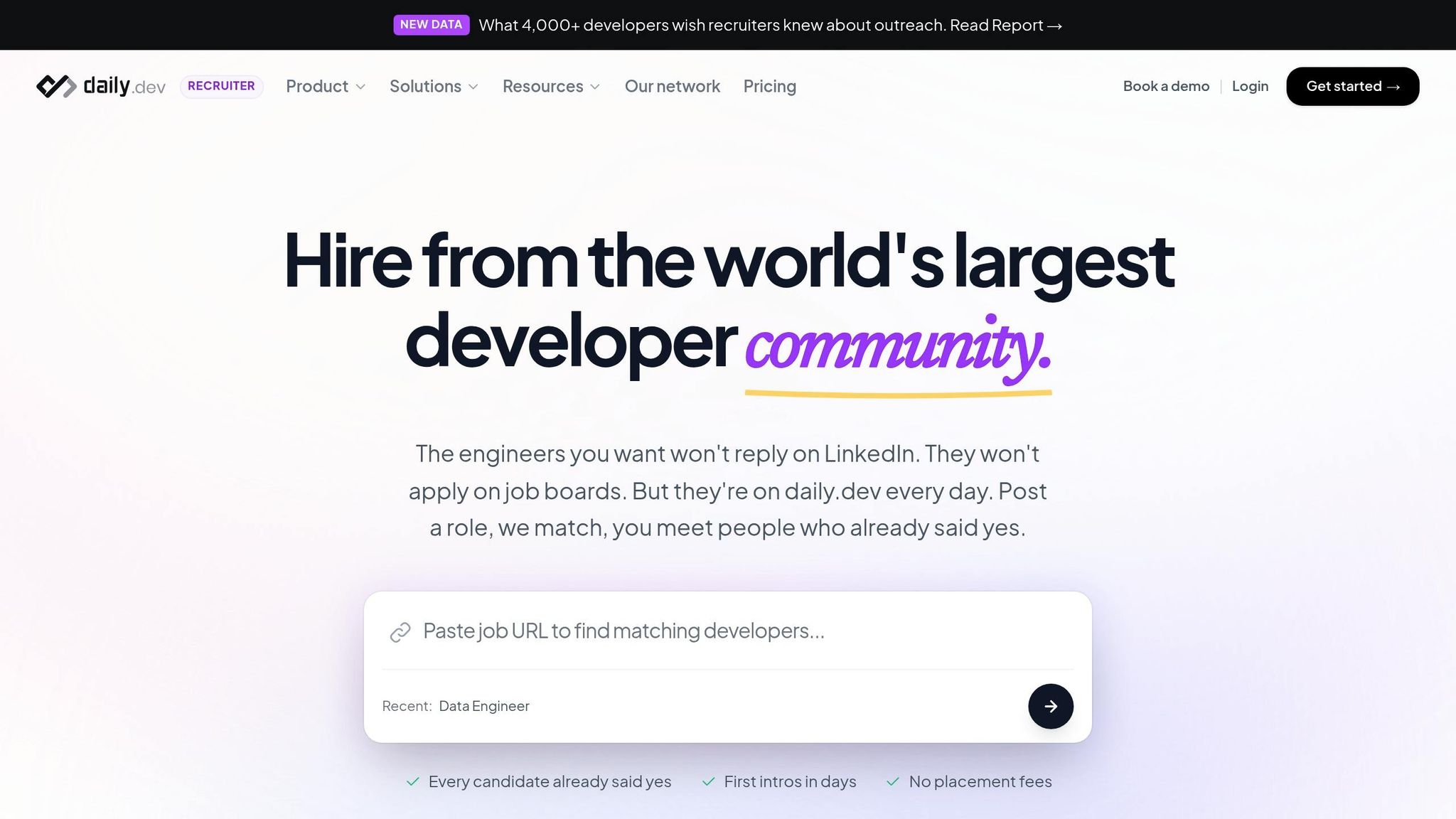
Crafting a strong employer brand through engineering blogs, open-source contributions, and community involvement is no small feat - it takes time, often months, to see tangible outcomes. But what if you need to hire now, without compromising the trust and credibility that senior engineers expect?
This is where daily.dev Recruiter steps in, elevating your employer brand by connecting you with developers who are already active in technical communities. This approach ensures you're engaging with pre-qualified candidates who value technical expertise.
Connect with Pre-Qualified Developers
daily.dev Recruiter uses a double opt-in connection model, which solves one of the biggest headaches in technical recruiting: cold outreach. Senior engineers are bombarded with unsolicited messages daily, which can tarnish your brand’s image. With this model, both you and the candidate must express mutual interest before any interaction begins. This not only respects developers' time but also fosters trust from the outset.
This approach changes how candidates perceive your company. Instead of being seen as "just another recruiter", your brand is viewed as one that truly understands developer culture and prioritizes meaningful engagement over mass outreach. And here's a critical stat to consider: 50% of candidates are likely to reject an offer from a company with a poor reputation, even if the salary is higher . Few things harm your reputation faster than impersonal, aggressive outreach.
The double opt-in system reinforces trust at every step, aligning perfectly with the authentic engagement strategies developers appreciate.
Get Visibility in Developer Communities
Your job postings are displayed directly within the daily.dev platform, putting them in front of passive talent - those senior engineers who may not be actively job hunting but are open to the right opportunity.
This is a far cry from generic job boards, where your brand can easily get lost in the noise. Here, your postings are seamlessly integrated into developers' daily workflows, making your company a natural part of their professional journey instead of an unwelcome interruption.
Simplify the Hiring Process
Beyond visibility and trust, daily.dev Recruiter also simplifies hiring. The platform connects you exclusively with developers who meet your technical needs and have already shown interest. This pre-qualification process not only improves your applicant-to-interview ratio but also ensures a smoother, more positive experience for candidates.
Conclusion
Attracting senior engineers to your company isn't about creating the flashiest careers page or launching elaborate marketing campaigns. What really matters is building authenticity, fostering trust, and backing it all up with consistent actions. As Amplēo puts it:
"Your employer brand is the story engineers tell each other about what it's like to work at your company."
This story unfolds through tangible elements like Glassdoor reviews, GitHub contributions, engineering blogs, and interview experiences - not through polished marketing slogans.
The numbers make it clear: a transparent and consistent employer brand delivers real results. Developers care deeply about engineering culture and practices. Before applying, they dig into a company's technical depth, looking for evidence of transparency, challenging engineering problems, and respect for their expertise and time .
Employer branding is a continuous effort, not a one-off initiative. Companies with strong engineering brands enjoy 53% lower recruitment costs and hire 41% faster . By investing in engineering blogs, open-source work, and engaging with the developer community, you can draw in passive candidates who might not be actively job hunting but are open to the right opportunity.
However, there's a catch: if the reality of working at your company doesn't match your promises, it won't stay hidden for long. Half of all candidates would turn down an offer from a company with a poor reputation - even if the salary is higher . Regularly auditing your claims, empowering engineers to share their authentic experiences, and focusing on consistent, transparent actions are critical steps to building credibility.
FAQs
How can we make our employer brand credible to senior engineers?
To connect with senior engineers and earn their trust, focus on being genuine and demonstrating technical expertise. These professionals value tangible indicators like detailed engineering blogs, contributions to open source projects, and honest developer experiences. When evaluating companies, they often look at factors such as Glassdoor reviews, GitHub activity, the chosen tech stack, and how the interview process reflects the company’s technical standards. By prioritizing openness and showcasing deep technical knowledge, you can effectively demonstrate your commitment to high-quality engineering practices.
What should we publish first: GitHub, an engineering blog, or post-mortems?
An engineering blog is a great way to showcase your technical expertise and depth - qualities that resonate strongly with senior engineers. Unlike lighter content such as post-mortems or GitHub activity updates, a well-crafted blog dives into real technical challenges and solutions. This approach not only demonstrates your team's skills but also builds credibility and trust.
By focusing on detailed, technical content, you can effectively attract top talent. Engineers value authentic problem-solving stories, and sharing these experiences can set your organization apart as a place where meaningful, complex work happens.
What hiring metrics show our employer branding is effective?
When assessing your employer branding, focus on these important metrics:
- Candidate Quality: This measures the caliber of applicants drawn to your company and reflects how appealing your brand is to top talent.
- Offer Acceptance Rate: A higher rate indicates that candidates trust your brand and are eager to join your team.
- Number of Open Applications: This shows how many people are actively seeking opportunities with your company, giving insight into your brand's reach and appeal.
- Source of Hire: Understanding where your hires come from helps you identify which channels are most effective in attracting developers.
These metrics provide a clear picture of how your brand resonates with developers and how well it supports your hiring efforts. Keep an eye on these indicators to ensure your branding aligns with your recruitment goals.


