

Consistent, developer-focused visibility makes your tool the default choice before engineers begin evaluations.
Want developers to choose your product before they even start comparing options? It all starts with brand awareness. Developers take their time evaluating tools, with 96% not ready to buy immediately and 63% needing at least three months to decide. To stand out, your brand needs to be visible, trusted, and top-of-mind across channels they already use - like GitHub, Stack Overflow, and newsletters.
Key Takeaways:
- Awareness is the first step: Developers need to know your brand exists before they consider it. Focus on educational content (90%) over promotional (10%).
- Be where developers are: Use platforms like technical blogs, GitHub, and developer-focused advertising (e.g., daily.dev Ads) for consistent visibility.
- Support evaluation: Provide demos, tutorials, and excellent documentation to help developers assess your tools independently.
- Adoption leads to advocacy: Once developers adopt your product, engage them with ROI tools and case studies to drive loyalty.
Metrics to Measure Success:
- Unaided recall: Are developers naming your brand without prompts?
- Share of voice: How much of the industry conversation includes your brand?
- Branded search volume: Are more developers searching for your brand specifically?
Building awareness means showing up consistently where developers learn and work. From sponsoring open-source projects to targeted ads, every touchpoint strengthens your position as the default choice.
The Developer Brand Funnel: Awareness → Consideration → Adoption
::: @figure 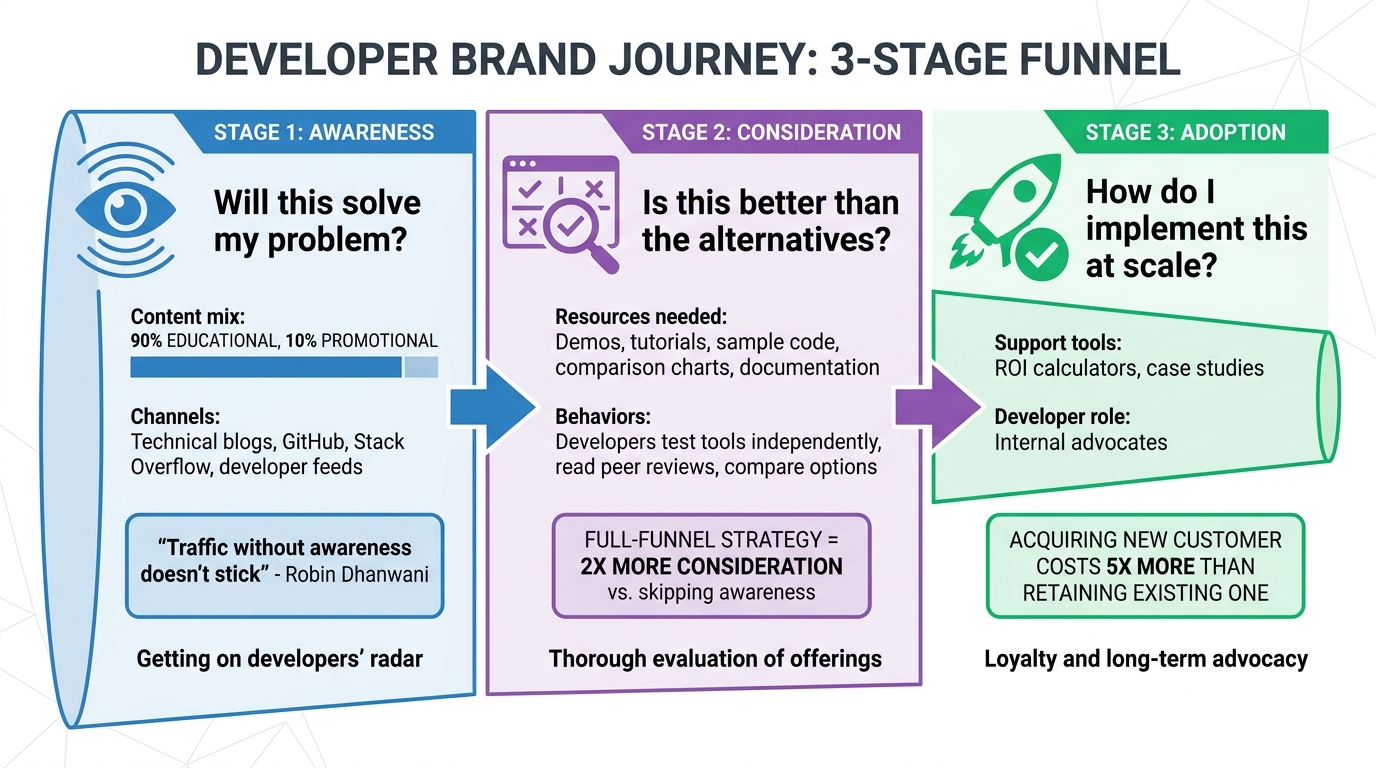 {Developer Brand Funnel: From Awareness to Adoption}
Developers move through three key stages - awareness, consideration, and adoption - with brand familiarity shaping their decisions at every step.
Awareness: Getting on Developers' Radar
At this stage, developers are asking themselves: "Will this solve my problem?" They’re not ready to commit just yet . Your main task? Be visible in the spaces developers already frequent. That includes technical blogs, GitHub repositories, Stack Overflow threads, and feeds tailored to developers .
The content mix here is critical - aim for 90% educational content and only 10% promotional material . Developers tend to shy away from traditional marketing, so focus on offering practical, no-nonsense resources that tackle specific challenges without unnecessary hype . As Robin Dhanwani, Founder of Parallel, aptly puts it:
"Traffic without awareness doesn't stick."
If your brand doesn’t leave a lasting impression during this initial interaction, the opportunity is lost. Getting on their radar lays the groundwork for the next step: deeper evaluation.
Consideration: Staying in Mind When Developers Evaluate Options
Once developers know about your brand, they shift to evaluation mode, asking: "Is this better than the alternatives?" This process is deliberate - they’ll test your tool, read reviews from peers, and compare it to other options .
To support this phase, offer resources like demos, tutorials, sample code, and comparison charts . Developers prefer to assess tools independently, without sales interference. Here’s where top-notch documentation becomes a key marketing tool - it reassures them that your product can meet their demands . Companies that invest in a full-funnel strategy, including awareness-building, see up to 2x more consideration compared to those that skip the initial stage . Once developers have thoroughly evaluated your offering, they’re ready to adopt solutions that provide clear, measurable benefits.
Adoption: Becoming the Go-To Solution
In the adoption phase, developers are asking: "How do I implement this at scale?" This is when they evolve into internal advocates for your product. Help them make the case with tools like ROI calculators and case studies .
Consistent early engagement makes adoption easier. When developers see your brand regularly - through community involvement, technical content, and developer-targeted platforms - they’re more likely to trust your product and promote it within their teams. And let’s not forget: acquiring a new customer costs 5x more than retaining an existing one . Investing in early awareness doesn’t just drive adoption; it builds loyalty and long-term advocacy.
Building Brand Frequency in Developer Channels
Developers don’t make quick decisions when it comes to tools - they need to encounter your brand multiple times before it becomes a trusted option. This consistent exposure builds on your initial awareness efforts, keeping your brand top-of-mind as they evaluate and eventually adopt new tools. When developers repeatedly see your brand in the right places, it transitions from being an unknown name to one they seriously consider.
The trick is knowing where to show up. Instead of blanketing ads across every platform, focus on the spaces developers already use to learn, explore, and stay updated on tech trends. Appearing alongside respected technical content not only increases visibility but also lends your brand credibility by association.
Using Developer-Focused Advertising Platforms
Platforms like daily.dev Ads offer a way to reach developers during high-intent moments. These ads place your brand within trusted workflows, ensuring it’s seen when developers are actively exploring new tools. As daily.dev explains:
"Campaigns perform better when the audience and context match the message. daily.dev Ads connects with developers during active discovery, so your brand lands in a high-trust moment instead of a low-intent scroll." – daily.dev
With 1 in 50 developers worldwide using daily.dev to stay informed, and the platform boasting 20,000 GitHub stars and a 4.8/5 rating on Product Hunt , it provides consistent visibility through native ads, post page ads, and personalized digest ads. These ad formats integrate naturally into developers' daily routines - whether they’re reading technical articles, exploring new frameworks, or catching up on industry news.
What makes this approach even more effective is granular targeting. You can tailor your campaigns based on factors like programming languages, seniority, or specific tools. And since most technical evaluations happen on desktops rather than mobile devices, focusing on desktop-first platforms ensures you’re reaching developers when they’re fully engaged in their work.
To further strengthen your presence, combine these high-intent ad placements with personal touchpoints in newsletters and developer communities.
Reaching Developers Through Newsletters and Communities
Newsletters and online communities offer another layer of consistent brand exposure. Technical newsletters deliver your message directly to developers’ inboxes, reinforcing your presence. Personalized digests - tailored to topics like Web Development, AI/ML, or DevOps - ensure your brand stays relevant to developers interested in specific areas.
Communities like Hacker News add even more opportunities. Developers frequent these forums to discuss tools, exchange knowledge, and follow emerging trends. Sponsoring key discussions or participating in meaningful conversations can enhance your visibility and foster engagement. Together, newsletters, forums, and targeted ads create multiple touchpoints that help move your brand from recognition to serious consideration.
Tactics to Build Developer Brand Awareness
To make your brand the go-to choice for developers, focus on strategies that boost visibility and trust while offering authentic contributions to the developer ecosystem.
Sponsoring Open Source Projects
Backing open source projects is a great way to earn goodwill and build trust within the developer community. Developers appreciate when brands actively support the tools they rely on every day. The trick is to align your sponsorships with projects that complement your technology stack or workflow. For instance, if your focus is on AI tools, sponsoring LangChain gets your name in front of developers in that space. Similarly, infrastructure companies might back Kubernetes, while web-oriented brands could benefit from integrations with Vercel .
This strategy works because it naturally increases your visibility. Developers exploring related projects often come across your brand as part of the ecosystem. However, there's a golden rule here: avoid over-marketing. As Louis Corneloup, Founder of Dupple, wisely notes:
"Maintainer voice carries more weight than brand voice for OSS"
Focus on meaningful contributions, whether that’s through code, documentation, or financial support, rather than pushing promotional content.
In addition to open source sponsorships, targeted advertising in developer-focused media can strengthen your brand’s presence.
Advertising in Developer Media
Developer-specific media channels - like podcasts, technical blogs, and conferences - offer excellent opportunities to engage with developers who are already in a learning mindset. Sponsoring newsletters such as Bytes, Pragmatic Engineer, or Cooperpress places your brand directly in front of developers through trusted sources . For example, the Techpresso newsletter reaches over 550,000 tech professionals, including approximately 165,000 engineers .
When advertising, keep your messaging technical and practical. Developers value ads that address specific challenges rather than vague marketing promises. Include code snippets, links to documentation, or sandbox access to let them evaluate your tool firsthand. The goal is to deliver instant value, making it easy for developers to explore your product on their terms.
Building DevRel and Developer Advocacy Programs
To complement sponsorships and advertising, invest in developer advocacy through a dedicated Developer Relations (DevRel) program. DevRel teams create personal, human connections that advertising simply can’t replicate. As Matthew Revell, Founder of DevRelCon, explains:
"Developer relations can be understood as a collection of strategies and tactics that help companies to work better together with software engineers"
These teams act as trusted insiders within the developer community. They not only promote your product but also gather valuable feedback to improve it. This two-way interaction fosters trust, showing developers that your brand listens and cares about their needs.
The scale of your DevRel efforts will depend on your company’s stage. Early-stage companies ($0–$500K ARR) often rely on founders and organic engagement to build relationships, while growth-stage companies ($500K–$5M ARR) typically hire dedicated advocates and invest in paid content . By tailoring your approach, you can build a strong connection with the developer community at any stage of your growth.
How to Measure Developer Brand Awareness
Once you've implemented strategies to build your brand, the next step is figuring out how well they're working. Tracking specific metrics helps connect your efforts to real-world outcomes and keeps your approach on track.
Aided and Unaided Recall Metrics
Unaided recall is one of the strongest indicators of brand awareness. It measures whether developers can name your brand without any hints. For example, asking, "Which cloud platforms are you familiar with?" gauges how top-of-mind your brand is. Sumit Saxena from Merren explains:
"Unaided recall is the gold standard of awareness: it means your brand exists in the consumer's mental shortlist without being prompted."
On the other hand, aided recall measures recognition when your brand is included in a list of options. If 80% of respondents recognize your brand in an aided recall test but only 15% in an unaided one, it suggests your brand is recognized but not yet top-of-mind.
To collect these metrics, use surveys distributed to paid panels like Pollfish or SurveyMonkey Audience. This approach gives a broader perspective than relying solely on your email list, which mostly measures engagement from existing users . Start with unaided recall questions to avoid influencing responses . For reliable data, aim for at least 200–400 survey participants, and track these metrics quarterly - or even monthly during active campaigns .
Share of Voice and Branded Search Volume
Share of voice (SoV) looks at how much of the conversation around your industry includes your brand. You can measure this by checking your SEO visibility for key terms or by analyzing your presence on AI platforms like ChatGPT and Perplexity . According to Ana Camarena from Semrush:
"The higher your share of voice, the more influential your brand likely is."
Branded search volume tracks how often developers search for your brand specifically. Growth here signals strong interest and intent. You can use Google Trends to monitor changes in branded search over time, and tools like Google Analytics 4 to track metrics like "New Users" and "Direct Traffic." Be sure to filter out paid traffic to avoid skewed results.
Direct traffic is a particularly strong indicator of brand recall, as it shows developers are coming to your site directly, without relying on search engines or external links . Additionally, tracking AI search visibility - how often your brand appears in AI-generated responses - offers insights into your relevance in today's evolving search landscape .
Campaign Performance Analytics
To go beyond general awareness, dive into how individual campaigns are performing. This helps you understand their impact and return on investment. For example, if you're running ads on daily.dev Ads, track metrics like click-through rates, engagement rates, and conversion rates. These numbers reveal which creative approaches and targeting strategies resonate most with developers.
Another useful metric is the growth in backlinks from developer-focused sites, which can signal increasing authority . Social listening tools are also valuable for tracking mentions of your brand on forums and blogs. Beyond just counting mentions, use sentiment analysis to see if the buzz around your brand is positive or negative.
Always compare your awareness metrics against competitors and your past performance to measure progress . As Sumit Saxena from Merren points out:
"A brand with high awareness but low consideration has a perception problem, not an awareness problem. More advertising will not fix it."
This is an important distinction. If developers recognize your brand but don't think of it as a viable option, it's time to rethink your messaging and positioning. These insights help ensure your brand isn't just recognized but also trusted and chosen when it matters most.
Comparison: Developer Brand Awareness Tactics
Different tactics impact key metrics in unique ways. Knowing these differences can help you allocate your budget wisely and find the right combination to achieve your goals.
daily.dev Ads offer a powerful mix of broad reach and precise targeting. With access to over 1 million developers worldwide, you can tailor your ads based on factors like developer seniority, programming languages, or tools. These ads integrate seamlessly into developers' daily content feeds, making them feel like a natural part of the browsing experience. This native format often generates better engagement compared to traditional banner ads. But how do other strategies stack up alongside this approach in building developer brand awareness?
Sponsoring open source projects is a great way to build credibility within the developer community. However, this tactic provides less control over when and where your message reaches its audience. Plus, it’s harder to measure its impact compared to digital advertising.
For a more direct approach, newsletters can be a valuable tool. Developer-focused newsletters connect you with an audience that has opted in for curated content, ensuring strong engagement. For instance, Circuit, part of the In Plain English brand, reaches 3 million monthly readers . However, this audience is shared among all sponsors, and as Kuba from Developer Markepear points out, "Developers resist overt sales pitches" . To avoid this, newsletter content needs to focus on education rather than promotion, which can sometimes dilute your brand’s direct messaging.
While ads and sponsorships provide quick visibility, developer advocacy programs are all about building trust and fostering long-term relationships. These programs take time to show measurable results but can create deep connections within the community. Sunil Sandhu emphasizes this point:
"Gaining the trust of developers and building a long-lasting relationship with them is not easy, but it's absolutely a worthwhile investment, especially in the long run" .
Conclusion
Developers tend to gravitate toward familiar tools before diving into feature comparisons or pricing. This makes brand awareness a game-changer. When your solution is visible across prominent developer channels, it becomes the go-to option, creating a strong mental association with your brand.
The journey from awareness to adoption relies on consistent visibility. Using strategies like open-source sponsorships, developer-focused media ads, and DevRel initiatives ensures repeated exposure. Over time, these efforts build momentum. In fact, brands with higher frequency in developer channels achieve three times the unaided recall rates , directly influencing their position in evaluations.
To turn awareness into a strategic advantage, measurement is key. Keep an eye on metrics like aided and unaided recall, share of voice in developer spaces, and branded search volume. These indicators reveal how well your campaigns are performing and often predict adoption trends before conversions start to show.
Platforms like daily.dev Ads integrate seamlessly into developers' workflows, offering access to over 1 million developers globally. With targeting options based on seniority, preferred programming languages, and tools, you can achieve both reach and precision. This combination ensures your awareness efforts are not just scalable but also measurable.
Now’s the time to act. Assess your visibility in critical developer spaces, establish baseline metrics, and experiment with 2–3 impactful tactics. The companies investing in awareness today will dominate mindshare tomorrow, becoming the first choice developers consider when it’s time to decide.
FAQs
How long does developer awareness take to convert into adoption?
Converting developer awareness into product adoption usually happens within 1 to 3 months for most developers. Data shows that about 51.2% make the leap during this period once they understand the product's value. The timeline can vary based on factors like how complex the product is, the effectiveness of awareness campaigns, and the level of engagement with developers. However, having strong brand recognition often accelerates the process, helping developers move smoothly from consideration to evaluation and, ultimately, adoption.
What’s the fastest way to increase developer mindshare in US channels?
To connect with developers in the U.S. and gain their attention quickly, prioritize genuine interactions in the spaces they already frequent. Some effective tactics include:
- Running targeted in-feed native ads that blend seamlessly into their online experience.
- Sponsoring developer communities, which fosters goodwill and positions your brand as a supporter of their work.
- Sharing technical content that directly addresses and solves practical challenges developers face.
These strategies help establish trust and make your brand more recognizable and respected within the developer community.
How can I measure brand awareness without relying on leads or demos?
You can gauge brand awareness by monitoring several key metrics. These include social media engagement, which reflects how actively people interact with your content, and branded search volume, which shows how often users search specifically for your brand. Additionally, tracking online mentions and your share of voice can reveal how much attention your brand is getting compared to competitors.
Other valuable indicators include survey results, which provide direct feedback from your audience, backlinks that point to your site, and earned media coverage, showcasing organic attention from press or influencers. Together, these metrics offer a well-rounded view of how your brand connects with its audience, beyond just leads or demo requests.


