

Referral programs succeed when they're simple, transparent, fast, and reward real engineering talent - design yours that way.
Employee referral programs work because engineers trust recommendations from peers. Referred candidates are often pre-vetted, align with company culture, and perform better. They also speed up hiring, with referrals accounting for 40% of hires but only 7% of applications. To make these programs effective:
- Simplify the process: Use quick, user-friendly tools like Slack or Google Forms.
- Provide transparency: Acknowledge referrals within 48 hours and give updates.
- Structure bonuses well: Offer competitive payouts (e.g., $2,500–$25,000) and split payments over milestones.
- Avoid common mistakes: Prevent referral fatigue and address diversity issues.
- Measure success: Track metrics like participation rate, time-to-hire, and retention.
Adding tools like daily.dev Recruiter can help reach passive candidates, complementing referrals. Prioritize trust, clear communication, and timely feedback to maximize results.
::: @figure 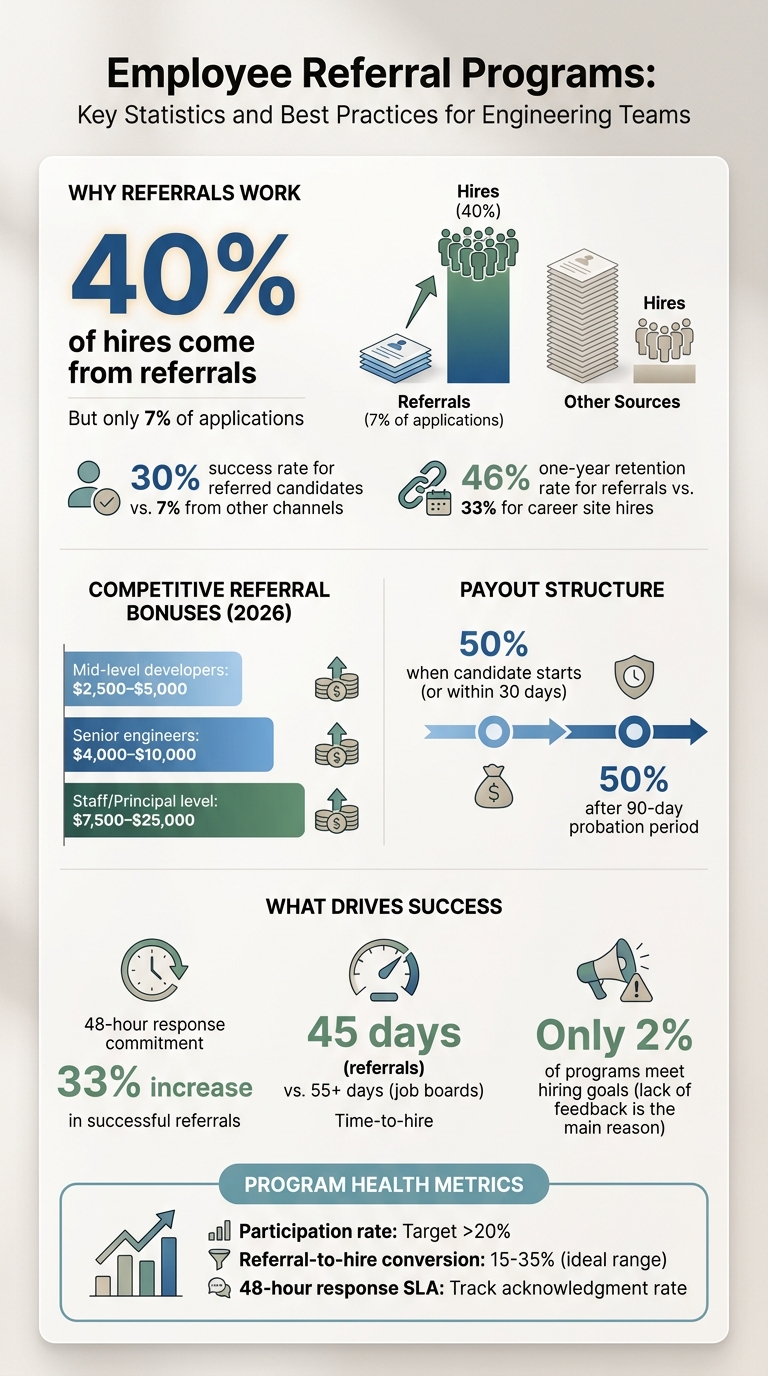 {Employee Referral Programs: Key Statistics and Best Practices for Engineering Teams}
How to Design Referral Programs Engineers Will Use
Keep the Process Simple
Engineers are not fans of overly complicated referral programs. If submitting a referral takes more than two minutes, you're likely to lose their interest . Avoid lengthy forms, essays, or unnecessary steps. Instead, aim for a one-click process: ask for the candidate's name and LinkedIn URL. You can include an optional field for a short note about their connection, but that's it. The recruiting team should handle everything else - screening, scheduling, and technical evaluations - so engineers don’t feel bogged down with extra tasks.
Make it even easier by integrating the referral process into tools engineers already use. Whether it’s a simple Google Form, a Slack channel, or an ATS integration , ensure the process is mobile-friendly so engineers can submit referrals anytime, even during off-hours .
Here’s a great example: Google implemented personalized prompts like, “Who’s the best backend developer you’ve worked with?” and paired that with a commitment to respond within 48 hours. The result? A 33% increase in successful referrals, all without changing their bonus amounts . You can also guide engineers by sharing specifics about open roles, including must-haves and deal-breakers . For added focus, consider publishing a monthly “priority referral” list that highlights roles open for over 30 days .
Once you've simplified the process, timely updates will help build trust and encourage ongoing participation.
Provide Transparency and Fast Feedback
After streamlining the referral process, the next step is ensuring engineers feel their efforts are appreciated. A lack of feedback can discourage future referrals . If someone submits a referral and hears nothing back, they’ll likely assume their time was wasted.
To prevent that, commit to acknowledging every referral within 48 hours . Beyond the initial acknowledgment, provide updates at key milestones - whether the candidate is being phone-screened, interviewed, offered a position, or rejected. Automating these updates through your ATS or Slack can save time while keeping the referrer informed. Even when rejecting a referral, include a brief explanation, such as “lacked experience with our tech stack” . This kind of transparency shows engineers their input is valued and helps them make better recommendations in the future.
"The companies with the highest referral participation rates are the ones that close the loop. Every referral gets a status update within two weeks."
– Truffle
Speed is critical here. Referred candidates should move through the hiring process faster than other applicants, ideally reaching a decision within 5 to 10 business days . Delays not only frustrate candidates but also erode the trust engineers place in the referral system. A quick, efficient process reinforces the value of their referrals and supports better hiring outcomes.
sbb-itb-d1e6221
Referral Bonus Structures That Get Results
Cash Bonuses: Amounts and Timing
When it comes to referral bonuses for engineering roles, the numbers tend to reflect the high demand for technical talent. For 2026, companies are likely to offer $2,500–$5,000 for mid-level developers, $4,000–$10,000 for senior engineers, and $7,500–$25,000 for staff or principal-level positions. These figures highlight just how competitive the hiring landscape is for specialized roles.
Timing is just as critical as the amount. A split payout system works best - 50% when the referred candidate starts (or within 30 days) and the remaining 50% after a 90-day probation period. This approach balances trust with accountability. Take HubSpot as an example: they offer a $10,000 bonus for developer referrals, with the condition that the new hire stays for at least four months.
For roles that are particularly hard to fill, "referral sprints" can be a game-changer. These involve temporarily increasing the bonus to drive urgency. For instance, if a backend developer position has been open for over a month, you could raise the bonus from $5,000 to $7,500 for a short two-week period. Clear communication about the urgency of such roles can make these sprints even more effective.
While cash bonuses are effective, non-cash rewards and tiered structures can add an extra layer of motivation for employee referrals.
Non-Cash Rewards and Tiered Bonuses
Cash isn’t the only way to incentivize referrals. Offering non-monetary perks or structuring bonuses by role level can broaden the appeal of your referral program. For example, DigitalOcean saw a 43% participation rate - four times the industry average - by combining a $3,500 cash bonus with a $1,500 charitable donation in the referrer’s name. This kind of hybrid reward resonates with employees who care about making an impact beyond their paycheck. Other popular non-cash incentives include extra PTO, tech gadgets, or tickets to events.
Tiered bonuses are another effective way to align rewards with the effort required. Referring a junior developer might earn $1,000 to $3,000, while referring a staff engineer could bring in as much as $15,000. Salesforce has taken a creative approach by running contests with prizes like San Francisco Giants tickets, awarded regardless of the candidate’s hiring outcome.
To further encourage participation, consider escalating rewards for repeat referrers. For instance, if an employee successfully refers three candidates in a year, increase their fourth bonus by 25–50%. This not only acknowledges their efforts but also reinforces their value as key contributors to your hiring success.
Common Referral Program Mistakes and How to Fix Them
Referral programs can fall apart if they fail to provide timely feedback or rely on vague, overly broad prompts. A well-structured program needs to avoid these missteps to maintain trust and attract a diverse pool of qualified candidates.
Preventing Referral Fatigue
One of the quickest ways to derail a referral program is by neglecting to give feedback. While 77% of employers have formal referral programs, only 2% achieve their goals - largely because they fail to close the loop with employees who submit referrals .
"An employee who submits a referral and hears nothing for two weeks rarely refers again." - ERE Research
To address this, aim for a strict 48-hour response time for every referral. Even a simple acknowledgment like, "We received your referral and will review it by Friday," helps maintain trust and keeps employees engaged . Quick responses have been shown to significantly improve both engagement and submission rates.
Another common mistake is treating every open position as equally suitable for referrals. Instead, use targeted prompts to make the process easier and more effective. For instance, ask specific questions like, "Who’s the best backend developer you’ve worked with?" This approach reduces mental effort for employees and encourages more thoughtful recommendations .
While timely feedback is crucial for avoiding fatigue, focusing too heavily on familiar networks can inadvertently limit diversity.
Reducing Bias and Clique Hiring
Although rapid feedback boosts engagement, it’s equally important to ensure that your referral program doesn’t unintentionally reinforce existing team demographics. Employees often refer people similar to themselves, which can lead to less diverse candidate pools. For example, women of color are 35% less likely than white men to receive an employee referral .
To counteract this, consider strategies like Intel’s 2015 initiative, where they doubled referral bonuses for candidates from underrepresented groups. This led to an increase in underrepresented hires from 32% to 41% within a year .
Additionally, ensure all candidates - whether referred or not - are evaluated using the same objective criteria. Tools like standardized rubrics and interview scorecards can help maintain fairness. Keep an eye on your referral-to-hire conversion rates; if they exceed 40%, it might indicate that referred candidates are being favored over others instead of being assessed equitably . Regularly track referral pipeline demographics, ideally on a quarterly basis, to spot and address any patterns of bias early .
How to Measure and Improve Your Referral Program
If you're not tracking the right data, your referral program is just a payout system. The difference between programs that hit their hiring targets and those that fall short lies in monitoring key metrics and acting on them. While 77% of organizations have formal referral programs, only 2% say their program meets its hiring goals .
Metrics to Track
To truly understand how your referral program is performing, focus on these key metrics:
Participation rate: This tells you the percentage of eligible employees submitting at least one referral. A rate below 20% suggests the program isn't resonating with employees or lacks trust .
Referral-to-hire conversion rate: Ideally, this should range between 15–35%. If it’s below 10%, employees might not fully grasp the role requirements. On the flip side, rates above 40% could mean favoritism is creeping into the process .
Time-to-hire: Referred candidates should average around 45 days to hire, compared to 55+ days for job board applicants. Faster hires often mean a more efficient process .
Retention rate: This measures quality over time. A one-year retention rate of 46% for referred hires - compared to 33% for career site hires - proves referrals often lead to better long-term matches .
Demographics in the referral pipeline: Review this quarterly to spot potential biases. For instance, women of color are 35% less likely than white men to receive referrals, highlighting the need to attract diverse candidates to your pipeline .
48-hour response SLA: Track how many referrals are acknowledged within two business days. Quick feedback is key to keeping employees engaged with the program .
These metrics provide a foundation for identifying what’s working and where adjustments are needed.
Using Feedback to Improve Results
Metrics are just the start - feedback is what transforms your program into a success.
Survey employees who don’t participate to uncover barriers like unclear communication, complicated processes, or uninspiring incentives . Addressing these concerns can boost engagement.
Be transparent with rejection reasons. For example, a clear explanation like, “They reached the final round but lacked experience with our tech stack,” helps referrers understand expectations and stay motivated .
"If your referral does not pass the interview, we make sure you get feedback on why and help you make more successful referrals in the future."
– Infobip
Talk to employees who frequently make referrals. Their insights can help refine the program. Additionally, review metrics quarterly to adjust things like bonus amounts, targeted roles, and how often the program is promoted .
The most successful programs ensure every referral gets a response within two weeks and provide feedback for every rejection. This kind of follow-through builds trust and keeps participation rates high .
Combining Referrals with Passive Sourcing
Referrals account for 7% of applicants but result in 40% of hires . While this makes referrals a valuable hiring tool, they alone can’t cover the majority of hiring needs - leaving 60–70% of the pipeline to be filled through other methods. That’s where passive sourcing steps in.
Expanding Beyond Direct Referrals
Employee networks have limits, and relying solely on them can restrict your talent pool. By asking targeted questions, you can uncover passive candidates - individuals who aren’t actively job hunting but might be open to the right opportunity. In fact, this approach has been shown to increase referral success rates by 33% . It’s a way to tap into extended networks and surface hidden talent.
Another effective strategy is to ask candidates who withdraw from the process to refer peers. This simple request can significantly increase referrals . Timing matters too - asking for a referral immediately after a positive interaction can yield response rates above 50%, compared to just 5% when no request is made .
The most reliable referrals often come from former direct coworkers (strong ties). These connections are nearly three times more likely to result in successful hires compared to casual acquaintances . Still, even the best referral programs typically account for only 30–40% of total hires . To bridge the gap and streamline outreach, leveraging a tool to connect with passive talent is key.
How daily.dev Recruiter Can Help
This is where daily.dev Recruiter steps in to enhance your sourcing efforts. The platform complements your referral program by introducing you to passive, pre-qualified developers who actively engage with technical content on daily.dev. These are engineers who are already immersed in tech discussions and updates.
The platform’s warm, double opt-in introductions ensure developers only see opportunities that genuinely interest them. This approach eliminates the time wasted chasing unresponsive candidates and focuses on meaningful connections.
"For a small team, [AI Sourcing] lets us focus on people rather than endless sourcing efforts." – Miles Randle, Head of People & Talent at Flip CX
Templates and Email Scripts You Can Copy
Referral Program Templates
To make your referral program run smoothly, you need templates that clearly outline the process. Start by defining who can refer candidates - this typically includes all full-time employees, but it’s a good idea to exclude HR and hiring managers when it comes to roles they oversee. The submission process should be quick and easy, like a simple form that takes less than two minutes to complete. Also, set clear expectations for when bonuses will be paid out.
A good bonus structure rewards both immediate results and long-term success. For example, you could pay part of the bonus when a candidate accepts an offer and the rest after a probation period. For urgent roles, consider paying the first half as soon as the hiring decision is made, even before the candidate starts, to create a sense of urgency.
You’ll also want to adjust bonuses based on how challenging it is to fill a role. Some companies use tiered bonuses ranging from $3,000 to $10,000 for harder-to-fill positions, which can speed up the hiring process and encourage more referrals .
Don’t forget to include a commitment to respond to every referral submission within 48 hours. Communicate this Service Level Agreement (SLA) in writing and stick to it. To keep employees in the loop, set up automated updates for key stages in the hiring process, like when a candidate is screened, interviewed, or receives an offer.
These templates are more than just tools - they create a transparent and efficient system that makes employees feel confident in referring candidates. Once your templates are solid, you can focus on using targeted emails to keep your referral program top of mind.
Internal Email Scripts
Weekly emails are a great way to keep employees engaged with your referral program. Send out a "Jobs We Need Filled" email every Monday, highlighting 2-3 high-priority roles. This approach mirrors the effectiveness of using targeted developer networks to find niche talent. Be specific about what you’re looking for - include details like the tech stack, must-have skills, and the bonus amount tied to each role. Instead of a vague request like “Know anyone good?”, try something more direct: “We’re looking for a Senior Engineer with experience scaling distributed systems and working with Go. If you know someone, here’s the link.”
It’s also important to frame referrals as a way to build a better team, not just a way to earn bonuses. Use language like “Help us build the team you want to work with,” since employees - especially engineers - tend to value working alongside talented colleagues.
Finally, make it as easy as possible for employees to share the opportunity. Provide a pre-written blurb they can copy and send to friends or post on social media. The easier you make it, the more likely they are to participate, which means more referrals for your team.
Conclusion: Building a Referral Program Engineers Trust
The most effective referral programs go beyond just offering bonuses - they're built on trust. Engineers are more likely to refer people they respect to companies that understand what developers want and demonstrate respect for the process. A great example of this is Google. In June 2025, they shifted their focus from increasing bonuses to guaranteeing a response to every referral within 48 hours. This change led to a 33% boost in successful referrals .
Transparency plays a key role here. Engineers need clarity on where their referral stands in the hiring process and when bonuses will be paid. For instance, setting clear milestones - like paying 50% of the bonus at hire and the remaining 50% after 90 days - can make a big difference. DigitalOcean saw this firsthand when they paired a $3,500 cash bonus with a $1,500 charitable donation option. This approach resulted in a 43% participation rate, which is four times the industry standard .
Timely communication and consistent timelines are the foundation of trust in any referral program. By committing to a 48-hour response time and treating referrals as priority candidates, companies can significantly improve their hiring outcomes. After all, referred candidates are hired at a 30% success rate compared to just 7% from job boards and other channels .
To broaden your hiring reach even further, consider tools like daily.dev Recruiter. This platform helps you connect with passive developers who are already engaged, ensuring your outreach is both targeted and respectful. Prioritizing trust, transparency, and prompt feedback can turn every referral into a powerful hiring tool.
FAQs
What should I do if engineers stop submitting referrals?
If engineers stop submitting referrals, take a closer look at the process to make sure it’s easy to use, clear, and quick - this way, contributing feels worth their time. Always follow up by acknowledging their referrals and sharing the outcomes. This helps build trust and keeps them engaged. Adjust referral bonuses to make them appealing, with tiers based on role seniority, and think about offering non-cash rewards to keep things fresh. Keep an eye on metrics like submission and conversion rates to spot and fix any issues holding the process back.
How can I keep referrals fast without favoring referred candidates unfairly?
To make sure referrals are both efficient and equitable, stick to a clear, open process. Respond promptly to referrers by acknowledging their submissions and keeping them updated - this helps build trust and keeps the process transparent. Focus on objective criteria rather than relying on personal connections to minimize bias. Keep an eye on metrics like submission rates and time-to-hire to spot any slowdowns or obstacles. Always follow up with referrers to maintain their engagement and avoid discouraging future participation.
When should I use daily.dev Recruiter in addition to referrals?
When you're looking to grow your team beyond the scope of personal referrals, daily.dev Recruiter can be a game-changer. Referrals are undoubtedly powerful, but they often fall short when it comes to reaching a broader and more diverse group of candidates. This is where daily.dev Recruiter steps in, giving you access to passive candidates and maintaining a pipeline of top-tier talent.
It's especially useful if your referral program has hit a ceiling or if you need to fill positions quickly with skilled and varied applicants. By combining referrals with daily.dev Recruiter, you can strike the perfect balance between efficiency and diversity in your hiring process.


