

Developers pick jobs for autonomy, transparent pay, challenging technical work, and asynchronous flexibility.
Developers care about more than just perks. They want competitive pay, autonomy, challenging technical work, and flexibility. In 2026, 73% of developers prioritize transparent compensation, and 89% prefer fully remote roles. Misaligned priorities and common recruiter mistakes often lead to hiring challenges.
Here’s what matters most to developers:
- Pay Transparency: Publish clear salary ranges upfront.
- Challenging Work: Offer roles involving system design, debugging, and architecture.
- Autonomy: Let developers make technical decisions.
- Remote Flexibility: Respect work-life balance and asynchronous communication.
- Career Growth: Provide learning opportunities and clear progression paths.
To attract and retain top talent, companies must align with these preferences and build trust through transparent practices, meaningful work, and a developer-friendly culture.
What Developers Want in 2026
::: @figure 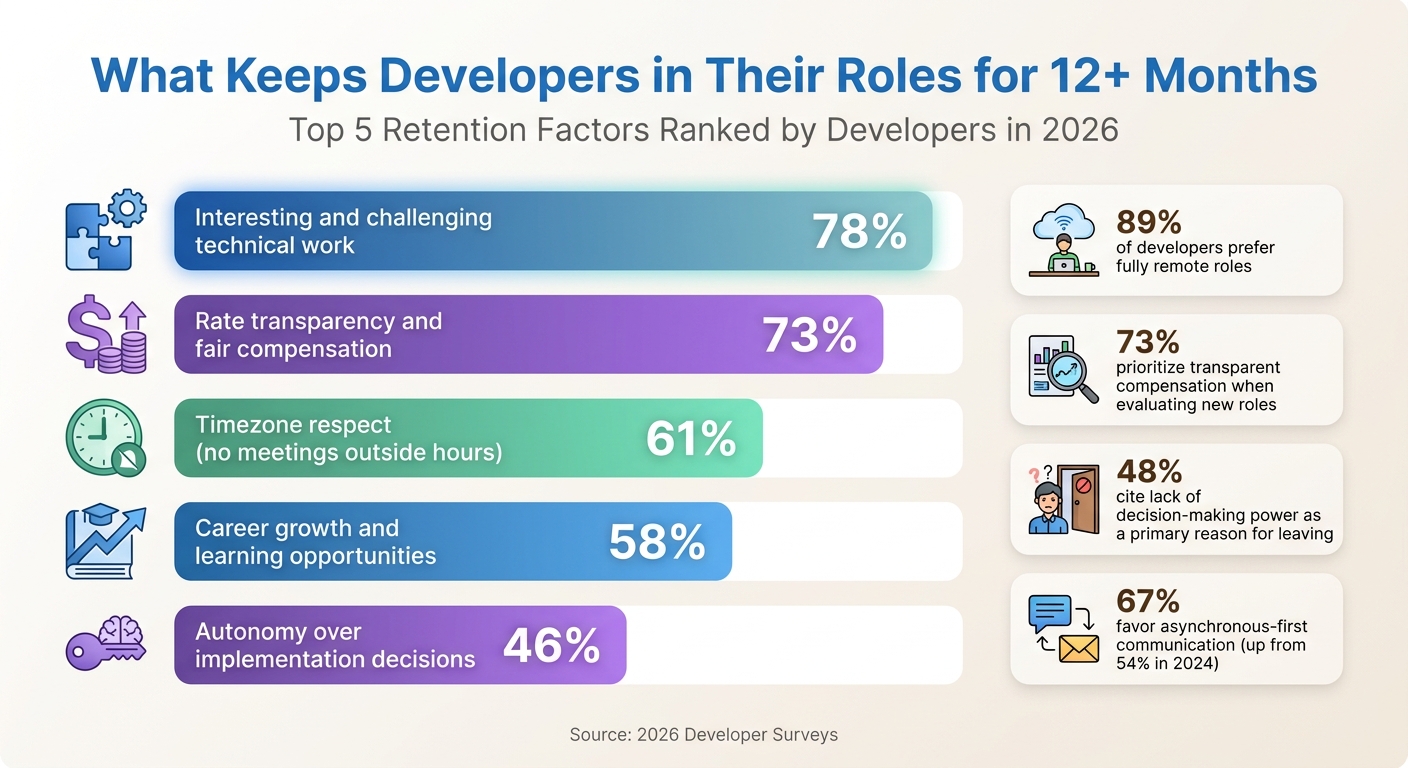 {What Developers Want Most in 2026: Key Retention Factors}
Understanding what developers value most is key to aligning job offers with developer goals. Recent surveys highlight a clear priority list: autonomy leads as the top factor in job satisfaction, followed by transparent and fair pay, and engaging technical challenges. Interestingly, while recruiters often emphasize team culture, developers themselves prioritize higher compensation as the main motivator for considering new roles .
Here’s a breakdown of what keeps developers in their roles for over 12 months:
| Factor | % Ranking in Top 3 for Retention |
|---|---|
| Interesting and challenging technical work | 78% |
| Rate transparency and fair compensation | 73% |
| Timezone respect (no meetings outside hours) | 61% |
| Career growth and learning opportunities | 58% |
| Autonomy over implementation decisions | 46% |
Each of these factors plays a crucial role in shaping developer satisfaction. Let’s dive into why they matter and how they influence retention.
Autonomy and Decision-Making Power
Developers place a high value on autonomy in their roles. A striking 48% cite the lack of decision-making power as a primary reason for leaving a company . Companies that trust engineers to make technical decisions - like choosing implementation methods or influencing technology purchases - create an environment where developers feel respected.
One effective approach is adopting written-first decision-making processes, such as RFCs (Request for Comments). These not only give developers a voice in architectural decisions but also encourage strong documentation practices . By fostering autonomy, companies can significantly enhance their appeal to top technical talent.
Challenging Technical Problems
As AI takes over routine coding tasks, developers are increasingly drawn to roles that involve solving complex problems. They want to work on system design, debugging, and architecture rather than just writing syntax. Principal Engineer Will Chilcutt from Yahoo! explains:
"There's no such thing as 'cheating' with AI. I want candidates to use AI tools to solve a problem end-to-end. Strong candidates will be able to produce a solution, critique it and suggest alternatives, and articulate their process" .
Providing opportunities for developers to engage in high-level problem-solving makes your organization more attractive to skilled professionals.
Career Growth Opportunities
Growth is another major factor in retention. With 58% of developers and 43% of contractors identifying limited growth as a reason to leave, offering learning budgets and clear progression paths is critical . Growth isn’t just about promotions - it’s about skill development.
For instance, 36% of developers are shifting toward AI/LLM skills, while 35% are focusing on machine learning . Companies that provide access to emerging technologies and structured learning opportunities signal long-term investment in their employees, making them a magnet for ambitious talent.
Remote Flexibility and Work-Life Balance
Work-life balance remains a cornerstone of job satisfaction. Fully remote work is now the norm for most developers - 89% prefer it, while only 4% want to return to the office full-time . But flexibility extends beyond location.
An asynchronous-first communication model is gaining traction, with 67% of developers favoring it, up from 54% in 2024 . Daily synchronous meetings outside preferred hours are a dealbreaker for many, with 43% citing work-life balance as their top reason for staying in a role . Respecting these boundaries is essential to attracting and retaining talent.
Competitive and Transparent Compensation
Transparent pay is a non-negotiable for developers. A significant 73% rank it as the most important factor when evaluating new roles . Delaying compensation discussions until late in the hiring process often backfires, wasting an average of 6.5 hours per candidate due to misaligned expectations .
To build trust, companies should publish salary bands early in the recruitment process. Developers earning at or above their expected rates are 2.3 times more likely to stay with a company for over a year. For 2026, median hourly rates range from $35 for junior developers to $130 for senior engineers, with annual increases between 8% and 12% . Transparent and competitive pay not only attracts top talent but also reduces friction during negotiations, making it a win-win for both sides.
sbb-itb-d1e6221
How Developers Assess Your Technical Credibility
Before submitting an application, developers often evaluate your GitHub repositories, engineering blog, and Glassdoor reviews. These elements offer a clearer picture of your technical culture than any job description could.
Active GitHub and Open-Source Presence
Your GitHub activity provides a direct view into how your team operates. Developers examine the quality of your pull requests (PRs) and commit messages. A vague PR title like "fixed stuff" can indicate carelessness, while something like "feat: Add user login with OAuth2 integration" demonstrates clarity and professionalism.
They also check whether your repositories show recent activity - commits and releases within the last year are key. Features like automated testing, branch protection, and security measures signal strong internal practices. Multi-maintainer projects suggest sustainability, while repos with outdated dependencies or unclear licensing can be a red flag, hinting at potential issues with your internal workflows.
This technical rigor sets the foundation for how your engineering blog can further solidify your credibility.
High-Quality Engineering Blog
An engineering blog helps bridge the gap between your technical work and your public image. In fact, 22% of developers leave interviews when they feel a company lacks transparency about its work . A blog showcasing the complex challenges your team tackles can resonate with developers, especially since 78% of them value engaging technical work as a retention factor for engineering talent .
Given that 32% of developers drop out of interviews if they dislike the tech stack , your blog should spotlight the tools and frameworks your team uses. Regular posts about adopting modern technologies - not just maintaining outdated systems - signal that your team is forward-thinking. A consistent publishing schedule with detailed, technical content demonstrates that your organization values innovation and transparency, which helps attract developers who thrive in such environments.
Reviews and Community Reputation
Beyond GitHub and blogs, your standing within developer communities carries substantial weight. For job-seeking developers, company reviews are often their first stop to gauge your engineering team's cultural fit . Negative reviews, disorganized hiring processes, or odd interview experiences can deter candidates - 24% of developers withdraw for these reasons alone .
Word travels fast in developer communities through platforms, Slack groups, and conferences. A single bad experience - whether it’s a poorly managed interview or a story about ineffective leadership (a factor in 71% of voluntary turnover in tech ) - can tarnish your reputation for months, making it harder to attract talent.
These factors collectively highlight the importance of a transparent and accountable technical culture - precisely what developers are looking for.
How to Attract Senior Developers
When it comes to senior engineers, the stakes are higher. These developers are looking for roles that challenge their expertise in system design, architecture, and strategic decision-making. They’re not just interested in writing code - they want to solve complex problems and shape the technical direction of projects. Research highlights that challenging work is a major factor in retaining senior engineers, with many favoring roles that focus on advanced system design and debugging over routine tasks .
Hard, Unsolved Problems
Senior developers thrive on tackling problems without clear solutions. They’re drawn to greenfield projects and impactful features, steering clear of repetitive maintenance work . In fact, 69% of developers cite "new challenges and learning" as a key motivator for switching jobs, while 66% are driven by opportunities to "build products and solve problems" .
The definition of technical excellence has evolved. For senior developers, it’s about more than just writing clean code - it includes debugging AI, making architectural decisions, and refining AI-generated outputs . Yaseen Deen, Co-Founder of OctogleHire, sums it up perfectly:
"Developers will accept a modest rate discount for genuinely stimulating technical problems - but they demand stimulating challenges." - Yaseen Deen
To attract top-tier talent, companies should go beyond assigning implementation tasks. Involve senior developers in shaping the technical direction and give them ownership of architectural decisions . While engineers only spend 16% of their week coding, 93% consider it the most rewarding aspect of their job . Offering opportunities to dive into meaningful technical challenges can make all the difference.
Modern Stack and Minimal Technical Debt
Outdated technology is a deal-breaker for senior developers. Twenty-seven percent of developers rank an "outdated or frustrating tech stack" as a top reason for leaving a company, while 37% see a "modern tech stack" as critical to staying engaged . Legacy systems are often viewed as career dead-ends, raising concerns about skill stagnation .
That said, "modern" doesn’t have to mean cutting-edge. Many experienced developers prefer reliable, well-documented technologies like PostgreSQL, React, and Python over unproven frameworks . For example, a senior architect at a Fortune 500 company demonstrated in October 2025 how a straightforward stack - PostgreSQL, Django, and vanilla JavaScript - handled 10 million daily requests with just four developers .
The takeaway? Be transparent about your tech stack and prioritize minimizing technical debt. As Selim Ataballyev, a Full Stack Engineer, aptly puts it:
"Use boring tech to deliver cutting-edge features. Your users don't care if you used the hottest framework. They care if your app works." - Selim Ataballyev
In addition to maintaining a modern stack, offering opportunities for open-source contributions can further appeal to senior developers.
Open-Source Contribution Opportunities
Open-source work is a win-win for companies and developers. It demonstrates trust, encourages autonomy, and attracts engineers who value quality and long-term ownership . These "missionary" developers often look for roles where they can make meaningful contributions beyond just closing tickets .
Supporting open-source collaboration aligns well with asynchronous work models. Companies that allocate time for open-source projects - through "Maker Schedules" or similar initiatives - become more appealing. This approach not only builds trust but also helps developers bridge the gap between the 16% of time they currently spend coding and the 93% who find it the most fulfilling part of their job .
Building a Developer-Friendly Culture
While competitive pay and technical challenges may attract developers, it's the workplace culture that keeps them around. For developers, the ability to manage their own tasks with autonomy and trust is the #1 factor for job satisfaction . However, studies reveal that micromanagement and a lack of autonomy are common reasons why developers leave their roles . This disconnect between what developers value and what many companies offer is a significant issue.
Engineering Autonomy and Trust
The key to fostering autonomy lies in giving developers control over how they execute tasks while leadership focuses on defining the objectives. This approach, often referred to as mission-type tactics, empowers engineers to make critical technical decisions, such as selecting frameworks or designing architectures, within their areas of expertise. In fact, 46% of developers say that autonomy in implementation decisions is one of the top three reasons they stay in a role for over a year .
Emily Dresner, a seasoned technical leader, highlights the importance of moving away from rigid control in favor of what she calls the "Trust Web":
"Trust builds communication networks and, more importantly, creates a culture of intellectual safety. In a culture of intellectual safety, the team feels comfortable taking risks, embracing occasional failure, and iterative learning."
This kind of trust isn't just theoretical - it translates into real-world outcomes. 48% of developers reported influencing or endorsing new technology purchases at their organizations in the past year . An example of this is Kayode Omotoye's initiative at AWS. By replacing top-down mandates with a hands-on workshop, he improved test coverage by 30% and reduced incidents by 25% . Omotoye explained his approach:
"Change doesn't start with compliance. It starts with relief. If you want people to care about reliability, show them how it gives them their nights back."
This trust-based culture also supports developers in structuring their workdays for maximum focus.
Protecting Deep Work with Maker Schedules
Developers work differently than managers. While managers often operate in one-hour blocks, developers need at least half a day of uninterrupted time to make progress on complex tasks . Even a single 30-minute meeting can disrupt their entire workflow, as research shows it takes over 23 minutes to refocus after an interruption .
To address this, 67% of developers now prefer asynchronous communication over real-time collaboration, a significant increase from 54% in 2024 . Companies are adapting by introducing "Maker Days" (Tuesday through Thursday) with no meetings allowed and reserving "Manager Days" (Monday and Friday) for collaborative activities.
Harrison Harnisch, a former Technical Lead at Buffer, implemented this split-week schedule, dedicating Mondays and Fridays to team discussions while keeping Tuesday through Thursday free for focused coding . Similarly, by 2026, Nuclino shifted nearly all internal meetings to written, asynchronous reports, enabling team members to process information without interruptions .
Paul Graham, the founder of Y Combinator, perfectly captures why this matters:
"For someone on the maker's schedule, having a meeting is like throwing an exception. It doesn't merely cause you to switch from one task to another; it changes the mode in which you work."
Ignoring this need for deep work comes at a cost - 36% of developers cite excessive meetings and synchronous communication as a major reason for leaving their roles .
While protecting focus time is critical, offering clear opportunities for career development is another vital piece of the puzzle.
Clear Career Growth Paths
Career growth for developers isn't just about climbing the management ladder. Many developers want to deepen their technical expertise, mentor others, and explore new technologies without taking on managerial responsibilities. This is reflected in the rise of roles like "Architect", which became the fourth most popular developer role in 2025 .
Transparency is key here. Companies should clearly link career advancement to expanded responsibilities and corresponding pay increases. This is especially important for contractors, who often face limited growth opportunities. Structured rate progression and learning budgets can help reduce turnover in distributed teams . Even contractors value opportunities to deepen their skills and tackle more complex projects, as stagnation is unacceptable to most developers .
In the past year alone, 36% of developers actively learned AI-enabled tools to advance their careers . Supporting this kind of growth through asynchronous learning - via written documentation, RFCs, and recorded sessions - not only aligns with developers' preferred working styles but also helps them grow professionally.
Why Compensation Transparency Matters
Transparent compensation aligns perfectly with what developers value in recruitment processes: autonomy, meaningful work, and fair opportunities for growth. It’s no surprise that 73% of developers consider salary transparency the most important factor when evaluating a new role . Yet, many companies still withhold compensation details until late in the hiring process, creating unnecessary friction that can scare off top talent before meaningful conversations even begin. Let’s dive into how clear salary bands and data-driven pay practices can help build lasting trust.
Publishing Salary Bands
Posting salary ranges upfront isn’t just a courtesy - it’s a powerful competitive edge. 68% of developers report wasting time on multi-round interviews only to discover the salary offered was far below their expectations . This misalignment doesn’t just frustrate candidates; it wastes resources. On average, companies lose up to 6.5 hours per candidate on interviews that go nowhere .
"Companies that hide compensation until late in the process are losing qualified candidates at the top of the funnel. Post the range. Absorb the minor negotiation disadvantage."
- Yaseen Deen, Co-Founder of OctogleHire
The numbers speak for themselves: developers who earn at or above their expected salary are 2.3x more likely to stick with a company for at least a year . By publishing salary bands, companies show they’re not relying on outdated data or guesswork. This is especially crucial for high-demand roles, like AI/ML specialists, where salaries have risen 15-20% annually. To stay competitive, salary benchmarks should be reviewed and updated quarterly .
Building Trust Through Transparent Practices
Transparency goes beyond salary bands - it’s about fostering trust across the organization. When companies are upfront about pay, they send a clear message: they respect candidates’ time, understand market trends, and value fairness. This is particularly important for senior developers, who often juggle multiple offers while passively exploring new opportunities.
The stakes are high. In 2026, 21% of developers rank higher pay as their top motivator for accepting a role. Yet, recruiters often underestimate its importance, ranking it as the sixth most critical factor . This disconnect between what developers prioritize and what companies communicate can lead to unnecessary turnover.
For those worried about internal conflicts stemming from pay transparency, the answer lies in rigorous market benchmarking. Use up-to-date salary data that accounts for programming languages, seniority, and specialized skills to justify pay scales. When developers see that compensation decisions are based on objective data rather than arbitrary negotiations, trust grows across the entire team. Transparent pay practices don’t just reflect fairness - they showcase a company’s commitment to running a modern, data-informed operation.
Building Inbound Interest Through Community Presence
Developers often spend their time reading technical content, contributing to open source projects, and engaging with developer communities. Here's the kicker: 46% of developers aren’t actively seeking new roles . That means traditional recruiting methods miss out on nearly half of the talent pool. To reach these passive candidates, you need to meet them where they already are, offer genuine value, and build trust over time.
Engaging Where Developers Spend Time
Platforms like GitHub, Stack Overflow, and daily.dev are where developers naturally gather - not LinkedIn. Establishing your company's presence on these platforms is a powerful way to showcase your technical credibility. For example:
- GitHub: Actively contributing to or maintaining open-source projects demonstrates your engineering team's expertise and commitment to the developer community.
- Stack Overflow: Answering technical questions helps build recognition and positions your team as problem-solvers.
- daily.dev: Sharing meaningful industry insights or commenting on technical trends allows you to highlight your work while engaging with an audience that’s already immersed in tech content.
By participating in these spaces, your team can naturally share technical insights, which not only builds recognition but also reinforces your company’s reputation as a leader in engineering.
Sharing Technical Content and Insights
Developers are drawn to authentic, detailed technical content. Whether it’s a blog post about architectural decisions, a case study on optimizing performance, or a deep dive into debugging a complex issue, these insights resonate with those who love solving tough problems.
An engineering blog, for instance, becomes more than just a content platform - it’s a recruiting tool that works around the clock. Even developers who aren’t actively job hunting today will take note of the challenges your team tackles and the autonomy your engineers have to share their work. Over time, this kind of content lays the groundwork for stronger connections within the developer community.
Sponsoring and Participating in Developer Communities
Sponsoring meetups, conferences, or open-source projects is another way to connect with developers in a meaningful way. This approach isn’t about pitching jobs - it’s about showing up and supporting the communities developers care about. Consider:
- Sending your engineers to speak at conferences or hosting meetups in your office to showcase your team’s expertise.
- Financially backing open-source projects that your team uses, demonstrating that you’re invested in the tools developers rely on.
These efforts build long-term relationships and position your company as an active, contributing member of the developer ecosystem - not just a place that shows up when it’s hiring. When developers eventually start exploring new opportunities, they’ll remember the companies that supported their communities, not the ones that only appeared with job postings.
Conclusion
Attracting developers isn't about offering flashy perks or running aggressive recruiting campaigns. It's about aligning your company's practices with what developers truly care about: having autonomy in their work, tackling interesting technical challenges, fair and transparent compensation, and respect for their time.
To recap the key points from this guide: publishing clear salary bands, respecting "maker schedules", building technical credibility through open source contributions and engineering blogs, and participating authentically in developer communities are not quick fixes. These are meaningful, structural changes that foster long-term trust. And in developer circles, trust spreads faster than any employer branding campaign. Developers share their experiences - on forums, Glassdoor, or even in casual conversations - whether they’re positive or negative.
The priorities developers emphasize - clear compensation, async-first communication, and engaging technical work - aren't just preferences. They are non-negotiable. Companies that fail to meet these expectations will face challenges not only in hiring but also in retaining top talent. By focusing on these principles, you can reshape your recruitment strategy in a way that resonates.
Start by being transparent, invest in genuine technical credibility, and engage consistently in the spaces where developers connect. These practices won’t just help you attract new talent - they’ll also show your current developers that they’re valued. After all, the developers you hope to hire are paying close attention to how you treat the ones already on your team.
FAQs
How do I prove engineering autonomy isn’t just a promise?
Prove that engineering autonomy is more than just a buzzword by showcasing real, actionable examples. Start with practices that empower your team, such as flexible work hours, self-directed projects, and developer-led decision-making. These aren’t just perks - they’re ways to ensure engineers feel trusted and valued.
For instance, highlight moments when engineers have chosen their own tools for a project or taken the lead in shaping its direction. Share examples of team members making meaningful contributions to open-source projects, reflecting their freedom to explore and innovate beyond company boundaries.
To back this up, gather anonymous feedback from your team. Honest input from the people directly experiencing this autonomy will validate your claims and demonstrate that it’s deeply embedded in your company’s culture. By sharing these stories and data, you show that autonomy isn’t just a promise - it’s a practice your team lives every day.
What should I publish to show technical credibility fast?
To establish your technical credibility quickly, focus on sharing content that demonstrates your expertise through tangible, validated work. Highlight contributions to open source projects, solutions to complex challenges, or the use of a cutting-edge tech stack. Writing technical blogs that break down difficult problems or showcase advanced technologies can also make a big impact. These efforts resonate with developers and can help build your professional reputation in no time.
How do I share salary bands without creating internal pay issues?
Transparency matters when it comes to sharing salary bands. Clearly publishing consistent pay ranges - based on factors like the role, experience level, and market data - helps set the right expectations. Open communication during the hiring process and within company policies shows a commitment to fairness. This not only attracts stronger candidates but also reduces negotiation headaches and avoids internal disputes by keeping everyone on the same page.


