

Target developer communities by programming language with tailored ad copy, platform targeting, and performance tracking.
Developers' choice of programming language reveals their technical priorities, workflows, and the ecosystems they work within. By understanding these preferences, you can craft ad campaigns tailored to specific developer communities. Here's a quick breakdown of how to target developers effectively based on their programming language:
- Python: Focus on AI, data science, and backend tools. Highlight model training, API performance, and machine learning integrations.
- JavaScript/TypeScript: Emphasize web and full-stack development. Mention compatibility with frameworks like React, Vue, and Angular.
- Rust: Appeal to memory safety and high performance. Showcase tools for systems programming and performance benchmarks.
- Go: Target cloud and infrastructure developers. Highlight scalability, microservices, and tools for distributed systems.
- Java/Kotlin: For Java, focus on enterprise stability and backend systems. For Kotlin, emphasize mobile development and Android compatibility.
Tailoring your campaigns by language ensures your product aligns with developers' needs and challenges, driving better engagement and ROI. Platforms like Google Ads, Reddit, Stack Overflow, and daily.dev offer precise targeting options to connect with these communities.
| Programming Language | Primary Focus | Key Targeting Message |
|---|---|---|
| Python | AI/Data Science | AI integration, ML tools, API performance |
| JavaScript/TypeScript | Web/Full-Stack Development | Framework compatibility, async workflows |
| Rust | Systems Programming | Memory safety, performance, low-level tools |
| Go | Cloud/Infrastructure | Microservices, scalability, cloud tools |
| Java/Kotlin | Enterprise/Mobile | Backend stability (Java), Android (Kotlin) |
Tailor ad copy to each language community’s unique priorities, and test campaigns to refine performance. This targeted approach ensures your product resonates with the right audience.
::: @figure 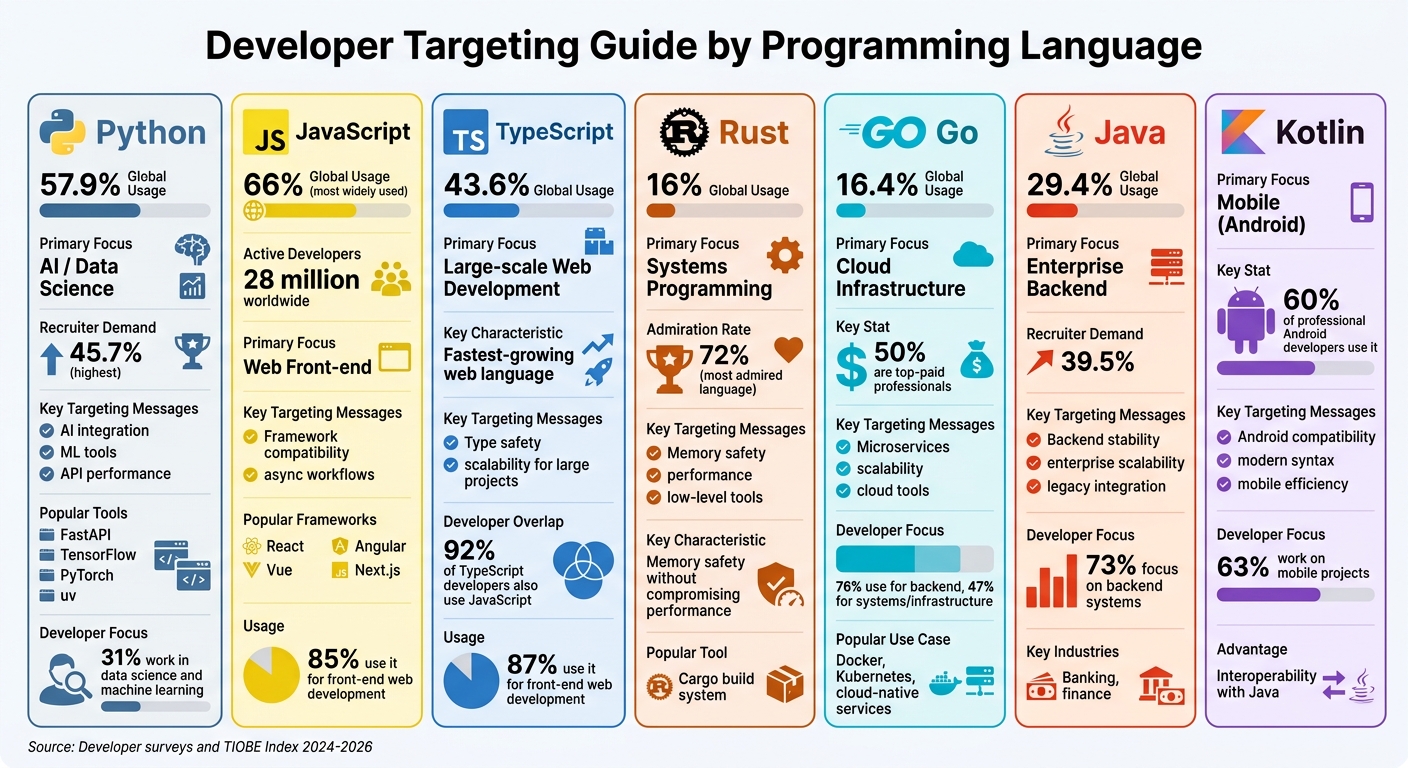 {Developer Targeting Guide by Programming Language: Usage Stats and Key Focus Areas}
Developer Audience Profiles by Programming Language
Different programming languages naturally attract developers with specific professional interests, technical needs, and buying habits. Each language's ecosystem provides clear cues for crafting messages that resonate with its community's priorities. Let’s break it down.
Python Developers: Data Science and AI Specialists
Python developers are at the forefront of AI and data science innovation. From 2024 to 2025, Python's usage climbed by seven percentage points, largely due to its dominance in these fields . By January 2026, Python held a 22.61% market share in the TIOBE Index, with 45.7% of recruiters actively seeking Python expertise - making it the most sought-after language .
These developers often rely on tools like FastAPI for APIs, TensorFlow and PyTorch for machine learning, and modern package managers like uv for dependencies . Around 31% of Python developers focus on data science and machine learning, while others build backend systems for AI-powered applications .
When reaching out to Python developers, highlight how your product supports AI integration, streamlines data pipelines, or boosts API performance. They appreciate tools that enhance their workflow, from training models to deploying them.
JavaScript and TypeScript Developers: Masters of Web and Full-Stack Development
JavaScript remains the world's most widely used programming language, with 66% of developers actively using it . Its community now includes 28 million active developers worldwide . Meanwhile, TypeScript has surged in popularity, with adoption reaching 43.6% by 2025 - nearly tripling over six years .
A significant 87% of TypeScript developers and 85% of JavaScript developers use these languages for front-end web development . TypeScript, now the go-to for large-scale projects, has even surpassed Python and JavaScript as the most used language on GitHub . Interestingly, 92% of TypeScript developers also use JavaScript, reflecting a strong overlap between these communities .
These developers commonly work with frameworks like React, Next.js, Vue, and Angular to build user-facing apps and full-stack systems. Messaging that emphasizes full-stack capabilities, compatibility with popular frameworks, and tools for seamless web development workflows will resonate with this group.
Rust Developers: Champions of Systems and Performance
Rust has earned its reputation for memory safety and high performance, becoming the most admired programming language with 72% admiration in 2025 (rising to 83% in 2024) . Though only 16% of developers use Rust, its users are concentrated in fields like industrial automation, blockchain, and low-level systems programming .
Rust developers are drawn to its ability to deliver memory safety without compromising performance. Tools like Cargo, Rust's build system, are integral to their workflow . Many Python developers even aspire to learn Rust, seeing it as a gateway to high-performance systems work .
When targeting Rust developers, focus on memory safety, performance benchmarks, and integration with their preferred tools. They value technical depth and tangible performance improvements.
Go Developers: Experts in Cloud and Infrastructure
Go developers excel in cloud computing, DevOps, and infrastructure engineering. While only 16.4% of developers use Go, they have outsized influence - 50% of Go developers are among the highest-paid professionals in their fields .
These developers are heavily involved in building cloud-native services, microservices, and infrastructure tools. 76% of Go developers use it for backend development, while 47% focus on systems and infrastructure work . The rise of Docker, which saw a 17-point usage increase between 2024 and 2025, is closely tied to Go developers .
To appeal to Go developers, emphasize features like scalability, microservices support, and infrastructure-as-code capabilities. They look for tools that simplify building and maintaining distributed systems.
Java and Kotlin Developers: Enterprise and Mobile Specialists
Java remains a cornerstone of enterprise software, used by 29.4% of developers worldwide . About 73% of Java developers focus on backend systems, particularly in industries like banking and finance that demand stability and long-term security . Recruiters also value Java expertise, with 39.5% actively seeking it for enterprise roles .
Kotlin, on the other hand, shines in mobile development. It’s the primary language for Android, with 63% of Kotlin developers working on mobile projects and 60% of professional Android developers choosing Kotlin over Java . Its modern syntax and interoperability with Java make it a favorite for Android apps.
For Java developers, highlight enterprise-grade stability, scalability, and seamless integration with legacy systems. For Kotlin developers, focus on mobile efficiency, Android compatibility, and modern development practices that build on Java's foundation.
| Language | Global Usage | Primary Focus | Key Characteristic |
|---|---|---|---|
| Python | 57.9% | AI / Data Science | Top recruiter demand (45.7%) |
| JavaScript | 66% | Web Front-end | Most used for 14+ years |
| TypeScript | 43.6% | Large-scale Web | Fastest-growing web language |
| Rust | ~16% | Systems Programming | Most admired (72%) |
| Go | 16.4% | Cloud Infrastructure | 50% are top-paid professionals |
| Java | 29.4% | Enterprise Backend | 39.5% recruiter demand |
| Kotlin | N/A | Mobile (Android) | 60% of pro Android devs use it |
These profiles provide a roadmap for aligning your product with the needs of each language's developer community.
sbb-itb-e54ba74
How to Match Your Product to Programming Language Communities
The best language-focused campaigns start with Language Market Fit (LMF) - the point where your product’s value clearly aligns with how a specific programming community approaches its challenges. If developers can’t understand your product’s value in under five minutes, your campaign is likely to fall flat. Building this connection means tailoring your product to the unique needs of each language community, which ties back to audience profiling. Achieving this alignment sets the stage for precise, language-specific campaigns.
To do this effectively, use the 4Ps Framework to ensure your product fits the technical needs of each community:
- Persona: Identify who you’re targeting. Are you focusing on Python-loving Data Scientists or DevOps Engineers who prefer Go and tools like Kubernetes?
- Problem: Pinpoint the pain points your product addresses. For instance, does it tackle memory safety for C++ developers or speed up deployment for JavaScript teams?
- Promise: Frame your product’s benefits in terms that resonate. Python developers might prioritize faster model training, while Rust developers may look for strong performance metrics.
- Product: Make sure your product delivers on the promises you’ve crafted for each group .
Every programming language community has its own personality, which influences buying behavior. For example, Python and Ruby developers often value productivity and flexibility, while TypeScript, Go, and Rust developers tend to focus on correctness, type safety, and performance . If you’re marketing a DevOps tool, you might highlight scalability and infrastructure-as-code for Go developers but emphasize ease of use and scripting capabilities for Python users.
To confirm you’ve nailed the fit, apply the 40% Rule by surveying each language community. If at least 40% of respondents say they’d be "very disappointed" without your product, you’ve achieved market fit in that segment . For example, Superhuman boosted its product-market fit score from 22% to 58% in just nine months by focusing on segment-specific feedback and enhancing features that high-value users cared about most . This kind of alignment ensures your product messaging will resonate as you move into targeted campaigns.
When prioritizing languages, balance market size with buying intent to focus on higher-income professionals. While some languages have a massive global reach, smaller communities often consist of users with greater purchasing power. For instance, a $50,000 enterprise infrastructure tool might generate better ROI by targeting a smaller but more affluent audience rather than casting a wide net. Use global developer usage data to estimate your addressable market, and refine further by analyzing signals like job titles, company size, and technical stack. This approach ties directly to the performance measurement strategies covered later in this guide.
How to Target Developers by Language on Different Platforms
Once your product aligns with specific language communities, the next step is to run campaigns on platforms where developers are most active. Each platform handles language targeting differently, so tailoring your approach to each channel ensures your message resonates with developers in spaces they trust. This builds on the language market fit strategy by placing your product in front of the right audience.
Google Ads: Keyword Intent Targeting
For Google Ads, create Search campaigns centered around language-specific keywords like "Python developer tools" or "JavaScript frameworks tutorial." Use a mix of broad match modifiers (e.g., +python +developer +ads) for wider reach and exact match keywords (e.g., [python tutorial]) for precision. To refine your targeting, exclude low-intent terms such as "learn python free" or "python course" using negative keywords. Boost bids by 15–20% for high-intent queries like "hire Python developer" or "enterprise Java tools." Additionally, layer in in-market audiences for software development to enhance targeting.
Reddit: Subreddit-Based Targeting
Reddit's community-driven nature makes it a powerful platform for reaching specific developer groups. Focus on key subreddits such as:
- r/python (250,000+ members discussing data and AI)
- r/javascript (1 million+ members focused on web development)
- r/rust (150,000+ members exploring systems programming)
- r/golang (200,000+ members interested in cloud infrastructure)
- r/java and r/kotlin (500,000+ combined members for enterprise and mobile development)
Use native sponsored posts with technical examples and headlines tailored to each subreddit, like "Optimize your Go microservices." Start with daily budgets of $50–$100 per subreddit and A/B test headlines to discover what resonates best. This approach can lead to a 2–3× increase in engagement compared to generic messaging.
Stack Overflow: Tag-Based Targeting
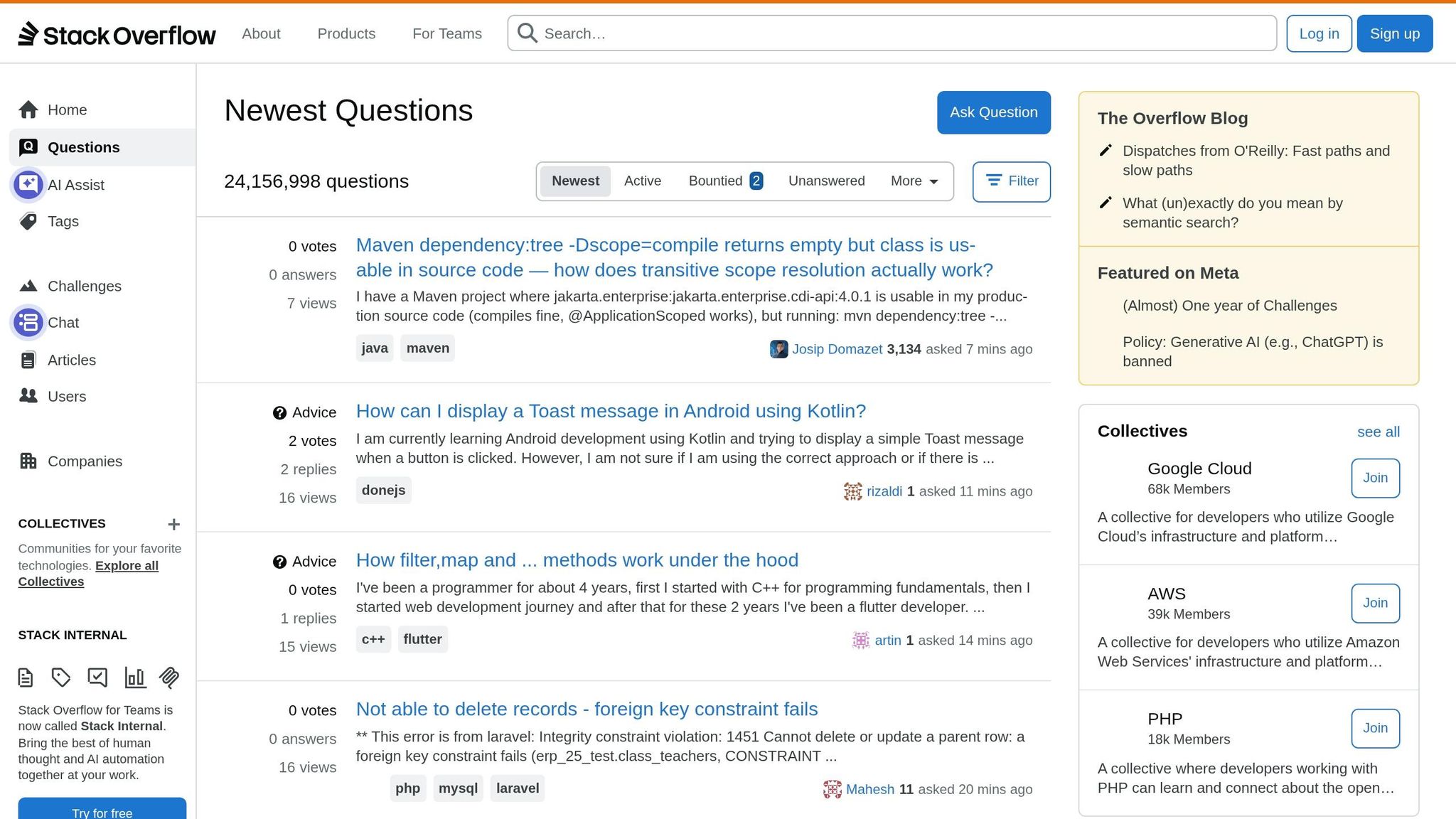
Stack Overflow allows you to target developers based on their activity around specific tags. Popular tags include:
- [python]: Over 2 million questions
- [javascript]: Over 3 million questions
- [rust]: 500,000+ questions
- [go]: 800,000+ questions
- [java]: 2.5 million+ questions
When setting up campaigns, you can choose between display or native ad formats. CPM bids typically range from $5–$15 per language, though competitive tags like JavaScript may require higher bids. Pairing tag targeting with job title filters (e.g., "Software Engineer") can improve click-through rates by 15–20%. To maximize efficiency, exclude irrelevant tags to focus your budget on the most qualified audiences.
daily.dev: Content Tag Targeting
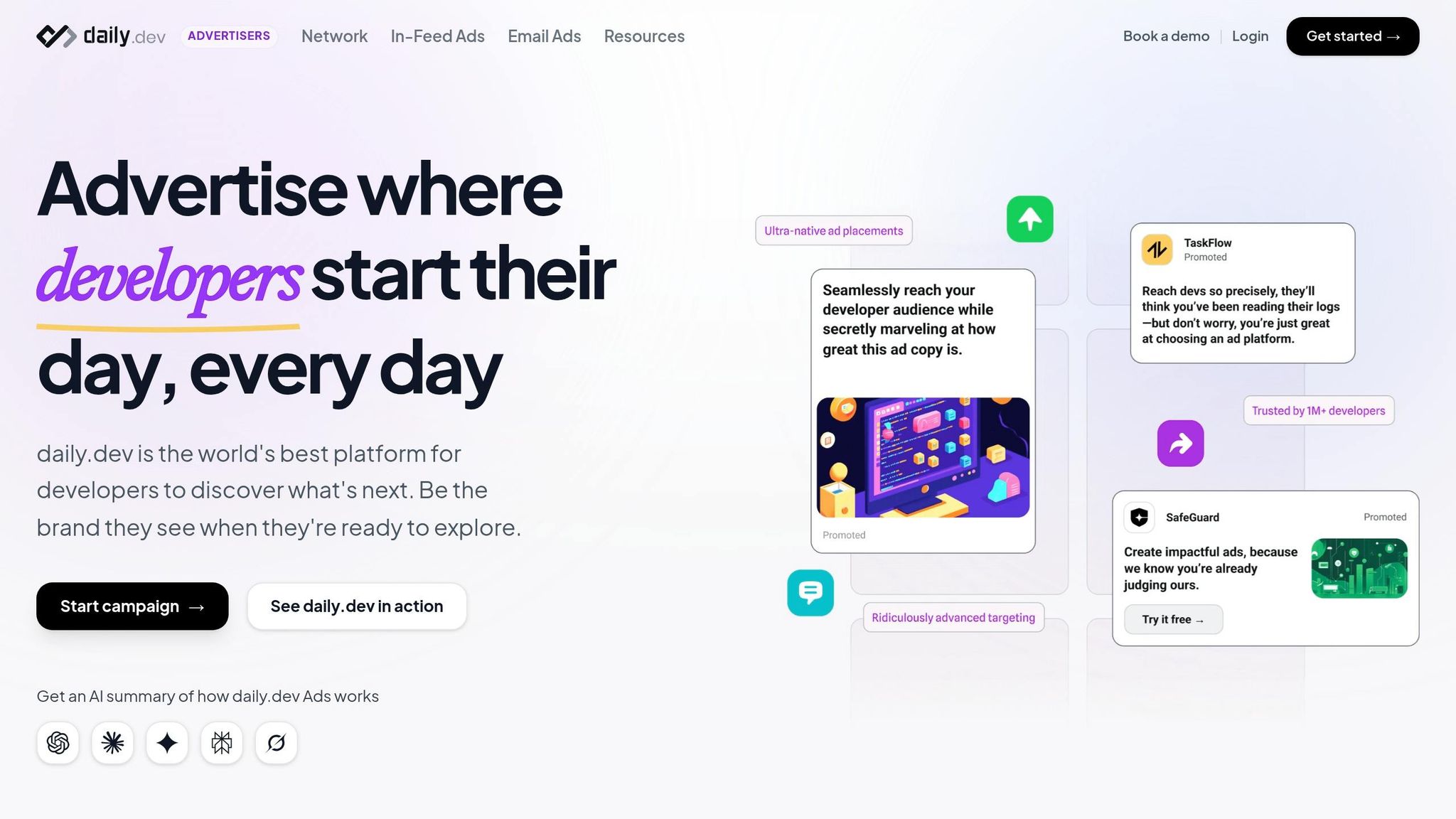
daily.dev connects with over 1 million developers by categorizing content based on programming languages and frameworks. Tags include Python (data and AI), JavaScript/TypeScript (web and full-stack development), Rust (performance), Go (cloud), and Java/Kotlin (enterprise). Campaigns can target these tags using native ad formats, with CPC bids ranging from $2–$5. To optimize results, allocate about 30% of your cross-platform budget to daily.dev, leveraging lookalike audiences from previous campaigns. Use UTM parameters to track performance across all channels and refine your strategy.
(Source: )
Writing Ad Copy That Speaks to Each Language Community
Developers tend to tune out generic marketing. To grab their attention, your ad copy needs to use the technical language they’re familiar with and address the specific challenges they face. For instance, a Python developer concerned with the Global Interpreter Lock (GIL) won’t connect with the same message as a Rust developer focused on zero-cost abstractions. Each programming community has its own jargon and priorities, and speaking their language is key to effective communication. This approach ties back to the broader strategy of tailoring messages to specific developer communities.
For Python developers, use terms like "Pythonic code", "f-strings", and "Type hints" to show you understand their workflow. Mentioning concurrency solutions in the context of the GIL or using phrases like "EAFP over LBYL" demonstrates familiarity with Python’s philosophy. Highlighting tools like "PyPI", "Poetry", or "Ruff" can signal that your product integrates seamlessly with their ecosystem.
For JavaScript and TypeScript developers, focus on references to async/await, popular frameworks, and efficient build tools. Headlines like "Optimize your React components" or "Debug TypeScript faster" directly address their daily challenges and goals.
For Rust developers, emphasize performance and memory safety. Phrases like "zero-cost abstractions" or mentions of the ownership model resonate with their focus on efficient, reliable code.
For Go developers, simplicity and cloud infrastructure are top priorities. Use messaging like "Deploy microservices faster" or "Simplify Kubernetes management" to align with their needs.
For Java and Kotlin developers, especially those in enterprise environments, focus on scalability, integration, and mobile development. References to "Spring Boot", "Android development", or "JVM optimization" can help position your product as a practical solution for their work. It’s crucial to avoid mixing terms from other languages - using Python-specific jargon in an ad for Java developers, for example, can undermine credibility.
To refine your messaging, A/B test headlines with specific tools or terms like "venv" for Python or "Gradle" for Java. Track which references resonate most with each developer segment and adjust your approach based on the results. This data-driven refinement ensures your ads remain relevant and effective.
Campaign Structure and Performance Measurement
Campaign Structure: Separate vs. Combined Language Groups
How you set up your campaigns plays a huge role in controlling messaging and budget. If you opt for separate ad groups by language, you gain more control. This setup lets you customize keywords, bids, and creative for each audience. For example, you can focus on data science features for Python developers or highlight performance benefits for Rust developers. This approach is especially useful when your product has language-specific features or when conversion rates differ significantly. In fact, segmented campaigns often achieve 20-50% higher click-through rates.
On the other hand, combined language groups are better suited for products that cater equally to multiple languages. For instance, a general DevOps tool could group Python and Go developers together under "cloud infrastructure", as both communities often work in similar environments. This setup simplifies campaign management and allows budgets to shift more fluidly across audiences. However, it comes at the cost of messaging precision, which might result in slightly weaker performance compared to more targeted campaigns.
There’s also a middle ground: create clearly labeled ad groups, such as "Python Developers - Data Science", within a single campaign. This approach balances targeted messaging with easier management. It allows you to pause underperforming segments without disrupting others, while keeping reporting and budget management centralized. The structure you choose will directly affect how you measure and refine your campaign's performance.
Measuring Performance by Language Segment
Tracking performance by language segment is essential to ensure your targeting strategy is working and your budget is being spent wisely. Focus on metrics like engagement (CTR, CPC, impression share), conversions (trial sign-ups, demo requests), and ROI (revenue vs. ad spend). These metrics reveal if your ads are connecting with their intended audience and delivering returns.
Start by setting benchmarks. Run all language segments with equal budgets for 2-4 weeks to establish baseline metrics. Then, compare average CTR, conversion rates, and cost-per-conversion against industry norms - tech audiences typically see a 2-5% CTR and 5-15% conversion rate for trial sign-ups. For example, if Python developers are converting at 12% but JavaScript developers only hit 4%, dig deeper to see if the issue lies in messaging, audience targeting, or product fit. Use a revenue-to-spend ratio (e.g., below 3:1) as a threshold to trigger creative testing. Allocate 20% of the segment’s budget to testing new strategies. If ROI surpasses your target by 50%, consider increasing the budget by 25-30%.
Make performance reviews a habit. Weekly reviews help you catch immediate issues, such as a 25% spike in CPC week-over-week, which might point to rising keyword competition or changes in bid strategies. Monthly reviews, on the other hand, focus on long-term trends using rolling 30-day metrics. These deeper insights can guide strategic decisions, like reallocating budgets. Campaigns that measure performance by segment often see ROI improvements of 15-30%.
Case Study: How Language Targeting Drove 3x Trial Sign-Ups for a DevOps Tool
This case study showcases the clear benefits of using language-based targeting to engage developers and drive results.
DeployFast CI/CD, a fictional DevOps platform, revamped its marketing strategy by focusing on developers who use Go, Rust, Python, and Java. Before this shift, the company’s broad developer campaigns had underwhelming results: a 1.2% click-through rate (CTR), a 2.1% trial sign-up rate, and a steep $45 cost per trial. It was clear something needed to change .
The team adopted a new approach by creating dedicated ad groups for each programming language. They allocated their budget strategically: 40% to Go and Rust (high-intent audiences) and 30% each to Python and Java. They then tailored their campaigns to each language across multiple platforms:
- daily.dev: Targeted content tags related to Go and Rust infrastructure.
- Google Ads: Focused on keywords like "Go DevOps pipeline" and "Rust deployment automation."
- Reddit: Engaged developers on subreddits like r/golang and r/rust.
- Stack Overflow: Used tags such as [go], [rust], and [ci-cd] to zero in on relevant discussions .
Each ad was customized to resonate with its target audience. For example:
- Go developers saw: "Streamline your Go microservices with DeployFast - zero-downtime deploys in seconds."
- Rust developers were shown: "Rust's safety meets DeployFast's performance: Bulletproof CI/CD for systems code."
- Python ads highlighted: "Automate your ML pipelines with DeployFast's Python-native integrations."
- Java messaging focused on: "Enterprise-grade CI/CD for Java/Kotlin monoliths - scale without the hassle."
These ads didn’t just use generic language - they incorporated terms developers care about, like "goroutines" for Go and "fearless concurrency" for Rust. This level of specificity helped the ads connect with each audience .
The results? A game-changer.
- CTR soared to 4.1%, more than tripling the original performance.
- Trial sign-up rates jumped to 6.3%, a 3x improvement.
- Cost per trial plummeted to $18.
- Go and Rust campaigns performed especially well, achieving an 8.2% trial conversion rate.
By using UTM parameters and A/B testing, the team found that 72% of incremental trials came directly from the language-specific campaigns .
There was one hiccup: Rust’s smaller developer base (around 500,000 active developers worldwide) limited campaign volume. To address this, the team increased their spend on daily.dev, where tag targeting delivered a 5× return on ad spend, and refreshed creatives every two weeks with language-specific code snippets. These adjustments boosted Rust trials by 4×, proving that even niche audiences can deliver strong results with the right strategy .
This case study demonstrates that aligning ads and targeting with specific developer communities not only drives higher engagement but also makes ad spend far more efficient. It’s a clear win for language-focused campaigns.
Conclusion
Programming language is the strongest targeting signal for reaching developers through your ad campaigns. It reveals the tools they rely on, the challenges they encounter, and the products they’re likely to consider. For example, targeting Python developers connects you with data scientists and AI engineers, while focusing on Rust developers reaches systems programmers who value performance and safety. This level of precision transforms broad developer marketing into focused campaigns that deliver results. Tailored messaging built around this insight becomes the backbone of effective campaigns.
By aligning your messaging with the unique ecosystem of each language, you can connect your product to the right audience and speak their technical language. For instance, a DevOps tool optimized for Go microservices should highlight that feature when targeting Go developers. Similarly, an API testing platform could emphasize Python integration to appeal to machine learning engineers. This approach has proven to be impactful, with a 3x increase in trial sign-ups as a result.
daily.dev Ads simplifies language-based targeting by enabling you to reach developers based on the programming languages and frameworks they actively engage with. As discussed earlier, aligning your product messaging with language-specific communities is critical. The platform utilizes targeted content tags to connect with developers already segmented by language, reinforcing this strategy. With 400,000+ active users and content from over 2,000 trusted developer sources, daily.dev Ads gives you access to 1 in 50 developers worldwide in a desktop-first, high-intent environment where engineers are exploring new tools and technologies . Additionally, you can refine your targeting further by combining language preferences with seniority levels or tools like Docker and Kubernetes for even greater accuracy.
Pinpoint the languages that indicate buying intent, then create dedicated ad groups for each language. Test your campaigns across different platforms, track performance by language segment, and refine your strategy based on what drives conversions.
Your campaigns should reflect these language-based segments for optimal results.
FAQs
How do I choose which programming languages to target first?
When deciding which programming languages to focus on, think about two key factors: current demand and how well your product fits into specific developer communities. Languages like Python, JavaScript, and Java are widely used and have active, engaged audiences.
The trick is to align your product's strengths with the ecosystem of each language. For example:
- Python is a go-to for fields like data science and AI.
- JavaScript dominates web development.
By prioritizing languages that best suit your product's use cases, you can connect with the right developers, boost engagement, and drive conversions through more focused targeting.
Should I run separate ad groups for each language or combine them?
Creating separate ad groups for each programming language is a smart move. It lets you fine-tune your targeting, craft messaging that resonates with specific developer communities, and align with their unique interests and tools. Plus, this segmentation makes it easier to track performance for each group, allowing you to adjust and improve your campaigns more effectively.
What metrics should I track to measure performance by language?
Track metrics such as click-through rate (CTR) and conversion rate (like sign-ups or downloads) to measure how well your audience is engaging with your content. To gauge the financial effectiveness of your campaigns, keep an eye on cost per click (CPC) and cost per thousand impressions (CPM) - these will help you evaluate how efficiently you're spending by programming language.


